“Don’t Fire Unless Fired Upon. But if They Mean to Have a War, Let it Begin Here.”

Today in History, April 19: 1775 – The Midnight Ride continues. Paul Revere and his fellow rider, William Dawes meet up while warning Lexington of the approaching British soldiers. They had stopped at several villages between there and Boston spreading the alarm.

In each village additional riders would set off in all directions to spread the word for minutemen to converge on Lexington and Concord. Village cannons were fired so they would be heard in neighboring villages…a pre-arranged signal. The system was so efficient that before the British soldiers were even disembarking from their boats, still miles away, hundreds of Patriots were converging on the British target of munitions at Concord. Unbeknownst to them, their mission had already been rendered moot. The “rebels”, long aware of the British plans, had already dispersed and hidden the munitions. Revere and Dawes had already warned Samuel Adams and John Hancock, who had been taken elsewhere to prevent their arrest.

In Lexington Revere and Dawes met up with Dr. Samuel Prescott, who had been visiting his fiance. The three set out for Concord to warn them. On the road they encountered an British patrol and were captured. As they were being taken to a nearby meadow Prescott shouted, “Put on!” (scatter, run for it). He and Revere rode off in opposite directions. Prescott jumped his horse over a neaby stone fence and was off into the night. Dawes escaped, but lost his horse, leaving him on foot. Revere made his second escape of the night, as he’d nearly been captured in Charleston earlier. However he soon came upon a group of British officers and was captured again. He would eventually be released, but without his horse. Precott, a Concord native familiar with the area, quickly made his way to Concord and warned them, then continued on to warn others.

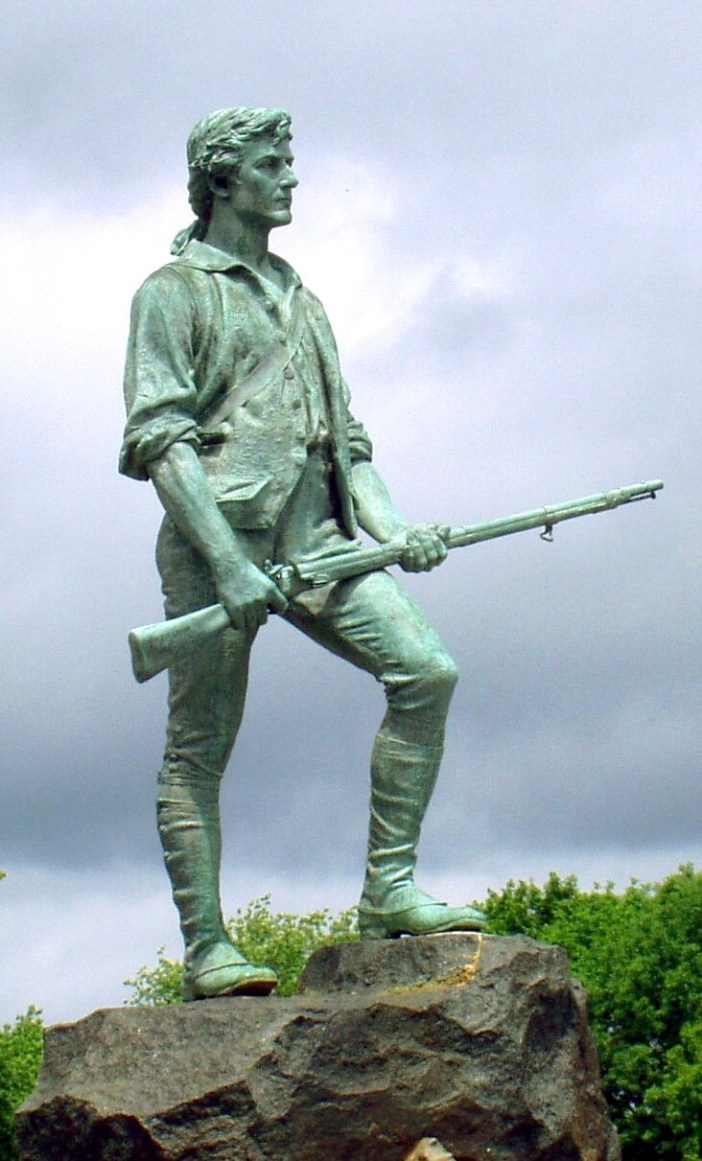
“Don’t fire unless fired upon, but if they mean to have a war, let it begin here.” –Militiaman Capt. John Parker, to his troops on Lexington Green. When the 700 British troops reached Lexington, they were confronted with a mere 77 minutemen who had managed to convene there. Capt. Parker, knowing that the British mission had already been rendered pointless, was not eager to risk the lives of is men. He had them form in ranks on Lexington Green, where they could give an expression of dissention without blocking the road to Concord. The British commander decided to confront them anyway. With an expression of great insult, the British commander ordered the “damned rebels” to disperse. Parker directed them to do so as the well trained British regulars approached. Nobody knows who fired the “shot heard ’round the world”. The Americans, of course, believe it was and over eager British soldier; the British believe it was from a minuteman; some speculation is that it was fired from the safety of a nearby tavern. Whoever fired that first shot, it resulted in the British cutting down nearly a dozen minutemen, and one injured British soldier. The British then marched past the dead and injured on their way to Concord. http://youtu.be/wAFz5YNCTGc

The Brits, emboldened, marched on Concord. When they got there they were confronted with more than 300 minutemen. The outcome was quite different than at Lexington. The British were quickly repelled, and decided to return to Boston. As they completed the long march back to Boston, the minutemen continuously fired upon them from behind trees, rocks, fences, etc. By the time the regulars made it back to Boston, they had lost over 300 men.

Why was it the “shot heard ’round the world”? Not just because of the American Revolution. The acts of the revolutionaries did not affect only the “Colonies”. The French were encouraged to aid the Americans with their fleet eventually. Other portions of the British Empire were encouraged to revolt. King George didn’t know it, but on this date, thanks to a few farmer and merchant “peasants”, the sun had begun to set on the British Empire.

Tokyo Bombed

Today in History, April 18, 1942:

A US Navy Task Force including aircraft carriers USS Hornet (CV-8) and USS Enterprise (CV-6) carries US Army Air Corps Colonel Jimmy Doolittle, his force of 16 twin engine B-25 Mitchell medium bombers and their crews to within 600 miles of the Japanese coast.

The intent was to get within 400 miles, but Japanese picket boats were encountered and the launch had to be made early lest the two American carriers (half of the carriers in the Pacific at that point) be destroyed by counter-attack.

Hornet carried the bombers, Enterprise provided cover with her planes. Doolittle’s men bombed their targets, made it across Japan’s defenses unscathed, but then had to crash land either in the sea or in China. Some made their way to safety with the assistance of Chinese resistance fighters; some were murdered by their Japanese captors.

When announcing the attack, which had a huge impact on American morale, President Roosevelt said the planes were launched from the new American base at “Shangri-la”, a reference to the 1933 novel Lost Horizon.

After the Japanese attack on Pearl Harbor, their forces had “swept the board” for months in the Pacific; this attack was needed to show the Japanese, and the world, that they were “touchable”.

The raid was a major influence on the Japanese command to go ahead with Operation MI…the invasion of Midway Island. The purpose for that operation was to draw out and destroy the American fleet.

“The Ship That Wouldn’t Die”


Today in History, April 16, 1945:

Picket duty in the seas off of Okinawa was a very dangerous place.  Destroyers were stationed in exterior positions from the US fleet to provide radar warnings for the carriers, bombardment and landing groups.  That also made them the first targets for Japanese Kamikaze aircraft inbound.

The USS Laffey (DD 724) was on picket duty.  She was already a veteran of D-Day where she served with Pearl Harbor survivor USS Nevada, and then several other actions in the Pacific.

A flight of approximately 50 Japanese suicide planes attacked the fleet, and many of them chose to target the tiny destroyer.  Val diver bombers and others repeatedly dove on the desperately maneuvering ship while the Laffey’s gun crews kept up a killing fire.  The crew kept fighting, shooting down several of the bombers, taking numerous bomb hits and being impacted by six of the Kamikazes.

A flight of 4 Grumman Wildcat F4F’s and a squadron of 12 F4U Corsairs from nearby carriers raced in the help, shooting down some of the attackers.  A couple of the fighters went down in the melee, including one Corsair which clipped the destroyer’s antennas before crashing into the sea.  Fortunately all of the flyers were rescued.

The Navy’s most notable Historian, Samuel Eliot Morrison, said, “Probably no ship has ever survived an attack of the intensity she experienced.”

The Presidential Unit Citation awarded to the Laffey’s crew read:

CITATION:  “For extraordinary heroism in action as a Picket Ship on Radar Picket Station Number One during an attack by approximately thirty enemy Japanese planes, thirty miles northwest of the northern tip of Okinawa, April 16, 1945. Fighting her guns valiantly against waves of hostile suicide planes plunging toward her from all directions, the U.S.S. LAFFEY set up relentless barrages of antiaircraft fire during an extremely heavy and concentrated air attack. Repeatedly finding her targets, she shot down eight enemy planes clear of the ship and damaged six more before they crashed on board. Struck by two bombs, crash-dived by suicide planes and frequently strafed, she withstood the devastating blows unflinchingly and, despite severe damage and heavy casualties, continued to fight effectively until the last plane had been driven off. The courage, superb seamanship and indomitable determination of her officers and men enabled the LAFFEY to defeat the enemy against almost insurmountable odds, and her brilliant performance in this action, reflects the highest credit upon herself and the United States Naval Service.”

For the President,

/s/ James Forrestal
Secretary of the Navy

You can still walk the decks where these brave men fought and several died aboard the Laffey at Patriot’s Point in Charleston Harbor, South Carolina.  Her museum location is significant as she was named for US Navy Seaman Bartlett Laffey, who earned the Medal of Honor during the Civil War, which began in Charleston Harbor.

Today in History, April 15, 1924:

Rand-McNally publishes the 1st Edition of The Rand-McNally Road Chum, the precursor to the Road Atlas they made popular.

William Rand and Andrew McNally had been in the publishing business since the 1860’s, and had been publishing regional maps for railroads and oil companies.

They initiated a numbering system for their highway maps and even put up road signs for their traveling customers. The system would be adopted by federal and state governments and is in use today.

Their first Atlas editions were provided for free in Gulf gas stations.

The Grapes of Wrath

Today in History, April 14, 1939:

The Grapes of Wrath by John Steinbeck is first published and would become iconic, capturing the hearts of those that had lived through the Great Depression in the preceding years.

The novel told the story of the Joads, one of many Oklahoma families driven off of their farms by the Dust Bowl and bankers who evicted them when they couldn’t raise crops to pay mortgages. Like so many others, the family was forced to leave Oklahoma for California, where they were derisively called “Okies”, to seek work as laborers in order to survive.

My father (who lived through it) used to counter that the migration of the “Okies” from Oklahoma to California had greatly increased the intelligence level of both states.

An Epic Hail Storm

Today in History, April 13, 1360:

“Black Monday”. During the Hundred Years War, English King Edward III had invaded France, bent on taking the French crown. The French locked themselves up within fortresses and castles while Edward and his armies sacked and pillaged the countryside. The English burned the Paris suburbs and then set their sights on Chartres. But on this date a sudden storm rose up….over 1,000 English troops, including two of their top commanders, were killed by….hail. The English saw this as a sign from God, and Edward soon agreed to a peace that included ending his desire for the French Monarchy. Within 9 years the French would declare that Edward had not lived up to the treaty they had signed, and the war would continue until 1453.

Steam

Today in History, April 11: 1803 – Instrumental in establishing the US Patent system, John Stevens receives a patent for the first screw driven, steam powered boat, or steamboat. The son of a member of the Continental Congress, A Captain and later Colonel in the Continental Army, Stevens turned his talents to inventions after the war. Robert Fulton would win the most fame for the steamship, but it was Stevens who first tied steam power to propeller driven naval craft. He would be best known as the father of the American railroad for steam powered railroad engines. Not nearly as famous as George Washington, or other American heroes…but how much more impact did Stevens have on the world with his inventions? He and his contemporaries took us from a world of sail to paddle wheeled steamships, to ironclads, to battleships, liners, supertankers, and more.

Appomattox

Today in History, April 9, 1865:

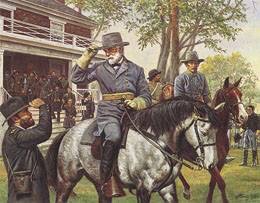
After years of foiling every move the Union made, Confederate Gen. Robert E. Lee had finally been run to ground. Several Yankee Generals had been bested by him, but he had finally met his match…not tactically, but in determination, by Lt. Gen. Ulysses S. Grant.

At Appomattox Courthouse, Virginia, Lee, his army starving and with nowhere else to run, in spite of the fact that he would “rather die a thousand deaths”, agreed to surrender the Army of Northern Virginia to Grant.

Lee arrived in his best uniform; Grant, typically, arrived in a muddy private’s uniform. Grant offered terms that included Confederate officers keeping their horses and sidearms, enlisted men keeping their horses so that they could farm their land, as long as they agreed to abide by their paroles and obey the laws of the land. Lee was very appreciative of these terms, saying they would be helpful to his army, men he loved.

As Lee mounted his horse and left the site of the surrender, Union soldiers began to cheer. Grant quickly silenced them, reminding them that the Confederates were once again their countrymen.

The surrender document was signed in the home of Wilmer McLean. Ironically, in the first battle of the war, First Bull Run, or First Manassas if you are from the South, Confederate Gen. P.G.T. Beauregard’s headquarters were in McLean’s home in Manassas, where cannon shot destroyed part of the house. McLean moved south to Appomattox Courthouse to keep his family safe. So, as is said, the Civil War began in Wilmer McLean’s front yard, and ended in his parlor.

McLean’s home was almost completely stripped of furniture by Union officers seeking momentos of the occasion.

Lee was given the opportunity by Grant to allow one of his subordinates to accept the surrender…to avoid humiliation. Lee refused…his FATHER, Light Horse Harry Lee, had been with Washington at Yorktown and witnessed the ungentlemanly act of British Gen. Lord Cornwallis sending a subordinate to surrender his sword to Washington. Lee refused to dishonor his family name by repeating the act. Grant did not require Lee to surrender his sword, but Lee was the man that represented his army at Appomattox Courthouse. Both gentlemen, North and South, maintained their honor.

John D. Lynde Improved Your Life…

aerosol

Today in History, April 8, 1862:

John D. Lynde of Philadelphia receives a patent for an “improved” aerosol spray bottle.  The concept was not new, but Lynde perfected the use of gasses to propel spray mists from a bottle.

Today we use aerosol devices for personal care products, kitchen sprays and many other applications in farming and industry.  Perhaps most importantly for medical purposes such as inhalers and atomisers.

Shiloh

Today in History, April 7, 1862:

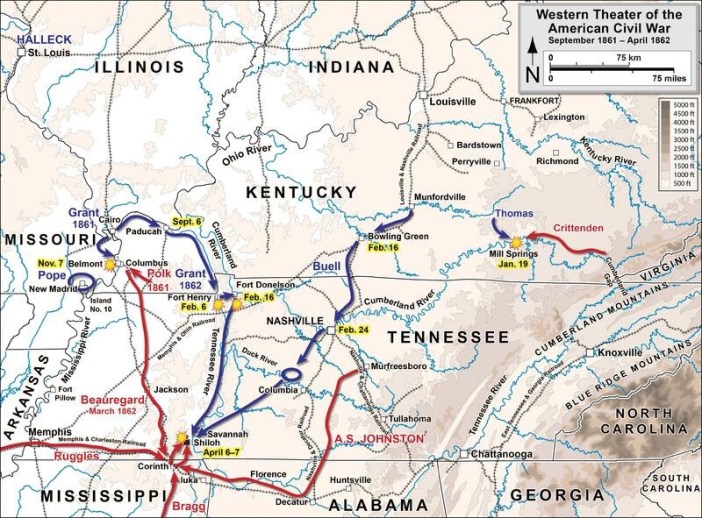
The Battle of Shiloh comes to and end with a Union “Victory”. Union Gen. US Grant had moved his army into Tennessee and was preparing his next campaign.

But Confederate Gen. Albert Sidney Johnston, considered second only to Robert E. Lee by both armies, had different ideas. His troops, in addition to those of CSA Gen. Pierre G. T. Beauregard almost literally caught the Northern Army sleeping….attacking in the morning and routing the Yankees.

The Confederates, always hungry due to their lack of supplies, actually stopped to eat the breakfasts the Union soldiers left in flight. The battle was vicious all through the day. But by the morning of the 7th, Grant had been reinforced by Gen. Buell’s Corps, and Grant quickly turned the rebels back. Shiloh was not so much a victory as a recovery for the North.

But the North nearly lost it’s best commander in the aftermath, as the press excoriated Grant as a drunk who was asleep at the wheel. President Lincoln answered the charges by saying that he could not spare Grant, “he fights” and offering to buy his other generals the brand of whiskey Grant used. In truth Grant had taken to drink when missing his family during his pre-war assignment in California, but was always focused during the Civil War Campaigns.

During the battle, Albert Sydney Johnston was mortally wounded. He died looking in fascination at the sky above.