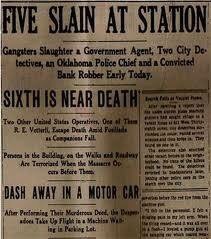
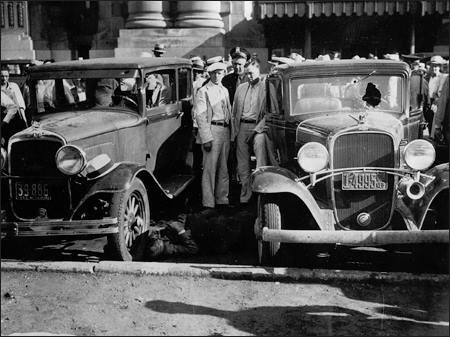
Kansas City Officers, FBI Agent, and an Oklahoma Chief of Police Lose Their Lives in the Kansas City Massacre

I’ve posted this story before. After losing two Officers in Kansas City this week, and the FBI taking it on the chin lately, I thought it worth repeating.

Today in History, June 17, 1933:

The Kansas City Massacre. This story is important to FBI history and to Oklahoma history.

As a young man, Frank Nash began his criminal career by robbing a Sapulpa, Oklahoma business of $1,000. He then shot his accomplice in the back of the head so he could have the loot all to himself. He managed to talk his way out of prison by convincing the warden he wanted to fight for his country in WWI.

Years, several crimes, and two prison sentences later, he had escaped federal custody.

Apprehended in Arkansas by an FBI agent and by MacAlester Chief Otto Reed, he was being transported back to Leavenworth when four gunmen attacked the officers at the Kansas City Railroad Station, in an attempt to rescue Nash (maybe…some versions have it as a hit, to keep Nash from talking).

Two Kansas City police officers, an FBI agent, and Chief Reed were all killed in the attack…along with Nash.

The importance in history for the FBI? Agents went from being unarmed without arrest powers to being armed with pistols, Winchesters and Tommy guns and having arrest powers within the year.

And for Oklahoma? Well…an Oklahoma lawman had tracked the bad guy down and his actions resulted in historic changes…not the first time and certainly not the last time.

Today in History, June 16, 1816:

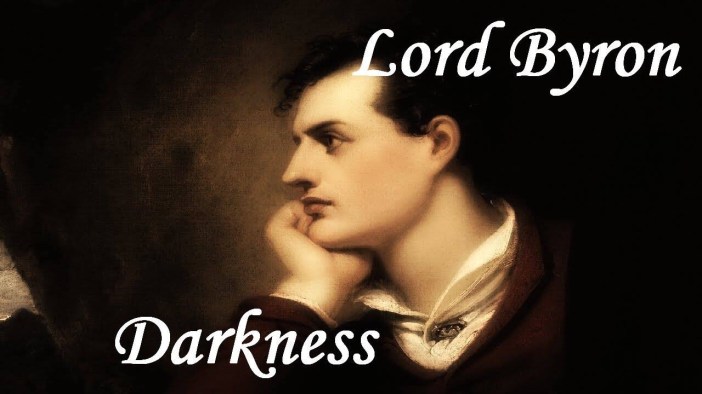
Lord Byron hosts a party at Villa Diodati. His guests include the Shelleys, Percy and Mary, Claire Clairmont and John Polidori.

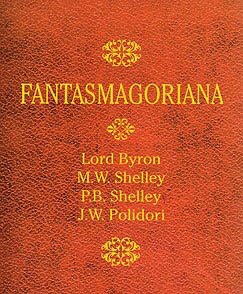
They partake in a reading of the horror collection Fantasmagoriana and Byron challenges his fellow authors to write a ghost story. The result is Mary Shelley’s “Frankenstein”, John Polidori’s “The Vampyre” and Byron’s “Darkness”.

General Slocum

Today in History, June 15, 1904:

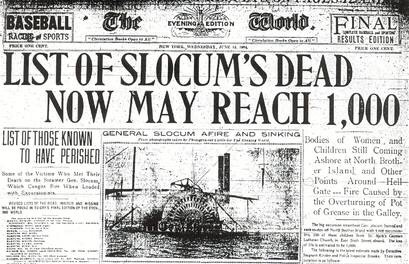
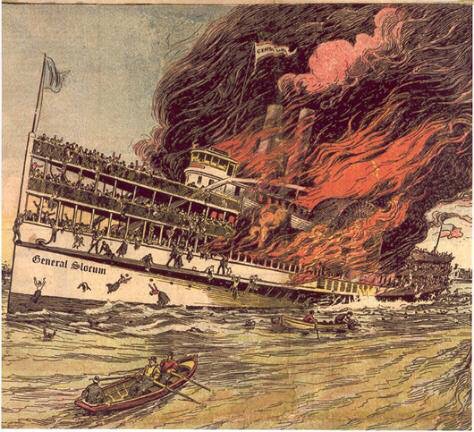
The General Slocum Disaster. The St. Mark’s German Lutheran Church charters the River Boat General Slocum to transport their teachers and children across the East River to Brooklyn to hold their annual picnic.

Keep in mind this was 1904, and Brooklyn was not part of a metropolis. One of the 1,360 passengers, a child, went to the boat’s captain to report that he had seen fire in a room below decks. The Captain responded basically with “go away kid”. By the time the crew found the fire, it was too late.

The Captain, Captain Van Schaik, decided to beach to boat on an island rather than at a dock where fire crews could have assisted with the fire. The boat’s rescue boats were tied down tight, so they couldn’t be used. The life preservers were not buoyant, so the children that donned them sank to the bottom of the river.

Over 1,000 of the passengers were either burned to death or drowned in the conflagration. The “Knickerbocker Company” was charged, but only the Captain actually served any time for the disaster. President Theodore Roosevelt fired the inspector responsible for the safety of the General Slocum.

Marie-Joseph Paul Yves Roch Gilbert du Motier de Lafayette

11425085_10202880403449887_4117592711264310725_n

Today in History, June 13, 1777:

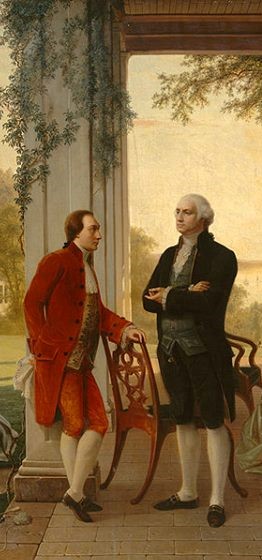
A 19-year-old boy, Marie-Joseph Paul Yves Roch Gilbert du Motier de Lafayette, Marquis de Lafayette, arrives at North Island, Georgetown, South Carolina from his native France. He had been a commissioned officer in the French Army since he was 13.

I’m sure Lafayette seemed somewhat ridiculous to many in the Continental Army at first, but he was dedicated to the American cause and soon gained the confidence of Gen. George Washington. He served with distinction in several battles, including the siege of Gen. Cornwallis at Yorktown. His influence as a French aristocrat gained vital support for the US cause from the French King and populace.

Americans were thoroughly impressed with him, and he idolized Washington…his only son would be named George Washington Lafayette. He would go on to be a key figure in the French Revolution, penning “Declaration of the Rights of Man and of the Citizen” with the assistance of Thomas Jefferson.

“Mr. Gorbachev, Tear Down This Wall”

Today in History, June 12, 1987:

President Ronald Reagan had taken actions that helped win the Cold War that our nation had fought for forty years, brought back our economy, and on this date traveled to Berlin. He was received by Germans with the same fervor as when Kennedy spoke there years earlier when he spoke those now famous words, “Mr. Gorbachev, tear DOWN this wall.”

Segregation

Today in History, June 11, 1963:

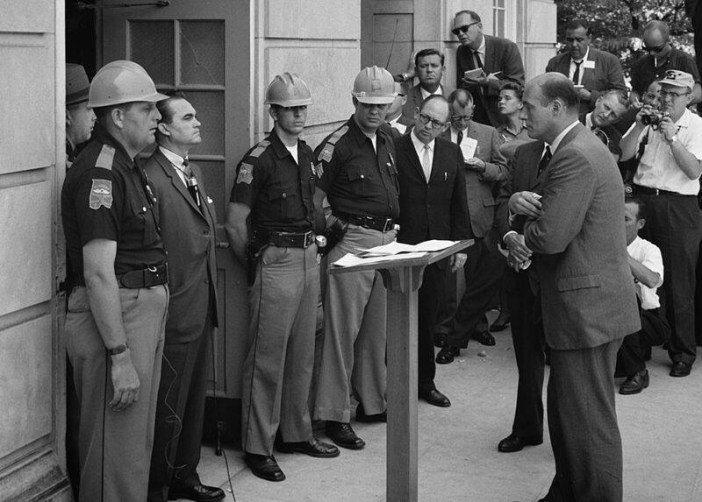
“In the name of the greatest people that have ever trod this earth, I draw the line in the dust and toss the gauntlet before the feet of tyranny, and I say segregation now, segregation tomorrow, segregation forever.”

Democrat Governor of Alabama George Wallace stands in a door way of the University of Alabama at Tuscaloosa in an attempt to prevent the enrollment of two African-Americans as students.

Democrat President John F. Kennedy had Federalized the Alabama National Guard to ensure that the enrollment occurred. American politics are often more nuanced that we realize. Wallace would run for President 4 times without success.

Nazi Atrocities

Today in History, June 10, 1944:

Oradour-sur-Glane, France. Elements of the Nazi SS, acting on belief that one of their officers had been captured by members of the French Resistance, rounded up every citizen of the town and 6 hapless passersby. They locked all of the women and children in a church, then took all of the men to barns, where machine gun nests were already set up. The men were intentionally shot in the legs so that they would die more slowly…once they were all unable to move, the Nazis poured gasoline over them and set the barns afire.

They then returned to the church, where they set off an incendiary device inside. As the church burned, women and children tried to climb out of windows…where they were machine-gunned. 642 innocent civilians were slaughtered.

1944 – Distomo, Greece. In retaliation for a partisan attack, German SS troops go house to house in the village (whose residents had nothing to do with the attack), killing every man woman and child, totaling 218 dead in the end. They disemboweled one infant in front of his family and committed numerous other atrocities before burning the village.

The Antiquities Act

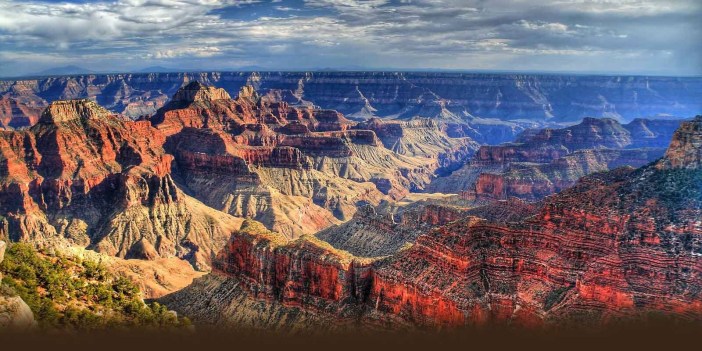
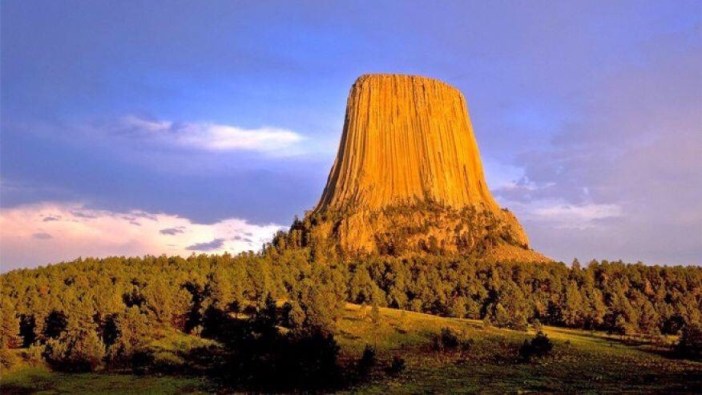
Today in History, June 8: 1906 – The Antiquities Act of 1906 is signed into law by President Theodore Roosevelt after being passed by Congress. In the preceding years historic sites had been discovered in the west, and of course, they were soon raided by thieves, vandals and historians from other countries. The Act was designed to protect these places as National Monuments, to be named either by the President or Congress. Roosevelt, a historian, quickly took advantage of the new power, naming 18 Monuments before his Presidency ended, including (first) Devil’s Tower, Muir Woods, The Grand Canyon, Chaco Canyon and the Petrified Forest. The Act has become more controversial in the years since FDR named The Grand Teton National Monument (near Jackson Hole, Wyoming) in 1943.

The Lee Resolution – and You Can’t Pick Your Family

Today in History, June 7, 1776:

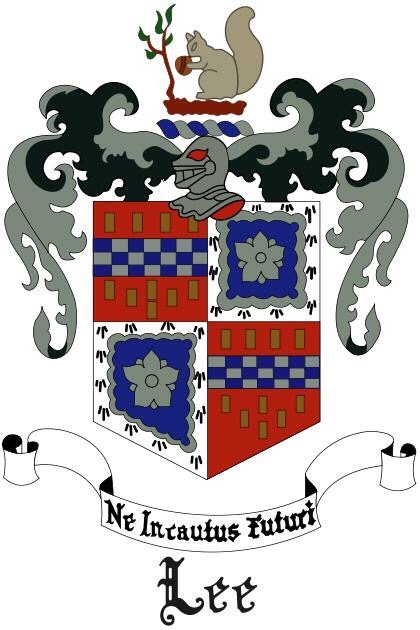
The Lee Resolution.

“Resolved, That these United Colonies are, and of right ought to be, free and independent States, that they are absolved from all allegiance to the British Crown, and that all political connection between them and the State of Great Britain is, and ought to be, totally dissolved. That it is expedient forthwith to take the most effectual measures for forming foreign Alliances. That a plan of confederation be prepared and transmitted to the respective Colonies for their consideration and approbation.”

Continental Congress member Richard Henry Lee, reperesentative from the Virginia Colony, proposes independence from Great Britain after receiving orders to do so from the Virginia Convention. It would take until July, after efforts by John Adams, Sam Adams, and Lee, to gather enough votes to pass the resolution as the Declaration of Independence.

The Lee family would fight in the revolution for Union and Independence. All families are complicated. I would love to know what Richard would have to say about his great-nephew Robert E. Lee fighting so hard to dissolve the Union Richard and his family fought so hard to create.

D-Day, the 6th of June

Today in History, June 6, 1944:

The skies overhead filled with aircraft…thousands of bombers, transports, fighters. The British populace watched the boys board transport ships bound for France…and wept. Their towns, so long filled with those damned Americans were now quiet and empty. They wouldn’t be coming back. Many would fill cemeteries across Europe; others would be headed home for the US after fighting their way to Germany.

In America, as the news was broadcast that the invasion had begun at long last, businesses, theaters, and other workplaces emptied and closed…and the churches filled to capacity.

Americans prayed for their sons, husbands and fathers. I’m sure they prayed not to see the Western Union courier on their street in the coming days.

The Allies had been planning, working for and arguing over this day since America had entered the war. Americans had wanted to make the assault on Europe as early as 1942. Stalin in Russia had been pushing for another front to be opened to relieve pressure on his country which had suffered incredible losses.

The British General Staff and Churchill had won the argument, which saw to fighting in Africa, Sicily and Italy first.

By 1944, as America provided more and more supplies…and troops…to the war, the invasion of France was planned.

The largest, most complex invasion in history began on June 6, 1944 with Americans, British, Canadians and troops from the occupied nations of Europe.

The world was saved by boys who should have lived long, happy lives.

We owe a debt we cannot possibly repay.

On that day, my father would be recognizing his 17th birthday. I don’t know when he shipped out, but that is the year he began his service in the Pacific.