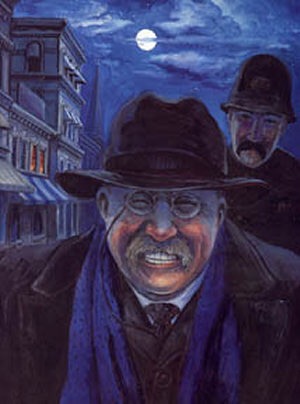
The Crusading Commissioner

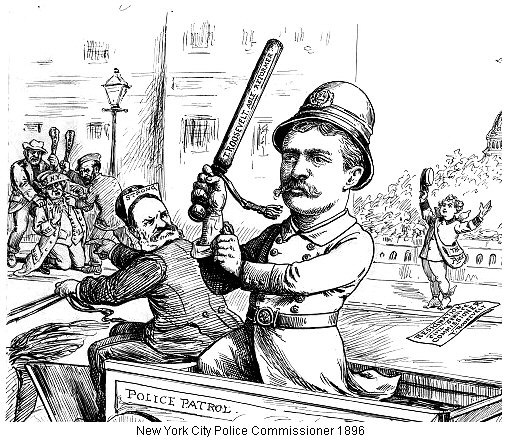
Today in History, May 6: 1895 – A former New York State Assembleyman who had been serving in DC of late is sworn in as a NYC Police Commissioner; one of several on the board. He would quickly be voted to be the President of the Police Commission.  Notably, he served on the commission with Frederick Dent Grant, son of former General and President US Grant. 

Theodore Roosevelt was out to make a name for himself, but also do some good; reform minded in light of recent events in the NYPD. 

He soon became a scourge for the officers as he began to conduct frequent walks through the streets at night, finding officers asleep or spending their time in bars rather than on patrol.  He also worked to weed out corruption, finding himself at odds with those that padded their salaries with bribe money. 

Roosevelt also found allies amongst those who appreciated his efforts not only for reform, but also to provide much needed training and equipment for the officers who wanted a more professional agency to emerge. 

He made a huge mistake in attempting to enforce a law in which bars must be closed on Sundays. Immigrants in the city worked 6 days a week, with only Sunday off to socialize and drink. The backlash cost TR’s Republican party in the next elections. 

Roosevelt would also be shaped during his midnight patrols and other tours. He would see the squalor that many lower income families endured, which would help drive his battles for better working conditions as President. 

Roosevelt would spend two years as NYPD Police Commissioner. The whirlwind that was his life would continue.  Back to DC as Assistant Secretary of the Navy, where he would drive the building of a 20th Century force, the Rough Riders and Cuba, Governor of NY, Vice President, then President…all by Sept 1901. 

We all must go Home

May 4, 1865. President Abraham Lincoln is buried in Springfield, Illinois, having been assassinated on April 14th. His 11-year-old son Willie, who had died during Lincoln’s term in office, is moved to be interned next to him. Lincoln’s funeral train stops in 180 communities along the path from Washington.

In Flanders Fields

Today in History, May 3: 1915 – The day after one of his closest friends is killed during the Second Battle of Ypres, Canadian Lt. Col. John McCrae writes the iconic poem In Flanders Fields while sitting in the back of an ambulance. Disatisfied, he crumpled it up and threw it away. It was retrieved by one of his squadmates, who convinced him to publish it. 
In Flanders Fields the poppies blow 

Between the crosses row on row, 

That mark our place; and in the sky 

The larks, still bravely singing, fly 

Scarce heard amid the guns below.
We are the Dead. Short days ago 

We lived, felt dawn, saw sunset glow, 

Loved and were loved, and now we lie 

In Flanders fields.
Take up our quarrel with the foe: 

To you from failing hands we throw 

The torch; be yours to hold it high. 

If ye break faith with us who die 

We shall not sleep, though poppies grow 

In Flanders fields.

The Luckiest Man on the Face of the Earth

Today in History, April 30: 1939 – “The Luckiest Man on the Face of the Earth.” Lou Gehrig played his 2,130th consecutive game in major league baseball, and his last. A member of the original New York Yankees “Murderer’s Row” (1927), by ’39 Gehrig’s health was obviously failing and in his last game he failed to hit a single ball. Two days later he walked up to the coach Joe McCarthy, “I’m benching myself, Joe.” The fans were in shock when it was announced that Gehrig would not be playing. Two weeks later he was diagnosed with ALS, a disease that slowly degraded the body, but fiendishly left the mind entirely in tact, now know as Lou Gehrig’s Disease. 1939 was an eventful year…Hitler’s Nazi party was preparing to take over Europe, war raged in the Orient, Gone with the Wind took to the silver screen. But after the news about Lou Gehrig spread, July 4th was designated Lou Gehrig Appreciation Day. Fans, dignitaries, teammates and the press filled Yankee Stadium beyond capacity and the country watched. After Babe Ruth and many others gave their tributes, Lou stepped to the microphone and announced that he was the Luckiest Man on the Face of the Earth, in spite of “catching a bad break”. There wasn’t a dry eye in stadium, likely few in the country.

Surrender at New Orleans

Today in History, April 29: 1862 – The surrender of New Orleans. The Confederacy was determined to protect the jewel of the South, it’s largest port and therefore source of supply from abroad. They were convinced the attack would come from the north, and placed the bulk of their army forces and naval forces in Tennessee and Mississippi. This left New Orleans to be defended by about 3,000 militia and two forts below her on the River, Ft. Jackson and Ft. St. Phillip. Union Flag Officer David Farragut took his force of Union ships and tried to silence the forts, and failing that decided to run past the batteries in a fierce battle. By the 28th his fleet lay off the city on the Mississippi. If you’ve ever been to the French Quarter and watched ships move by ABOVE you on the river, you’ll understand why the Confederate commander there told the mayor the battle was already lost and withdrew his forces. The next day, the 29th, Farragut’s childhood home surrendered to him. David Farragut was adopted by Capt. David Porter after his mother died, and began his naval career at age 9. He would become the first Rear Admiral, the first Vice Admiral, and the first Admiral in the US Navy. His adoptive brothers, David Dixon Porter and William Porter would also be naval heroes that attained flag rank. The capture of New Orleans by Union forces helped cut off the Confederacy from outside supply, and from their territories in the west.

Coincidentally, on this same date in 1629, 17-year-old Joan of Arc led a force that liberated Orleans, France from the English. 

For Love of Paradise

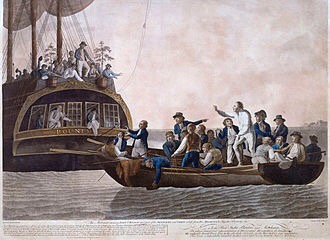
Today in History, April 28: 1789 – The Mutiny on the Bounty. The HMS Bounty had sailed from England to Tahiti, there to pick up a load of breadfruit saplings and transport them to the West Indies. The ship stayed in Tahiti for five months, during which the crew experienced the incredible peace and beauty of the islands, the very friendly hospitality of the Polynesians there. Master’s mate Fletcher Christian fell in love with one of the Tahitian women. Three weeks after the Bounty left Tahiti, Christian led a mutiny against the reportedly over-strict Captain William Bligh….Christian and his cohorts set Bligh and 18 sailors loyal to him adrift in a 26 foot long boat in the middle of the Pacific…effectively leaving them for dead. Through good seamanship however, Bligh and his sailors traveled 3,600 miles in just over two months to Timor in the East Indies. Bligh made it back to England and completed his breadfruit mission with another ship. Christian and his group returned to Tahiti. 16 of them stayed there, but Christian and 8 others, knowing they couldn’t stay on an island which was a regular stop for British authorities, they set off with a group of Tahitians in search of an unknown island. They settled on Pitcairn Island. The 16 who remained on Tahiti were captured, taken back to England and hanged. In 1808, nearly 20 years later, an American whaling ship was drawn to Pitcairn Island when they saw smoke (cooking). They found that all but one of the original mutineers had died of conflict or disease. The sole survivor, a sailor named John Adams, was eventually granted amnesty by the English. Many of the descendants of the mutineers and the Tahitians still live on Pitcairn Island, although relocated twice. Half of the population of Norfolk Island (one of the relocation islands) are their descendants.

Almost Home…the SS Sultana Tragedy

Today in History, April 27: 1865 – The SS Sultana. They had left their farms, their jobs and their families, to fight for the Union, some for glory, some for honor. Any glory in the war faded, as it always must, as they fought through terrible battles. They saw their friends die mutilated, many of them suffered irreparable injuries. Then they were captured by their enemy and sent to horrific prison camps such as the despised Andersonville. Conditions there were unspeakable; even if the Confederates had any sympathy for them, the South didn’t have the resources to care for it’s own, much less it’s prisoners. Finally after months or years of starvation and brutality, the war was over; they were liberated. They were going home! Can you imagine the joy, the rapture they must have felt? Most had to have believed it would never happen, that they would die in their captivity. They marched (those that could still walk) to ports on the Mississippi to board steamships for the trip north and home. Desperate to get home as quickly as possible, they begged, cajoled, bartered or simply boarded the overloaded river boats clandestinely. You can take just one more, right? The steamer SS Sultana was one of those commissioned by the Union Government to get them home. Her capacity was for 376 passengers. 376. By the time she sailed from the captured city of Vicksburg, MS she was loaded down with at least 2,400…mostly those Union prisoners on their way home. At 2 AM on the 27th of April her decks and quarters were jammed beyond capacity, but their must have been peace amongst the passengers. The ship was top heavy and as she made the turns of the river, the water in her inter-connected boilers sloshed back and forth, lowering the water levels in the boilers opposite the turn. One of the boilers had been hastily patched to allow her use on the trip. Suddenly, one of the boilers burst, causing at least two more to follow. The ship exploded, the suddenly escaping steam burned hundreds to death in an instant, setting the wooden ship afire to kill hundreds more. Most of those that managed to escape the ship into the water, already emaciated, drowned before they could be rescued; the first ship to reach them was an hour away in the frigid waters. Of the 2,400, as many as 1,900 perished. 7 to 9 miles above Memphis on the river, even the recently defeated Confederates there responded with compassion, opening their homes to the few survivors.

Brothers, Enemies, then Brothers Again…a Lesson in Honor

Today in History, April 26: 1865 – Following Robert E. Lee’s action on the 9th, Confederate Gen. Joseph E. Johnston surrenders the largest Confederate army to Union General William T. Sherman at Durham, North Carolina. Wow. An event on a date in history. But there is so much more, as there usually is. Both men had been graduates of West Point, and both had served with distinction in the US Army. Johnston was Quartermaster General when he resigned to return to his home of Virginia at the beginning of the war. Sherman would face off against Johnston several times during the war, most notably at Kennesaw Mountain, where the Union won a strategic, if not technical victory, causing CS President Jefferson Davis to relieve Johnston, which was probably a mistake. After the war, the two men often met in DC for dinner, if not close friends, at least comrades. In February of 1891, Sherman had taken cold and eventually died of pneumonia. At his funeral in New York City, General Johnston stood over him, hat in hand. A fellow attendee asked him to put on his hat, it was cold. Johnston replied, “If I were in his place and he were standing here in mine, he would not put on his hat.” Johnston caught cold that day, and within a month shared the fate of his comrade, his adversary, his contemporary. I love history and the people that made it for us.

Demise of an Assassin

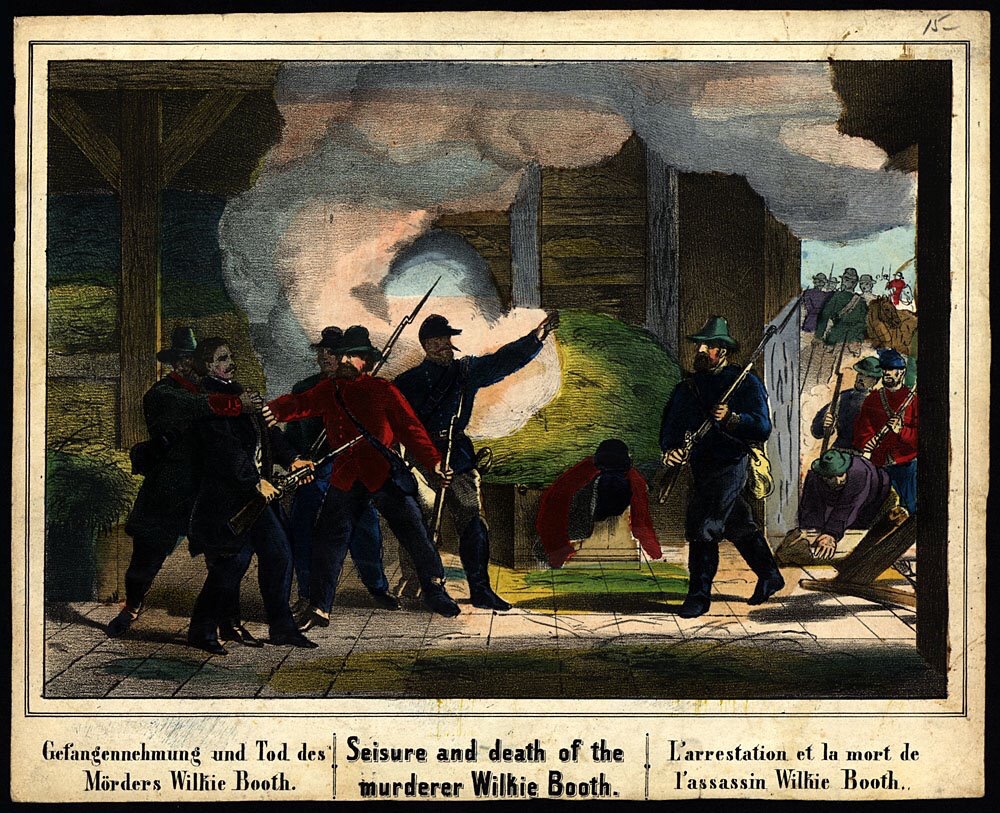
Today in History, April 26: 1865 – Union Army forces track down John Wilkes Booth 12 days after he assassinated President Lincoln. In the meantime, he had been hidden by Confederates, treated by Doctor Samuel Mudd (your name is mud) and hidden in a barn on the Garrett farm in Virginia, where he was found. The barn was set afire and his associate surrendered. Booth refused…a Union soldier, Boston Corbett, saw Booth inside the barn and fired his Colt revolver…causing a mortal wound to Booth. Many Confederates saw Booth as a hero. However many Southerners wept openly at Lincoln’s death, and Confederate Generals, including Lee and Johnston, denounced Booth’s actions. Fortunately, in the interim between his deed and his death, Booth was able to see news accounts that recorded his hero’s denunciation of his act. So when he died, he knew what he was.