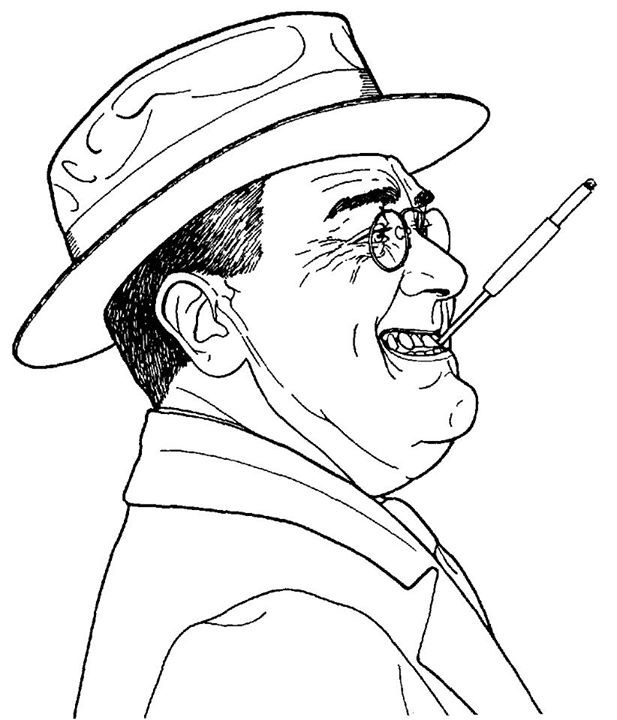
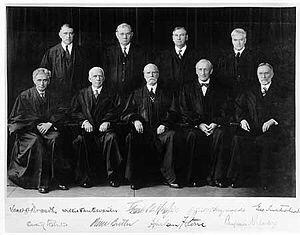
 Today in History, February 5: 1937 – “The Judicial Procedures Reform Bill”. President Franklin Roosevelt had experienced much success in advancing his reformist economic agenda, trying to bring the country out of the Great Depression. However some of his New Deal actions had been ruled unconstitutional by the Supreme Court. This was unacceptable to the Democrat FDR. So….if the laws aren’t working for you…change the laws. Every President tries to “pack the court” with justices sympathetic to their party’s views…but FDR took it to a new and radical level. He had a bill introduced in Congress that would give him the power to add as many as SIX new justices for every current justice that was over 70 years and six months old. This would take the Supreme Court from 9 to 15 justices, most of them appointed by FDR. Before the legislation came to a vote, one of the justices turned to Roosevelt’s side, and his agenda began to be voted constitutional. In the end, the power-grabbing bill was rejected by the Senate. But with 3 full and one partial term as President, FDR would have plenty of time to “pack the court”.
Ain’t I a Woman? -Sojourner Truth

Today in History, February 4: 1986 – The US Postal Service issues a stamp commemorating the life of Sojourner Truth as part of the Black Heritage series.
Sojourner Truth was born a slave in upstate New York about 1797 (nobody recorded the date.) Her mother and father were from different farms (owners) and their relationship was forbidden…Sojourner’s mother never saw her father after they were separated. Sojourner was actually born Isabella Baumfree, but changed her name in 1843. In 1826, she escaped slavery; a year before it was abolished in New York state.
She was raised speaking Dutch, the language of her mother and their first owner, but she learned English later in life. Sojourner dedicated her life to the abolitionist and women’s rights causes, among others. She spoke publicly and often, sharing her experiences along with friends Frederick Douglas, William Lloyd Garrison and later Susan B. Anthony.
In May of 1851, Sojourner Truth spoke at the Second Women’s Rights Convention in Akron, Ohio. There are two versions, one recorded (written down) in 1851 and one during the Civil War. I have included the first…several sites point out this one is more likely accurate. The second uses much Southern slang which Sojourner Truth likely did not use due to her background.
“May I say a few words? Receiving an affirmative answer, she proceeded; I want to say a few words about this matter. I am for woman’s rights. I have as much muscle as any man, and can do as much work as any man. I have plowed and reaped and husked and chopped and mowed, and can any man do more than that? I have heard much about the sexes being equal; I can carry as much as any man, and can eat as much too, if I can get it. I am as strong as any man that is now.
As for intellect, all I can say is, if woman have a pint and a man a quart–why can’t she have her little pint full? You need not be afraid to give us our rights for fear we will take too much–for we won’t take more than our pint will hold.
The poor men seem to be all in confusion and don’t know what to do. Why children, if you have woman’s rights give it to her and you will feel better. You will have your own rights, and there won’t be so much trouble.”
This speech, which due to the later and more famous printing would be called “Ain’t I a Woman?” would help advance Sojourner’s fame and her cause. During the Civil War, she helped recruit black men for service in the Union Army, and conferred with President Lincoln. She would continue to fight for her causes into the 1870’s, and would die in 1883 in Battle Creek, Michigan.
The Four Chaplains
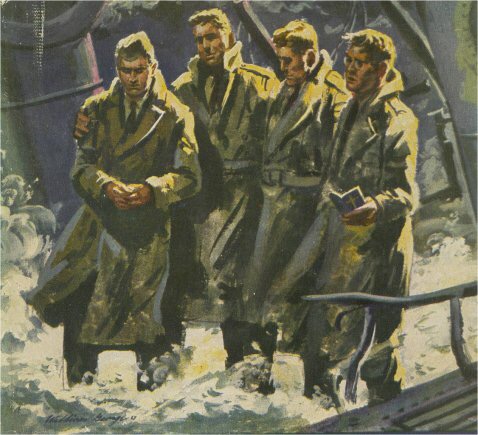

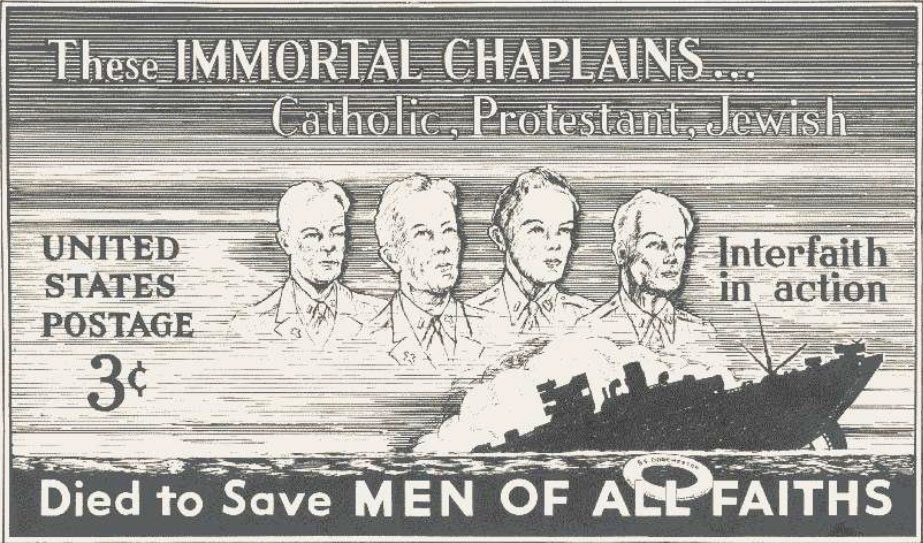 Today in History, February 3: 1943 – The SS Dorchester, formerly a cruise ship, had been converted to a troop ship after the outbreak of WWII. In the frigid waters of the North Atlantic between midnight and 0100 hours she was sailing near Newfoundland, part of a convoy en route to Europe. Her crew and her passengers amounted to approximately 900 souls on board. Most were sleeping far below deck when their lives changed in a flash…literally, as a U-Boat’s torpedo tore into her hull.
As they abandoned ship, four Army Chaplains did all they could to assist. Reverends George L. Fox and Clark V. Poling, Father John P. Washington and Rabbi Alexander D. Goode passed out life jackets and helped the men into life boats. Then when the life jackets ran out, they each removed their own and gave them to others.
Hope is indemic in humans. Even after you’ve buried friends, you don’t really think it will happen to you. What must have been in the minds of the sailors and soldiers in the water that morning? Only 230 would survive with the opportunity to see their families again, to grow old and live a life. But those that died of injuries or hypothermia must have held out hope til the end.
But the four Chaplains knew their fate. After having done everything they could for others, they stood on the deck together and waited. Survivors in the water reported watching them singing hymns and praying together…not for themselves, but for the men in the water. They prayed together in Latin, Hebrew and English until the bow rose up and the ship disappeared beneath the waves.
Rescue Mission
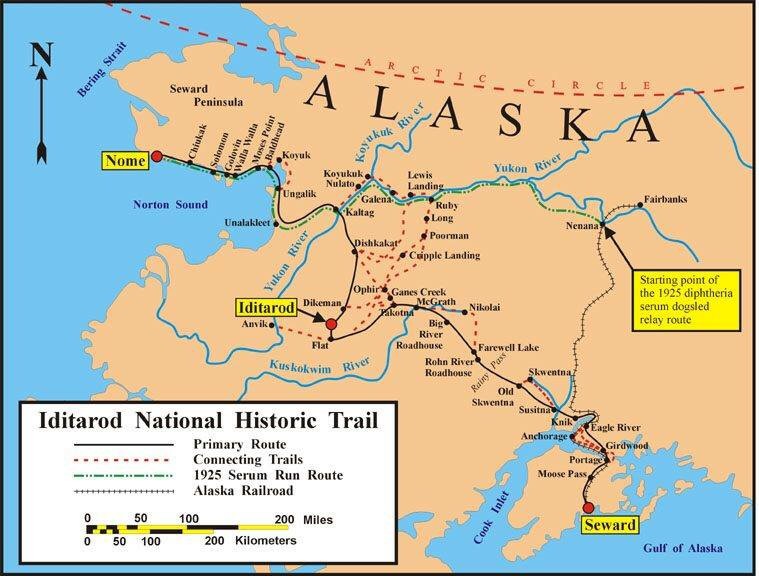

Today in History, February 2: 1925 – The children were dying. The last ship had left, and they were iced in. They may as well be living on Mars, considering the distance and conditions. It was 50 below, windswept and icy. By the time the ice thawed and the next ship arrived, they would most likely all be dead, here within a few miles of the North Pole. A diphtheria epidemic had begun in Nome, Alaska. The only doctor, in desperation, sent a telegraph, “An epidemic of diphtheria is almost inevitable here STOP I am in urgent need of one million units of diphtheria antitoxin STOP Mail is only form of transportation STOP I have made application to Commissioner of Health of the Territories for antitoxin already STOP There are about 3000 white natives in the district.” The native population was unaccustomed to disease…and would most likely be wiped out completely. Supplies of medicine were sent to the Port of Seward, and after many rough men and their teams of Huskies forced their way across 674 miles of the most harsh territory on Earth, the antidote was delivered to Nome on this date in 1925. Had it been a decade in the future, an aircraft could have easily delivered the medicine, but not in 1925. Then it took heroes to save 10,000 souls and perhaps more had the virus spread in the region. A hazardous trip across mountain ranges and frozen tundra that normally took 30 days was made in FIVE…because it had to be. Thus was born the modern Iditarod Race, to commemorate the event.
The Importance of the Court
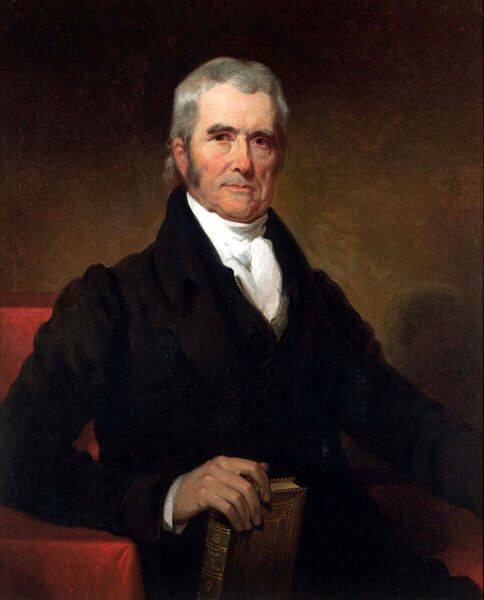 Today in History, January 31: 1801 – John Marshall is appointed as the fourth Chief Justice of the US Supreme Court. His decisions would make the Supreme Court the true 3rd segment of the American Government, a “check and balance” of the other two. This only gives us faith in our government when the court makes decisions based on law, and not on politically biased opinions. Marshall, the longest serving Chief Justice, would serve for 34 years, taking part in over 1,000 decisions. He would affect law through six presidencies.
1st Assassination Attempt of a US President
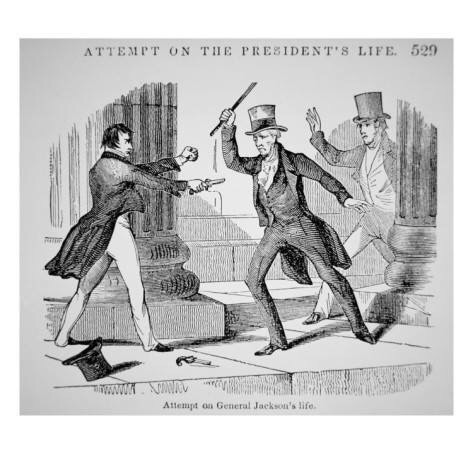 Today in History, January 30: 1835 – The first assassination attempt on an American President occurs when an insane out of work English painter approaches President Andrew Jackson as he walks out of the East Portico of the US Capitol, and attempts to fire two pistol in succession at the President. Both pistols misfired, “Old Hickory” clobbered the would be assassin with his cane, and nearby legislators including Davy Crockett subdued the man. The attempted assassin initially said he was angry about President Jackson’s efforts to dismantle the corrupt Second Bank of the United States, which he felt caused his unemployment. Soon he was claiming that he was a deceased King of England, however and was deemed insane. He was tried for the crime (the prosecutor was Francis Scott Key) and found not guilty by reason of insanity. He would spend the rest of his life institutionalized. Conspiracy theories abounded…Jackson suspected Senator John C. Calhoun of sponsoring the attack, which Calhoun denied on the Senate floor. Others suspected Mississippi Senator George Poindexter, who’s house the man had recently painted…so much so that Poindexter was voted out of office. In his inaugural address President Jackson stated, in part, “I feel in the depths of my soul that it is the highest, most sacred, and most irreversible part of my obligation to preserve the union of these states, although it may cost me my life.” It very nearly did.
Bleeding Kansas Joins the Union

Today in History, January 29: 1861 – Kansas enters the Union as a free state. Plain, flat Kansas has played a very large role in the formation of our nation.
I wasn’t there but a little while when I went to help a feller shingle a roof. It was about eight o’clock in the mornin’, and I was sittin’ there on the roof just lookin’ out at those miles and miles of prairies, and way off in the distance I see somethin’ about the size of a cigar standin’ up on the horizon. It didn’t seem to get no bigger and after I watched it a while I says to the feller, ‘Look at that thing out there, don’t it look funny.’ He looked where I was pointin’ and he says ‘Know what that is? That’s the freight train comin’ in.’ Well, we worked all mornin’ and we went in and was eatin’ dinner when we heard that train pull into the depot.
“Mr. Botsford on Travel—Kansas,” Art Botsford, Interviewee; Francis Donovan, Interviewer; Thomaston, Conn., December 27, 1938. American Life Histories: Manuscripts for the Federal Writers’ Project, 1936-1940. Manuscript Division
“Bloody Kansas” had fought the battle between abolishionists and slavery proponents from Missouri throughout the 1850’s. It’s internal battle was a precursor to the Civil War, during which the entire nation would battle for it’s very life over the unholy concept of one man owning another.
A Hero Comes Home at Last
Today in History, January 26: 1913 – – John Paul Jones is laid to rest at the US Naval Academy in Annapolis, Maryland.  I know I’ve told this story before, but I believe it is interesting enough to repeat. John Paul was born in Scotland and went to sea with British merchant ships at 13. In the West Indies he killed another sailor whom he said was a mutineer and had to flee. He settled in the American colonies and changed his name to John Paul Jones. He joined the Continental Navy when the Revolution began and became famous for his daring and courage; capturing several ships as prizes, raiding the English coast and fighting a horrific battle with his ship “Bonhomme Richard” (French for Poor Richard in honor of Benjamin Franklin) during with he responded to a demand for surrender with “I have not yet begun to fight!” After the war he served briefly in the Russian Navy as an admiral, but wanted to return to American Naval Service. The “Father of the US Navy” died without fanfare in Paris and was buried in an unmarked grave. Over 100 years later, in 1905, US Ambassador to France Gen. Horace Porter led the search to find Jones’ body, and with the help of the French, succeeded. Jones was taken back to America aboard the cruiser USS Brooklyn and was escorted into port by 7 battleships and 2 other cruisers. President Theodore Roosevelt, a naval history enthusiast, spoke at a ceremony at the US Naval Academy honoring Jones. Jones was eventually moved to his current tomb in the chapel at the Academy. An interesting aside; Gen. Porter had quite a history of his own. He was a Medal of Honor recipient for valor during the Civil War, was aide-de-camp to Gen. US Grant, was present in the room at Appomattox when Lee surrendered, and was Grant’s personal secretary during his Presidency.
Around the World in 72 Days

Today in History, January 25, 1890 – Courageous, Crusading journalist Nellie Bly (Elizabeth Cochran-Seaman) arrives home after traveling around the world in 72 days by ship, horse, rickshaw…any means necessary. Nellie Bly (pen name) worked for the New York World, and had set out to prove that Jules Verne’s fictional Phileas Fogg could have traveled “Around the World in 80 Days.” Anything a man can do…
Her adventures were covered by Joseph Pulitzer’s New York World through dispatches, articles upon her return, and in the novel she would write.
Ms. Bly had already made a name for herself by going undercover to expose the practices at a Women’s Insane Asylum. She would complete numerous other exposes into other realms as well.
Hero -“Traitor” – Hero
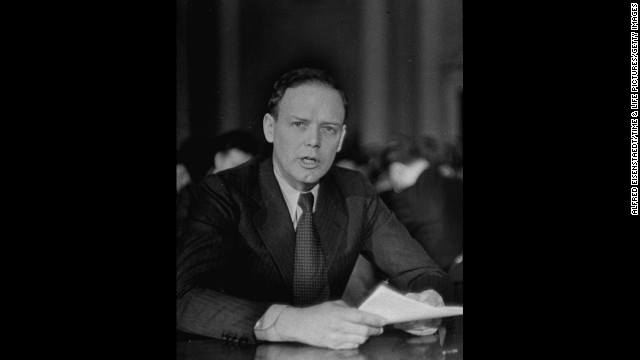
Today in History, January 23: 1941 – American hero Charles Lindbergh, who in 1927 was the first to fly solo across the Atlantic, sits before the US Congress and encourages the US to remain neutral with Nazi Germany. After his son was kidnapped and subsequently murdered, Lindbergh and his wife moved to Europe to avoid attention. While there he became enamored with the German air superiority (at least warning America about that) and their “advancements”. When he returned, son of a US Congressman, he sat before congress and denounced FDR’s administration, Jews, and the British, encouraging neutrality. A fool on a fool’s errand? Perhaps. Only history can determine whether he can be forgiven for his poor judgement after he flew 50 combat missions in the Pacific against the Japanese once the war began. He would die in Hawaii in 1974. Hero or traitor? We all make poor choices at some point in our lives, but can we obtain redemption?
 Mark Loves History!