Colt Walker

Today in History, January 4: 1847 –

Samuel Colt sells 1,000 revolvers to the Texas Rangers. Capt. Samuel Walker of the Rangers had used one of Colt’s revolvers in the Seminole wars and was so impressed that he traveled to New York City to find Colt. He ordered the revolvers, insisting that the order include 6 shots rather than 5, and have enough caliber to kill man or horse. The finished product was named the “Colt Walker”, and was followed by another thousand, which allowed Colt to build his own factory.

Colt was not the first to make a “revolving gun”, but he did perfect interchangeable parts and an assembly line to make his reliable pistols.

The Gadsden Purchase Drama

Today in History, December 30: 1853 –

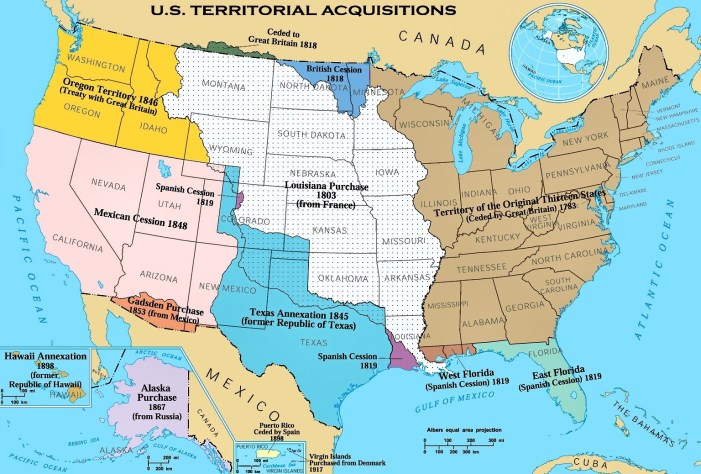
The Gadsden Purchase. The last major expansion of continental US territory takes place when US Ambassador to Mexico James Gadsden and Mexican President General Antonio Lopez de Santa Anna sign a treaty giving over a large segment of what is now New Mexico and Arizona from Mexico to the US for 15 million dollars to facilitate a southern US railroad, because a more northern route was too mountainous. The story seems pretty plain. But as I researched it, I found more and more intrigue and drama to be involved.

Gadsden was an ardent slavery proponent, sent on this mission by then US Secretary of War Jefferson Davis to negotiate the agreement on behalf of President Pierce. Gadsden and Davis, of course, shared views that more slave holding states should be added to the Union.

This was a point of major contention in the Congress, which debated the treaty extensively for those very reasons. Santa Anna, having lost badly in the war for the independence of Texas (Tejas) and the Mexican-American War, had been in and out of office repeatedly. Ironically, he was willing to sell additional Mexican territory to the United States so that he could afford to fund a Mexican army to defend against…the United States.

This last purchase established the current continental boundaries of our nation. Primarily because southern business interests didn’t want to depend upon a northern railroad route to ship their goods to California, not trusting the Yankees in this pre-Civil War era.

The Trent Affair

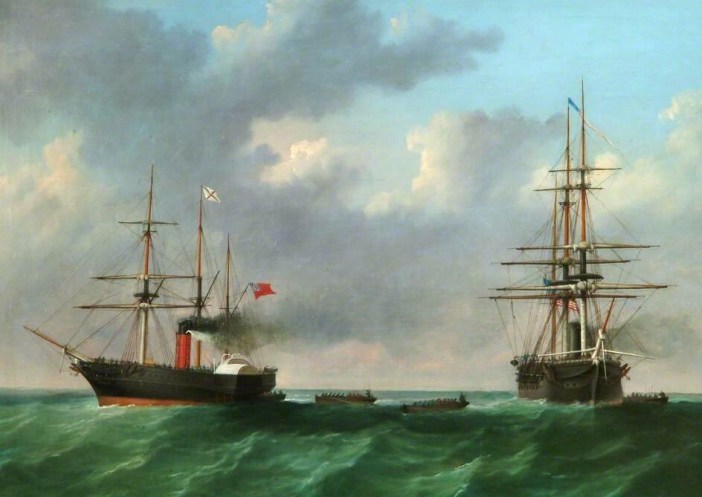
Today in History, December 26: 1861 – The “Trent Affair” ends with the release of Confederate envoys James Mason and John Slidell into British custody. Seems mundane initially, but this is a fascinating story that helps define American character. Earlier in the year, Union forces had been made aware that Confederate emissaries were being sent to Britain…believing that the desire for Southern cotton (King Cotton) by British merchants would inspire the UK Government to recognize the Confederacy as as separate nation, and to support her against the North. The USS San Jacinto, commanded by US Navy Captain Charles Wilkes, found the HMS Trent, a mail “packet” ship carrying Mason and Slidell to Britain to lobby for recognition and for support. He ordered the ship boarded and the envoys arrested as “contraband”, taking them to a Union port. Wilkes had led the American Exploring Expedition years earlier…science was his domain, not international relations. He created an international incident….the British were outraged that one of their ships had been boarded and her passengers seized. Ironically, by international law, had he seized the entire ship and brought her to port pending a trial, nobody would have been offended. US Secretary of State William Seward had to deal with the situation. American public sentiment was that the Southerners were taken legitimately. But if you looked at American history to that date…the Revolution had been won partially because Americans had gained foreign recognition by France. So was the Confederacy really doing anything that the Americans of the Revolution hadn’t done? Subsequently, the War of 1812 had been fought largely because Americans were tired of the British boarding their ships and seizing the ships crewmen. So could Capt. Wilkes’ actions be defended? Foremost in Seward’s thinking (and Lincoln’s) was that the Union would be hard pressed to win the Civil War if Britain came in on the side of the Confederacy, deciding that the CSA was a nation unto itself rather than a rebellious segment of one nation. In the end Seward voiced an eloquent conciliatory message to the British, released the Southern envoys to the British government, and avoided creating another enemy the North could not fight. Mason and Slidell continued on to Britain, but their efforts came to naught.

A Christmas Gift

Today in History, December 22: 1864 – “I beg to present you, as a Christmas gift, the city of Savannah, with 150 heavy guns and plenty of ammunition, and also about 25,000 bales of cotton.”. General William Tecumseh Sherman wired this message to President Lincoln after his army siezed one of the few remaining port cities in the South.

The message was not merely well received. It ended a six week cliff hanger for the President and the people of the North. That was when Gen. Sherman had taken the daring move of leaving the conquered city of Atlanta, thus cutting his army off from it’s supply lines. The large army would be solely dependent upon the supplies it could obtain from the land. Everything that was not needed to feed or provision the Union Army in a huge swath between the two cities was destroyed to prevent it’s use by the South.

Sherman had several objectives: Take Savannah to prevent supplies reaching the Confederacy from overseas, join up with the Navy, and bring the horrors of war to the Southern populace in an effort to demoralize them and shorten the war.

Bad Choices, Bigger Picture

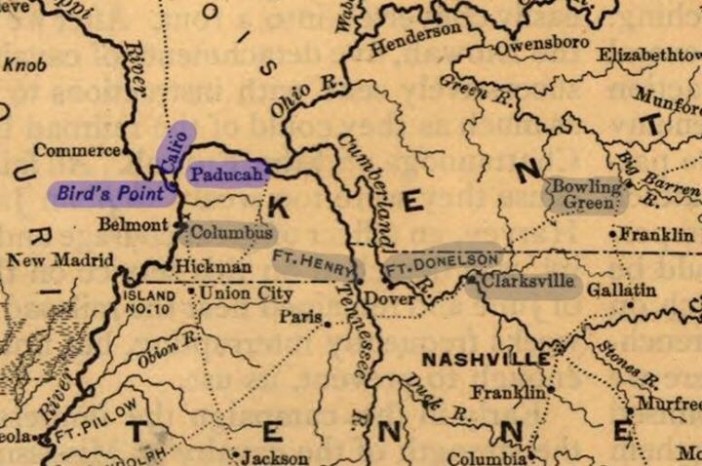
Today in History, December 17: 1862 – Even our heroes make misguided decisions. Gen. Ulysses S. Grant issues General Order 11, expelling all Jewish people from the area he commands, Tennessee, Mississippi and Kentucky. During the war, trade in the South’s staple, Cotton, was severely restrained, which of course led to a black market trade. It became a real problem for the Union Army in the west. Grant felt it was being driven by Jewish profiteers and ordered them expelled. After complaints from the Jewish community and Congress, President Lincoln quickly rescinded the order. Grant would go on to gain Lincoln’s…and the nation’s trust. But this was not his finest moment.

A Pardon for “Little Sister”

Today in History, December 14: 1863 –

President Lincoln grants amnesty to his sister-in-law, Emilie Todd Helm, whose Confederate General husband had been killed at the Battle of Chickamauga. Emilie had made her way to DC and was staying in the White House with the President and her half sister, Mary Todd Lincoln. This was part of a plan Lincoln had to re-unite the Union.

By his order, any Confederate “rebel” that would swear an oath of loyalty to the Union would be granted amnesty. Lincoln hoped this would foster reconciliation and diminish the ranks of the Confederate Army.

Ironically, “four score and seven” years earlier, the British Army had pronounced the same decree, stating that any “rebel” involved in the Revolutionary War who would swear an oath of loyalty to the British Crown, would be granted amnesty; and the British decree was proffered for the same reason. In 1776 it met with limited success. In 1863, it met with some success, but the war would continue for two more years.

Nothing Lives Long. Except the Earth and the Mountains. -Death song of Chief White Antelope, age 75

Today in History, November 29:  1864 –

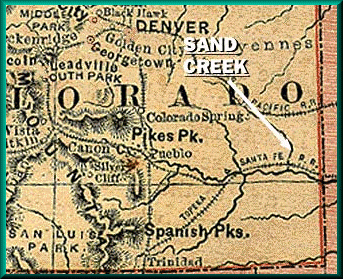
The Sand Creek Massacre.

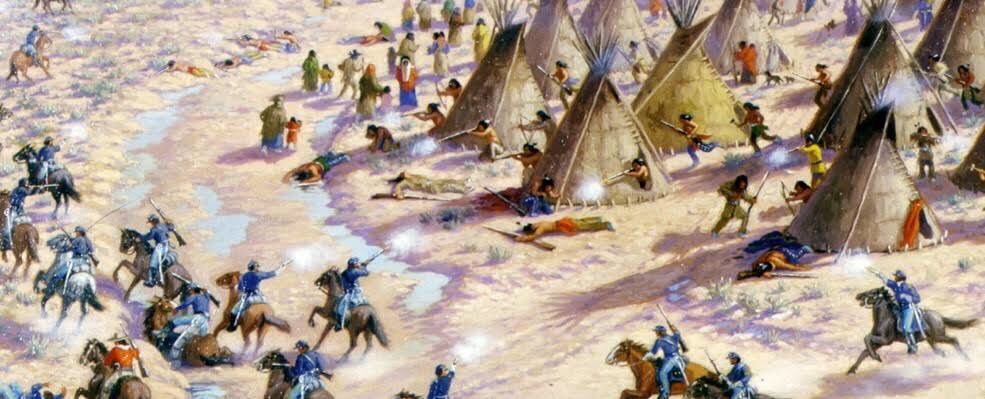
As the morning was dawning the sleepy village, Chief Black Kettle saw them approaching, and hoisted the Stars and Stripes above his Tipi as a sign of brotherhood and peace.  And then the blue coated soldiers began firing.

The Cheyenne and Arapaho of Colorado had settled in for the winter along a bend in Sand Creek in eastern Colorado.  Resources in the barren area were in short supply and they expected a harsh time.  900-1,000 people in hundreds of Tipis, although many were out hunting buffalo that morning.

The Civil War raged further east, and in Colorado and New Mexico a few months previous.  Colonel John Chivington of the Colorado Volunteers had fought in those battles, but now was looking for a new fight.  After a family of settlers was killed, allegedly by Arapaho or Cheyenne, the Governor tasked Chivington with raising a regiment to defend against hostile Indians.

But his regiment’s enlistment was nearly up and he hadn’t found any hostile Indians.  So he took over 700 troops to attack the peaceful village along Sand Creek.

After the attack on the settlers, the white authorities told the peaceful Indians to encamp at military forts and facilities where they would be protected.  Chief Black Kettle had spoken to the commander of a nearby fort seeking to comply.  He was told to keep his people at Sand Creek until the commander received further orders, and they would be safe.

Hundreds of women and children dropped to their knees in front of the soldiers that morning, imploring them for mercy.  There was no mercy given as the women and children were shot down or had their skulls caved in.  Many then ran for the creek where they sought cover, or fled north.  For the next several hours Chivington’s soldiers chased them down and killed as many as they could.

Seeing what was happening, Chief White Antelope approached the soldiers, folded his arms, and began singing his death song, “Nothing lives for long.  Except the Earth and the Mountains.”

Chief Black Kettle carried his wounded wife and fled north towards another band of Cheyenne.  He would make his way to Oklahoma, where he led his people to again attempt peaceful existence.  He would live two days shy of four years more…when he and his wife would be chased down and killed by soldiers of George Custer’s command at the Massacre along the Washita River.

One of the Union officers present that day refused to follow commands and ordered his company not to fire; and tried to save some of the victims.  Captain Silas Soule was career Army and recognized the cowardly acts being carried out.  The next day he wrote a letter to a Major friend of his back east, telling of the horrific behavior of Chivington’s “mob”.  He told of women and children having their brains bashed in.  He said that Chiefs had their ears and genitals cut off as trophies, and all those killed were scalped.  The crazed killers cut out many of the women’s genitalia as souvenirs.

Chivington would escape court martial by resigning from the Volunteers.  But even during the Civil War, the government and the people were aghast at the atrocities carried out at Sand Creek, and Congressional hearings were held in 1865, during which Captain Soule testified at against Chivington.

For his trouble he was gunned down in the street in Denver a few months later.  His murderers were never prosecuted.

The assault was supposedly intended to force peace for the nascent settlements in Colorado.  It had exactly the opposite effect, as the Cheyenne Dog Soldiers and others fought a decade’s long war with the settlers, their trust of the white people destroyed.

The story was eventually all but forgotten, and was a touchy subject when it was spoken of.  However Colorado eventually began to come to terms with this dark part of its history, and in 2007 the Sand Creek Massacre National Historic Site was established, run by the National Park Service.

Many visit the site in homage to the approximately 200 Native Americans who died that day.

Several of the sites I read in preparation for this posting indicated the subject was not covered much until the 2000’s.  However if you read (or watch) James Michener’s “Centennial”, you’ll find that he covered the events very well, just with a change in names.

Texas Rangers Become Official

Today in History, November 24: 1835 –

The provincial legislature of Texas, before Texas was a nation or a state, orders the creation of companies of “Rangers” to patrol the range, or frontier. Their job, continuing a less official group of rangers begun by Stephen F. Austin in 1823, was to protect citizens from Indians and bandits.

The Rangers would see success at fighting Commanche and bandits. When the Texas war for independence came they served as scouts and couriers.

During the Mexican-American War they would earn more fame (or infamy depending on your position…the Mexican populace referred to them as los Diablos Tejanos, or Texas Devils) for their fighting acumen and scouting for the US Army. How many police agencies can say they were recruited as a unit to fight alongside the military at war?

Over the next century and a half the Rangers would have their highs and lows…being all but disbanded during the Civil War and due to politics on other occasions.

But when it counted they were there to track down bad guys like John Wesley Hardin, Sam Bass and other terrors as the West was settled, and Bonnie and Clyde during the thirties.

The Rangers were known for their relentless tactics against the Native American tribes and others. They also took the fight to the KKK and against lynchings.

Today the Texas Rangers are much different. They are still the elite response unit…but as part of the Texas Department of Public Safety they are the investigators working with the patrol arm of the Highway Patrol.

“I should be glad, if I could flatter myself that I came as near to the central idea of the occasion, in two hours, as you did in two minutes.”

Today in History, November 19: 1863 – “I should be glad, if I could flatter myself that I came as near to the central idea of the occasion, in two hours, as you did in two minutes.” -Edward Everett, popular orator that spoke with President Lincoln at Gettysburg to commemorate those that died there during the pivotal Battle of Gettysburg earlier in the year. President Lincoln spoke briefly, and his speech was criticized at the time by some media, but has become legendary for it’s prescience. See below for the full text….

Four score and seven years ago our fathers brought forth on this continent, a new nation, conceived in Liberty, and dedicated to the proposition that all men are created equal.

Now we are engaged in a great civil war, testing whether that nation, or any nation so conceived and so dedicated, can long endure. We are met on a great battle-field of that war. We have come to dedicate a portion of that field, as a final resting place for those who here gave their lives that that nation might live. It is altogether fitting and proper that we should do this.

But, in a larger sense, we can not dedicate — we can not consecrate — we can not hallow — this ground. The brave men, living and dead, who struggled here, have consecrated it, far above our poor power to add or detract. The world will little note, nor long remember what we say here, but it can never forget what they did here. It is for us the living, rather, to be dedicated here to the unfinished work which they who fought here have thus far so nobly advanced. It is rather for us to be here dedicated to the great task remaining before us — that from these honored dead we take increased devotion to that cause for which they gave the last full measure of devotion — that we here highly resolve that these dead shall not have died in vain — that this nation, under God, shall have a new birth of freedom — and that government of the people, by the people, for the people, shall not perish from the earth.

Little Mac


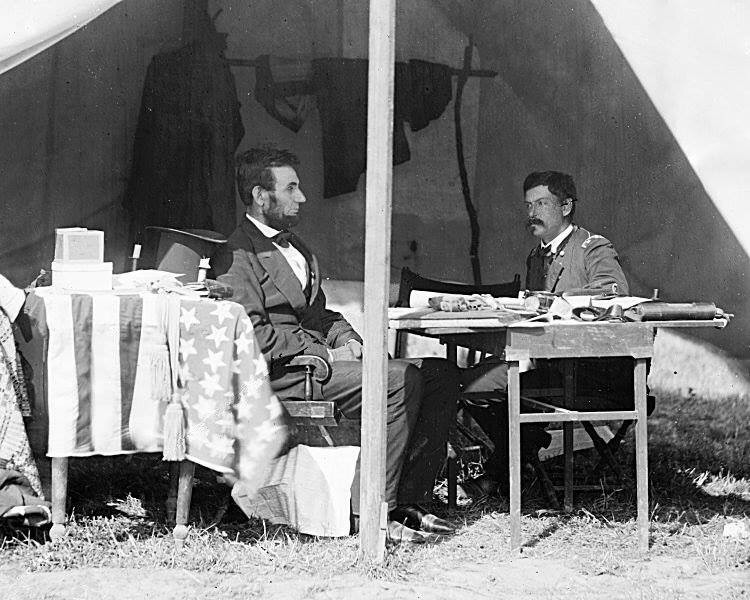
Today in History, November 5: 1862 – President Abraham Lincoln relieves Gen. George B. McClellan of the command of the Army of the Potomac for the second and last time. “Little Mac” was a great organizer, and drilled the army into a very competent force…but refused to use it. On numerous occasions Lincoln suggested, cajoled, asked, and ordered McClellan to take offensive action. Gen. McClellan always assumed his enemy had many more soldiers than they actually had and found excuses not to advance. Finally Lincoln had enough. McClellan, who referred to Lincoln as a well meaning gorilla, would run against his boss for President as an anti-war Democrat. I read and listen to a lot of history. It always bothers me when an author judges a leader rather than just reporting the facts…we weren’t there, and I’ve been “second guessed” myself. Gen. McClellan is my exception. I’ve read too many historical accounts, too many biographies in which he was mentioned. I don’t believe he was a coward. I don’t necessarily believe he was a traitor. But he repeatedly and adamantly acted against the interest of his government. I would love to know what was in his mind.