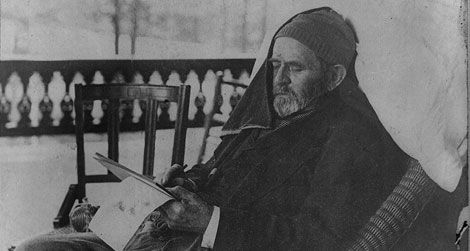
Raison D’être – Sam Finishes His Book

Today in History, July 16, 1885: Sam finishes his book.

Sam had led a bit of a rough life. He saw great success, no doubt, but he was also an alcoholic. His father struggled with the demon for a time, and his grandfather had succumbed to it. In those days they didn’t realize it was often a family trait or a disease…it was simply a weakness. Sam had fought the demon his entire adult life. He was brilliant at is chosen profession. He quit it for a time because of his drinking and tried other jobs…farmer, realtor, shopkeeper…none worked out. As brilliant as he was, he had another weakness; he had a big heart and was much to quick to trust people with his money. So Sam spent most of his life broke.

Even with this, events in his life led him in a round about way to the pinnacle of success. He succeeded where others failed miserably due to his tenacity, his organizational skills and his ability to see the big picture. Yet through it all, no matter how much he achieved, his detractors never forgot, and certainly never let him forget, his demons.

Sam had made his fortune at last…but then, in his older years when there was little to no chance of building success anew, his other failure reared its ugly head again. The people he trusted with his money were scoundrels, and he found himself…and more importantly to him, his family, destitute once again.

Living on borrowed money, things got worse. One day while eating a peach his wife had given him, he felt as if he had been stung by something within it. He had no time for doctors and stubbornly toiled for months until the pain was unbearable to relent to his wife’s demands to see his physician. By then, it was too late. The mouth and throat cancer was advanced, and all that could be done was to provide him with pain killers until the end would come.

Sam’s father had been an inveterate braggart, a schemer and an incessant talker. It embarrassed Sam so that he became the exact opposite. Quiet and humble to a fault, it took everything he had to do what he had refused for years…to blow his own horn and tell his own story. But now it was the only way he could leave his wife and children with a means of support. So he threw himself into the task.

For over a year he wrote. He wore a muffler to cover the baseball sized tumor at his throat. Typical of his demeanor, he never complained of the excruciating pain that wracked him day and night…his family only saw him grimace from the pain when he was asleep and unable to hide it.

Sam worked with a purpose…he amazed his publisher by finishing 10,000 words in a day, written out. Mark couldn’t believe it…Mark was one of the most prolific story-telling authors of his time, and could never match Sam, who disliked the task of telling his own story. But now he had to…for his family…for his legacy because his old detractors were only too happy to repeat their own refrain, “See, we told you so.”

Fighting past the pain and past the fog of his medications, he toiled even when he could no longer write, and tortured himself to dictate his story to others.

Finally on July 16, 1885, Sam completed his autobiography. Mark had promised to publish it for a handsome price which would see to it that Sam’s family did not want for anything. It was suspected that Mark had ghostwritten the work…which he adamantly and angrily denied. His friend Sam had written the work…brilliant and surprising as usual.

Having won his last battle, he could let go now. Seven days later on July 23, 1885, Hiram Ulysses Grant, “U.S. Grant” due to an Army administrator’s error in his youth, Sam to his friends, a drunk to his detractors, an amazing horseman and hero of the Mexican-American War, General of the Army and President of the United States, passed from this earth.

Mark Twain saw that “The Personal Memoirs of U.S. Grant” was published and the family was treated fairly and well. Sam had found someone trustworthy this time. I’ve read General Grant’s memoirs, and they would be impressive if written by someone in perfect health. They are nothing less that heroic considering the suffering he endured during his final work.
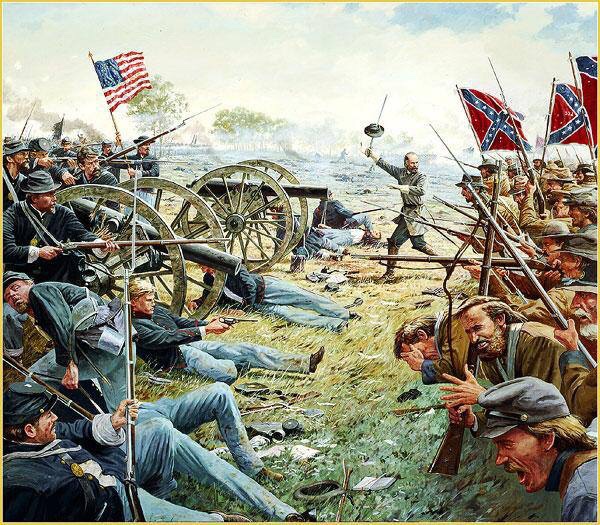
“Steady, men….steady! ChaaaaAAAaaRRGE!!”

Today in History, July 1:

A day for important battles.

1863 – The Union and the Confederates first clash at The Battle of Gettysburg, and both send reinforcements. The first day went badly for the Union, but the largest battle in North America had three more days to go, and would become a major turning point in the Civil War.

1898 – The Battle of San Juan Hill becomes a major victory for the US in the Spanish-American War as the US Army’s Fifth Corps takes the heights over Santiago de Cuba. It also set the stage for Colonel Theodore Roosevelt to become President as he became famous for leading his Rough Riders up Kettle Hill (not San Juan).

1916 – The Battle of the Somme in France; after a week’s bombardment with over 250,000 shells, the British launch an attack into no-man’s land. The Germans had retained many machine guns despite the bombardment, and the British soldiers were slaughtered. With 20,000 dead and 40,000 wounded in one day, it was one of the worst defeats for the British military’s history.

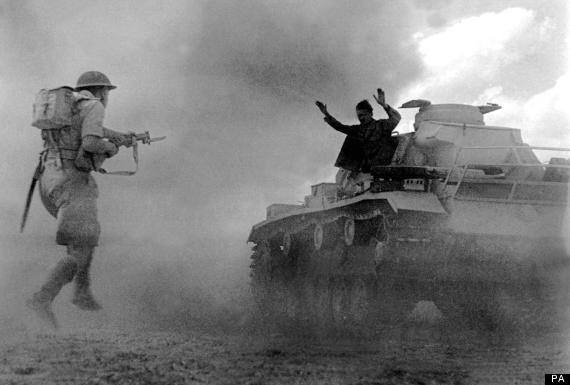
1942 – The Battle of El Alamein; In North Africa Erwin Rommel’s army had routed the British and their allies, driving them back so quickly that they had to leave much of their equipment behind. But on today’s date the British Army, resupplied by Americans and reorganized, turned the tide back on Rommel at El Alamein.

“Oh, ah, Mr. Wayne, I heard you were dead?” ——-“NOT Hardly…..”

Today in History, June 11, 1979:

John Wayne, The Duke, Marion Michael Morrison, dies. He was not just an actor, he was an American icon that inspired us to great things. We won’t see his like again.

Yet John Wayne lives on in his legacy. Each time someone tries to emulate him, live like him, the country is all the better for it.

So perhaps the Duke is not gone at all.

Full-Contact Politics

Today in History, May 22, 1856:

Years before the Civil War. On May 20, 1856 US Senator Charles Sumner, a free soil Democrat and later Republican from Massachussetts, had given a firey speech entitled “Crime Against Kansas” about the violence in that state over slavery.

A devout abolitionist, he excoriated the south, in particular Senator Andrew Butler of South Carolina, who he likened to a pimp abusing a prostitute (slavery).

This enraged Butler’s nephew, Senator Preston Brooks. When Sen. Stephen Douglas heard the speech, he commented, “this damn fool Sumner is going to get himself shot by some other damn fool.”

On the 22nd, Brooks entered the Senate chamber with two other Southern Senators, found Sumner at his desk writing and proceeded to bludgeon him nearly to death with his heavy metal tipped cane while Sumner was trapped within his desk, defenseless.

Southerners hailed Brooks a hero.

Northerners called him a coward. One of these, Republican Representative Anson Burlingame called him such on the House floor.

Brooks challenged Burlingame to a duel. When Burlingame actually accepted and showed up, Brooks did not.

Sumner would suffer debilitating pain for the rest of his life from his injuries, but would recover to become a key proponent of abolitionist policies during reconstruction, living until 1872.

Brooks on the other hand died in January 1857, less than a year after the attack, of the croup.

You Must First Catch the Rabbit…

Today in History, May 19, 1863:

The Siege of Vicksburg continues.

After two failed assaults, the Union troops and the Union Navy settle in for an extended siege.

After 44 days, during which Vicksburg would be compared to a “Prairie Dog Town”, with most of the population living underground, the Vicksburg newspaper, “The Daily Citizen” was reduced to printing it’s media on used wallpaper,

By day 44, the paper printed, “[T]he great Ulysses—the Yankee Generalissimo, surnamed Grant—has expressed his intention of dining in Vicksburg on Saturday next, and celebrating the 4th of July by a grand dinner and so forth. When asked if he would invite Gen. Jo Johnston to join he said. ‘No! for fear there will be a row at the table.’ Ulysses must get into the city before he dines in it. The way to cook rabbit is ‘first catch the rabbit.’ &c.” A week later, the Union troops had taken over the paper, having taken Vicksburg, and added and addendum, “Two days bring about great changes, The banner of the Union floats over Vicksburg, Gen. Grant has ‘caught the rabbit;’ he has dined in Vicksburg, and he did bring his dinner with him. The ‘Citizen’ lives to see it. For the last time it appears on ‘Wall-paper.’ No more will it eulogize the luxury of mule-meat and fricasseed kitten—urge Southern warriors to such diet never-more.”

“I Cannot Spare This Man…He Fights!”

Today in History, May 18, 1863:

Running the Table.

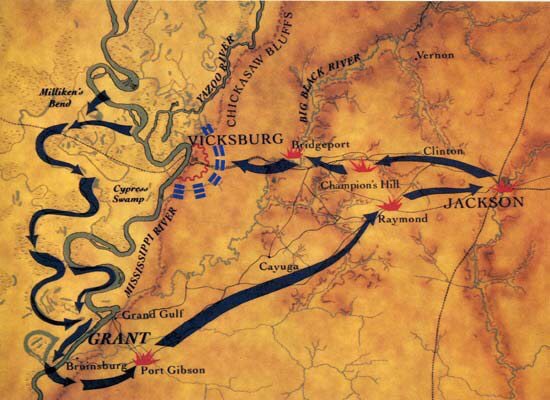
Gen. Grant planned the taking of Vicksburg and Admiral David Dixon Porter’s running of the guns at that fortress city. In the interim between then and today’s date, Grant’s army was taken across the Mississippi from several victories in Louisiana, won five major victories in Mississippi, including taking the capitol of Jackson. He pushed Confederate Gen. John C. Pemberton back to the Big Black River Bridge, which Pemberton burned on the 14th during his retreat to Vicksburg.

Pemberton could no longer face Grant in the field, having lost three quarters of his army. Grant had the bridge rebuilt by the 18th, and the siege of Vicksburg had begun.

Grant made two unsuccessful attempts to take the city and then determined to have no more losses, lay siege to the city. The siege involved entrenchments, mines and bombardment by land based artillery as well as by Admiral Porter’s ships.

The civilians and soldiers in the city had to live underground. By July 4th, his troops and civilians starving and demoralized, Pemberton agreed to surrender. Grant initially demanded his trademark “Unconditional Surrender”, then reconsidered. Even after having lost 3/4 of it’s manpower, Pemberton’s army still numbered 30,000 famished troops. He decided instead to utilize a long respected military method of “paroling” the rebel troops. That meant that they would be freed as long as they never took up arms against the Union again. It would have taken months and a great deal of manpower Grant did not want to expend to move 30,000 prisoners north. The Confederates agreed to the terms. Yet many of them were back in battle against Union troops by Pemberton could no longer face Grant in the field, having lost three quarters of his army. Grant had the bridge rebuilt by the 18th, and the siege of Vicksburg had begun. Grant made two unsuccessful attempts to take the city and then determined to have no more losses, lay siege to the city. The siege involved entrenchments, mines and bombardment by land based artillery as well as by Admiral Porter’s ships. The civilians and soldiers in the city had to live underground. By July 4th, his troops and civilians starving and demoralized, Pemberton agreed to surrender. Grant initially demanded his trademark “Unconditional Surrender”, then reconsidered. Even after having lost 3/4 of it’s manpower, Pemberton’s army still numbered 30,000 famished troops. He decided instead to utilize a long respected military method of “paroling” the rebel troops. That meant that they would be freed as long as they never took up arms against the Union again. It would have taken months and a great deal of manpower Grant did not want to expend to move 30,000 prisoners north. The Confederates agreed to the terms.

Yet many of them were back in battle against Union troops by September. This ended the act of paroling for the remainder of the war.

After Vicksburg and Port Hudson fell in July, President Lincoln proclaimed, “The Father of Waters again goes unvexed to the sea.” This victory was considered the turning point in the Civil War; Union control of the Mississippi not only allowed US Navy movement and resupply all along it’s course, it effectively cut the Confederacy in half, depriving it of the resources and armies of the west. This battle is also largely the reason Grant was advanced to command of all Union Armies…as Lincoln said, “I cannot spare this man…he fights!” A quality the President found lacking in many of his other Generals.

New Orleans Surrenders

Today in History, April 29, 1862:

The surrender of New Orleans.

The Confederacy was determined to protect the jewel of the South, it’s largest port and therefore source of supply from abroad.

They were convinced the attack would come from the north, and placed the bulk of their army forces and naval forces in Tennessee and Mississippi. This left New Orleans to be defended by about 3,000 militia and two forts below her on the River, Ft. Jackson and Ft. St. Phillip.

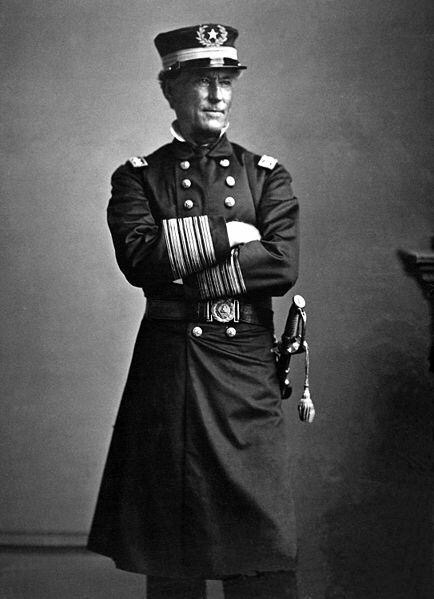
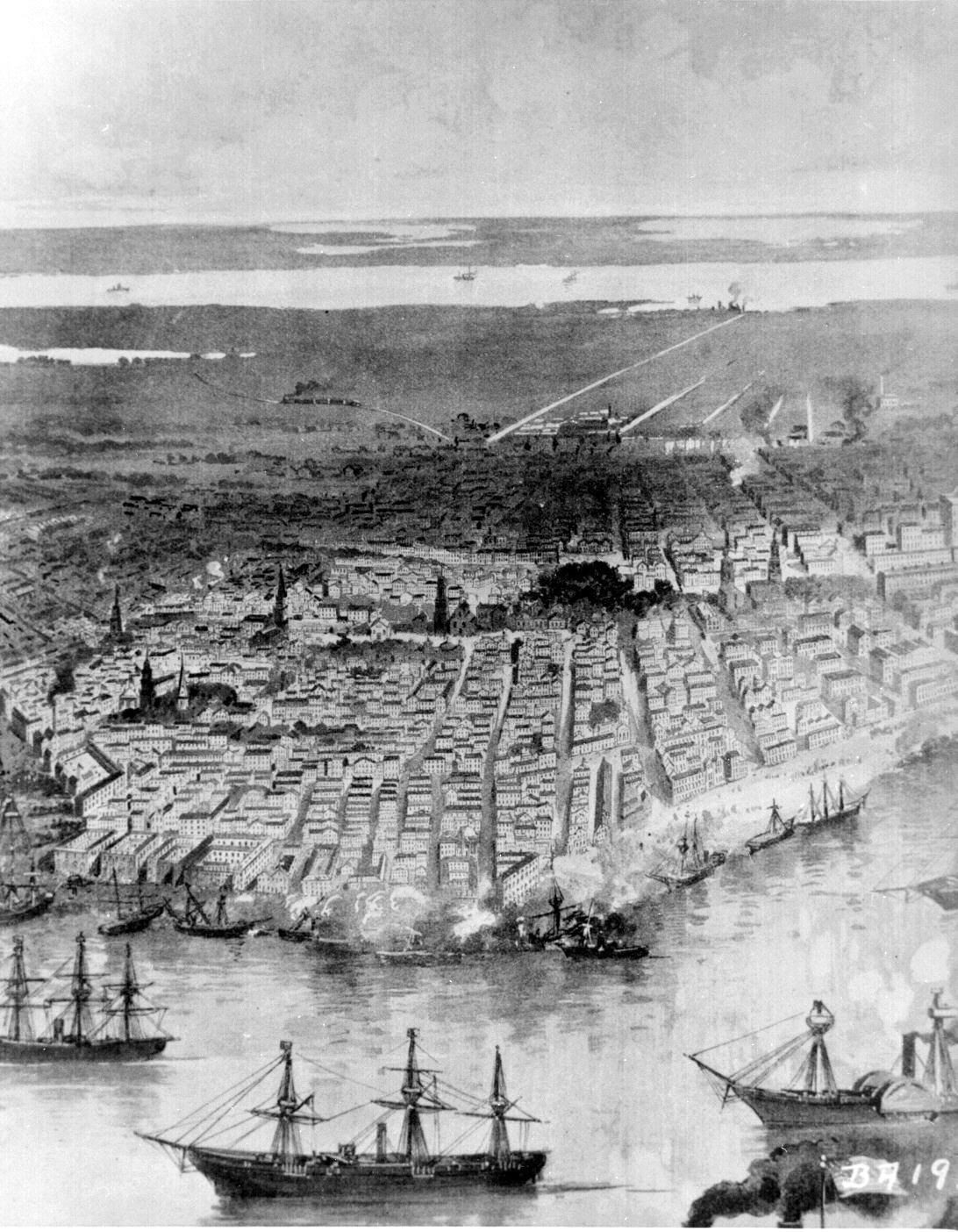
Union Flag Officer David Farragut took his force of Union ships and tried to silence the forts, and failing that decided to run past the batteries in a fierce battle. By the 28th his fleet lay off the city on the Mississippi.

If you’ve ever been to the French Quarter and watched ships move by ABOVE you on the river, you’ll understand why the Confederate commander there told the mayor the battle was already lost and withdrew his forces.

The next day, the 29th, Farragut’s childhood home surrendered to him. David Farragut was adopted by Capt. David Porter after his mother died, and began his naval career at age 9. He would become the first Rear Admiral, the first Vice Admiral, and the first Admiral in the US Navy. His adoptive brothers, David Dixon Porter and William Porter would also be naval heroes that attained flag rank.

The capture of New Orleans by Union forces helped cut off the Confederacy from outside supply, and from their territories in the west.

Lincoln’s Assassin Killed

Today in History, April 26, 1865:

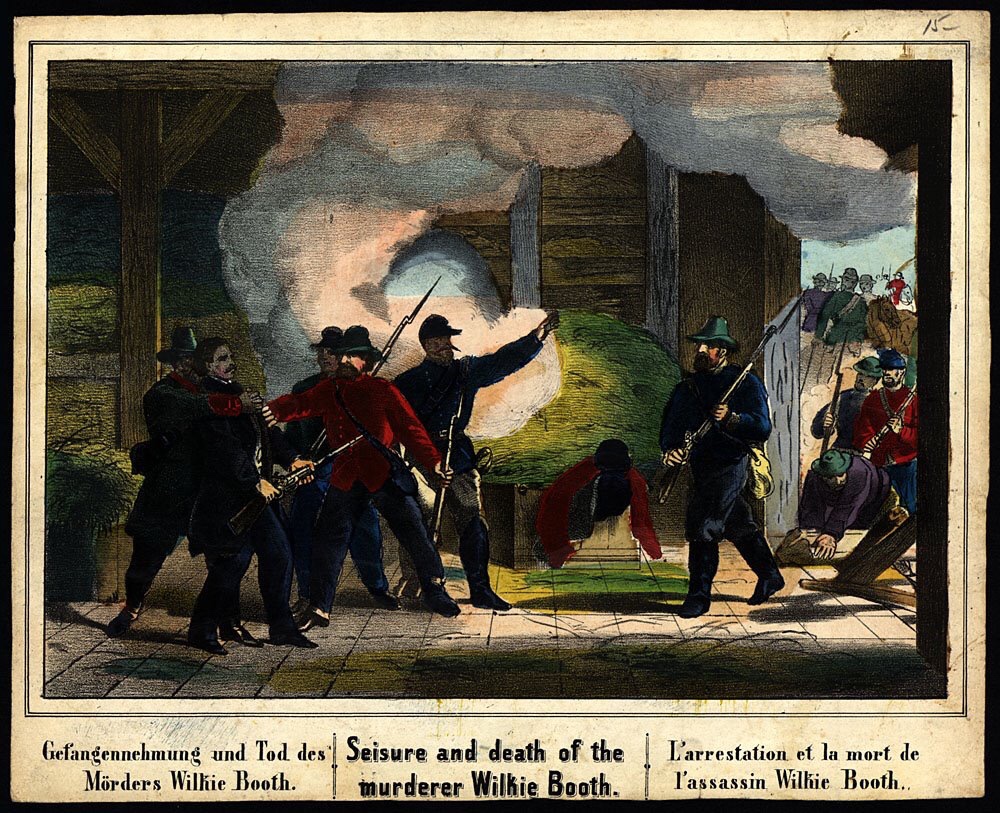
Union Army forces track down John Wilkes Booth 12 days after he assassinated President Lincoln.

In the meantime, he had been hidden by Confederates, treated by Doctor Samuel Mudd (your name is mud) and hidden in a barn on the Garrett farm in Virginia, where he was found. The barn was set afire and his associate surrendered.

Booth refused…a Union soldier, Boston Corbett, saw Booth inside the barn and fired his Colt revolver…causing a mortal wound to Booth.

Many Confederates saw Booth as a hero. However many Southerners wept openly at Lincoln’s death, and Confederate Generals, including Lee and Johnston, denounced Booth’s actions.

Fortunately, in the interim between his deed and his death, Booth was able to see news accounts that recorded his benefactor’s denunciation of his act. So when he died, he knew what he was.

Irredeemable Loss & Grief…Assassination of President Lincoln

Today in History, April 14, 1865:

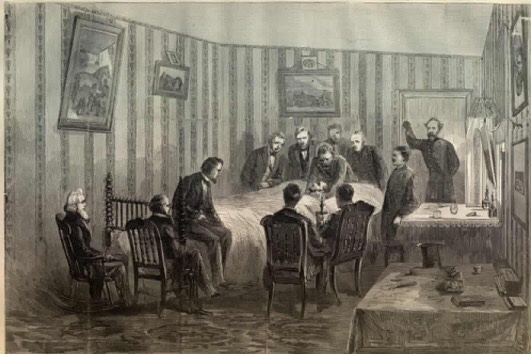
Within a week of the surrender at Appomattox, a coward assassinated President Abraham Lincoln.

If you were old enough on 9/11, you experienced the indescribable loss, grief, and helplessness we all experienced.

I use this in an attempt to fathom the emotions Americans must have felt at the loss of Lincoln. He had led them through the most traumatic time in our nation’s history…the times ahead were still uncertain. How would the North and South reunite? Was the war really over? They needed his steady hand on the rudder stearing the ship of state more than ever.

And suddenly Abraham was gone.

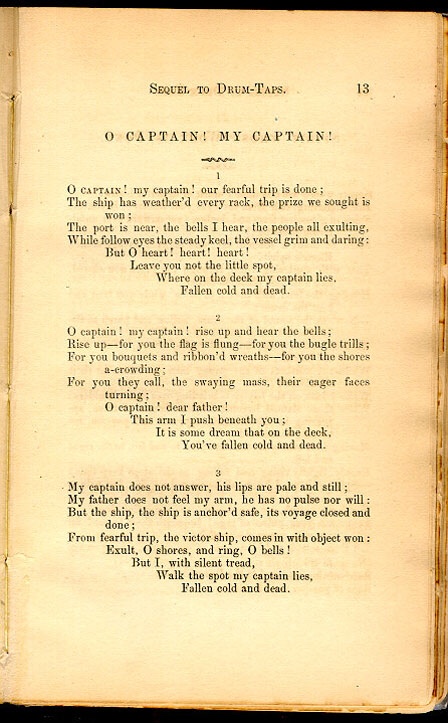
I post “O Captain! My Captain!” By Walt Whitman almost every year on this date, because I believe he came closest to capturing the grief the nation must have felt.

O Captain! My Captain!

O Captain! my Captain! our fearful trip is done,
The ship has weather’d every rack, the prize we sought is won,
The port is near, the bells I hear, the people all exulting,
While follow eyes the steady keel, the vessel grim and daring;
                         But O heart! heart! heart!
                            O the bleeding drops of red,
                               Where on the deck my Captain lies,
                                  Fallen cold and dead.
O Captain! my Captain! rise up and hear the bells;
Rise up—for you the flag is flung—for you the bugle trills,
For you bouquets and ribbon’d wreaths—for you the shores a-crowding,
For you they call, the swaying mass, their eager faces turning;
                         Here Captain! dear father!
                            This arm beneath your head!
                               It is some dream that on the deck,
                                 You’ve fallen cold and dead.
My Captain does not answer, his lips are pale and still,
My father does not feel my arm, he has no pulse nor will,
The ship is anchor’d safe and sound, its voyage closed and done,
From fearful trip the victor ship comes in with object won;
                         Exult O shores, and ring O bells!
                            But I with mournful tread,
                               Walk the deck my Captain lies,
                                  Fallen cold and dead.

“So. You’re the little woman who wrote the book that made this big war?” – A. Lincoln

Today in History, March 20, 1852:

“So…you’re the little woman who wrote the book that made this great war!”

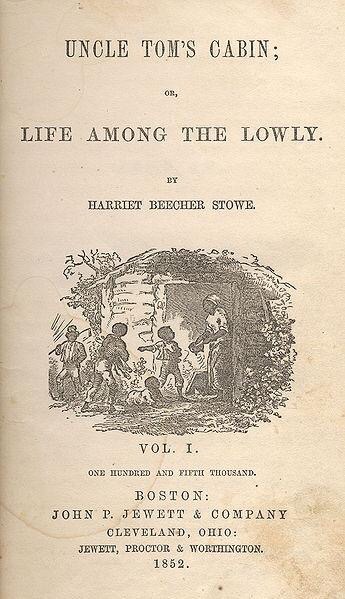
President Abraham Lincoln greets Harriett Beecher Stowe at the Presidential Mansion in 1862, ten years after her novel “Uncle Tom’s Cabin” was first published.

I am amazed at the foresight and courage displayed by this woman, a school teacher turned author.

By her own admission, in the epilogue of the book, for the first part of her life, she knew of slavery, disapproved of it, but being a Northerner, it was distant and she felt that the problem would be resolved eventually on it’s own.

How many of today’s injustices do we see the same way? Between meeting some runaway slaves, becoming familiar with the Underground Railroad, and stories from her family and friends, and finally the Compromise of 1850 (in which the government promised to return runaway slaves in exchange for new limitations on slavery expansion), she became an avid abolitionist.

She wrote Uncle Tom’s Cabin to illustrate the aspects of slavery that most did not understand at that time.

As slaves, a mother’s children were often sold off, never to be seen again.

Women were sold into prostitution, to be used until their value had diminished.

If a good and kindly “master” came on hard times, he might sell a good man “down the river” to cruel and harsh masters, as “Uncle Tom” was.

With her novel, Mrs. Stowe humanized the slavery issue, brought it home to people and chastised them for not living up to their Christian values.

The novel would become the best selling novel of the 19th century and would inspire abolitionist views amongst Americans. It was certainly far from the only cause of the Civil War…but the novel played it’s part in American History.

One has to wonder if this “little woman” had any idea of the importance her words would have. If you haven’t read (or listened to) this novel, you should.ance her words would have. If you haven’t read (or listened to) this novel, you should.