1863 – The Union and the Confederates first clash at The Battle of Gettysburg, and both send reinforcements. The first day went badly for the Union, but the largest battle in North America had three more days to go, and would become a major turning point in the Civil War.
1898 – The Battle of San Juan Hill becomes a major victory for the US in the Spanish-American War as the US Army’s Fifth Corps takes the heights over Santiago de Cuba. It also set the stage for Colonel Theodore Roosevelt to become President as he became famous for leading his Rough Riders up Kettle Hill (not San Juan).
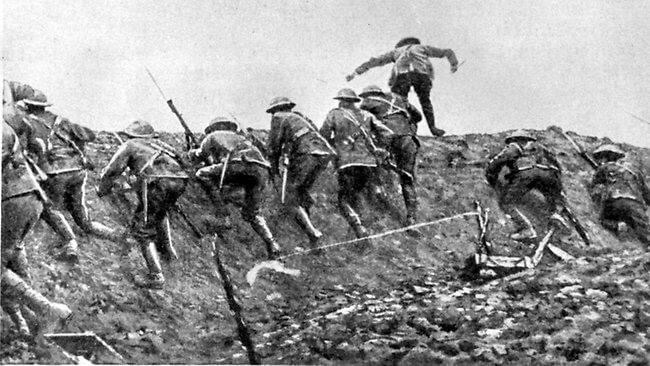
1916 – The Battle of the Somme in France; after a week’s bombardment with over 250,000 shells, the British launch an attack into no-man’s land. The Germans had retained many machine guns despite the bombardment, and the British soldiers were slaughtered. With 20,000 dead and 40,000 wounded in one day, it was one of the worst defeats for the British military’s history.
1942 – The Battle of El Alamein; In North Africa Erwin Rommel’s army had routed the British and their allies, driving them back so quickly that they had to leave much of their equipment behind. But on today’s date the British Army, resupplied by Americans and reorganized, turned the tide back on Rommel at El Alamein.
Illinois “circuit” lawyer Abraham Lincoln, running to be the Senator from that state, gives a speech at the capitol of Springfield and gains the Republican nomination.
One of his most famous speeches, the “House Divided” speech did not gain him the job of US Senator from Illinois, that would go to his opponent, Stephen A. Douglas.
However, published nationally, it did launch him onto the national stage, along with his series of debates against Douglas, which would gain him the Presidency two years later.
The speech was prophetic, as Lincoln told his listeners that after recent events, the nation could no longer expect to be half free and half slave, but must be all one or the other.
“A house divided against itself cannot stand. I believe this government cannot endure, permanently, half slave and half free.
I do not expect the Union to be dissolved — I do not expect the house to fall — but I do expect it will cease to be divided. It will become all one thing or all the other.
Either the opponents of slavery will arrest the further spread of it, and place it where the public mind shall rest in the belief that it is in the course of ultimate extinction; or its advocates will push it forward, till it shall become lawful in all the States, old as well as new — North as well as South.
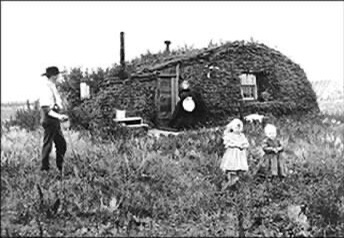
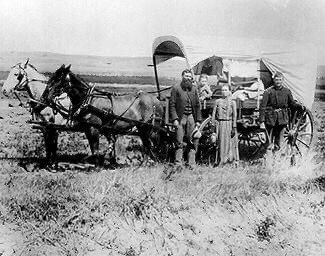
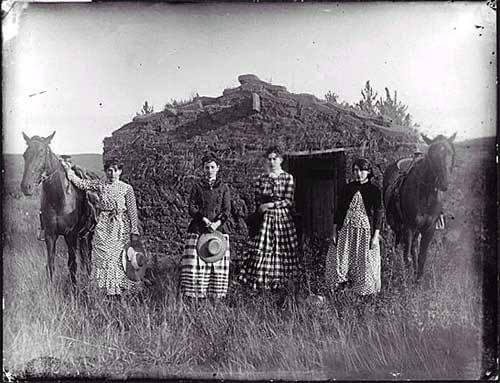
President Lincoln signs the Homestead Act, which would give 160 acres of western lands to anyone who would farm it successfully for 5 years and build a residence upon it (often a sod building).
The Act would encourage vastly expanded settlement of the west; bad news for Native Americans, good news for those newer Americans wanting to improve their lot in life.
Congress had attempted to pass similar acts in 1852, 1854, and 1859, but each time the attempts were shot down by Southern Democrats who were afraid that if the west were populated it would result in more “free” states, which would result in more votes against slavery.
Once the Republican Lincoln was elected, and the Civil War began, the Southern Democrats were no longer part of the equation.
The Republicans soon passed the Homestead Act and the settlement of the west began in earnest. By the end of the war 15,000 settlers (some of which were merely pawns for land speculators) had accepted their lands. Eventually 80 Million acres would be settled.
The first of seven debates between two candidates for an Illinois Senate seat begins.
Now famous as the Lincoln-Douglas Debates, former Congressman Lincoln, a former Whig and member of the infant Republican Party, tried for incumbent Democrat Stephen A. Douglas’ Senate seat.
The primary focus of the debates was Lincoln’s desire to curtail the spread of slavery to midwest and western states, and Douglas’ belief that each state should be able to decide for itself.
It is “debatable” who won the debates, but Lincoln lost the election.
Yet the debates launched this little known lawyer onto the national stage. Two years later he would face Douglas and others for the Presidency and would win.
It is important to note that while Lincoln was an abolitionist at heart, he was not yet arguing for complete abolition, only restrictions on slavery. Each of the debates lasted for hours. Here is one telling quote from Lincoln,
“This declared indifference, but, as I must think, covert real zeal for the spread of slavery, I cannot but hate. I hate it because of the monstrous injustice of slavery itself. I hate it because it deprives our republican example of its just influence in the world—enables the enemies of free institutions, with plausibility, to taunt us as hypocrites—causes the real friends of freedom to doubt our sincerity, and especially because it forces so many really good men amongst ourselves into an open war with the very fundamental principles of civil liberty—criticizing the Declaration of Independence, and insisting that there is no right principle of action but self-interest.”
Lincoln did not have all of the answers. He had little choice but to play politics and compromise to achieve his goals. I personally do not see how an analysis of his speeches, writings, and actions can lead to any conclusion other than he was an abolitionist.
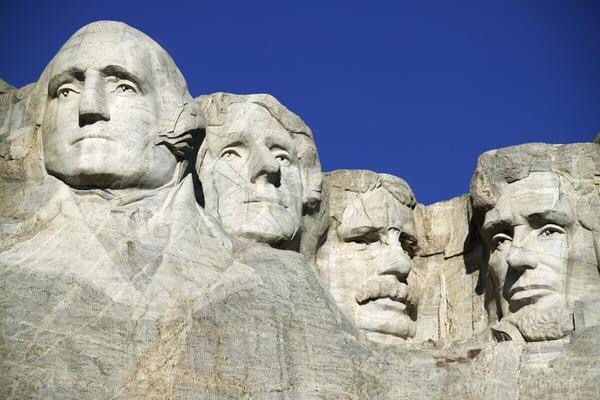
The Memorial at Mt. Rushmore is dedicated by President Calvin Coolidge.
The memorial wouldn’t be declared complete until October 31, 1941, seven months after the man in charge of it’s carving, Gutzon Borglum, had died. His son Lincoln finished the project.
President Washington was chosen for obvious reasons, having led the battles that created our nation;
President Jefferson was chosen due to his instrumental work in creating our Declaration of Independence, which has inspired Democracy around the world;
President Lincoln was chosen for leading the nation through the Civil War, preserving the Union and abolishing slavery;
Theodore Roosevelt was chosen for leading the nation through the industrial revolution of the late 19th century, seeing to the construction of the Panama Canal.
An interesting aside…Mt. Rushmore is named for a young NYC attorney who visited the area in 1884 to check land ownership for some eastern investors. He was impressed with the mountain and asked prospectors what it was called…they replied that it had no name, but since he had asked, they would call it Rushmore Peak…and so it was.
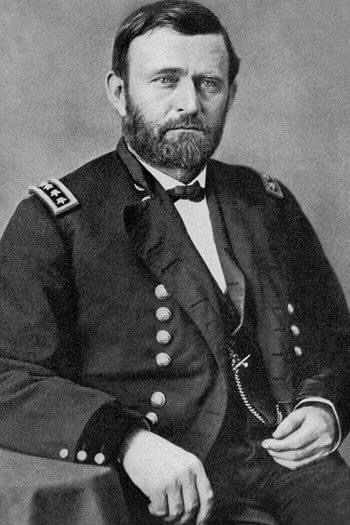
Congress creates the new rank of “General of the Army of the United States” specifically for the US Army’s commanding general, Ulysses S. Grant.
Typical of Grant’s unpretentious nature, he chose to signify the honor with a simple 4 star should board on his basic uniform.
Grant would hold the rank until elected President, at which time he was succeeded by William Tecumseh Sherman, who was succeeded by Phillip Sheridan. The rank died when Sheridan did in 1888, until WWII, when it was signified with 5 stars.
Sam had led a bit of a rough life. He saw great success, no doubt, but he was also an alcoholic. His father struggled with the demon for a time, and his grandfather had succumbed to it. In those days they didn’t realize it was often a family trait or a disease…it was simply a weakness. Sam had fought the demon his entire adult life. He was brilliant at is chosen profession. He quit it for a time because of his drinking and tried other jobs…farmer, realtor, shopkeeper…none worked out. As brilliant as he was, he had another weakness; he had a big heart and was much to quick to trust people with his money. So Sam spent most of his life broke.
Even with this, events in his life led him in a round about way to the pinnacle of success. He succeeded where others failed miserably due to his tenacity, his organizational skills and his ability to see the big picture. Yet through it all, no matter how much he achieved, his detractors never forgot, and certainly never let him forget, his demons.
Sam had made his fortune at last…but then, in his older years when there was little to no chance of building success anew, his other failure reared its ugly head again. The people he trusted with his money were scoundrels, and he found himself…and more importantly to him, his family, destitute once again.
Living on borrowed money, things got worse. One day while eating a peach his wife had given him, he felt as if he had been stung by something within it. He had no time for doctors and stubbornly toiled for months until the pain was unbearable to relent to his wife’s demands to see his physician. By then, it was too late. The mouth and throat cancer was advanced, and all that could be done was to provide him with pain killers until the end would come.
Sam’s father had been an inveterate braggart, a schemer and an incessant talker. It embarrassed Sam so that he became the exact opposite. Quiet and humble to a fault, it took everything he had to do what he had refused for years…to blow his own horn and tell his own story. But now it was the only way he could leave his wife and children with a means of support. So he threw himself into the task.
For over a year he wrote. He wore a muffler to cover the baseball sized tumor at his throat. Typical of his demeanor, he never complained of the excruciating pain that wracked him day and night…his family only saw him grimace from the pain when he was asleep and unable to hide it.
Sam worked with a purpose…he amazed his publisher by finishing 10,000 words in a day, written out. Mark couldn’t believe it…Mark was one of the most prolific story-telling authors of his time, and could never match Sam, who disliked the task of telling his own story. But now he had to…for his family…for his legacy because his old detractors were only too happy to repeat their own refrain, “See, we told you so.”
Fighting past the pain and past the fog of his medications, he toiled even when he could no longer write, and tortured himself to dictate his story to others.
Finally on July 16, 1885, Sam completed his autobiography. Mark had promised to publish it for a handsome price which would see to it that Sam’s family did not want for anything. It was suspected that Mark had ghostwritten the work…which he adamantly and angrily denied. His friend Sam had written the work…brilliant and surprising as usual.
Having won his last battle, he could let go now. Seven days later on July 23, 1885, Hiram Ulysses Grant, “U.S. Grant” due to an Army administrator’s error in his youth, Sam to his friends, a drunk to his detractors, an amazing horseman and hero of the Mexican-American War, General of the Army and President of the United States, passed from this earth.
Mark Twain saw that “The Personal Memoirs of U.S. Grant” was published and the family was treated fairly and well. Sam had found someone trustworthy this time. I’ve read General Grant’s memoirs, and they would be impressive if written by someone in perfect health. They are nothing less that heroic considering the suffering he endured during his final work.
I am fortunate to have what appears to be a 1st Edition of volume 1. Would love to find the matching volume 2! I’ve listened to the audible book.
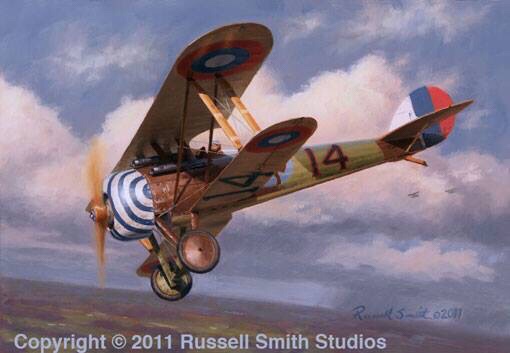
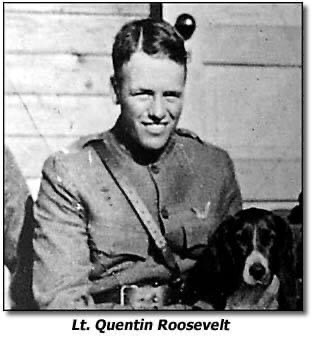
US Airman Quentin Roosevelt, youngest son of President Theodore Roosevelt, dies when he is shot down over France in WWI.
He and his brothers, who all served in WWI were very competitive in the voracity of their service, trying to live up to their father’s exploits…a father who also wanted to serve but was refused due to President Wilson’s fear that TR’s service might lead to a run for President in 1920. TR wouldn’t live that long…and he spent his last years heartbroken over the loss of his youngest son.
TR Jr. would die of a heart attack just weeks after leading his division in the Normandy invasion of 1944…again living up to his father’s legacy. A family of immense wealth; several generations of which dedicated their lives to service to their country.
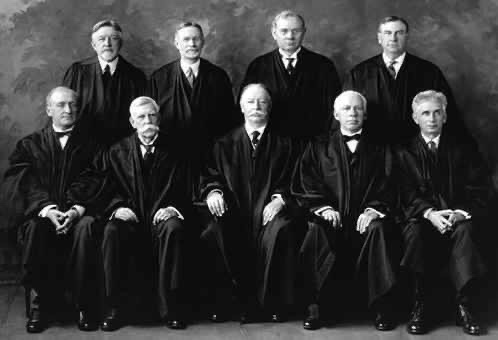
Former President William Howard Taft is sworn in as the 10th Chief Justice of the US Supreme Court, replacing the recently deceased Chief Justice that he himself had appointed when he was President.
It was Taft’s dream job, and he took to it enthusiastically. He would be the only person to be both President and Chief Justice, and therefore the only President to swear in other Presidents.
President Woodrow Wilson asks Congress for a Declaration of War.
“It is a war against all nations. American ships have been sunk, American lives taken, in ways which it has stirred us very deeply to learn of, but the ships and people of other neutral and friendly nations have been sunk and overwhelmed in the waters in the same way. There has been no discrimination. The challenge is to all mankind. Each nation must decide for itself how it will meet it.
The choice we make for ourselves must be made with a moderation of counsel and a temperateness of judgment befitting our character and our motives as a nation.
We must put excited feeling away. Our motive will not be revenge or the victorious assertion of the physical might of the nation, but only the vindication of right, of human right, of which we are only a single champion.”











 Mark Loves History!