“Dewey Defeats Truman”

Today in History, November 2, 1948:

“Dewey Defeats Truman”.

The Chicago Tribune is so confident that New York Governor Thomas Dewey will win the Presidential election that the paper publishes it’s desired results in an early edition…but Truman won by 2M votes.

Most sources will describe this as a solitary example of media bias, however in 2000 the media almost in it’s entirety called the election for Al Gore as Florida polls closed…several hours before the polls closed in the majority of the nation. Many voters, hearing the news as they drove home, decided there was no point in going to the polls. As it turned out, not even Florida could be declared for Gore at that point.

The media’s actions would send the nation into a legal limbo for weeks as the victor was determined in the courts. In the attached photo a victorious President Truman holds up the erroneous headline.

In 2016, the polls….and the media…reported it was nearly a forgone conclusion that Secretary Clinton would win.

Bill Tilghman

Today in History, November 1, 1924:

– This should make you Oklahoma proud. Law enforcement proud. THIS is what its all about: On this day, William Tilghman is murdered by a corrupt prohibition agent who resented Tilghman’s refusal to ignore local bootlegging operations. Tilghman, one of the famous marshals who brought law and order to the Wild West, was 71 years old.

Known to both friends and enemies as “Uncle Billy,” Tilghman was one of the most honest and effective lawmen of his day. Born in Fort Dodge, Iowa, in 1854, Tilghman moved west when he was only 16 years old. Once there, he flirted with a life of crime after falling in with a crowd of disreputable young men who stole horses from Indians. After several narrow escapes with angry Indians, Tilghman decided that rustling was too dangerous and settled in Dodge City, Kansas, where he briefly served as a deputy marshal before opening a saloon. He was arrested twice for alleged train robbery and rustling, but the charges did not stick.

Despite this shaky start, Tilghman gradually built a reputation as an honest and respectable young man in Dodge City. He became the deputy sheriff of Ford County, Kansas, and later, the marshal of Dodge City. Tilghman was one of the first men into the territory when Oklahoma opened to settlement in 1889, and he became a deputy U.S. marshal for the region in 1891. In the late 19th century, lawlessness still plagued Oklahoma, and Tilghman helped restore order by capturing some of the most notorious bandits of the day.

Over the years, Tilghman earned a well-deserved reputation for treating even the worst criminals fairly and protecting the rights of the unjustly accused. Any man in Tilghman’s custody knew he was safe from angry vigilante mobs, because Tilghman had little tolerance for those who took the law into their own hands. In 1898, a wild mob lynched two young Indians who were falsely accused of raping and murdering a white woman. Tilghman arrested and secured prison terms for eight of the mob leaders and captured the real rapist-murderer.

In 1924, after serving a term as an Oklahoma state legislator, making a movie about his frontier days, and serving as the police chief of Oklahoma City, Tilghman might well have been expected to quietly retire. However, the old lawman was unable to hang up his gun, and he accepted a job as city marshal in Cromwell, Oklahoma. Tilghman was shot and killed while trying to arrest a drunken Prohibition agent.

“Boo!! America!!

Today in History, October 30: 1938 – “The War of the Worlds”. For Halloween, Orson Welles had produced a radio show based on a nineteenth century novel by H.G. Wells. After a disclaimer preceding the show, it was designed as if the events were actually occurring, as if newsmen were reporting an actual invasion of the Earth by Martians….

Unfortunately, most Americans were listening to another popular radio show as The War of the Worlds began, and tuned in AFTER the disclaimer. As many as a million people thought they had actually tuned into coverage of aliens landing and assaulting the planet. The show described people all over the country fleeing in terror; which actually did occur since so many thought it was real. Part way through the show, Welles was informed of the mass panic and interrupted the show with another disclaimer….”This is Orson Welles, ladies and gentlemen, out of character to assure you that The War of The Worlds has no further significance than as the holiday offering it was intended to be: the Mercury Theatre’s own radio version of dressing up in a sheet and jumping out of a bush and saying “Boo!” Starting now, we couldn’t soap all your windows and steal all your garden gates by tomorrow night, so we did the best next thing. We annihilated the world before your very ears, and utterly destroyed the C. B. S. You will be relieved, I hope, to learn that we didn’t mean it, and that both institutions are still open for business. So goodbye everybody, and remember, please, for the next day or so the terrible lesson you learned tonight: that grinning, glowing, globular invader of your living room is an inhabitant of the pumpkin patch, and if your doorbell rings and nobody’s there, that was no Martian — it’s Halloween.”

It was 1938. Unfortunately, within a year, the world would find the horrors they imagined were all too real; but they didn’t need aliens in WWII.

Halsey Takes Command – Its All About Attitude

Today in History, October 18, 1942:

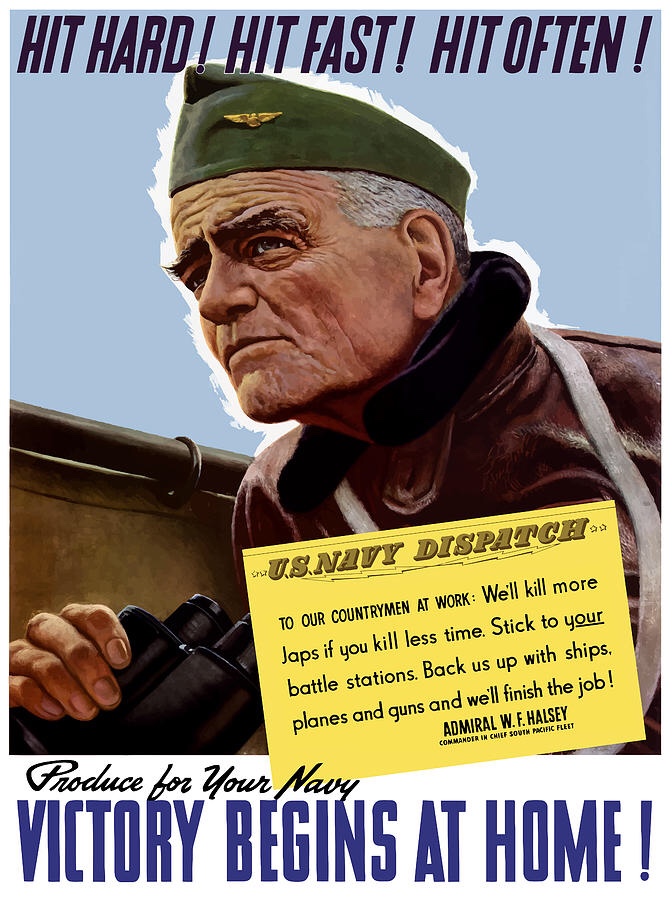
Vice Admiral William “Bull” Halsey is named commander of the South Pacific forces.

Things had not been going well after the invasion of Guadalcanal; a series of losses due to indecision by the previous commander, Admiral Ghormley, had left the troops demoralized.

CINCPAC (Commander in Chief, Pacific) Chester Nimitz knew the man for the job and appointed Halsey. Halsey was a no nonsense, get er done leader.

He had issued orders to his task force to shoot first and ask questions later if they spotted Japanese ships or aircraft…on November 28, 1941, ten days before the Japanese attack at Pearl Harbor.

He was famously quoted as saying, “Before we’re done with ’em, the Japanese language will be spoken only in hell.” His operational order for his command was simple: “Kill Japs, Kill Japs, Kill more Japs!” In retrospect, this attitude made be considered harsh or even racist. But during the largest conflict in human history, it was all about winning.

The demoralized Sailors and Marines serving on and around Guadalcanal had a sudden burst of confidence when they heard Halsey was their new boss. Things turned around almost immediately. The people under Halsey’s command knew he was willing to take chances for them, and they returned the sentiment.

Harper’s Ferry

Today in History, October 16, 1859:

Abolitionist John Brown leads a small group of followers on a raid of the US Army Armory in Harper’s Valley, Virginia. Brown planned to seize the weapons in the armory and start an insurrection. He believed he would be sparking a firestorm of slaves and abolitionists around the country to end slavery.

However local militia grabbed their weapons and responded quickly, surrounding the armory. A contingent of US Marines led by US Army Colonel Robert E. Lee and Lt. JEB Stuart arrived and attacked the armory, killing several of the raiders and arresting a wounded Brown. Brown was hanged on Dec. 2nd of the same year.

It may not have happened as he envisioned, but within months of the raid at Harper’s Ferry, the nation would be in the midst of a Civil War that would result in his goals being achieved.

The men that led the contingent that arrested him would be Confederate leaders. John Brown’s legacy would include an inspirational marching song that would be come immensely popular in the North, entitled “John Brown’s Body”. The ballad would have many versions, but the final song matched to the tune would become “The Battle Hymn of the Republic”.

The Mighty Eighth

Today in History, October 14, 1943:

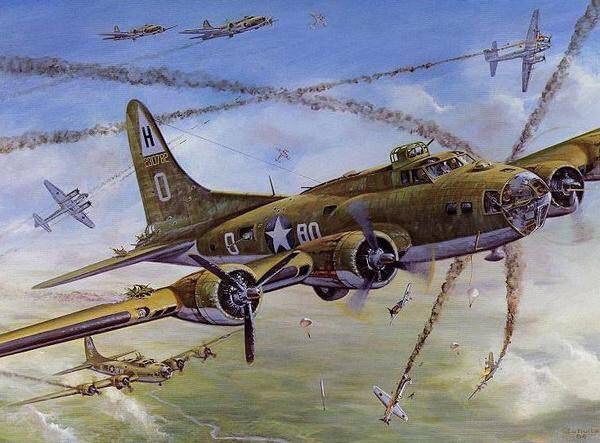
During it’s Second Raid on Schweinfurt, Germany’s ball bearing plants, the Mighty US Eighth Air Force loses SIXTY B-17 Flying Fortress bombers to German fighters and anti-aircraft fire.

That number becomes more ominous when you know that each aircraft had at least a 10 man crew, meaning that 600 airmen either lost their lives or were captured that day. Many don’t realize that the casualties of the Eighth Air Force over Europe accounted for more than half of the losses for the entire US Army Air Corps, and at over 26,000 dead, surpassed the horrific losses of the US Marine Corps during the war by far…the USMC having lost almost 18,000 dead in the bitter battles in Pacific Islands.

Today in History, October 11, 1986:

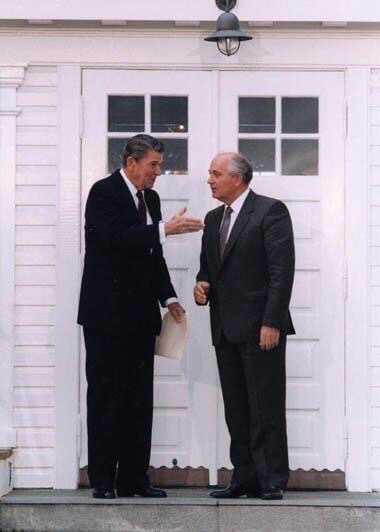
President Reagan meets for the second time with Soviet leader Mikhail Gorbachev at Reykjavik, Iceland to discuss limitations on nuclear missiles. The Russian attempted to add “SDI” or the Strategic Defense Initiative, or “Star Wars” to the discussion. SDI was a planned space based missile shield that would make America impervious to nuclear missile attack.

Reagan, knowing the supposed defense system gave the US an incredible strength in the negotiations, refused. While they came away from Iceland empty handed, Reagan’s poker face worked. The next year in DC the two leaders came to an agreement on missile reduction. The USSR was on it’s way out.

Peace in Space?

Today in History, October 10, 1967:

The Outer Space Treaty between the US, Great Britain, the USSR and others goes into effect. The treaty committed the signatories to not placing weapons of mass destruction in space or on the moon and other celestial bodies, for use or storage. Also that nations would not lay claim to celestial bodies, as they were the property of al mankind. Dr. No or Moonraker, Mr. Bond?