The Birth of Naval Aviation. Samuel Langley and Theodore Roosevelt Together Again…

530155_2490408238323_104830550_n

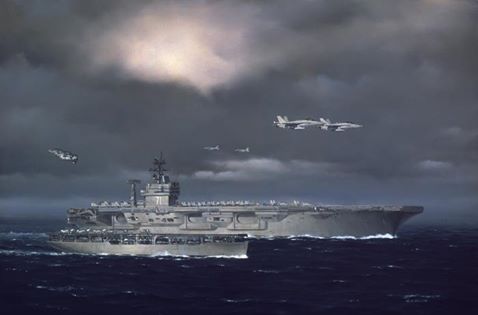
Today in History, March 25: 1898 – Assistant Secretary of the Navy Theodore Roosevelt (that crazy cowboy) proposes that the Navy investigate the use of a flying machine being researched by Samuel Langley. As a result, congress authorized $50,000 to support Langley’s design. This was nearly a decade before the Wright Brothers accomplished the first manned, powered flight, but many people had been working on the challenge for years. Langley’s, and Roosevelt’s insight was the beginning of US Naval Aviation. Check out this print by R.G. Smith, which portrays the 1st US aircraft carrier, the USS Langley (CV 1), and the nuclear powered aircraft carrier USS Theodore Roosevelt (CVN 71) cruising together. Of course this is inspired imagination…Langley, converted to a sea plane tender, was lost in WWII.

The Langley was converted from the Collier USS Jupiter in 1920. By WWII she had been converted to a seaplane tender, her larger subsequent sisters taking on the aircraft carrier role. Attempting to deliver p-40 fighter planes to Java, on February 27, 1942 she was attacked by Japanese aircraft and damaged so badly she had to be scuttled.

Give Me Liberty, or Give Me Death!

Today in History, March 23: 1775 – “Is life so dear, or peace so sweet, as to be purchased at the price of chains and slavery? Forbid it, Almighty God! I know not what course others may take; but as for me, GIVE ME LIBERTY, OR GIVE ME DEATH!” Patrick Henry implores his fellow legislators at the Virginia Convention for separation from England. Henry, the son of Scottish immigrant, had failed at business twice before becoming a successful lawyer. He became part of the Virginia legislature and soon became a talented politician. Considered one of the Founding Fathers, he risked his life to see America free. After freedom was won, he was an ardent opponent to the federalist system, believing any affront to states rights would destroy individual rights.

Uncle Sam Finds His Stride…


Today in History, March 13: 1852:

The first cartoon image of Uncle Sam appears in “The New York Lantern” newspaper, drawn by cartoonist Frank Henry Bellew. Uncle Sam had been used to represent the US Government for years, becoming most popular during the War of 1812, but Bellew’s was the first cartoon to portray him. The cartoon was critical of the US government, expressing that “John Bull” (representing the British government) was helping the US shipping industry while Uncle Sam stood by and did nothing for the industry. The use of Uncle Sam became popular when Samuel Wilson, who provided meat products to the military during the War of 1812. He stamped the products with “US” for United States. However when someone asked a worker what it stood for, the reply was “Uncle Sam” (for Sam Wilson). The moniker stuck.

“You May Cast Off, Buck, When You Are Ready.”

ron5-3MacArthur's_Escapept32220px-USS_Olympia_with_Dewey_at_Battle_of_Manila_bay_DSCN4191_at_Vermont_Statemanila bay


Today in History, March 11, 1942:

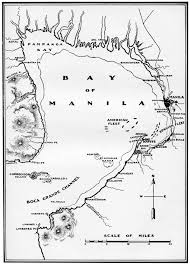
General Douglas MacArthur is evacuated from the Philippines at the order of President Franklin Roosevelt.  At the beginning of WWII the previous December the Japanese had invaded the Philippines; the American and Filipino forces, commanded by MacArthur, had been fighting off persistent advances ever since.  At the outset the American air forces had been almost completely destroyed on the ground, caught by surprise by the initial attacks.  Now they had been backed up to the peninsula of Bataan, and in the middle of the bay, the island of Corregidor.

General MacArthur was already quite famous when the war began; his father Arthur was also a noted American general, Douglas served in WWI and was in command in Washington, DC when protesting WWI veterans were dispersed during the Depression.  He and his father would become the first father and son to be awarded the Medal of Honor.

American morale was already suffering, and the President did not want an additional blow of MacArthur being taken prisoner when the Philippines fell, which was a foregone conclusion at this point.  So he ordered MacArthur to evacuate to Australia, leaving General Jonathan Wainwright in command of the fall.

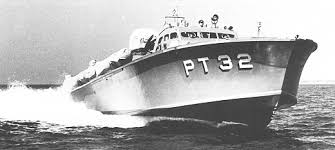
MacArthur had the choice to leave by submarine, aircraft, or by PT (patrol torpedo) boat.  He knew and trusted the commander of PT squadron 3, Lieutenant John D. Bulkeley, so he chose to leave by boat.

On the evening of March 11, 1942, Lt. Bulkeley’s PT-41 was alongside the north pier at Corregidor with General MacArthur and his family aboard, when the General looked to the Lieutenant and said, “You may cast off, Buck, when you are ready.”  Thus began a 600 mile run to Mindanao through minefields and enemy infested waters which MacArthur would later liken to a ride in a cement mixer.  Almost everyone was seasick.  Bulkeley would meet up with the remainder of his PT squadron, their decks filled with gasoline drums so they could make the trip.  It was a harrowing journey; from Mindanao MacArthur and his staff would continue the journey by air.

The journey, how it came to be, and it’s aftermath are all worth more detail.  But for this post, I can’t help but focus on MacArthur’s words as he set sail from his defeat in Manila Bay…

“You may cast off, Buck, when you are ready.”

General MacArthur was an intelligent, educated man, a West Point graduate and a fast climber through the ranks.  What was in his mind as he escaped one of the worst military defeats in American history that day?  The MacArthur family was also already a significant part of Philippine history.  Nearly forty-four years earlier, in 1898 during the Spanish-American War, Arthur MacArthur had been victorious during the Battle of Manila.  He would then command during the Philippine-American War and become the Military Governor General of the Philippines until he got sideways when the Civilian Governor of the Philippines, William Howard Taft.

At the outset of the Spanish-American War, the Philippines were a Spanish possession.  The war was significant because with it, America would become a player on the world stage, defeating one of the European colonial powers.

With the Battle of Manila Bay on May 1, 1898, the US Navy would show it’s mettle in easily defeating the Spanish fleet stationed there.  Admiral George Dewey commanded the US Asiatic Fleet from the bridge of his flagship, the USS Olympia.  As they approached the Spanish ships, Dewey spoke a now famous phrase to the commander of the Olympia, Captain Charles Gridley…

“You may fire when ready, Gridley.”

To enter Manila Bay from the South China Sea, Admiral Dewey and his fleet would have sailed past the island which guarded the entrance to the bay, Corregidor.  Hours before his famous victory, Admiral Dewey would have sailed within a few hundred yards of where MacArthur would stand in 1942, having lost all Dewey had gained.  In his mind’s eye, was he watching the Olympia pass by?

“You may cast off, Buck, when you are ready.”
Historic Connections: Lincoln-Hay-Roosevelt

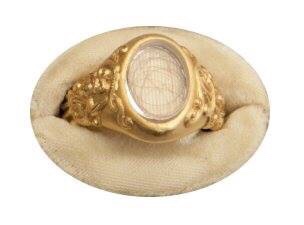
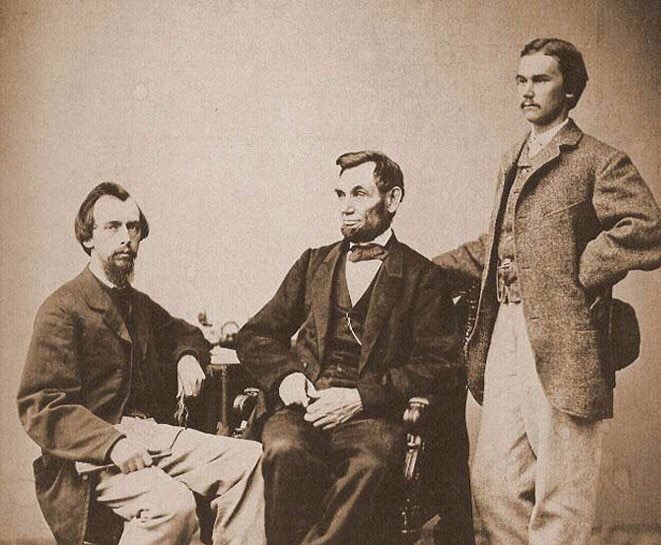
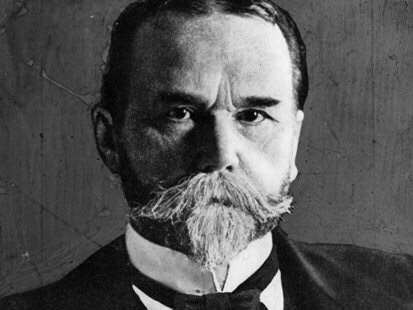
Today in History, March 4: 1861 (Lincoln Inauguration) / 1905 (Theodore Roosevelt Inauguration) – A very special connection between two Presidents, 40 years apart. As a young man in Illinois, John Hay got the chance of a lifetime. His friend John Nicolay was working at the law firm of Abraham Lincoln, Presidential candidate. When Lincoln was elected, Hay and Nicolay became his private secretaries in the Executive Mansion and became his confidants…he would stay up nights sharing stories with them and came to trust them; they helped to keep him balanced through the trials and tragedies of the Civil War. They, in turn nearly idolized him, referring to him as the Ancient One. When Lincoln was assassinated it devastated Hay. He recovered and went on to serve in numerous posts within the government, including the Ambassador to the Court of St. James (England); he was a successful author and journalist (remarkably understated..but I must keep this somewhat brief). He served several other presidents, becoming Secretary of State for President William McKinley. When McKinley was assassinated, Hay stayed on to serve in Theodore Roosevelt’s administration. He was largely responsible for the Open Door Policy in China and negotiated the Hay–Bunau-Varilla Treaty to build the Panama Canal. He initially thought TR a rogue cowboy, but as he grew to respect the President, they became fast friends. TR came to respect Hay’s experience and wisdom, and came to depend upon him. The night before TR was to be inaugurated for his second term, his first in which he was elected, John Hay sent TR a gift. A ring containing a strand of President Lincoln’s hair under glass, taken during his autopsy. Hay included a note:

“Dear Theodore:

The hair in this ring is from the head of Abraham Lincoln. Dr. Taft cut it off the night of the assassination, and I got it from his son-a brief pedigress.

Please wear it tomorrow; you are one of the men who most thoroughly understand and appreciate Lincoln.

I have had your mongram and Lincoln’s engraved on the ring.

Longas, O utiman, bone dux, ferias, Praestes Hesperia.

(Mayest thou, Good Captain, give long holiday to Hesperia!)

Yours affectionately, John Hay”

TR replied:

“Dear John, Surely no other President, on the eve of his inauguration, has ever received such a gift from such a friend. I am wearing the ring now; I shall think of it and you as I take the oath tomorrow. I wonder if you have any idea what your strength and wisdom and sympathy, what the guidance you have given me and the mere delight in your companionship, have meant to me these three and a half years?

With love and gratitude, Ever yours….”

What a life! A integral part of the story of two of our best presidents, and a key player in numerous historic decisions and events. Aside from the photos of the ring, there are photos of Hay in his youth, as an older man (he would die later in 1905), and even the photo of Lincoln’s funeral procession through New York City is important…in a window of one of the buildings to the left are two small boys watching the procession go by…young Theodore Roosevelt, Jr and his brother Elliott.

A Five and Dime Pioneer

Today in History, February 22, 1878:

Frank W. Woolworth opens his first store in Utica, New York.  The venture would fail, but Frank did not give up.  He and his brother would open another store in Lancaster, Pennsylvania.  Their marketing, customer service and business practices would be the model for the modern shopping experience.

As with many other pioneers in retail, Woolworth stores eventually went out of business, although they have reinvented themselves elsewhere.  Woolworth stores still exist in other countries around the world.

Mesa Verde Cliff Dwellings – The Antiquities Act


Today in History, December 18: 1888 –

Rancher Richard Wetherill and his brother-in-law Charles Mason, with the help of Ute guide Acowitz “discover” some of the Cliff Dwellings in the canyons of the Mesa Verde area of Southwest Colorado.  The Wetherills were certainly not the first to discover the hundreds of amazing ancient homes built into the protection of the cliffs centuries earlier.  However they did persist in a campaign to institute Federal protection of the sites.  The Wetherills were fearful that tourists and vandals would loot and destroy the sites.

Archaeologists tell us ancient Native Americans made the Cliff Dwellings their home for over seven hundred years before moving away within a two generations in the thirteenth century.  As a reference, elsewhere in the world the Mongols were conquering Asia and the seventh Crusades were occurring.

The Wetherill family spent years exploring the canyon dwellings, collecting hundreds of artifacts which now reside in museums.  Unfortunately much of the vandalism did occur and Swedish scientist  Baron Gustaf E. A. Nordenskiöld mapped and collected many artifacts, taking them back to Sweden before the American government acted to protect the site.

After years of pressure from the Wetherill family and many others, and four unsuccessful attempts, Congress finally passed a bill creating the Mesa Verde National Park, which President Theodore Roosevelt signed into law.

In the same month in 1906, Congress passed and President Roosevelt signed into law “An Act for the Preservation of American Antiquities”, or “The Antiquities Act”, inspired to protect sites such as Mesa Verde and others for generations to come.  TR made great use of the Antiquities Act to set aside Historic sites for preservation.

The law has been in the news lately as President Trump dialed back the extent of land set aside by Presidents Clinton and Obama at Bears Ears and Grand Staircase National Monuments.

According to the National Parks Conservation Association, the have been 157 National Monuments designated by 16 Presidents since President Theodore Roosevelt enthusiastically named 18 sites during his terms as Chief Executive.

All We Are Now Began Long Ago…

Today in History, March 5: 1496 – English King Henry VII issues letters patent to Italian navigators John Cabot (Giovanni Caboto) and his son Sebastian, sponsoring them for explorations. “…free authority, faculty and power to sail to all parts, regions and coasts of the eastern, western and northern sea, under our banners, flags and ensigns, with five ships or vessels of whatsoever burden and quality they may be, and with so many and with such mariners and men as they may wish to take with them in the said ships, at their own proper costs and charges, to find, discover and investigate whatsoever islands, countries, regions or provinces of heathens and infidels, in whatsoever part of the world placed, which before this time were unknown to all Christians.” John would find Newfoundland in North America, initiating future settlements in North America. The Vikings and Columbus came before the Cabots, but their explorations bore fruit for England.