“Johnny Get Your Gun!”

Mark Mears 1918 – Famous Opera Singer Enrico Caruso records “Over There”, a patriotic song written by George M. Cohan for the First World War…..Verse 1

Johnny,[2] get your gun, get your gun, get your gun.

Take it on the run, on the run, on the run.

Hear them calling you and me,

Every Son of Liberty.

Hurry right away, no delay, go today.

Make your Daddy glad to have had such a lad.

Tell your sweetheart not to pine,

To be proud her boy’s in line.

Verse 2

Johnny, get your gun, get your gun, get your gun.

Johnny, show the “Hun”[3] you’re a son-of-a-gun.

Hoist the flag and let her fly

Yankee Doodle[4] do or die.

Pack your little kit, show your grit, do your bit.

Yankee[5] to the ranks from the towns and the tanks.[6]

Make your Mother proud of you

And the old red-white-and-blue[7]

Chorus

Over there, over there,

Send the word, send the word over there

That the Yanks are coming, the Yanks are coming

The drums rum-tumming everywhere.

So prepare, say a prayer,

Send the word, send the word to beware –

We’ll be over, we’re coming over,

And we won’t come back till it’s over, over there. http://youtu.be/uIr-FoBW5Xw

A Day of Battles


Today in History, July 1: A day for important battles. 

 1863 – The Union and the Confederates first clash at The Battle of Gettysburg, and both send reinforcements. The first day went badly for the Union, but the largest battle in North America had three more days to go, and would become a major turning point in the Civil War. 

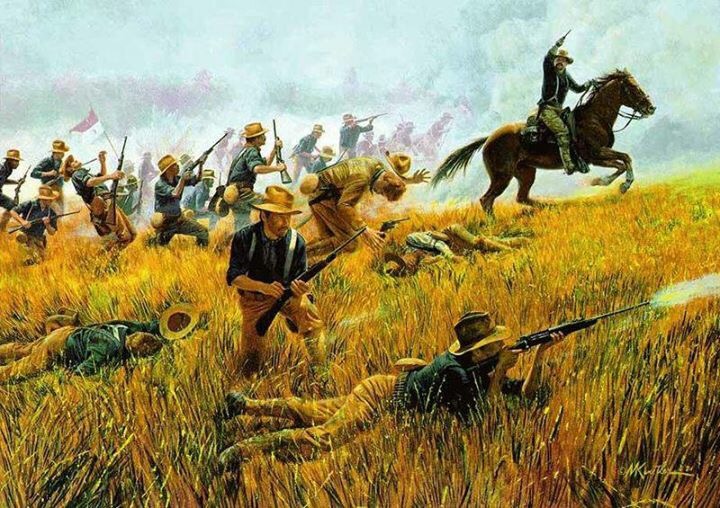
 1898 – The Battle of San Juan Hill becomes a major victory for the US in the Spanish-American War as the US Army’s Fifth Corps takes the heights over Santiago de Cuba. It also set the stage for Colonel Theodore Roosevelt to become President as he became famous for leading his Rough Riders up Kettle Hill (not San Juan). 

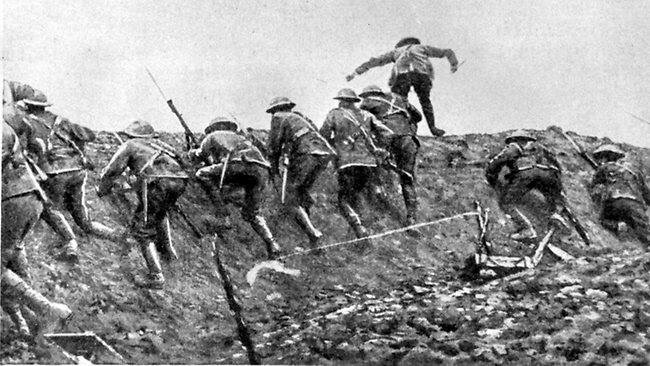
 1916 – The Battle of the Somme in France; after a week’s bombardment with over 250,000 shells, the British launch an attack into no-man’s land. The Germans had retained many machine guns despite the bombardment, and the British soldiers were slaughtered. With 20,000 dead and 40,000 wounded in one day, it was one of the worst defeats for the British military’s history. 

 1942 – The Battle of El Alamein; In North Africa Erwin Rommel’s army had routed the British and their allies, driving them back so quickly that they had to leave much of their equipment behind. But on today’s date the British Army, resupplied by Americans and reorganized, turned the tide back on Rommel at El Alamein.

William Jennings Bryan


Today in History, June 9: 1915 – William Jennings Bryan, US Secretary of State, resigns. After a German U-Boat had torpedoed a British passenger ship, the Lusitania, resulting in the deaths of 128 Americans, Bryan sent a conciliatory, almost apologetic message to the German government without President Wilson’s consent. Germany felt impowered and issued an aggressive statement, to which Wilson replied in kind, leaving little doubt that America would not tolerate the sinking of non-combatants. Germany backed off, for a time, and Bryan resigned in protest, believing Wilson was leading the nation towards war. Bryan had been an impressive orator, 3 times a candidate for president, and L. Frank Baum’s inspiration for the Cowardly Lion of the Wizard of Oz in 1900.

In Flanders Fields

Today in History, May 3: 1915 – The day after one of his closest friends is killed during the Second Battle of Ypres, Canadian Lt. Col. John McCrae writes the iconic poem In Flanders Fields while sitting in the back of an ambulance. Disatisfied, he crumpled it up and threw it away. It was retrieved by one of his squadmates, who convinced him to publish it. 
In Flanders Fields the poppies blow 

Between the crosses row on row, 

That mark our place; and in the sky 

The larks, still bravely singing, fly 

Scarce heard amid the guns below.
We are the Dead. Short days ago 

We lived, felt dawn, saw sunset glow, 

Loved and were loved, and now we lie 

In Flanders fields.
Take up our quarrel with the foe: 

To you from failing hands we throw 

The torch; be yours to hold it high. 

If ye break faith with us who die 

We shall not sleep, though poppies grow 

In Flanders fields.

Death From Afar Before the Age of Rockets & Missiles

Today in History, March 23: 1918 – At 7:20 AM the peace in Paris, France was shattered by an artillery barrage. The fire was from a new weapon designed by the Germans, the “Pariskanone”, a 210mm cannon with a 118 ft long barrel. The gun could fire a shell to an altitude of 25 miles; the cannons bombarding Paris were firing from safety 74 miles away. By the end of the assault on August 9, 260 Parisians had been killed.