Carpathia – History Connections

Today in History, July 17, 1918:

Crossing paths in history.

As most know, on April 12, 1912, RMS Titanic struck an iceberg and sank within 4 hours.

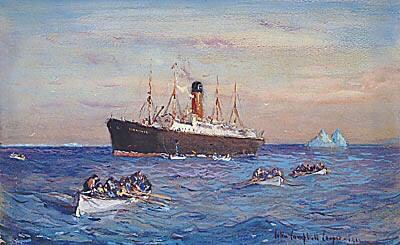
The nearest ship to receive her distress signal was the RMS Carpathia, which sped at full speed for two hours to the disaster scene. Upon her arrival, she rescued 705 survivors from the freezing waters of the North Atlantic.

The Carpathia’s crew became heroes, being awarded medals. Her Captain, Arthur Henry Rostron, was knighted and was a guest of President William Taft in the White House.

During WWI the Carpathia served as a troop ship, transporting thousands of American soldiers across the Atlantic to the war in Europe.

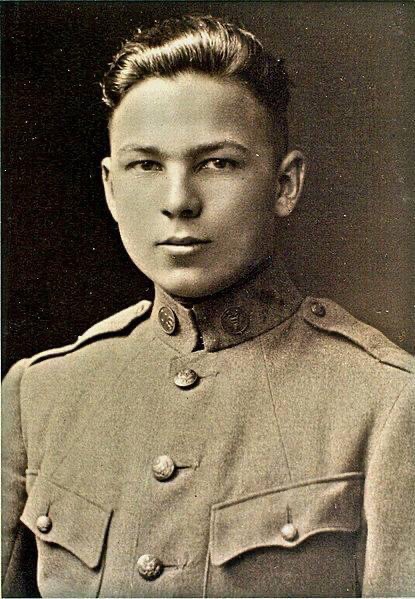
One of those doughboys was Frank Buckles, who would become the last surviving American Soldier from WWI before his death in 2011.

He was a prisoner of war in the Philippines during WWII (as a civilian) and a strong advocate for a WWI Memorial, which…led him to be a guest of President George W. Bush in the White House.

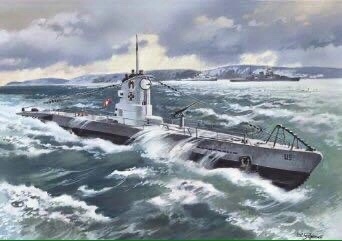
On this date in 1918 the Carpathia was sunk by German U-Boat U-55. All but 5 of her crew managed to escape to lifeboats.

They were in turn saved by the Sloop HMS Snowdrop, which arrived and drove off the German sub before it could machine gun the crew in their boats.

Everything is connected in history…you just have to find it. We usually know only a snippet of people’s lives. But they normally touch so much more.

Also on this date, in 1763, John Jacob Astor was born in Germany. He would immigrate to America and become America’s first millionaire. His grandson, John Jacob Astor IV, the world’s richest man, would die during the Titanic disaster.
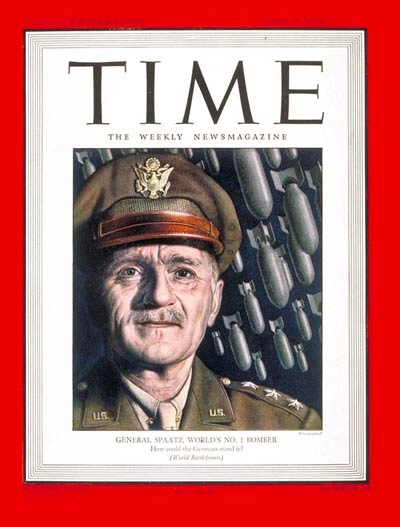
Gen. Carl Spaatz dies

Today in History, July 14, 1974:

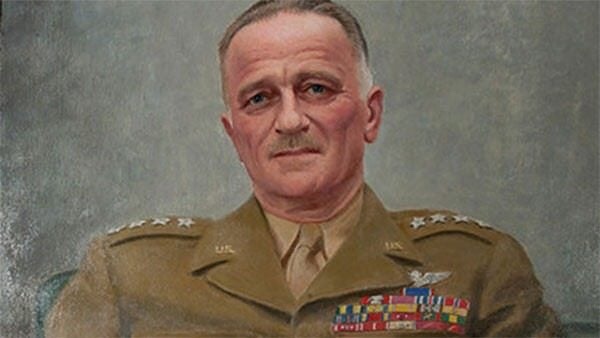
General Carl Spaatz dies.

Spaatz was a fighter pilot in his youth during WW1.

He remained in the Army Air Corps, and when WW2 began went to England.

As German bombs fell and everyone else ran for the shelters, Spaatz sat on rooftops to gain knowledge of German tactics.

When America entered the war, he became the commander of the Eighth Air Force as it began daylight bombing raids over Germany.

After the war, the Army Air Corps was separated from the US Army and became its own military branch, the US Air Force. Spaatz was it’s first Chief of Staff.

A Day for Historic Battles

Today in History, July 1:

A day for historic battles.

1863 – The Union and the Confederates first clash at The Battle of Gettysburg, and both send reinforcements. The first day went badly for the Union, but the largest battle in North America had three more days to go, and would become a major turning point in the Civil War.

1898 – The Battle of San Juan Hill becomes a major victory for the US in the Spanish-American War as the US Army’s Fifth Corps takes the heights over Santiago de Cuba. It also set the stage for Colonel Theodore Roosevelt to become President as he became famous for leading his Rough Riders up Kettle Hill (not San Juan).

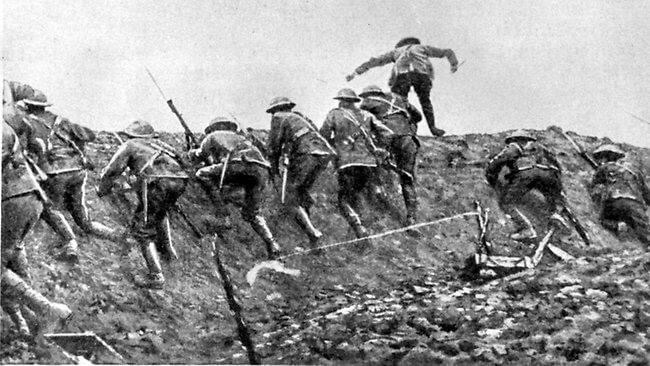
1916 – The Battle of the Somme in France; after a week’s bombardment with over 250,000 shells, the British launch an attack into no-man’s land. The Germans had retained many machine guns despite the bombardment, and the British soldiers were slaughtered. With 20,000 dead and 40,000 wounded in one day, it was one of the worst defeats for the British military’s history.

1942 – The Battle of El Alamein; In North Africa Erwin Rommel’s army had routed the British and their allies, driving them back so quickly that they had to leave much of their equipment behind. But on today’s date the British Army, resupplied by Americans and reorganized, turned the tide back on Rommel at El Alamein.

Hellcats!

Today in History, June 26, 1942:

A new Navy fighter, the F6F Hellcat, flies for the first time.

When WWII started, the F4F Wildcat was the primary Navy fighter. Both built by Grumman, the cats served their pilots well.

The Wildcat was too slow and ungainly to compete with the Japanese Zero well, but it held it’s own. It was so well built that it was hard to knock out of the Pacific skies, and it’s weight made it better in a dive.

Grumman took it’s advantages and improved on it with the Hellcat, which was just as tough but faster than the Zero, and armed with 6 .50 cal. machine guns.

The Hellcat and the F4U Corsair would sweep the Pacific of Japanese air power. But the Hellcat would hold the title…having downed 5,271 enemy aircraft, she holds the title for destroying more enemy aircraft than any other fighter type.

Bud Wilkinson’s Winning Streak…Owed to 3 Feet and a Few Seconds

TODAY IN HISTORY, JANUARY 2, 1956:

The University of Oklahoma Sooners win at the Orange Bowl.

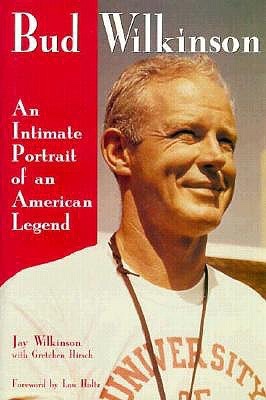
30 games into a historic 47 game winning streak, legendary OU football coach Bud Wilkinson led his team to victory at the Orange Bowl. Wilkinson set the standard for the program.

All of that very nearly never happened.

Wilkinson had been part of several football victories in Minnesota during the thirties.

When Japan bombed Pearl Harbor, Bud did what many American heroes did, he put his life on hold and joined up. In his case, it was the U.S. Navy.

So it was that Bud became a member of yet another legendary team. The crew of the USS Enterprise had earned 20 Battle Stars during the war.

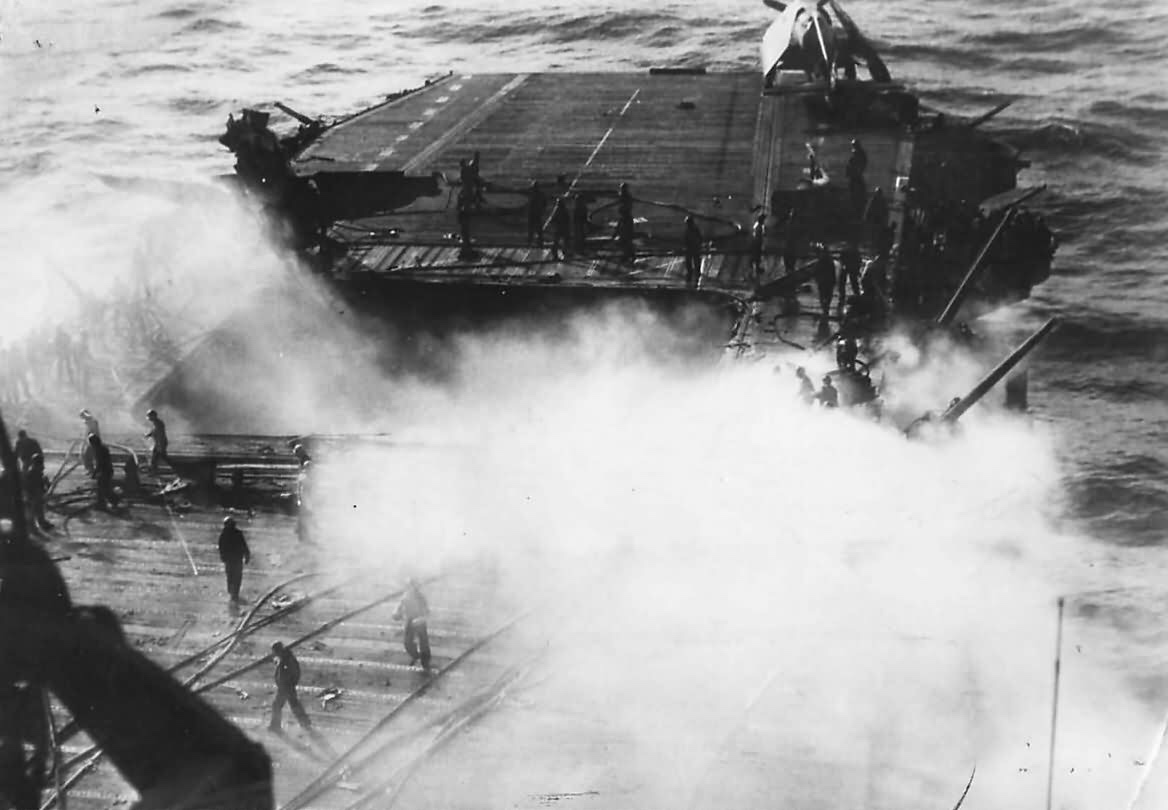
On May 14, 1945, Lieutenant Charles “Bud” Wilkinson was the Hangar Deck Officer. The Big E was maneuvering violently to avoid an onslaught of Kamikaze planes off the coast of Japan. Finally one of the suicide planes got through, and crashed into the flight deck just aft of the forward aircraft elevator. The explosion sent a large part of the 15 ton elevator 400 feet into the sky. Fourteen men were killed, 60 wounded.

The hangar deck was devastated, 25 aircraft aboard were destroyed.

Lt. Wilkinson happened to be standing on the opposite side of a girder from the blast…by Bud’s reckoning, had he been three feet closer to the explosion, he would have been killed. (Barrett Tillman, “Enterprise”, 2012)

How many Bud Wilkinsons did we lose? And how many owe their success in life to a matter of seconds which saved the coach’s life that day?

Bud Wilkinson would begin his OU odyssey two years later, leading the program from 1947 to 1963.

Kristallnacht…The Night Of Broken Glass

Today in History, November 9, 1938:

Kristallnacht…the Night of Broken Glass.

In order to direct Germany in the direction they wanted, the Nazis believed that they had to give the people someone to blame, someone to hate, for their misfortunes. The Jewish people of Germany and Austria were the perfect targets.

The Nazis used the murder of a low level diplomat in Paris as an excuse.

Hitler ordered storm troopers to ACT as if they were citizens angered by the murder and to vandalize and destroy Jewish businesses, thus “The Night of Broken Glass” from the broken windows.

Many Jews were killed and 30,000 men were arrested and sent to concentration camps. They were released if they promised to leave Germany….100,000+ did so. Kristallnacht would eventually lead to the Holocaust, during which 6,000,000+ Jews were killed in the Nazis attempt at genocide.

Familiar?

Casus Belli

Today in History, August 31, 1939:

Casus Belli: : an event or action that justifies or allegedly justifies a war or conflict

“I will provide a propagandistic casus belli. Its credibility doesn’t matter. The victor will not be asked whether he told the truth.”

— Adolph Hitler.

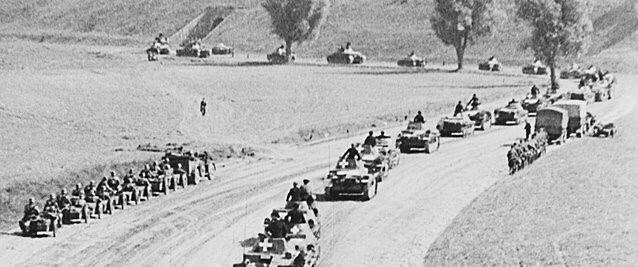
The Gleiwitz incident, an assault on a German radio station near the border with Poland, as part of Operation Himmler, takes place.

The assault was conducted by GERMAN SS troops, posing as Polish troops, upon a German radio station. The ruse went so far as to leave Polish prisoners, captured previously, dead at the station as “proof” of the assault.

The next day, already prepared, German troops invaded Poland in “response” to the atrocity.

Thus began the conflict which would cost millions of military and civilian peoples of many nations their lives. In a real sense, WWII had been raging in Asia and through limited German actions already, but September 1, 1939 is considered the beginning.

The victors will not be asked whether they told the truth. Unfortunately this is usually accurate, similar to “to the victor go the spoils” and “the victors write the history books.”

Either contemporaries are actually trusting, or to fearful the wolf will turn on them, to act.

We should remember our history. We are MERELY human, and always shall be. It is arrogance to believe we will not achieve the same mistakes.

The Ship That Would Not Go Gentle Into That Good Night

Today in History, July 31, 1948:

The USS Nevada was the first “dreadnaught” or battleship, to use oil rather than coal for fuel, the first to use the later standard 3 main gun turrets.

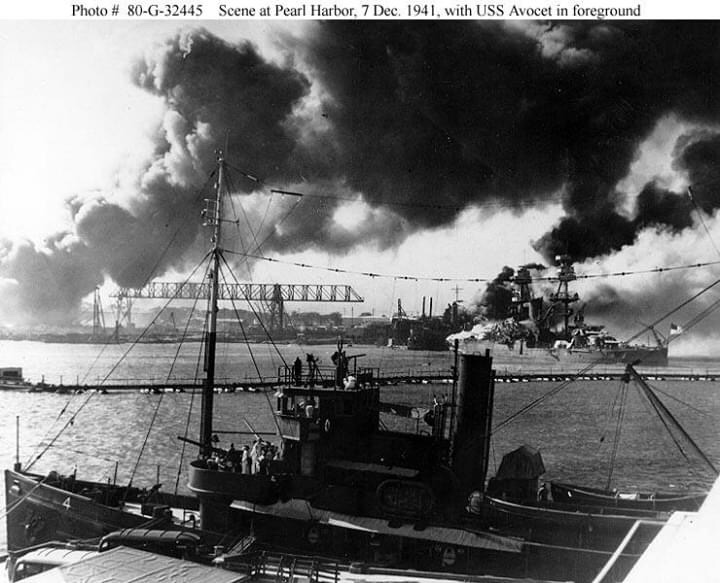
Commissioned in 1914, she would serve in WWI and WWII. At Pearl Harbor, she was the only battleship on “battleship row” to get underway. Her executive officer, who was in charge in the Captain’s absence, made the wise decision to beach her at Hospital Point, as she had taken six bombs and a torpedo; had he continued his attempt to gain the sea, the massive ship could have sunk in the channel leading to the harbor, trapping other ships either in or out of Pearl Harbor.

She would be repaired and would serve in both the Atlantic and Pacific Theaters, at Normandy and Okinawa.

One of these photos shows her with the only remaining battleship to have served in both WWI and WWII, the USS Texas (visit her in Houston).

The obsolete warrior would be used for atomic testing at Bikini Atoll, being the subject of two atomic bomb tests.

She still would not quit, and had to be sunk with aerial torpedoes. Her only sister ship was not so fortunate. The USS Oklahoma capsized at Pearl Harbor, then sank while being towed back to the states for repair.

Just this year, the Nevada was located 65 miles southwest of Pearl Harbor on the ocean floor.

General of the Army of the United States

Today in History, July 25, 1866:

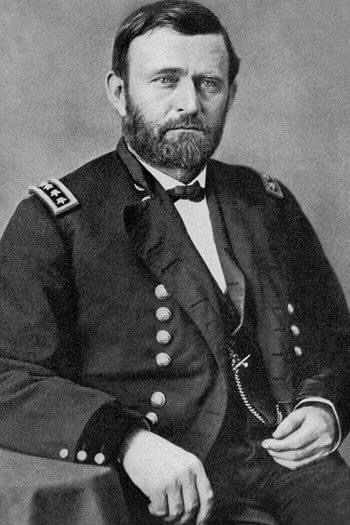
Congress creates the new rank of “General of the Army of the United States” specifically for the US Army’s commanding general, Ulysses S. Grant.

Typical of Grant’s unpretentious nature, he chose to signify the honor with a simple 4 star should board on his basic uniform.

Grant would hold the rank until elected President, at which time he was succeeded by William Tecumseh Sherman, who was succeeded by Phillip Sheridan. The rank died when Sheridan did in 1888, until WWII, when it was signified with 5 stars.

Medger Evers

Today in History, June 12, 1963:

“…Law alone cannot make men see right…”. In the early morning hours Civil rights activist Medger Evers is assassinated by a rifle shot in the driveway of his Jackson, Mississippi home.

Evers was a WWII veteran, having served in the European theater. When he returned home he attended college and in the fifties became involved in the civil rights movement.

Just hours before his death, President John F. Kennedy had given a moving speech calling for civil rights legislation. Whether you grew up in the sixties like my peers and I did, or were an adult then, or are too young to remember, take 6 minutes to watch this video. Be thankful for the rights we all experience now; and for brave men like these. A little 5 months later, JFK would share Medgers fate.