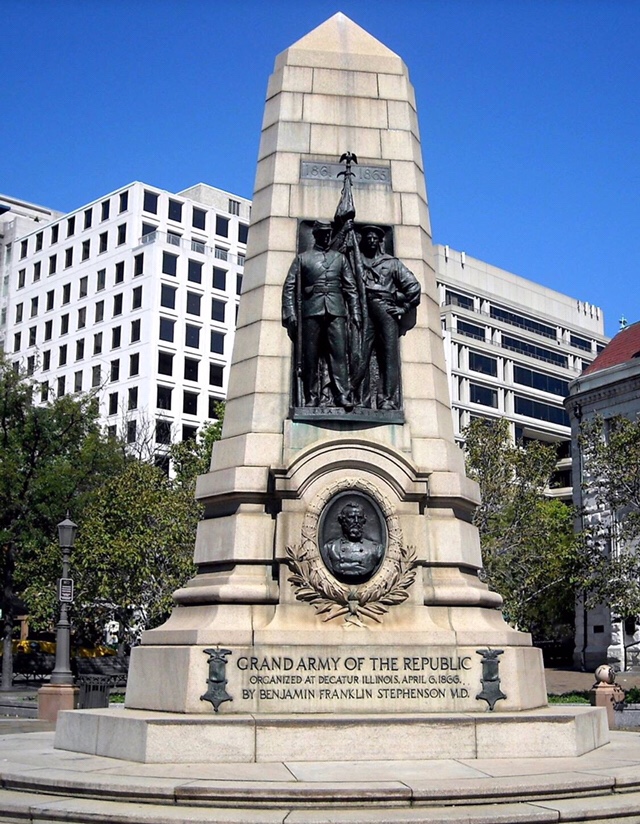
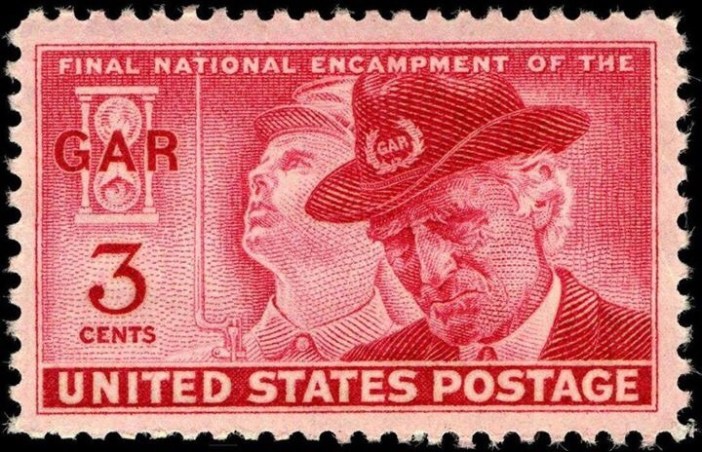
The Grand Army of the Republic

Today in History, April 6, 1866:

Fraternity, Charity and Loyalty.” The Grand Army of the Republic is formed in Decatur, Illinois, bringing together a Fraternal organization of veterans of the Union (US) Army, Navy, Marines, and “Revenue Cutter Service” (Coast Guard) from the Civil War.

Admittedly an arm of the Republican Party, the GAR was one of the first bi-racial fraternal organizations in the US…white and black veterans worked together to gain veteran’s pensions, elect Republican Presidents Grant, Hayes, Garfield, Harrison and McKinley, all Civil War veterans.

At it’s high point, the organization had 490,000 members; it passed with it’s last member’s death in 1956, to be replaced by the “Sons of Union Veterans of the Civil War.
Victory and Assassination

Today in History, April 4: 1865:

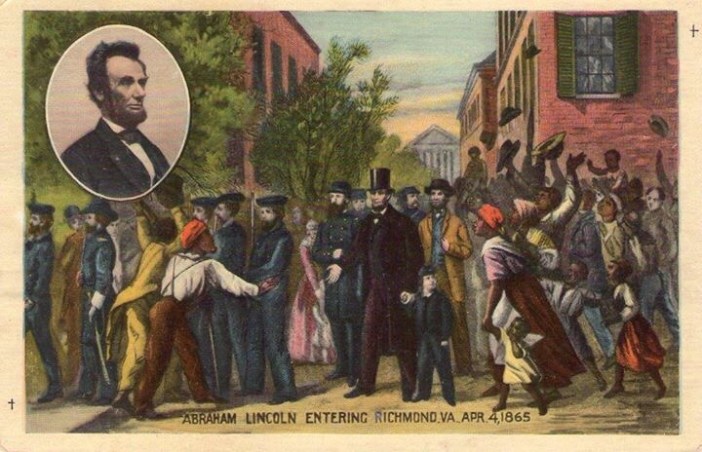
150 years ago today. President Lincoln enters Richmond, the Confederate Capitol. Lincoln had been at City Point when informed that Richmond had been taken the day before by Union Army forces.

He immediately sailed on the USS Malvern, Flag Officer David Dixon Porter’s flagship for Richmond. After he disembarked, he was initially escorted through crowds by a contingent of sailors, who were very relieved when they were met by a group of Union Cavalry to assist in escorting the President to the home of Confederate President Jefferson Davis.

Many former slaves attempted to pay homage to Lincoln, who would not allow it. Onlookers watched from the windows and street corners.

At Davis’ house, Lincoln sat in Davis’ chair, then toured the house.

When later asked by Union Gen. Weitzel how the conquered rebels should be treated, Lincoln indicated that he would not give an order in that regard, but that his advice would be to, “Let them up easy….let them up easy”.

As for the nervous sailors and cavalrymen that escorted him? As it turns out, Lincoln was safer in the Confederate capitol that his own. He had only ten days until he would be assassinated.

103 years later to the day, another man dedicated to civil rights and the advancement of justice, Dr. Martin Luther King, Jr. would be assassinated in Memphis, Tennessee.

April is a Historic month with many stories to tell.

“We, As a People, Will Get to the Promised Land…

Today in History, April 3, 1968:

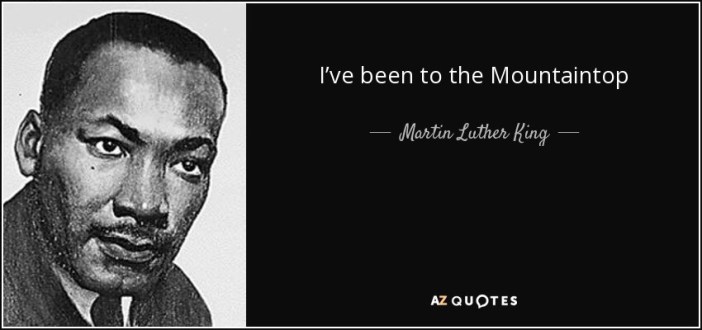
Dr. Martin Luther King, Jr. gives his “I have been to the mountaintop” speech at Memphis, Tennessee. The speech supported striking workers, civil rights, the Constitution, and, comments that if his death were to come he would be at peace. Because he had been “to the mountaintop” as Moses had, and had seen the future success of his works.

The next day an assassin would end Doctor King’s life.

But not his dream.

“Well, I don’t know what will happen now. We’ve got some difficult days ahead. But it really doesn’t matter with me now, because I’ve been to the mountaintop. And I don’t mind. Like anybody, I would like to live – a long life; longevity has its place. But I’m not concerned about that now. I just want to do God’s will. And He’s allowed me to go up to the mountain. And I’ve looked over. And I’ve seen the Promised Land. I may not get there with you. But I want you to know tonight, that we, as a people, will get to the Promised Land. So I’m happy, tonight. I’m not worried about anything. I’m not fearing any man. Mine eyes have seen the glory of the coming of the Lord.”

American Patrol & The Girl I Left Behind Me

gm-american-e1428418484501


Today in History, April 2, 1942:

In Hollywood, California, Glenn Miller and his Orchestra record their version of “American Patrol.”  The tune was originally written in 1885 by F. W. Meacham, but Miller’s orchestra would add swing and jazz to the already inspiring instrumental.

This would make it representative and nearly synonymous with the jaunty, cock-sure attitude of American servicemen fighting World War II in multiple theaters.  Miller and his band would entertain the troops with this and other hits in live shows until his death on December 15, 1944, when he would be lost while flying to France for a performance.  Think of the most popular entertainer you can, and they would pale in comparison to Glenn Miller in the late thirties and early forties.  Major Miller’s loss was felt.

It is important to remember what was occurring in April of 1942.  The attack on Pearl Harbor was only five months in the past, American troops at Bataan were about to surrender, the US Navy was conducting hit and run raids on Japanese strongholds, the Doolittle Raid on Tokyo was in this month, and Americans were training up for the war in Europe while U-Boats lurked off of American shores.

“The Girl I Left Behind Me.”  If you listen, and know what you are listening for, at about the 1:40 mark you pick up on the overlay Miller’s crew added to “American Patrol” of “The Girl I Left Behind Me.”  While versions of this tune were popular in Dublin and the British service long before, it became popular in the US Army during the Civil War and in the Cavalry as a marching tune.  So popular in fact, you’ve likely heard it in movies about the US Cavalry.


This is (was) Marlboro Country…

919ec295cafeee7714041dbb1c8d3ee4


Today in History, April 1, 1970:  President Nixon signs the Public Health Cigarette Smoking Act into law.

Public health officials had recognized the hazards of tobacco usage since the thirties (at least) and restrictions on sale to juveniles had been enacted, along with a surgeon general’s warning.

With the act enacted by Congress and signed in 1970, cigarette advertising was banned from television and radio, although it would continue in print media.  This was an effort to minimize exposure to children.

The stronger warning on tobacco packaging, “Warning: The Surgeon General Has Determined that Cigarette Smoking Is Dangerous to Your Health” was also added.

The last televised ad would appear in the form of a Virginia Slims commercial during the Johnny Carson Show on January 2, 1971.