Today in History, January 21: 1954 – The USS Nautilus (not the first), in this incarnation the first nuclear powered submarine, SSN 571, is launched at Groton, Connecticut, christened by First Lady Mamie Eisenhower.
She would also be the first submarine to sail beneath the Arctic. Her WWII ancestor had a storied career also, conducting numerous war patrols in the Pacific. Jules Verne had used the name for his stories; but the results of Admiral Hyman Rickover’s hard work made the name.
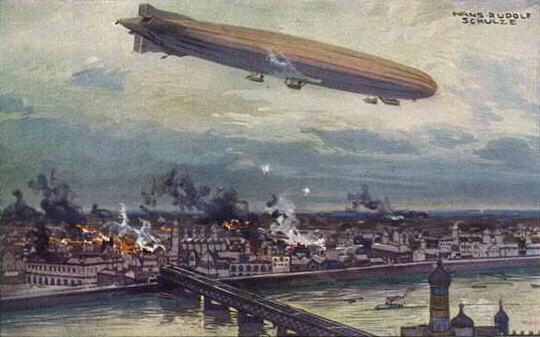
Germany begins aerial bombing of Britain using dirigibles, mostly Zeppelins during WWI.
The attacks would cause many deaths, but would be mostly ineffective and inaccurate.
The Zeppelins would eventually be replaced with aircraft. The bombings would lead to an early warning system and tactics by the Royal Air Force which would carry into the Battle of Britain during WWII.
Many civilians would die in the Zeppelin raids, leading to them being labeled “baby killers”, raising anger rather than the intended demoralization.
Today in History, January 18: 1778 – As the American Revolutionary War waged, English Captain James Cook discovers what he called the Sandwich Islands during an exploring expedition to the Pacific; it was not his first. The Hawaiians thought the Europeans were Gods, and the sailors were only too happy to encourage the misconception. The islanders were fascinated with the iron metal used on the ships; the sailors used it to barter for goods and “comfort” from the Polynesian women. Cook continued his voyage, looking for the Northwest Passage. After returning to the Islands a year later, Cook and his sailors continued the ruse. When one of his crew died, they were discovered to be mere mortals. The natives took one of the ship’s cutters. When Cook and crew attempted to retrieve it, killing some of the residents in the process, they were attacked, and Cook was killed.
“A Live Jackass Kicking a Dead Lion” “And Such a Lion! and Such a Jackass!”
Harper’s Weekly cartoonist Thomas Nast publishes a cartoon which popularizes the Jackass as the symbol for the Democrat party.
A German immigrant, Nast is considered by many to be the father of the modern political cartoon. In addition to the Democrat Jackass, he popularized the Republican Elephant and our conception of Santa Claus. I use the term popularize because he wasn’t the first to use any of these symbols, but he made them known to everyone.
The Jack-ass originally became known as a Democrat symbol when someone called President Andrew Jackson a jack-ass, and he decided to “own it.”
Among other things Nast was an abolitionist and a patriot. Which is why Northern Copperheads angered him so. Copperheads were Northern Democrats that were sympathetic to the Confederate (Southern Democrats) cause. Nast considered them racists and traitors.
Edwin M. Stanton had been part of President Lincoln’s “Team of Rivals”, the Secretary of War who prosecuted the Civil War from Washington and had become respectful and loyal to Lincoln. When Stanton died suddenly on Christmas Eve 1869, the Copperhead Papers in the North continued their criticism of him, speaking ill of the dead.
This was the inspiration for Nast’s cartoon.
This isn’t to say Stanton was a lovable character. He angered many in D.C. and in the Army. General William T. Sherman refused to shake his hand at a military review at the close of the war due to Stanton’s treatment of him. Stanton was an opportunist, but he worked hard at his job.
Elvis Presley performs at a concert in Honolulu, Hawaii which was carried live via satellite in 40 countries in Asia and Europe. The concert would reach 1 to 1.5 Billion viewers. It would not be aired in the US until April 4 because it conflicted with that years’ Super Bowl.
My mom and countless others were big fans. In 1977 when the news of his unexpected death at age 42 came across the radio, she had to pull the car over because she was crying.
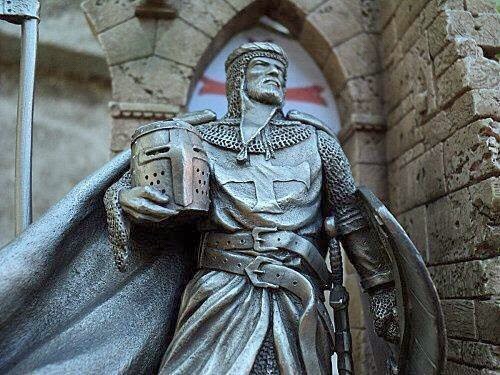
The Knights Templar are named an “Army of God” and given a papal sanction by Pope Honorius II. The Templars protected pilgrims traveling to and from the Holy Land during the Crusades. They called themselves the Templars after the Temple Mount in Jerusalem, where they were headquartered.
By the 14th century the wealthy and powerful had become jealous of the wealth and status of the Templars. The Templars were arrested, accused of heresy, tortured, and burned at the stake. Pope Clement V dissolved the Templars and their extensive property and wealth was turned over to the French and English monarchies. Today’s Catholic church has acknowledged the unfounded persecution of the order.
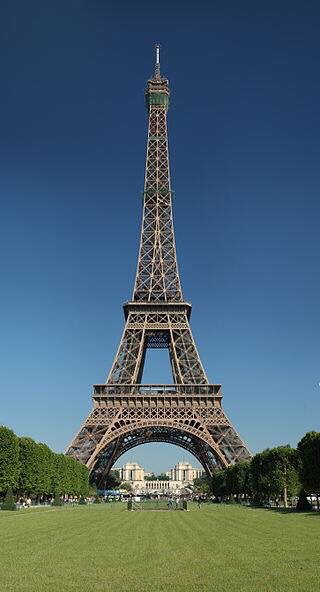
Today in History, January 12: 1908 – A long distance radio signal message was sent from the Eiffel Tower for the first time. Within a few years the signals would be exchanged with the US Naval Observatory in Washington, DC for scientific purposes. The tower had been designed by Gustave Eiffel for the 1889 World Exposition held in Paris.
Eiffel had also designed the interior support for the Statue of Liberty, which was a gift given to the United States in the 19th century by the people of France in recognition of America’s inspiration to France for independence and freedom.
President Ronald Reagan gives his farewell speech from the White House,
“…And that’s about all I have to say tonight, except for one thing. The past few days when I’ve been at that window upstairs, I’ve thought a bit of the “shining city upon a hill.” The phrase comes from John Winthrop, who wrote it to describe the America he imagined. What he imagined was important because he was an early Pilgrim, an early freedom man. He journeyed here on what today we’d call a little wooden boat; and like the other Pilgrims, he was looking for a home that would be free.
I’ve spoken of the shining city all my political life, but I don’t know if I ever quite communicated what I saw when I said it. But in my mind it was a tall, proud city built on rocks stronger than oceans, wind-swept, God-blessed, and teeming with people of all kinds living in harmony and peace; a city with free ports that hummed with commerce and creativity. And if there had to be city walls, the walls had doors and the doors were open to anyone with the will and the heart to get here. That’s how I saw it, and see it still.”
Reagan had spoken of the “Shining city on a hill” throughout his career, and in a 1974 speech he quoted Winthrop; “Standing on the tiny deck of the Arabella in 1630 off the Massachusetts coast, John Winthrop said,
“We will be as a city upon a hill. The eyes of all people are upon us, so that if we deal falsely with our God in this work we have undertaken and so cause Him to withdraw His present help from us, we shall be made a story and a byword throughout the world.”
What will we leave behind when we “Walk off into the city streets?”
Julius Caesar’s time was up as the General in charge of Cisalpine Gaul, a province of the Roman Republic encompassing current France, etc.
The Senate had ordered Caesar home to Rome…and by tradition, to leave his army behind; Armies were not allowed in the Republic proper, and for good reason.
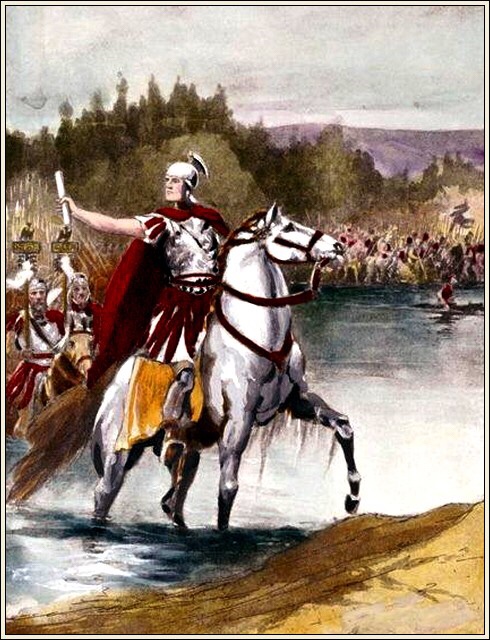
As Caesar sat on the other side of the river Rubicon, with his army, he made a decision to cross. Once he did so he would become a criminal, committing an act of war. And there would be no turning back.
He made his decision and plunged Rome into a civil war. He would be named dictator for life when he was victorious, something that was as significant for Romans as it would be for us.
Hence, “crossing the Rubicon” and “the die is cast” are synonymous with making an irreversible decision.





 Mark Loves History!