Flying Tigers Enter Combat

BG-home

Today in History, December 20: 1941 –

Nearly two weeks after the surprise attack by the Japanese Navy on Pearl Harbor, Hawaii, the First American Volunteer Group (AVG) enters combat for the first time in defense of Kunming from Japanese Air Force bombers.

The AVG was made up of pilots and air crews who were allowed to resign their positions in the USAAF, US Navy and US Marines before the US entered World War II in order to fly for the Nationalist Chinese Air Force defending the Burma Road…China’s primary access to military supplies.  The AVG members had been recruited by a retired USAAF officer, Claire Chennault, who had been training and supervising Chinese flyers for Chinese leader Chiang Kai-Shek since the 1930’s.  The covert program had begun in April 1941, and by the time the AVG’s pilots, crews and their Curtiss P-40 Tomahawk fighter aircraft had arrived in Asia and trained, the US had entered the war.

In their first combat the Flying Tigers destroyed 5 of the attacking bombers.  In the coming months they destroyed nearly 300 Japanese aircraft with a loss of 14 of their own aircraft.  In the dark months after Pearl Harbor the Japanese were “sweeping the table” across the Pacific, and the victories of the small Flying Tigers units provided much needed morale boosters for the Allied powers.  In July of 1942, after little more than six months, the unit would be absorbed into USAAF units in the Asian theater of operations.  Most of the pilots returned to US service, including “Tex” Hill and Gregory “Pappy” Boyington.

Mesa Verde Cliff Dwellings – The Antiquities Act


Today in History, December 18: 1888 –

Rancher Richard Wetherill and his brother-in-law Charles Mason, with the help of Ute guide Acowitz “discover” some of the Cliff Dwellings in the canyons of the Mesa Verde area of Southwest Colorado.  The Wetherills were certainly not the first to discover the hundreds of amazing ancient homes built into the protection of the cliffs centuries earlier.  However they did persist in a campaign to institute Federal protection of the sites.  The Wetherills were fearful that tourists and vandals would loot and destroy the sites.

Archaeologists tell us ancient Native Americans made the Cliff Dwellings their home for over seven hundred years before moving away within a two generations in the thirteenth century.  As a reference, elsewhere in the world the Mongols were conquering Asia and the seventh Crusades were occurring.

The Wetherill family spent years exploring the canyon dwellings, collecting hundreds of artifacts which now reside in museums.  Unfortunately much of the vandalism did occur and Swedish scientist  Baron Gustaf E. A. Nordenskiöld mapped and collected many artifacts, taking them back to Sweden before the American government acted to protect the site.

After years of pressure from the Wetherill family and many others, and four unsuccessful attempts, Congress finally passed a bill creating the Mesa Verde National Park, which President Theodore Roosevelt signed into law.

In the same month in 1906, Congress passed and President Roosevelt signed into law “An Act for the Preservation of American Antiquities”, or “The Antiquities Act”, inspired to protect sites such as Mesa Verde and others for generations to come.  TR made great use of the Antiquities Act to set aside Historic sites for preservation.

The law has been in the news lately as President Trump dialed back the extent of land set aside by Presidents Clinton and Obama at Bears Ears and Grand Staircase National Monuments.

According to the National Parks Conservation Association, the have been 157 National Monuments designated by 16 Presidents since President Theodore Roosevelt enthusiastically named 18 sites during his terms as Chief Executive.

Bad Choices, Bigger Picture

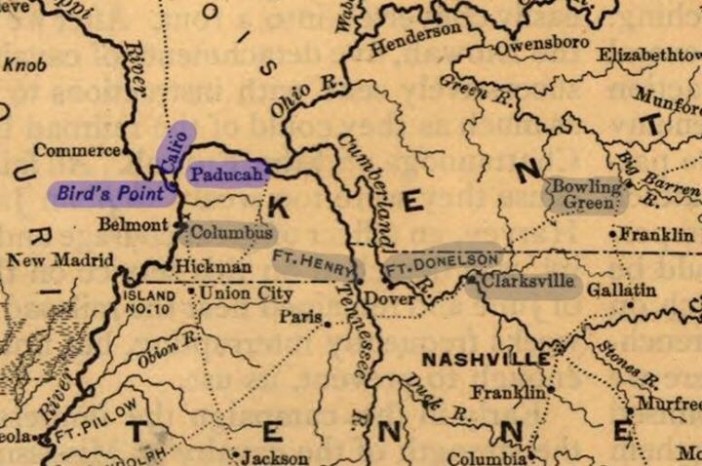
Today in History, December 17: 1862 – Even our heroes make misguided decisions. Gen. Ulysses S. Grant issues General Order 11, expelling all Jewish people from the area he commands, Tennessee, Mississippi and Kentucky. During the war, trade in the South’s staple, Cotton, was severely restrained, which of course led to a black market trade. It became a real problem for the Union Army in the west. Grant felt it was being driven by Jewish profiteers and ordered them expelled. After complaints from the Jewish community and Congress, President Lincoln quickly rescinded the order. Grant would go on to gain Lincoln’s…and the nation’s trust. But this was not his finest moment.

The Great White Fleet

Today in History, December 16: 1907 –

The Great White Fleet, a task group of 16 American battleships and their support ships, sets sail from Hampton Roads, Virginia beginning a world good will tour, circumnavigating the Earth. President Theodore Roosevelt had long been a proponent of sea power in line with the teachings of Admiral Alfred Thayer Mahan, that a strong Navy could project authority world wide. The fleet of white warships were to provide cordial visits to ports in nations that were potential adversaries, most prominently, Japan. There were many other purposes, such as improving morale and patriotism during a depression at home, and research to improve the seagoing capabilities of the US Navy. The Great White Fleet displayed to the world something that still stands today, although greatly enhanced. That the US Navy could project American influence anywhere in the world. The journey would take 14 months until February of 1909, and would take the fleet through the dangerous Straits of Magellan and across the Pacific. The event was a sensation the world over, as moving so many coal powered ships so far was a remarkable achievement.

Bartolomeu Dias

Today in History, December 16: 1497 – Bartolomeu Dias! Remember his name from history class? Probably not. In 1488 Dias, a Portuguese explorer, discovered the Cape of Good Hope and sailed around the Horn of Africa…he named it the Cape of Storms…and after his crew bucked up, turned back for home. In 1497 Vasco da Gama, another Portuguese explorer, and whose name you probably remember, made the same trip, but kept going…opening up India and the Orient to European trade by sail. Portugal (and it’s economy) would rule Asian trade for a century as a result.

A Sad End to an Amazing Life


Today in History, December 15: 1890 –

Sitting Bull, Hunkpapa Lakota Sioux medicine man, is killed by his own people. Sitting Bull had been an important and historical figure amongst his people, long before his conflicts with the white man.

He had a vision of the white soldiers falling before the Sioux, and it came to pass with Custer’s Last Stand during Battle of the Little Big Horn. He would survive that battle and spend several years spent in Canada.

Later he would tour with Buffalo Bill Cody’s Wild West Show across the nation. Eventually he retired to the Standing Rock Agency. In the year of his death young Sioux had begun taking part in a resurgent “Ghost Dance” movement…agency officials feared that Sitting Bull would lend his name to the movement, and sent Indian Agency Police to arrest Sitting Bull. Things went south quickly, and the Indian Agency Police shot and killed Sitting Bull, leading to the first incident at Wounded Knee.


A Pardon for “Little Sister”

Today in History, December 14: 1863 –

President Lincoln grants amnesty to his sister-in-law, Emilie Todd Helm, whose Confederate General husband had been killed at the Battle of Chickamauga. Emilie had made her way to DC and was staying in the White House with the President and her half sister, Mary Todd Lincoln. This was part of a plan Lincoln had to re-unite the Union.

By his order, any Confederate “rebel” that would swear an oath of loyalty to the Union would be granted amnesty. Lincoln hoped this would foster reconciliation and diminish the ranks of the Confederate Army.

Ironically, “four score and seven” years earlier, the British Army had pronounced the same decree, stating that any “rebel” involved in the Revolutionary War who would swear an oath of loyalty to the British Crown, would be granted amnesty; and the British decree was proffered for the same reason. In 1776 it met with limited success. In 1863, it met with some success, but the war would continue for two more years.

And Good Riddance!

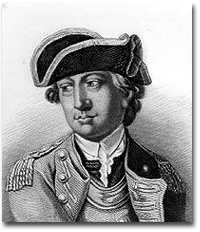
Today in History, December 13: 1776 – This is one of those “God knows what you need more than you do” stories. When the Continental Congress chose George Washington as commander-in-chief of the Continental Army, they bypassed an extremely experienced and competent alternative; Gen. Charles Lee…

Charles Lee has served as an officer in the British Army, serving with distinction in the French and Indian War. Lee never forgave the perceived slight.

In the fall of 1776, Washington and the army he commanded had fled in horrible conditions across New Jersey and were holed up at the Delaware River, bedraggled, barely clothed, starving, and facing a vastly superior force of British regulars. What was worse was that many of Washington’s soldier’s enlistments were up soon, and few were likely to stay.

Washington sent repeated messages to Lee encouraging him bring his well rested army to the Delaware. Lee, satisfied to see Washington fail, hesitated, delayed and finally responded slowly. On this day in 1776 he left his Army and went with a small guard contingent to look for female companionship at a local tavern.

Loyalists to the crown were often informing the British of Colonial movements. Two days later Lee was caught in his bedclothes as he relaxed in the tavern where he had partaken of his chosen prostitutes. British Col. Banastre Tarleton and his troops raided the tavern and captured Lee, who was the Colonial’s most experienced Officer; many had called for him to lead the Army rather than Washington.

The British were exhilarated at having captured Lee, the Americans were demoralized. Washington, however, was privately relieved. Now the army that had been commanded by Lee could be utilized by more loyal officers to continue the fight.

Listen to the Professionals

Today in History, December 12: 1917 –

Rail disaster in the Alps. Between 1,000 and 1,200 French soldiers had Christmas leave from the Italian front, and boarded an overloaded train bound for France over the Alps.

The train’s engineer refused to begin the trip…the passenger cars did not have enough brakes to make the trip safely. He changed his mind when when a well-meaning French officer pointed a pistol to his head…intent on his troops seeing their families for Christmas.

As the train reached the bottom of a long grade near Modane, France, the engineer’s fears were realized…the brakes would not slow the train and when the train reached a wooden bridge it derailed, most of the passenger cars bursting into flames. At least half of the soldiers were killed in the horrific crash…over 500. Listen to the professionals.

A Proclamation in Jerusalem

Today in History, December 11: 1917 –

During WWI, the British Prime Minister David Lloyd George had ordered that Jerusalem be taken as part of a second front in the war against the Ottoman Empire…German allies.

The war had not been going well in 1917. Lloyd George decided to move on of the Western Front commanders, Gen. Edmund Allenby, to the Middle East. Allenby reported to Cairo, taking command of the Egyptian Expeditionary Force (EEF) and immediately making changes.

Allenby and his troops fought hard battles across the desert, entering Palestine and arriving outside Jerusalem on December 9. The Ottoman Turks, having fought hard, abandoned the city.

On the 11th Allenby entered through the Jaffa Gate by foot as a display of respect for the Holy City.

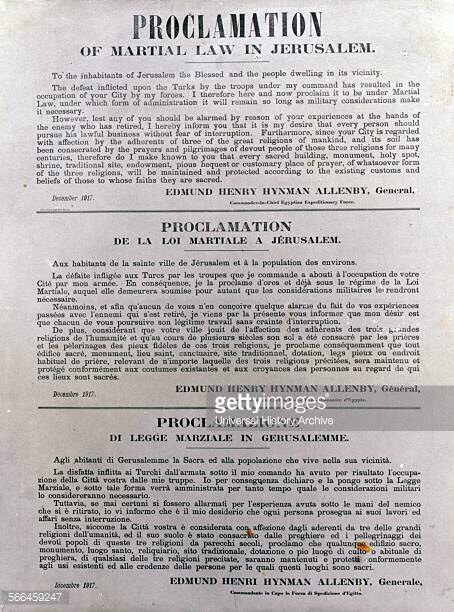
Having ended hundreds of years of Ottoman rule over the city, he presented a proclamation in English, French, Italian, Hebrew, Arabic, Russian and Greek assuring people of all religions of his intent to keep Holy sites open to all.

So much History and importance before and since in Jerusalem.

According to the Times of Israel, a re-enactment of the event was held today with the assistance of the Tower of David Museum, complete with descendants of General Allenby in attendance.