Liberty Enlightening the World


Today in History, October 28: 1886 – “Not like the brazen giant of Greek fame, With conquering limbs astride from land to land;

Here at our sea-washed, sunset gates shall stand

A mighty woman with a torch, whose flame

Is the imprisoned lightning, and her name

Mother of Exiles. From her beacon-hand

Glows world-wide welcome; her mild eyes command

The air-bridged harbor that twin cities frame.

“Keep, ancient lands, your storied pomp!” cries she

With silent lips. “GIVE ME YOUR TIRED, YOUR POOR,

YOUR HUDDLED MASSES YEARNING TO BREATHE FREE,

THE WRETCHED REFUSE OF YOUR TEEMING SHORE.

SEND THESE, THE HOMELESS, TEMPEST TOST TO ME,

I LIFT MY LAMP BESIDE THE GOLDEN DOOR!”

—Emma Lazarus, 1883

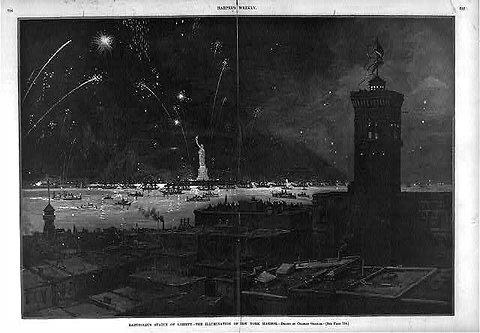
“Liberty Enlightening the World” a statue gifted to America by France in recognition of the two nation’s alliance during the Revolutionary War, is dedicated in New York harbor. The dedication was presided over by President Grover Cleveland.

Desperate Courage – The Battle Off Samar


Today in History, October 25: 1944 – 

A desperate fight for survival, The Battle off Samar.  The Battle off Samar was only one of several major naval conflicts that constituted the Battles of Leyte Gulf. 

Gen. Douglas MacArthur had returned to the Philippines and invaded Leyte. His invasion was supported by what is likely the largest assembled fleet in history. In the days since the invasion began, the Japanese Navy had sent 3 battle groups to intercede. One group of Battleships, cruisers and destroyers were to approach the landing forces in Leyte Gulf through Surigao Strait, another built around the massive IJN Yamato was to approach via San Bernadino Strait, and the last, built around Fleet Carriers with few planes left, was to sail far to the north and make sure they were seen, so that major US forces defending the thin skinned landing ships would leave them unprotected. 

 The Japanese fleet approaching through Surigao Strait was decimated by American Battleships raised from the mud of Pearl Harbor in the last Battleship vs Battleship engagement in history (US Cruisers and Destroyers were key also). 

Admiral Kurita’s force around Yamato was bombed on the 24th and turned back. Admiral William F. Halsey, known to Americans and Japanese for his aggressive nature, “By the time we’re done, the Japanese language will be spoken only in hell” commanded the US 3rd fleet…4 battle groups of 4 fast carriers each, and another of fast battleships. He took the bait, going after the Japanese carriers that were actually playing no combative part in the battle. This left only cargo ships, small combatants, and “Jeep Carriers”, or Escort Carriers…basically cargo ships with a flight deck built atop their small, thin hulls. 

 The escort carriers were tasked with close support for troops ashore, and were not equipped with ammunition for a sea battle. So far, I’ve just set the stage for the events of the Battle off Samar Island…now for the good part. There were 3 small escort carrier task forces left in Leyte Gulf…Taffy 1, Taffy 2 and Taffy 3. As they began operations on the morning of the 25th, Admiral Clifton “Ziggy” Sprague and the men of Taffy 3 were shocked to find that IJN Admiral Kurita’s task force of fast battleships, cruisers and destroyers, who had turned around in the night, bearing down on them. Reference “Last Stand of the Tincan Sailors” by James Hornfischer, although I knew about this battle, I found out much more, and Oklahoma connections. The entirety of Taffy 3…6 jeep carriers, 2 Fletcher class destroyers and 3 destroyer escorts…did not match the tonnage of the Yamato alone. And Yamato was joined by several other Battleships, Cruisers and destroyer task forces. The Japanese could manage much more speed than the small American ships, and their guns (18 inch for the Yamato, 14 and 8 inch for the others, out-ranged the American’s 5 inch guns by MILES. As the long range rifles (22 miles avg) began dropping shells around the carriers and destroyers, Admiral Sprague ordered the small destroyers and destroyer escorts to lay smoke and attempt to delay the inevitable. Oklahoman Harold Kite, loading a 5 inch gun on the stern of the carrier USS Fanshaw Bay, watched the tiny escort ships turning to race towards the huge enemy ships, and likened them to the horses that had raced across the plains of central Oklahoma as he was growing up, and marveled at their courage. The closest escort ship to the Japanese fleet, the USS Johnston, was commanded by another Oklahoman…Commander Ernest E. Evans, known to his Annapolis classmates as “Chief” for his Cherokee heritage. His crew knew what they were in for. Cmdr. Evans had been there for the American defeat during the Guadalcanal campaign, and took his warrior heritage seriously. When he took command of the Johnston, he told her crew, “This is going to be a fighting ship. I intend to go in harm’s way, and anyone who doesn’t want to go along had better get off right now. Now that I have command of a fighting ship, I will never retreat from an enemy force.” See comments for much more.

And he didn’t. Under the fire of longer range, larger guns and other fast destroyers, he raced in close, ordering his gun crews to fire constantly, which they did with amazing effect, and launched his small ship’s torpedoes against the enemy, achieving strikes that disabled cruisers. Fighting to the end, Evans was looking after the survivors of his sinking ship when a Japanese shell destroyed the part of the superstructure he was in, and he went down with his ship. The other American destroyers and destroyer escorts (even smaller) followed suit, delaying the Japanese ships and confusing them to the point that the Japanese thought they were actually fighting American cruisers and fast carriers…heavies in Navy parlance. 

The Jeep carrier’s aircrews were launched in desperation as the battle began…armed with whatever they had…depth charges, anti-personnel bombs, but nothing that was designed to sink ships. The aircrews, flying torpedo bombers, dive bombers and fighter planes, attacked the Japanese ships with desperate ferocity. They dropped the depth charges as best they could beneath enemy ships, dropped their bombs, then came back and made runs against the enemy ships without arms because it would mean the IJN ships had to evade (and slow down) since they didn’t know there were no torpedoes or bombs on the American aircraft. One pilot, out of ammunition, flew alongside a Japanese heavy, opened his canopy, and emptied his .38 revolver into the ship’s bridge to the amazement of her crew. The flyers then flew to a land base on Leyte and re-armed to attack again. In the end, Admiral Kurita, believing he was attacking a much larger force, ordered his massive force to turn about and retreat.

As for Halsey, who couldn’t leave even his Battleships, or even 4 of his 16 Carriers to defend the Taffy’s and the all but defenseless cargo ships in Leyte Gulf….he received a dispatch from his boss, Admiral Chester W. Nimitz, asking, “Where is Task Force 34? All the world wonders.” The story is that “all the world wonders” was just jibberish added to transmissions to confuse the enemy…but the result was an angry Halsey throwing his cap to the deck and spewing a string of invectives. Of the destroyers, including the Johnston and the Samuel B. Roberts that went down in the battle? Amazingly, many of their crew were lost to sharks before they were rescued in the days hence, the result of faulty reports of their locations. So many brave heroes.
An Impactful Day

Today in History, October 26: 

 Such a huge day! I couldn’t pick. So…

1774 – The First Continental Congress adjourns. They hadn’t yet declared Independence, but…

1775 – King George III of Great Britain goes before Parliament to declare that the American colonies are in rebellion and to order a military response. 

 1825 – The Erie Canal, man-made water passage from Albany, New York to Lake Erie, opens. 

 1861 – The Pony Express ends it’s 18 month run. 

 1881 – The Gunfight at the O.K. Corral in Tombstone, AZ. 

 1940 – The P-51 famous Mustang makes it’s maiden flight. 

 1942 – During the Guadalcanal Campaign, the Battle of the Santa Cruz Islands takes place…The USS Hornet is sunk and the USS Enterprise, now the only American carrier in the Pacific to hold the line against the Japanese, is badly damaged. 

 1944 – The Battle of Leyte Gulf, the largest sea battle in history encompassing several days, comes to an end with Japanese defeat. 

1958 – A Pan American Airways Boeing 707 makes the aircraft’s first commercial flight between New York and Paris.

Band of Brothers at Agincourt

Today in History, October 25: 1415 – 

600 years ago, The Battle of Agincourt. During the Hundred Years War, English King Henry V had invaded France. On this date, Saint Crispin’s Day, his army was exhausted after a 250 mile march, sick and vastly outnumbered by a well rested French Army which included many noblemen (Knights). 

Henry decided that waiting would only make things worse, and began the battle. He protected his Archer’s, armed with Longbows, and they once again proved their worth, cutting down the French knights and the majority of the French Army. At the end of the day, there were 6,000 French casualties to 400 English. 

 Shakespeare’s play included a rousing speech by Henry V, now famous of course, for “And Crispin Crispian shall ne’er go by, From this day to the ending of the world, But we in it shall be remembered- We few, we happy few, we band of brothers!” Among so many that can, in the time since, share in the Brotherhood of St. Crispin’s Day, are the Cavalry of the “Charge of the Light Brigade” during the Crimean War (1854) and the Sailors, Airmen, Marines and Soldiers who fought in the largest Naval Battle in History at Leyte Gulf (1944).          

Communication is Key to Development

12065543_10203482440460436_7320918058428442627_n

Today in History, October 24: 1861 – The Transcontinental Telegraph in the US is completed at Salt Lake City, Utah by the Western Union Telegraph Company, operating under a $40,000 per year subsidy. The logistics of the construction had been daunting. Glass insulators and wire had to be shipped by sea to California, the hauled by wagon over the mountains. Similarly, there was no source for the thousands of tall poles on the plains, and these too had be hauled long distances. The connection of the pre-existing eastern and western telegraph systems would spell the end of the 18-month-old Pony Express, and would bring near instantaneous comminication between Washington and California. The importance of this during the Civil War was recognized before construction began.

On the Brink of Armageddon

Today in History, October 22, 1962:  President Kennedy announces in a speech from the Oval Office that the Soviet Union has placed nuclear missiles in Cuba, only 90 miles from Florida.  Any city within the United States could be destroyed within moments.

President Kennedy announced the US Navy was conducting a “Quarantine” of Cuba, another name for a Blockade, which “could” be considered an act of war.  He also made clear that any missile launched from Cuba upon any nation in the Western Hemisphere would result in an attack on the Soviet Union.  Could this be interpreted as enforcement of the Monroe Doctrine?

Today we are experiencing stressful times, a showdown with North Korea.  We’ve been here before, even worse.  We are made nervous by the rhetoric voiced by our government.  President Kennedy kept us safe by letting the Soviets and Cuba know the consequences would be dire if they acted in bad faith.  At that time Castro and the Soviet government were viewed as “madmen” much as Kim is today.

Horror


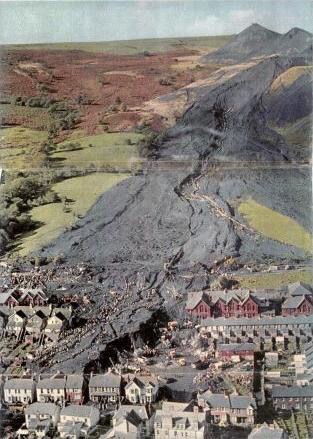
Today in History, October 21: 1966 – The Aberfan Disaster. For 50 years British mining companies had been piling earthen debris dug out of nearby mines in “tips” or piles on the mountain above the village of Aberfan in Wales. After several days of rain, tip #7 gave way, and tens of thousands of cubic meters of a slurry swept down the mountain into the village in minutes. There was no time to warn the fog covered village, whose residents could hear the roar of the landslide, but could not see it. The local school was covered in at least 33 feet of muck, killing 116 children and 28 adults. Panicked parents clawed at the debris covering their children with their hands desperately trying to save their children.

US Doubled


Today in History, October 20: 1803 – The Louisiana Purchase is ratified by the US Senate. When Spain returned the Louisiana territory to France in 1800, President Jefferson became concerned that France would cut off access to New Orleans and sent emissaries to attempt the purchase. Napoleon Bonaparte was cash strapped in the midst of a war with the English, and didn’t want to deal with the far off territories at that point…so he agreed to sell the territory for $15M, or 4 cents per acre. Some members of the Senate actually criticized Jefferson, saying that he had spent a vast sum on a wasteland. Nonetheless, the treaty was ratified and the territory of the United States more than doubled overnight.

America’s First and Real “Yes We Can”


Today in History, October 17: 1777 – 

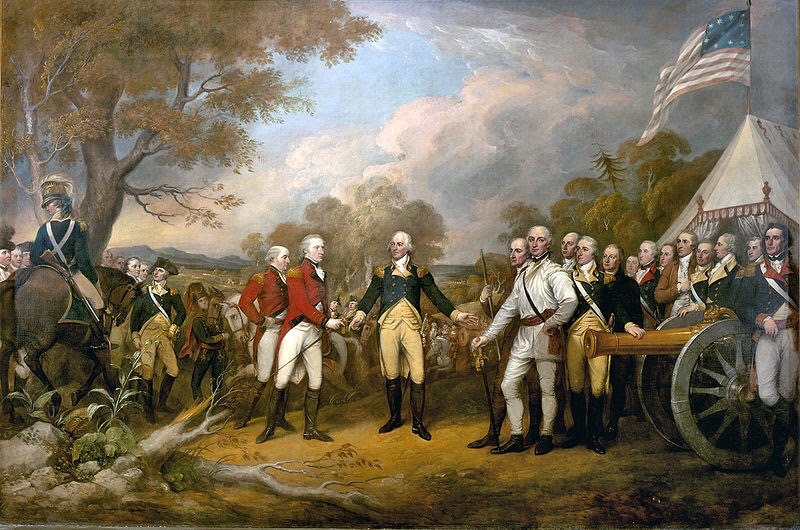
Surrender of British Army at the Battle of Saratoga. British Gen. John Burgoyne was leading an army of 8,000 British regulars south from Canada to meet up and combine forces with Gen. Sir William Howe on the Hudson River. 

 His army clashed with the American army several times, and finally had to take refuge in the village of Saratoga, NY. With about 5,000 of his troops left, surrounded by nearly 20,000 American troops, he had no choice but to surrender the largest British force to that date to the “Colonials”. 

 The battle showed the world that the Americans could defeat the British in combat, which gave France and Spain the confidence to enter the war and provide supplies, soldiers and naval support to the Americans. Their support was instrumental in winning the war, thus Saratoga is seen as a turning point in the Revolution.