The Birth of US Naval Aviation

530155_2490408238323_104830550_n

Today in History, March 25: 1898 – Assistant Secretary of the Navy Theodore Roosevelt proposes that the Navy investigate the use of a flying machine being researched by Samuel Langley. As a result, congress authorized $50,000 to support Langley’s design. The Wright Brothers may have accomplished the first manned, powered flight, but many people had been working on the challenge for years. Langley’s, and Roosevelt’s insight was the beginning of US Naval Aviation. Check out this print by R.G. Smith, which portrays the 1st US aircraft carrier, the USS Langley (CV 1), and the nuclear powered aircraft carrier USS Theodore Roosevelt (CVN 71) cruising together. Of course this is inspired imagination…Langley’s namesake ship was lost in WWII.

The Langley was converted from the Collier USS Jupiter in 1920.  By WWII she had been converted to a seaplane tender, her larger subsequent sisters taking on the aircraft carrier role.  Attempting to deliver p-40 fighter planes to Java, on February 27, 1942 she was attacked by Japanese aircraft and damaged so badly she had to be scuttled.

Early Warnings, the Beginning

Today in History, March 25: 1948 – Major Ernest J. Fawbush. Capt. Robert C. Miller. On March 20th, a devastating tornado struck Oklahoma City, and Tinker Air Force Base in particular, causing the most destruction in Oklahoma history to that point; the impact still stands as the second most damaging storm in OK history. Two meteorologists on the base, Fawbush and Miller, sought to provide warning regarding storms and began studying the dynamics of the storm that created the devastating tornado. Within 5 days they got their wish, and were the first to provide early warning against tornadoes. On the morning of March 25th they observed that conditions were amazingly similar to those of March 20th, and they issued warnings not only for the base, but for the surrounding populace. Another tornado struck that night, and while the damage was still severe, expensive resources on the base were secured and civilians sought shelter. How many lives have been saved in the years since?

Gunboat Diplomacy

Today in History, March 24: 1927 – Gunboat Diplomacy. Chinese nationalists and communists had been struggling for control of the country. When the fight reached Nanking (Nanjing), the nationalist forces left the city. The communist soldiers that entered the city raided the consulates of western nations there; British and American citizens were injured and some killed. All of the western nations that had commercial interests in China had a Naval presence in the region. In response to the assaults, the Royal Navy and the United States Navy vessels on the Yangtze fired on the soldiers and civilians sacking the western sections of the city, driving them away. Marines evacuated the western civilians to ships that were then escorted out of the area. In the process, the escorting ships, mostly the USS William B. Preston, had to suppress fire from the shore several times. The Nationalist forces eventually took back the city. By the next year the government had apologized for the incident and the communist forces agreed to pay reparations.

Death From Afar Before the Age of Rockets & Missiles

Today in History, March 23: 1918 – At 7:20 AM the peace in Paris, France was shattered by an artillery barrage. The fire was from a new weapon designed by the Germans, the “Pariskanone”, a 210mm cannon with a 118 ft long barrel. The gun could fire a shell to an altitude of 25 miles; the cannons bombarding Paris were firing from safety 74 miles away. By the end of the assault on August 9, 260 Parisians had been killed.

Disaster in New Orleans…No, Not That One…

Today in History, March 21: 1788 – Have you ever visited the French Quarter in New Orleans? Did you know that the vast majority of those buildings in the “French” Quarter are actually…Spanish? On this date in 1788 the Army Treasurer in New Orleans, Don Vincente Jose Nunez, and his family were celebrating Good Friday in their home less than a block from the Plaza de Armas (later Jackson Square). They apparently lit a few too many candles while immersed in prayer and caught their home on fire. Before the day was over, 856 of the 1,100 buildings in the city were destroyed, most of the city. Spain had control of Louisiana at that time, and during a subsequent fire in 1794 that took 212 buildings. So the structures that replaced those of wood that were lost were made of stucco or brick, and of Spanish architecture.

Louisiana Governor Miro’s report: If the imagination could describe what our senses enable us to feel from sight and touch, reason itself would recoil in horror, and it is no easy matter to say whether the sight of an entire city in flames was more horrible to behold than the suffering and pitiable condition in which everyone was involved. Mothers, in search of a sanctuary or refuge for their little ones, and abandoning – their earthly goods to the greed of the relentless enemy, would retire to out-of-the-way places rather than be witnesses of their utter ruin. Fathers and husbands were busy in saving whatever objects the rapidly spreading flames would permit them to bear off, while the general bewilderment was such as to prevent them from finding even for these a place of security. The obscurity of the night coming on threw its mantle for a while over the saddening spectacle; but more horrible still was the sight, when day began to dawn, of entire families pouring forth into the public highways, yielding to their lamentations and despair, who, but a few hours before, had been basking in the enjoyment of more than the ordinary comforts of life. The tears, the heartbreaking sobs and the pallid faces of the wretched people mirrored the dire fatality that had overcome a city, now in ruins, transformed within the space of five hours into an arid and fearful, desert. Such was the sad ending of a work of death, the result of seventy years of industry.

For some chronological relation, further east on our continent the nascent 13 nascent states spent the years of 1788 approving the US Constitution; two weeks after the disastrous fire, pioneering Americans established Marietta (later Ohio) as the first American settlement beyond the borders of “America.”

Uncle Tom’s Cabin Published

Today in History, March 20: 1852 – “So…you’re the little woman who wrote the book that made this great war!” President Abraham Lincoln greets Harriett Beecher Stowe at the Presidential Mansion in 1862, ten years after her novel “Uncle Tom’s Cabin” was first published. I am amazed at the foresight and courage displayed by this woman, a school teacher turned author. By her own admission, in the epilogue of the book, for the first part of her life, she knew of slavery, disapproved of it, but being a Northerner, it was distant and she felt that the problem would be resolved eventually on it’s own. How many of today’s injustices do we see the same way? Between meeting some runaway slaves, becoming familiar with the Underground Railroad, and stories from her family and friends, and finally the Compromise of 1850 (in which the government promised to return runaway slaves in exchange for new limitations on slavery expansion), she became an avid abolitionist. She wrote Uncle Tom’s Cabin to illustrate the aspects of slavery that most did not understand at that time. As slaves, a mother’s children were often sold off, never to be seen again. Women were sold into prostitution, to be used until their value had diminished. If a good and kindly “master” came on hard times, he might sell a good man “down the river” to cruel and harsh masters, as “Uncle Tom” was. With her novel, Mrs. Stowe humanized the slavery issue, brought it home to people and chastised them for not living up to their Christian values. The novel would become the best selling novel of the 19th century and would inspire abolitionist views amongst Americans. It was certainly far from the only cause of the Civil War…but the novel played it’s part in American History. One has to wonder if this “little woman” had any idea of the importance her words would have. If you haven’t read (or listened to) this novel, you should.

“Crimes” and Punishment


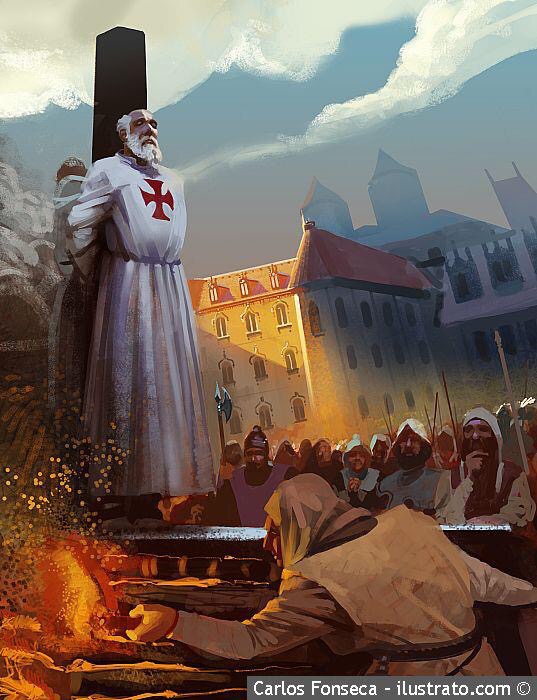
Today in History, March 18: 1314 – Jacques de Molay, Grand Master of the Knights Templar, and Geoffroi de Charney, Master of Normandy, are taken to an island in the middle of the Seine and very slowly burned to death. The Templars were men from wealthy European families that took vows of devotion to God, and fought in the Crusades. In the process, the Templars amassed a lot of property and wealth, all owned by the order, as the Knights themselves took a vow of poverty. French king Phillip IV was in a fix…the royal coffers were all but empty and he owed an incredible sum to the Templars. To fix his problem he accused the Knights of heresy, saying that they did several things against God during their initiations. He ordered them arrested and seized their wealth; now he had their money and their property, and no longer owed them anything. Many were burned at the stake. The others were imprisoned while Phillip and the Pope went back and forth over what was to be done with them. de Molay was tortured and eventually confessed to his “crimes”. When later questioned by Cardinals, he recanted the confession. After languishing in prison for 7 years, he and the others were brought out into public and sentenced to be imprisoned for the remainder of their lives. de Molay and de Charney both stood and publicly stated that the only crime they had committed was to betray the order by making false confessions to save their own lives. Phillip was enraged. While the Cardinals sent by the Pope discussed this new development, he had the two troublesome Templar leaders taken to Isle de Juifs, secured to scaffolds, and slowly burned; if they “confessed” again, they would be spared. de Molay remained calm and stoic, refusing to betray his Order again. How often have we seen the corrupt accuse the righteous of committing crimes to cover their own?

Happy Saint Patrick’s Day

Today in History, March 17: 1780 – “The General directs that all fatigue and working parties cease for to-morrow the SEVENTEENTH instant,” read the orders, “a day held in particular regard by the people of [Ireland].” General George Washington’s Army was bedded down amidst 6 foot snow drifts, suffering through the worst winter on record…even worse than Valley Forge. Recently the Irish, who were also in rebellion against the Crown, had declared themselves AMERICANS in solidarity with the American colonists that were fighting for their independence. At least a quarter of Washington’s army was Irish…and a vast majority of his commanders shared that distinction. So GW decided that St. Patrick’s Day…(not Christmas, nor Easter)…would be a day of rest and celebration for his army.

US Military History – One Family

Today in History, March 16: 1802 – Connections through history. The US Congress approves legislation creating the United States Military Academy at West Point, New York…now one of the oldest military academies in the world. The post had been created during the Revolutionary War on the Hudson River…Gen. George Washington at one time used it as his command post…and Gen. Benedict Arnold betrayed his country when he connived with the British in an attempt to give up the post.  Just creating the USMA was controversial for a nation that didn’t even believe in having a standing Army.  It’s initial purpose was primarily to teach Engineering.  My military friends can tell us how important engineering is to military operations.  One of the first superintendents of the USMA, Sylvanus Thayer, is credited with establishing the high standards now famous for West Point. One of his instructors, Dennis Hart Mahan, so impressed with Thayer, named his child after him…Arthur Thayer Mahan…who would go on to be the author and creator of US Naval strategy in the 19th and 20th Centuries, writing, The Influence of Sea Power Upon History, which influenced the creation of modern navies.

A Legacy of Unintended Consequences

Today in History, March 14: 1794 – You never know what your legacy will be. Eli Whitney is granted a patent for his cotton gin (engine), although the patent wouldn’t be free and clear of legal suits until 1807. Whitney was emigrating south to S. Carolina when a fellow passenger, the widow of Revolutionary War hero Gen. Nathanael Greene, convinced him to go to her Georgia plantation instead. It was here that he and his partner, with help from Mrs. Greene, would develop the machine that changed the process of removing seeds from cotton from laborious to simple.  As a result of Whitney’s innovation the South’s cotton exports went from less that 500,000 lbs in 1793 to over 93 million in 1810. It had another effect not intended. Slavery had been of waning use in the late 18th century…but with “King Cotton”, the Antebellum South’s burgeoning economy needed labor, and slavery became an integral part of their livelihood, dashing the hopes of those abolitionists who expected it to die out. In the meantime…all of the legal wrangling over his invention left Eli broke. So to make money he turned to making weapons for the government. While he was not the originator, he was an avowed proponent of using inter-changeable parts…which would eventually influence the industrial revolution. So…both of Whitney’s successes greatly influenced (contributed to?) the Civil War and the nation’s development long after his death in 1825. The Civil War began about state’s rights…but about the right to keep slaves by those states. Expansion westward in the South was mostly about beginning new plantations…hence more slaves. And I’m sure many of Eli’s muskets survived for use in the war. None of which was likely on this little known inventors mind as he worked his trade.