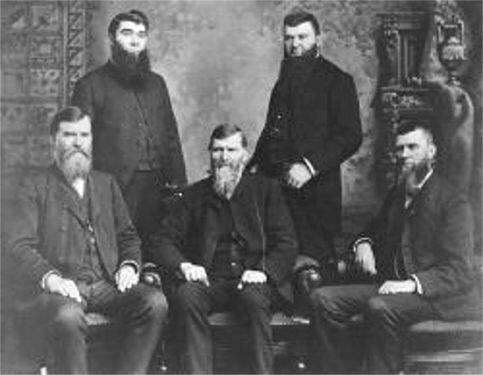


 Today in History, February 16: 1852 – The five brothers, Henry, Clement, John Mohler, Peter Everst and Jacob Franklin, had been taught the skill of wagon making by their parents, who had been taught by their parents, who had arrived in America in 1736. They began their combined business on this date in 1852, and soon they were providing fully half of the wagons used for the migration west, and a quarter of those in the nation. They made bank during the Civil War, selling wagons to the Union Army. Their business continued to thrive…those beautiful red 1900 model wagons pulled by the Budweiser Clydesdales…are Studebakers. When motorized vehicles came to be, the Studebaker Company began making first electric and then gasoline cars. The company would last until 1957, having a reputation for quality and class in their cars.
Category: Uncategorized
A Combative Congress…American Tradition
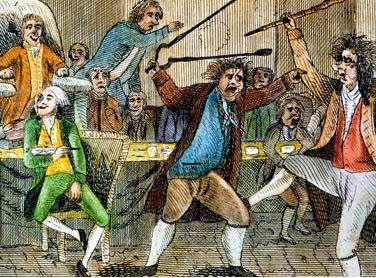
Today in History, February 15: 1798 – Combat on the House Floor. Matthew Lyon was a Democratic-Republican from Vermont. Roger Griswold was a Federalist Representative from Connecticut. Two weeks earlier, the two had argued on the house floor, Griswold commented about allegations of cowardice about Lyon during the Revolution; Lyon responded by spitting tobacco juice on Griswold. When the House failed to censure Lyon for the “gross indecency”, it infuriated Griswold. On this date he ambushed Lyon at his desk on the House floor, beating him about the head and shoulders with his wooden cane. Lyon retreated to a fireplace, where he took up a pair of tongs to combat the assault. Other Representatives had to separate the two. A vote was held to expel both of them, but it failed, 73-21. This would certainly not be the last physical fight in Congress.
“There is a curse on this House”
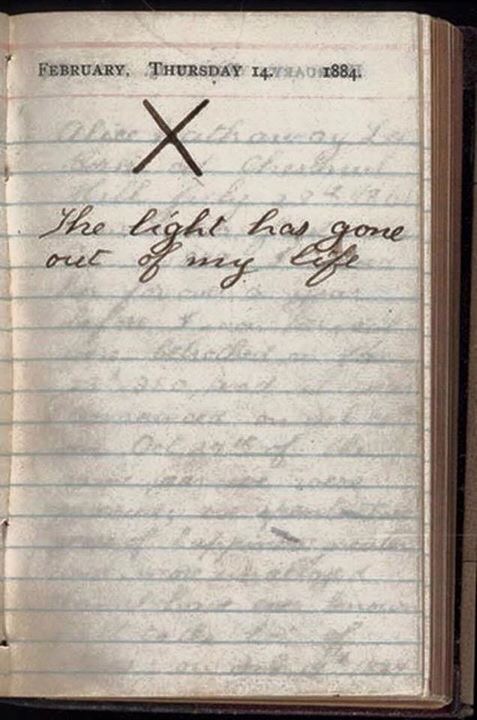

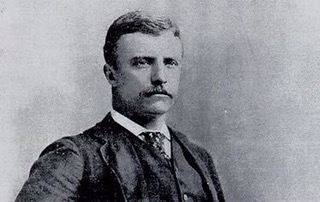 Today in History, February 14: 1884 – 25 year old Theodore Roosevelt was at work in the New York Assembly in Albany fighting for a reform bill when he received an urgent telegram to return to his home in New York. When he reached his front door his brother Elliott greeted him, “There is a curse on this house”. Their mother Mittie was suffering from Typhoid fever, and Teddy’s wife Alice, who had given birth to her namesake just two days earlier, was suffering from Bright’s Disease. TR went up and down the stairs to be with them. Mittie died first, followed within hours by Alice. Roosevelt was devastated. His diary entry for that date was simply a large X and the note, “The light has gone out of my life”. He could never speak of his first wife again, not even mentioning her in his autobiography. When he returned to the legislature, even his detractors treated him with deference for a time because of the tragedy. He soon left the Assembly, left the infant Alice with his sister Bamie and struck out west to the Dakotas to escape. He would become a rancher and a sheriff, and make many friends who would later be “Rough Riders” with him. In ’86 he returned east, re-entered politics and re-married. His daughter Alice became famous for outlandish behavior, dealing with her own demons due to the temporary abandonment and a new family. Adversity affects us all differently. One has to wonder if TR would have accomplished all that he did if this tragedy hadn’t driven him west and altered his life.
Saint Valentine
 Today in History, February 14: 278 AD – Valentine is beaten to death, then be-headed in Rome. Roman Emperor Claudius II (The Cruel) was overseeing several bloody wars at once. He was having trouble keeping soldiers in his armies, and believed that it was because the men were too loyal to wives and families. So, he outlawed marriage…A priest, Valentine, continued marrying people in secret. When he was found out, Claudius ordered him executed. He was arrested and brought before the Prefect, who ordered him beaten to death and then be-headed. The Catholic church later declared Valentine to be a Saint for his sacrifice.
“Rendezvous”


Today in History, February 13: 1822 – Missouri Lt. Governor William Ashley, already an enterprising entrepreneur in the gunpowder business, posts an advertisement in the Missouri Gazette and Public Advisor seeking 100 men to volunteer for an expedition up the Missouri River as fur trappers. The expedition first tried to setting up a trading post on the Yellowstone River in Montana, but the Arikara Indians, firmly entrenched in the fur trading business themselves, kept raiding the post to eliminate the competition. Ashley then set upon a new idea; he told his trappers, including Jim Bridger, Jedediah Smith, James Beckwourth (first African-American mountain man) to go overland by horse into the mountains to trap, and once a year they would meet at a location set by Ashley for a “Rendezvous”, where they would spend several weeks trading their furs for supplies…and taking the opportunity for a rare socializing event, spent mostly intoxicated. The Mountain Men sold their furs to Ashley for a tidy profit, and then disappeared into the wilderness again. Ashley spent two years at this venture, making a huge profit, then sold his Rocky Mountain Fur Company and returned to politics, serving terms in the House and the Senate. But the Rendezvous system carried on for years in the fur trade.
The Beauty of the West brought to the World


Today in History, February 12: 1837 – Thomas Moran is born in Bolton, England. Moran would immigrate to America, and as an American became an accomplished artist. In 1871 he accompanied the U.S. Geological Survey of the Territories, and along with photographer William Henry Jackson created images of the West. Jackson took Moran’s paintings back east after the expedition, and Moran’s paintings soon convinced Congress to approve the creation of the Yellowstone National Park. Moran brought the incredible images of the west home to Americans and inspired many to be pioneers.
O Captain! My Captain!
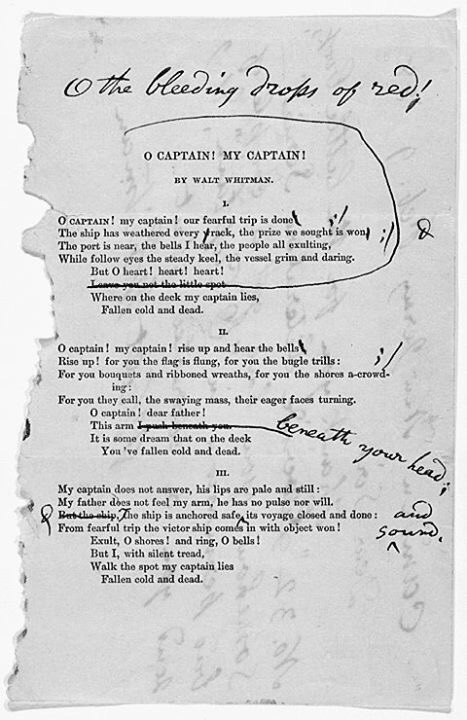 Today in History, February 9: 1888 – Poet Walt Whitman writes a note to the publishers of the Riverside Literature Series #32, correcting their printing of the poem that he had written amid his, and the nation’s grief over the assassination of President Abraham Lincoln in 1865.
O CAPTAIN! my captain! our fearful trip is done;
The ship has weathered every rack, the prize we sought is won;
The port is near, the bells I hear, the people all exulting,
While follow eyes the steady keel, the vessel grim and daring.
But O heart! heart! heart!
O the bleeding drops of red!
Where on the deck my captain lies,
Fallen cold and dead.
Overcoming Adversity
 Today in History, February 5: 1934 – Baseball Hall of Fame member Henry “Hank” Aaron is born in Mobile, Alabama. Aaron taught himself how to play the game as a boy since his school didn’t have a team, playing in sandlot games. He began playing professionally in the early fifties, and by 1974 had broken Babe Ruth’s record of 714 home runs. He finished his playing career in 1976 with 755 home runs and became part of the Braves’ management.
Packing the Court
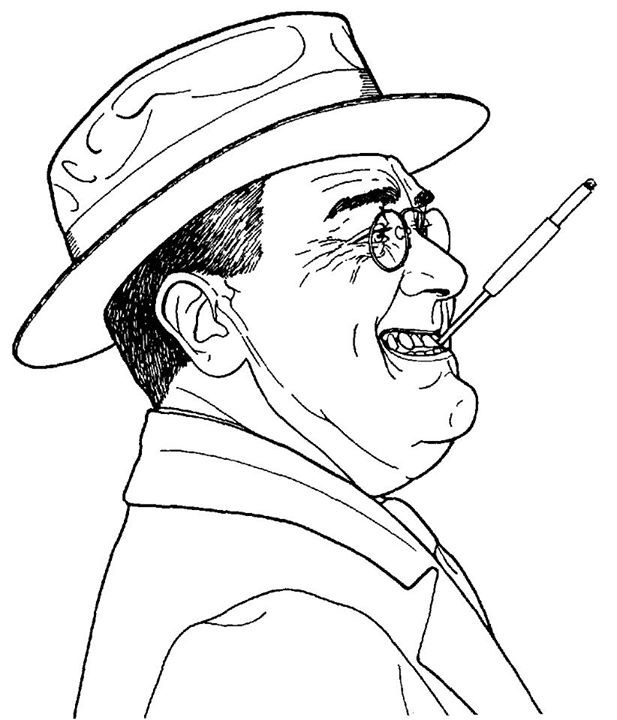
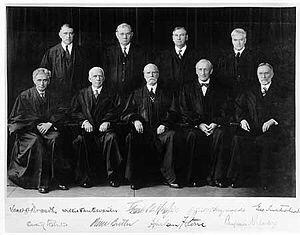 Today in History, February 5: 1937 – “The Judicial Procedures Reform Bill”. President Franklin Roosevelt had experienced much success in advancing his reformist economic agenda, trying to bring the country out of the Great Depression. However some of his New Deal actions had been ruled unconstitutional by the Supreme Court. This was unacceptable to the Democrat FDR. So….if the laws aren’t working for you…change the laws. Every President tries to “pack the court” with justices sympathetic to their party’s views…but FDR took it to a new and radical level. He had a bill introduced in Congress that would give him the power to add as many as SIX new justices for every current justice that was over 70 years and six months old. This would take the Supreme Court from 9 to 15 justices, most of them appointed by FDR. Before the legislation came to a vote, one of the justices turned to Roosevelt’s side, and his agenda began to be voted constitutional. In the end, the power-grabbing bill was rejected by the Senate. But with 3 full and one partial term as President, FDR would have plenty of time to “pack the court”.
Ain’t I a Woman? -Sojourner Truth

Today in History, February 4: 1986 – The US Postal Service issues a stamp commemorating the life of Sojourner Truth as part of the Black Heritage series.
Sojourner Truth was born a slave in upstate New York about 1797 (nobody recorded the date.) Her mother and father were from different farms (owners) and their relationship was forbidden…Sojourner’s mother never saw her father after they were separated. Sojourner was actually born Isabella Baumfree, but changed her name in 1843. In 1826, she escaped slavery; a year before it was abolished in New York state.
She was raised speaking Dutch, the language of her mother and their first owner, but she learned English later in life. Sojourner dedicated her life to the abolitionist and women’s rights causes, among others. She spoke publicly and often, sharing her experiences along with friends Frederick Douglas, William Lloyd Garrison and later Susan B. Anthony.
In May of 1851, Sojourner Truth spoke at the Second Women’s Rights Convention in Akron, Ohio. There are two versions, one recorded (written down) in 1851 and one during the Civil War. I have included the first…several sites point out this one is more likely accurate. The second uses much Southern slang which Sojourner Truth likely did not use due to her background.
“May I say a few words? Receiving an affirmative answer, she proceeded; I want to say a few words about this matter. I am for woman’s rights. I have as much muscle as any man, and can do as much work as any man. I have plowed and reaped and husked and chopped and mowed, and can any man do more than that? I have heard much about the sexes being equal; I can carry as much as any man, and can eat as much too, if I can get it. I am as strong as any man that is now.
As for intellect, all I can say is, if woman have a pint and a man a quart–why can’t she have her little pint full? You need not be afraid to give us our rights for fear we will take too much–for we won’t take more than our pint will hold.
The poor men seem to be all in confusion and don’t know what to do. Why children, if you have woman’s rights give it to her and you will feel better. You will have your own rights, and there won’t be so much trouble.”
This speech, which due to the later and more famous printing would be called “Ain’t I a Woman?” would help advance Sojourner’s fame and her cause. During the Civil War, she helped recruit black men for service in the Union Army, and conferred with President Lincoln. She would continue to fight for her causes into the 1870’s, and would die in 1883 in Battle Creek, Michigan.

