
Today in History, July 4, 1803:
President Thomas Jefferson announces the signing of a treaty in Paris formalizing the Louisiana Purchase, effectively doubling the size of the United States in one day for $15M.
Today in History, July 4, 1803:
President Thomas Jefferson announces the signing of a treaty in Paris formalizing the Louisiana Purchase, effectively doubling the size of the United States in one day for $15M.
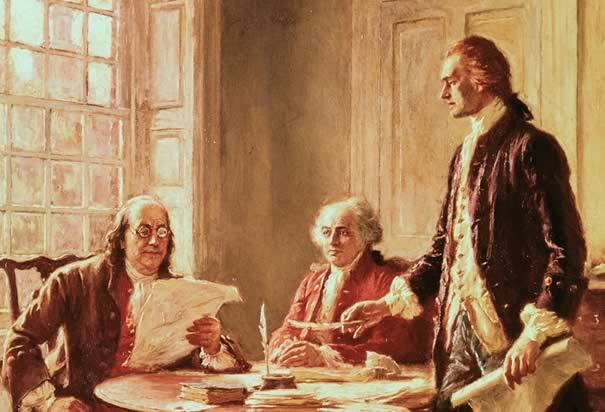
Today in History, July 4, 1776:
“We hold these truths to be self-evident, that all men are created equal, that they are endowed by their Creator with certain unalienable Rights, that among these are Life, Liberty and the pursuit of Happiness.”
The second Continental Congress adopts the Declaration of Independence from England after years of conflict as colonists.


Today in History, July 4, 1754:
During the French and Indian Wars, a young colonial member of the British Army abandons “Fort Necessity” after surrendering it to the French the day before.
The officer, 22-year-old Lt. George Washington had also commanded British forces in the first battle of the war on the American continent weeks before. The French and Indian Wars were only part of a global conflict between England and France, the Seven Years War.
His experience here would serve Washington well in our War for Independence. The conflict would also contribute to the American Revolution. The war was very expensive for the Crown, and had to be paid for to save the English economy. The colonialists considered themselves as English subjects; they fought alongside the regulars fighting the French and the Indians, many paying with their lives. After the war the government felt the colonists owed them for their “rescue.” The colonists however, felt the Crown owed them for saving British territory.
The ill feelings between the “homeland” and the colonies would only continue to multiply.


Today in History, June 30, 1921:
President Warren G. Harding nominated former President William Howard Taft as Chief Justice of the Supreme Court of the United States after the death of the previous Chief Justice, Edward Douglass White…who Taft had nominated when he was President.
The irony is that Taft never wanted to be President…he became such as the result of the efforts of President Theodore Roosevelt…one of his closest friends.
TR then turned on him vociferously when Taft didn’t carry out TR’s policies to his liking. Taft was crushed by the attacks by his friend…but in the end, he obtained the job he had wanted since he was a child…Chief Justice of the Supreme Court of the United States…years after being President.
Taft’s history in the law and government made him very well qualified for the job.
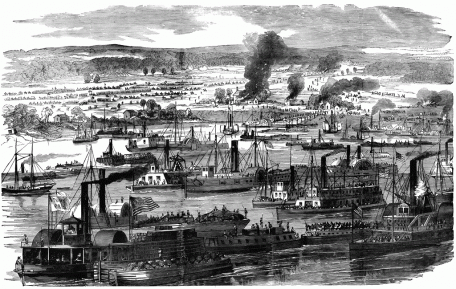
Today in History, June 28, 1862:
Union soldiers inadvertently burn the White House. No, not that White House. In fact, the Executive Mansion which housed the President wasn’t known by that name until 1902 when President Theodore Roosevelt renamed it.
Another difference between these “White Houses”, is that George Washington never resided in the Presidential Mansion along the Potomac. His successor, John Adams was the first President to live there.
But he courted and married the widow Martha Custis at and near the White House on the Pamunkey River.
One of General Washington’s officers was Henry “Light Horse Harry” Lee. His son, Robert E. Lee, would marry Martha Custis-Washington’s granddaughter, Mary.
Together they would live in Arlington House, overlooking the Potomac…and the Executive Mansion. When the Civil War began, Robert E. Lee chose to support “his country”, Virginia; which also meant the Confederacy. As a result he and his family had to leave Arlington House and move to one of their more southern Virginia properties…the White House on the Pamunkey.
As the Union dead mounted, Union Secretary of War Edwin Stanton ordered the area around Arlington House to be used as a cemetery so that Lee could never again live there. Today it is Arlington National Cemetery.
In 1862 during the Seven Day’s Battles, Union forces pushed the Confederates back past the Lee family’s new home at White House Landing, using it as a major supply base.
Before she fled further south from yet another home, Mary Lee left a message on the door of the residence, “Northern soldiers, who profess to reverence Washington, forbear to desecrate the house of his first married life, the property of his wife, now owned by her descendants.”
Union soldiers agreed. General George McClellan ordered a guard to posted around the house to prevent looting or vandalism.
McClellan took a lot of heat from the press and DC for the protection of General Washington’s one-time home. It should be used as a hospital for Union soldiers! Even though it had but six rooms.
As was frequent in the Civil War, the lines moved back north after moving south. And on this date in 1862 Confederates took White House Landing back. As the Union Army fled, McClellan ordered all supplies and outbuildings burned to prevent their use by the Confederates…with the exception of the White House, it was to be spared.
As often happens in war, orders from the top rarely get carried out to the letter. The White House was burned to the ground.

Today in History, June 27: 1829 – Strange that we should be thankful that Henry James Hungerford died childless in 1835. On this date in 1829 a British scientist who had never set foot on American soil died in Genoa, Italy. James Smithson was a wealthy man. He wrote in his will, “In the case of the death of my said Nephew without leaving a child or children, or the death of the child or children he may have had under the age of twenty-one years or intestate, I then bequeath the whole of my property… to the United States of America, to found at Washington, under the name of the Smithsonian Institution, an Establishment for the increase & diffusion of knowledge among men.”….
So thanks to James Smithson’s eccentricity, which he never explained, and the untimely death of his nephew, the US came into possession of over $500,000.00 in funds dedicated to research and learning. President Andrew Jackson sent a diplomat to receive the funds, President James K. Polk signed the bill creating the Smithsonian Institute once Congress agreed how to use the money. President Theodore Roosevelt saw to the movement of Smithson’s body from Italy to “The Castle” of the Institute in 1904. Smithson was escorted from Genoa to Washington by none other than Institute regent Alexander Graham Bell and his wife. Today the Smithsonian has 19 museums and the national zoo, including the National Aeronautics and Space Museum, the most visited museum in the world. Thank you, Mr. Smithson.


Today in History, June 25, 1913:
“We have found one another again as brothers and comrades in arms, enemies no longer, generous friends rather, our battles long past, the quarrel forgotten—except that we shall not forget the splendid valor.” –President Woodrow Wilson.
The Great Civil War Reunion at Gettysburg, Pennsylvania. Nearly half a century after the end of the Civil War, aged men and women who had been sworn enemies, who had lost loved ones on both sides of the great conflict, began to gather at Gettysburg for a reunion to honor those they had lost…and each other.
Men missing limbs commiserated with each other, slapped backs, shared stories, joined together as brothers…Union, Confederate, White, Black, recognized that the War was history and they were comrades again. If men and women that were so committed to killing each other could do this….can’t we?
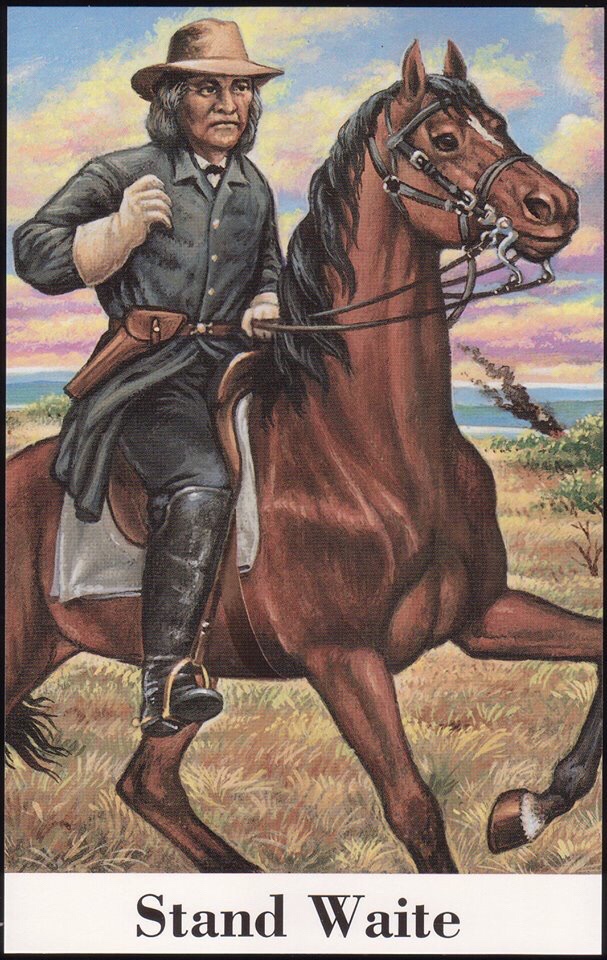
Today in History, June 23, 1865:
The last Confederate General surrenders to Union authorities. Cherokee Chief and Confederate Brigadier General Stand Watie surrendered his Cherokee Rifles Cavalry Brigade at Ft. Towson in Oklahoma Territory.
Watie had a checkered past…he was one of the Cherokees that voted for the law that moved the tribe to the Oklahoma Territory, and part of his family was assassinated as a result. He competed with Chief John Ross for the leadership of the tribe…Watie was a slave owner, Ross was a Union sympathizer. Watie and his unit were important in the Battle of Pea Ridge, Arkansas also.

Today in History, June 19, 1864:
The Battle off Cherbourg. In 1861 the screw sloop CSS Alabama was launched in England, which was just the beginning of the intrigue involving the Confederate cruiser that wreaked havoc on Union shipping until her demise on this date in 1864.
The British gov’t had ordered no ships be built or sold to the rebels, but the company that built the Alabama did so clandestinely. During the intervening years the Alabama, which had both steam engines and sails, circled the globe sinking Union merchant shipping (60 at least) and a Union warship.
She had put in at Cherbourg, France for much needed repairs, but was rebuffed. Before she could leave, the Union screw sloop USS Kearsarge arrived outside the harbor.
Capt. Charles Pickering and many other Union Captains had been searching for the infamous Alabama and Capt. Raphael Semmes for years. Semmes set out to engage the Kearsarge, firing the first shot. The two ships parried, but the Kearsarge had some advantages; powerful new “Dahlgren” guns and chains draped over her sides for protection. Within an hour the Kearsarge’s crew sent the Alabama to the bottom. Semmes escaped on a passing British ship to England with 41 of his crew.


Today in History, June 19, 1944:
Reversal of Fortunes, exhibited by “The Great Marianas Turkey Shoot”, or the First Battle of the Philippine Sea.
US Marines, supported by their parent service, the US Navy, are invading Saipan and other islands in the Marianas Islands, which is such a threat to Japan that the Imperial Japanese Navy finally comes out to fight a definitive battle.
When the war began the Japanese had the most advanced aircraft available, while the US Navy lagged sorely behind. The Japanese Zero, for example, was much faster and more maneuverable than the American Wildcat fighter. But by 1944 the American industrial complex had engaged fully. As late as 1943 the USS Enterprise stood alone in the Pacific against numerous IJN Carriers.
But by June of 1944 the Americans put to sea 15 Aircraft Carriers in 4 Task Groups equipped with modern aircraft that far out matched Japan’s aircraft, which had not been updated since the war began. In addition, Japan’s air service had lost nearly all of it’s experienced pilots, while the Americans had thousands of combat hardened, well-trained pilots and crews.
When the IJN sent it’s carriers and their crews against TF 58, they were massacred. In two days the Japanese lost over 400 aircraft and their crews, 3 aircraft carriers they could not spare, and the Americans lost 29 aircraft (some of the crews were rescued) and no ships. So many Japanese aircraft fell from the skies that a Lexington pilot referred to it as an old time turkey shoot, and the name stuck.
The air crews of the task force had been launched late in the day on the 20th to attack the Japanese fleet. When they returned, it was well after dark and they began landing their planes in the sea, unable to see the carriers well enough for landings aboard.
With the threat from enemy submarines and aircraft during the war, blackout conditions were the rule. Admiral Marc Mitscher wasn’t going to lose his boys and their planes, however. With his order the fleet lit up, and the planes began landing on fumes.
 Mark Loves History!