Assassination Connections

Today in History, February 15: 1933 –

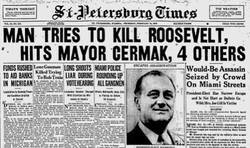
Assassination; Courage; and links between courageous Presidents. President elect Franklin Delano Roosevelt gives a speech, from his car (he is crippled, though few know it), in Bayfront Park in Miami, Florida. Standing on the running board of the car was a political ally, Chicago Mayor Anton Cermak.

Nearby a 5 foot, unemployed Italian immigrant bricklayer stands on a chair so that he can see the soon to be president, and fires his revolver. Instead of FDR he strikes Cermak before a woman standing beside him attacks him…and his next four shots injure standersby instead.

Within weeks Cermak dies…and the assassin will die by execution. Stories will go forward about whether FDR was the intended target, or Cermak, who was at the time fighting the Chicago mob.

What I find most interesting is the extended story. The crowd was about to beat the assassin to death in a bloodlust…Franklin calmed them…the suspect should face a court of law. FDR then directed that the Chicago mayor be loaded into his car, and cradled him in his lap as he was rushed to a nearby hospital. Cermak would die, the assassin would be executed…but FDR’s courage would inspire the nation.

FDR had adored his distant cousin, Theodore Roosevelt. TR had been shot in the chest while campaigning for the Presidency in Milwaukee, Wisconsin (by an insane immigrant)discouraged the crowd from abusing the would-be assassin…and continued on to finish a lengthy speech before seeking medical attention…he was a Bull Moose.

When he was a young boy in 1865 in New York, Teddy Roosevelt had watched from the window of a New York apartment as the body of his idol, President Abraham Lincoln, passed by in a funeral escort after he was assassinated in Washington, D. C. Lincoln had been discouraged from public appearances, including at Ford’s Theater, and responded to the effect that if someone wanted him dead, they would find a way. Our history is not nearly as disconnected as we think, and courage comes from knowledge and perspective.
“The Light Has Gone Out Of My Life”

Today in History, February 14: 1884:

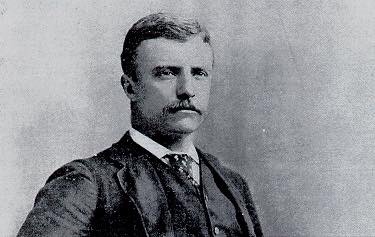
25 year old Theodore Roosevelt was at work in the New York Assembly in Albany fighting for a reform bill when he received an urgent telegram to return to his home in New York.

When he reached his front door his brother Elliott greeted him, “There is a curse on this house”.

Their mother Mittie was suffering from Typhoid fever, and Teddy’s wife Alice, who had given birth to her namesake just two days earlier, was suffering from Bright’s Disease. TR went up and down the stairs to be with both of them.

Mittie died first, followed within hours by Alice. Roosevelt was devastated.

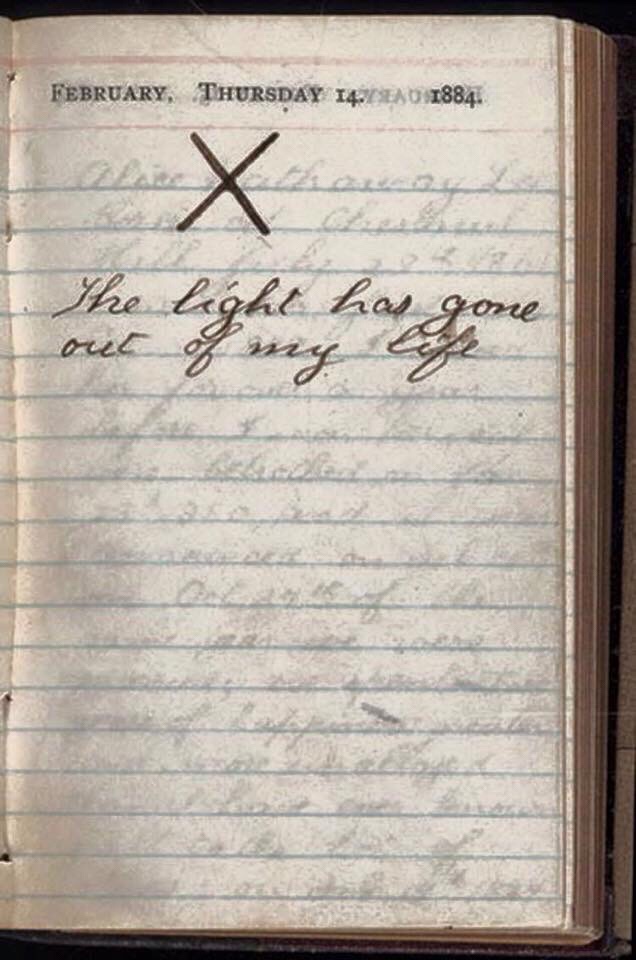
His diary entry for that date was simply a large X and the note, “The light has gone out of my life”.

He could never speak of his first wife again, not even mentioning her in his autobiography. When he returned to the legislature, even his detractors treated him with deference for a time because of the tragedy.

He soon left the Assembly, left the infant Alice with his sister Bamie and struck out west to the Dakotas to escape. He would become a rancher and a sheriff, and make many friends who would later be “Rough Riders” with him. In ’86 he returned east, re-entered politics and re-married. His daughter Alice became famous for outlandish behavior, dealing with her own demons due to the temporary abandonment and a new family.

Adversity affects us all differently. One has to wonder if TR would have accomplished all that he did if this tragedy hadn’t driven him west and altered his life.

Strategic Bombing – Dresden to Rolling Thunder

Today in History, February 13: 1945:

British bombers stage a night attack on Dresden, Germany. Later American bombers would stage a daytime attack. Most recent studies indicate 25,000 civilians died, not 500,000 as the Nazis claim.

What is a fact is that the incendiary bombs caused a firestorm that destroyed most of the city.

1965: President Johnson authorized “Operation Rolling Thunder”, the strategic bombing of targets in North Vietnam in an attempt to stem the tide of enemy troops and supplies streaming into the combat zone. More tonnage of bombs would dropped than in WWII before the operation was called off in 1968.

Submarine on Submarine…The USS Batfish

Today in History, February 12, 1945:

The USS Batfish, an American Balao class fleet submarine, sinks it’s second Japanese submarine within three days. She would sink three Japanese submarines during her WWII career.

Sinking another submarine is quite an accomplishment, accounting for range, depth and speed with the technology of the time.

The Batfish had an active Naval career. If you’d like to see her, she lives on as a war memorial in Muskogee, Oklahoma. We’re pretty proud of her.

http://www.history.navy.mil/danfs/b3/batfish-i.htm

The Real “First” World War?

Today in History, February 10: 1763 –

“The Seven Years War”, or as it was known in the colonies, “The French and Indian War” ends with the Treaty of Paris. Britain and France had been battling for years in America, Europe, India and on the high seas over their competing imperial interests. Spain had taken sides with France. Both Britain and France had their allies in what could be considered a World War.

After several British victories on land and at sea, and after several of France’s allies had signed separate peace treaties, France and Spain finally came to the table. France gave up several of her holdings including in Canada, America and India.

The Spanish received the Louisiana Territory, the British received Spanish Florida.

Probably the most important issues for the American colonies however, are these: Many Americans, such as George Washington, gained extensive military experience fighting the French and their Indian allies during the war. And when Americans decided less than two decades later to fight for their independence from the British Crown, the French had a grudge to settle; it wasn’t that difficult for Ben Franklin to convince France to come in on the side of the Colonials. French Naval might was pivotal to the American victory.

US Weather Service

Today in History, February 9: 1870 –

President US Grant signs a joint resolution of Congress creating The US Weather Bureau. The Bureau was initially placed under the Secretary of War, in the belief that weather watch stations placed on military bases across the interior would give warning to the east coast of approaching weather fronts. The Bureau had several incarnations as it grew with technology. Today it is part NOAA, the National Oceanic and Atmospheric Administration…the Bureau has saved countless lives with it’s continued advancements in warning capabilities.

A Happy Home

Today in History, February 7: 1867 –

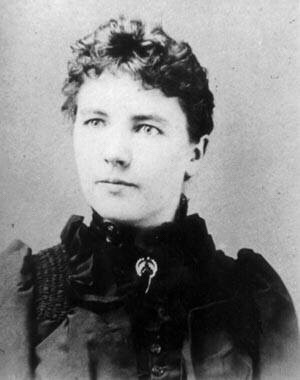
“Pa and Ma always managed to create a happy, secure home wherever they lived–whether in the little log cabin in the woods near Lake Pepin, Wisconsin, on the prairie near the Verdigris River in Indian Territory, the sod dugout by Plum Creek in Minnesota, the surveyor’s house on Silver Lake, the homestead shanty on the claim, or in Pa’s house in the brand-new town of De Smet in Dakota Territory.”

Laura Ingalls-Wilder is born in Wisconsin. Her children’s books would bring the frontier prairie home to millions.

http://memory.loc.gov/ammem/today/today.html

“The Way to Disarm is to Disarm” -US Sec of State Charles Evans Hughes

Today in History, February 6, 1922:

The Washington Naval Treaty of 1922 is agreed to by the remaining Navy powers from WWI. It would be a year until all the signatories had done so, but their representatives in DC made the agreement today.

It should have been perfect, as it had that one thing necessary for a successful negotiation: Everyone agreed, nobody was happy.

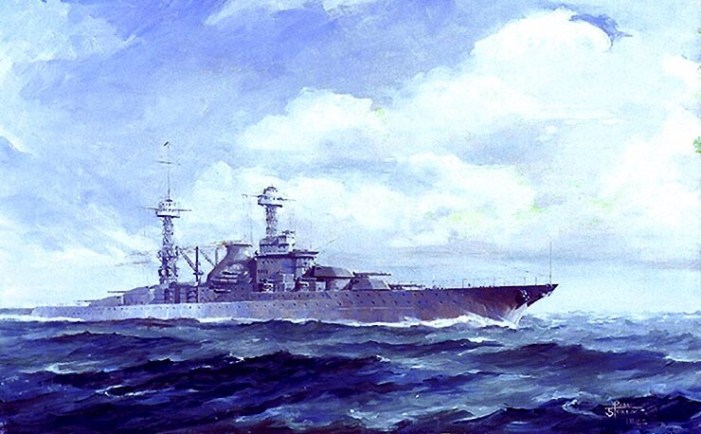
It agreed that certain capital ships would be limited by number and tonnage. Battleships and Battlecruisers would be limited.

The ratio of Navy size would be 5-5-3-1.75-1.75…England-US-Japan-France-Italy. So you can see why nobody was happy.

This was the nuclear limitations treaty of the 20’s.

Here are the many consequences of the treaty:

New Battleships could only be of a certain tonnage with guns no more than 16 in. In the mid 30’s Japan began ignoring the limitations, so for the beginning of WWII, American BB’s were seriously undersized compared to the monsters Yamato and Musashi. But that wouldn’t last long.

After WWI several of the nations had battlecruisers under construction…they could either scrap them or convert them to “less valuable” warships…Aircraft Carriers. This were born Akagi, Kaga, Lexington and Saratoga. More carriers of limited tonnage could be buit…this were born the Ranger, Yorktown, Enterprise and Hornet; Shokaku, Zuikaku and others.

After nearly two decades of intrigue, cheating, etc, as a result of the Washington Naval Treaty, Japanese flyers sank obsolete Battleships at Pearl Harbor, with planes from carriers.

The American carriers who amswered back, and unfortunately the USN and IJN traded losses fairly evenly…until only one US Carrier was left to counter the Japanese fleet in the Pacific.

But as the Japanese sailors in DC in 1922 had predicted, due to massive American industrial might, within a year of that carrier finding herself alone, the Enterprise was joined bu over a dozen modern, huge carriers of the Essex class and fast new Battleships.

Heroism and Sacrifice

The date is off for today’s post. My extended family is mourning the loss of yet another first responder in Colorado. So my mind went back to some other Colorado heroes who affected me and so many others years ago. I had to share it in their memory and in the honor of my Colorado LE family.

Today in History, July 31: 1976 –

The Big Thompson Canyon Flood. While Colorado was celebrating its Centennial, a highly unusual thunderstorm broke out high in the mountains, near the source of the Big Thompson Canyon in northern Colorado.

The storm deluged the canyon with the equivalent of 3/4’s of the areas annual rainfall in a matter of hours. It sent a wall of water 20 feet high racing down the canyon; residents and tourists miles away from the storm near the mouth of the canyon had no idea there was a storm higher up, much less a torrent of flood water headed their way. 144 died.

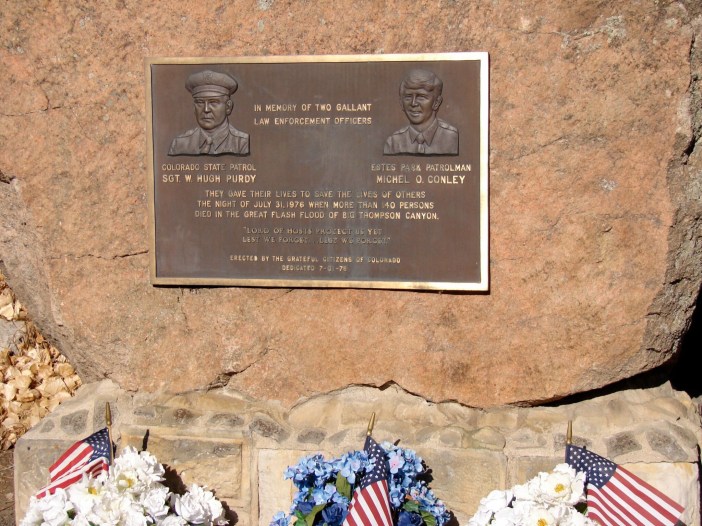
Colorado State Trooper Sgt. W. Hugh Purdy and Estes Park Officer Michel O. Conley were advised of the approaching flood. Remember that this before cel phones and other mass media, most of which wouldn’t have worked in the canyon anyway.

These men drove their patrol cars up the canyon, telling people to flee using their public address systems, with full knowledge of what they were doing….until they met the water and were killed.

I saw this memorial while visiting relatives in Greeley, CO as a teen. These men are part of the reason I’m a cop. God bless them and their families.