The Mob Whacks Dutch to Protect a Lawman

1382326_4851981196171_1099061748_n

Today in History, October 23: 1935 – The Chophouse Massacre. Gangster and racketeer Dutch Schultz and several of his crew are gunned down in his “headquarters”, the Palace Chophouse in Newark, New Jersey by 2 hit men from Murder, Inc. I find the interesting part of the story in why he was killed, and the future of another man involved. Schultz had been prosecuted twice by a very talented and aggressive US Prosecutor, Thomas Dewey. Schultz had gone to his fellow Mafioso and sought permission to assassinate Dewey. When they declined, afraid the full weight of national law enforcement would be brought to bear on them, Schultz was furious and made plans to kill Dewey anyway. That’s when the decision was made that Schultz had to be eliminated. Schultz’s death and Dewey’s survival meant that Dewey would become the NY DA, NY Governor, and would run for President 3 times. In 1948 it was so much assumed he would win that the Chicago Tribune ran the headline “Dewey Defeats Truman”, a paper that the real victor, Truman, held up for a famous photo…relegating crusading prosecutor Thomas Dewey, known for his photographic mind that helped him tear apart suspects on the stand, who so angered the Mafia that they wanted to kill him, to a punchline for most. This is why I like finding the links in history

Communication is Key to Development

12065543_10203482440460436_7320918058428442627_n

Today in History, October 24: 1861 – The Transcontinental Telegraph in the US is completed at Salt Lake City, Utah by the Western Union Telegraph Company, operating under a $40,000 per year subsidy. The logistics of the construction had been daunting. Glass insulators and wire had to be shipped by sea to California, the hauled by wagon over the mountains. Similarly, there was no source for the thousands of tall poles on the plains, and these too had be hauled long distances. The connection of the pre-existing eastern and western telegraph systems would spell the end of the 18-month-old Pony Express, and would bring near instantaneous comminication between Washington and California. The importance of this during the Civil War was recognized before construction began.

On the Brink of Armageddon

Today in History, October 22, 1962:  President Kennedy announces in a speech from the Oval Office that the Soviet Union has placed nuclear missiles in Cuba, only 90 miles from Florida.  Any city within the United States could be destroyed within moments.

President Kennedy announced the US Navy was conducting a “Quarantine” of Cuba, another name for a Blockade, which “could” be considered an act of war.  He also made clear that any missile launched from Cuba upon any nation in the Western Hemisphere would result in an attack on the Soviet Union.  Could this be interpreted as enforcement of the Monroe Doctrine?

Today we are experiencing stressful times, a showdown with North Korea.  We’ve been here before, even worse.  We are made nervous by the rhetoric voiced by our government.  President Kennedy kept us safe by letting the Soviets and Cuba know the consequences would be dire if they acted in bad faith.  At that time Castro and the Soviet government were viewed as “madmen” much as Kim is today.

Horror


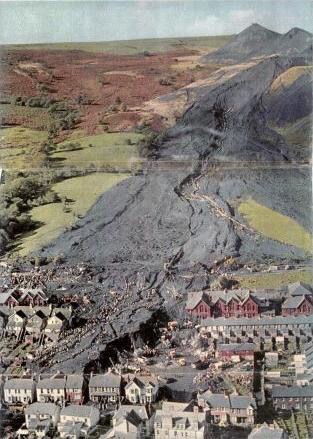
Today in History, October 21: 1966 – The Aberfan Disaster. For 50 years British mining companies had been piling earthen debris dug out of nearby mines in “tips” or piles on the mountain above the village of Aberfan in Wales. After several days of rain, tip #7 gave way, and tens of thousands of cubic meters of a slurry swept down the mountain into the village in minutes. There was no time to warn the fog covered village, whose residents could hear the roar of the landslide, but could not see it. The local school was covered in at least 33 feet of muck, killing 116 children and 28 adults. Panicked parents clawed at the debris covering their children with their hands desperately trying to save their children.

US Doubled


Today in History, October 20: 1803 – The Louisiana Purchase is ratified by the US Senate. When Spain returned the Louisiana territory to France in 1800, President Jefferson became concerned that France would cut off access to New Orleans and sent emissaries to attempt the purchase. Napoleon Bonaparte was cash strapped in the midst of a war with the English, and didn’t want to deal with the far off territories at that point…so he agreed to sell the territory for $15M, or 4 cents per acre. Some members of the Senate actually criticized Jefferson, saying that he had spent a vast sum on a wasteland. Nonetheless, the treaty was ratified and the territory of the United States more than doubled overnight.

America’s First and Real “Yes We Can”


Today in History, October 17: 1777 – 

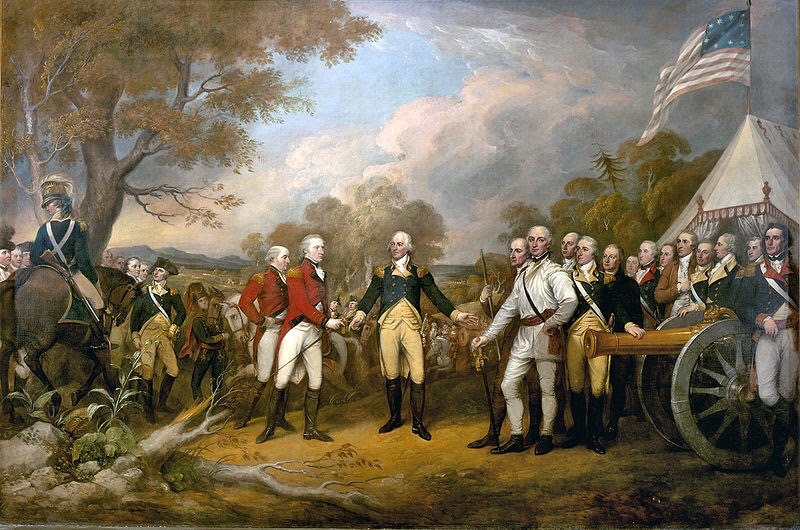
Surrender of British Army at the Battle of Saratoga. British Gen. John Burgoyne was leading an army of 8,000 British regulars south from Canada to meet up and combine forces with Gen. Sir William Howe on the Hudson River. 

 His army clashed with the American army several times, and finally had to take refuge in the village of Saratoga, NY. With about 5,000 of his troops left, surrounded by nearly 20,000 American troops, he had no choice but to surrender the largest British force to that date to the “Colonials”. 

 The battle showed the world that the Americans could defeat the British in combat, which gave France and Spain the confidence to enter the war and provide supplies, soldiers and naval support to the Americans. Their support was instrumental in winning the war, thus Saratoga is seen as a turning point in the Revolution.

The CSS Hunley Sinks – For the Second Time


Today in History, October 15: 1863 – 

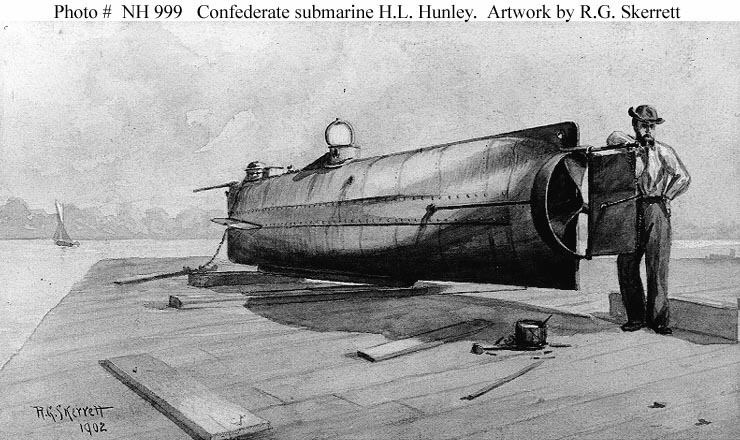
The first successful (after a fashion) submarine, the CSS Hunley, sinks in Charleston Harbor. It was the second time the sub had sunk. Earlier it had gone down in Mobile Bay, killing two of it’s crew. 

 It was salvaged and transported to Charleston by train, to be used in an attempt to break the Union blockade of that port. The sub’s creator, Horace Hunley, took her out for a test run with a new crew. In front of onlookers, the sub slipped beneath the waves, and never surfaced. Hunley and 7 crewmembers died. 

Nonetheless, the sub was once again salvaged and yet another crew took her out in February of 1864. They placed a torpedo (mine) against the USS Housatonic and backed away; the explosive sank the Union ship. But the Hunley never made it back to port, sinking for the final time, taking another crew with her. She was raised in 2000.

“It Takes More Than That to Kill a Bull Moose”


Today in History, October 14: 1912 –

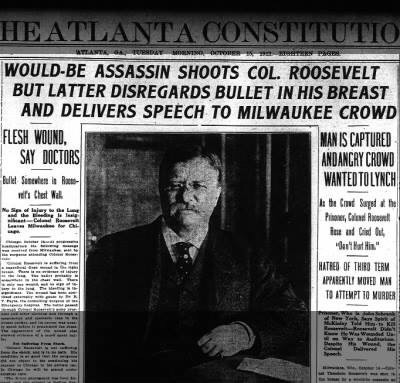
 “Ladies and gentlemen, I don’t know whether you fully understand that I have just been shot; but it takes more than that to kill a Bull Moose.” 

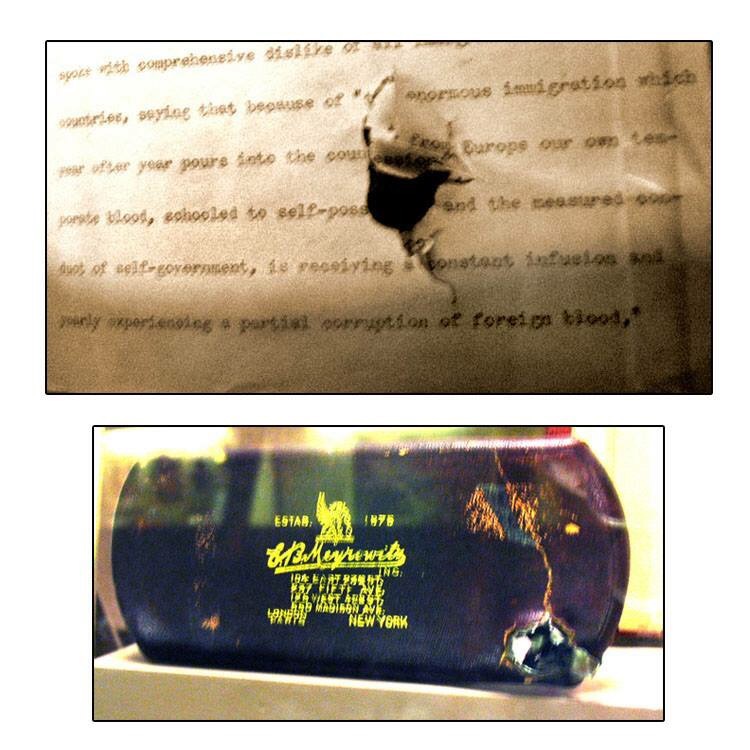
 As he is leaving his hotel in Milwaukee to give a campaign speech, former President Theodore Roosevelt is shot point blank by a would-be assassin. The bullet went through TR’s glasses case, the 50 page speech he had in his jacket, and penetrated his chest. 

 An experienced hunter, Teddy decided that since he wasn’t coughing up blood, he wasn’t in immediate danger, as he reasoned, because the bullet hadn’t penetrated his lungs. 

 He continued on and spoke for over an hour, blood still seeping from his chest wound. Afterwards he finally went to the hospital. The incident not only gave evidence of his strength and resolve, but gave a name to the party he was representing.


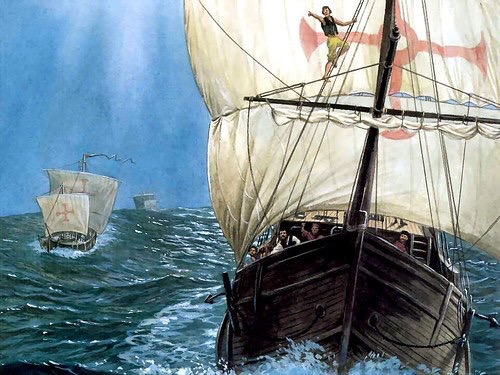
Today in History, October 12: 1492 – Three ships, the Nina, Pinta, and Santa Maria, commanded by Christopher Columbus, discover the New World. Columbus went ashore on one of the Bahama Islands and claimed it for his sponsors, King Ferdinand and Queen Isabella of Spain. He continued on to find Cuba and Hispaniola in the days ahead, which he thought were Cathay (China) and Japan respectively. The expedition believed they had accomplished their mission of finding a western trade route to the far east. He would bring back riches to Spain that would set off a competition for new lands in the New World by the major powers of Europe.

Millions would die in the years to come due to disease brought on by the meshing of multiple cultures who had no immunity to each other. Also due to the Europeans using the indigenous peoples as slave labor. 

Should we honor Columbus and his contemporaries as heroes?  Or demonize them for their abuses?  It is possible to recognize both. History is what it is and should be studied that way. 

Columbus, the Vikings, Hudson, Magellen, etc, etc. The Americas were going to be discovered and settled by what were then foreigners. 

The atrocities which occurred did not have to have occurred. Columbus statues should not be removed…they are history. Instead, lets also recognize people who have previously been forgotten to history whose stories are just as important.