
 Today in History, March 19: 1916 – First US Air Combat mission. American hero John Joseph “Black Jack” Pershing leading is an expedition into Mexico to seek out Pancho Villa. On today’s date in 1916 the first US air combat mission is carried out by the First Aero Squadron over Mexico, to provide information for Gen. Pershing. Black Jack was not only the first to use the mechanized power of aircraft, he also was in command as young George S. Patton first used automobiles in combat…a precursor to his use of the tank invented in England. So Gen. Pershing led America into mechanized warfare after having served in the US Army through Indian campaigns and the Spanish-American War.
“Crimes” and Punishment
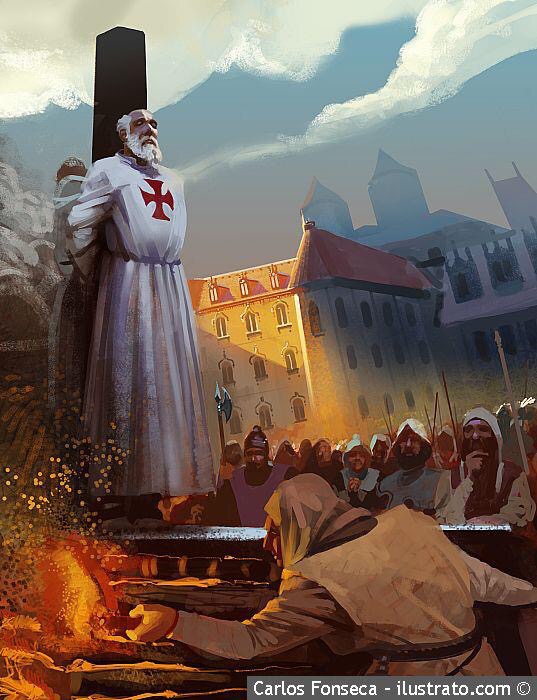
Today in History, March 18: 1314 – Jacques de Molay, Grand Master of the Knights Templar, and Geoffroi de Charney, Master of Normandy, are taken to an island in the middle of the Seine and very slowly burned to death. The Templars were men from wealthy European families that took vows of devotion to God, and fought in the Crusades. In the process, the Templars amassed a lot of property and wealth, all owned by the order, as the Knights themselves took a vow of poverty. French king Phillip IV was in a fix…the royal coffers were all but empty and he owed an incredible sum to the Templars. To fix his problem he accused the Knights of heresy, saying that they did several things against God during their initiations. He ordered them arrested and seized their wealth; now he had their money and their property, and no longer owed them anything. Many were burned at the stake. The others were imprisoned while Phillip and the Pope went back and forth over what was to be done with them. de Molay was tortured and eventually confessed to his “crimes”. When later questioned by Cardinals, he recanted the confession. After languishing in prison for 7 years, he and the others were brought out into public and sentenced to be imprisoned for the remainder of their lives. de Molay and de Charney both stood and publicly stated that the only crime they had committed was to betray the order by making false confessions to save their own lives. Phillip was enraged. While the Cardinals sent by the Pope discussed this new development, he had the two troublesome Templar leaders taken to Isle de Juifs, secured to scaffolds, and slowly burned; if they “confessed” again, they would be spared. de Molay remained calm and stoic, refusing to betray his Order again. How often have we seen the corrupt accuse the righteous of committing crimes to cover their own?
Happy Saint Patrick’s Day

Today in History, March 17: 1780 – “The General directs that all fatigue and working parties cease for to-morrow the SEVENTEENTH instant,” read the orders, “a day held in particular regard by the people of [Ireland].” General George Washington’s Army was bedded down amidst 6 foot snow drifts, suffering through the worst winter on record…even worse than Valley Forge. Recently the Irish, who were also in rebellion against the Crown, had declared themselves AMERICANS in solidarity with the American colonists that were fighting for their independence. At least a quarter of Washington’s army was Irish…and a vast majority of his commanders shared that distinction. So GW decided that St. Patrick’s Day…(not Christmas, nor Easter)…would be a day of rest and celebration for his army.
US Military History – One Family


Today in History, March 16: 1802 – Connections through history. The US Congress approves legislation creating the United States Military Academy at West Point, New York…now one of the oldest military academies in the world. The post had been created during the Revolutionary War on the Hudson River…Gen. George Washington at one time used it as his command post…and Gen. Benedict Arnold betrayed his country when he connived with the British in an attempt to give up the post. Just creating the USMA was controversial for a nation that didn’t even believe in having a standing Army. It’s initial purpose was primarily to teach Engineering. My military friends can tell us how important engineering is to military operations. One of the first superintendents of the USMA, Sylvanus Thayer, is credited with establishing the high standards now famous for West Point. One of his instructors, Dennis Hart Mahan, so impressed with Thayer, named his child after him…Arthur Thayer Mahan…who would go on to be the author and creator of US Naval strategy in the 19th and 20th Centuries, writing, The Influence of Sea Power Upon History, which influenced the creation of modern navies.
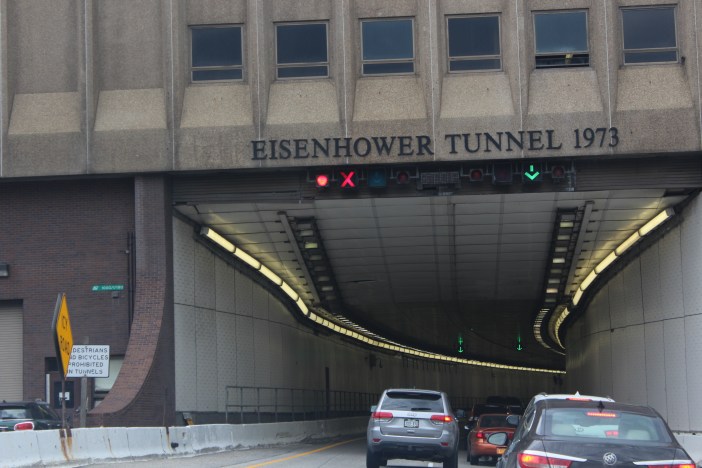
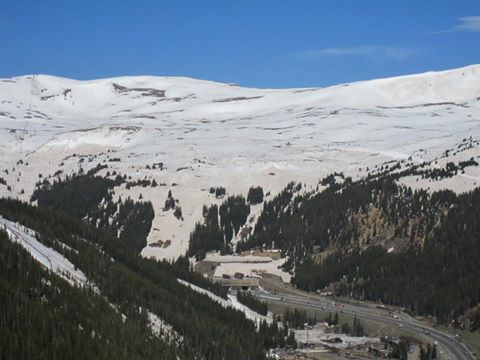
Today in History, March 15: 1968 – Construction begins on the Eisenhower Tunnel west of Denver, Colorado. The highest vehicle tunnel in the world, the tunnel cuts 1.6+ miles at over 11,000 feet, cutting through the Continental Divide and connecting Interstate 70. It takes much longer, and is much more dangerous to cross the Divide by driving over the mountain. The tunnel was named after President Dwight Eisenhower, who was President in the 50’s when the Interstate road system was begun. As a young Army Major in 1919 Eisenhower had been involved with a transcontinental convoy that traveled from Washington, DC to San Francisco. The convoy averaged 5 mph and faced much difficulty in navigating the country’s poor road system. This experience is why creating a modern, safe road system was one of President Eisenhower’s primary goals.
A Legacy of Unintended Consequences


Today in History, March 14: 1794 – You never know what your legacy will be. Eli Whitney is granted a patent for his cotton gin (engine), although the patent wouldn’t be free and clear of legal suits until 1807. Whitney was emigrating south to S. Carolina when a fellow passenger, the widow of Revolutionary War hero Gen. Nathanael Greene, convinced him to go to her Georgia plantation instead. It was here that he and his partner, with help from Mrs. Greene, would develop the machine that changed the process of removing seeds from cotton from laborious to simple. As a result of Whitney’s innovation the South’s cotton exports went from less that 500,000 lbs in 1793 to over 93 million in 1810. It had another effect not intended. Slavery had been of waning use in the late 18th century…but with “King Cotton”, the Antebellum South’s burgeoning economy needed labor, and slavery became an integral part of their livelihood, dashing the hopes of those abolitionists who expected it to die out. In the meantime…all of the legal wrangling over his invention left Eli broke. So to make money he turned to making weapons for the government. While he was not the originator, he was an avowed proponent of using inter-changeable parts…which would eventually influence the industrial revolution. So…both of Whitney’s successes greatly influenced (contributed to?) the Civil War and the nation’s development long after his death in 1825. The Civil War began about state’s rights…but about the right to keep slaves by those states. Expansion westward in the South was mostly about beginning new plantations…hence more slaves. And I’m sure many of Eli’s muskets survived for use in the war. None of which was likely on this little known inventors mind as he worked his trade.
Uncle Sam

Today in History, March 13: 1852 – The first cartoon image of Uncle Sam appears in “The New York Lantern” newspaper, drawn by cartoonist Frank Henry Bellew. Uncle Sam had been used to represent the US Government for years, becoming most popular during the War of 1812, but Bellew’s was the first cartoon to portray him. The cartoon was critical of the US government, expressing that “John Bull” (representing the British government) was helping the US shipping industry while Uncle Sam stood by and did nothing for the industry. The use of Uncle Sam became popular when Samuel Wilson, who provided meat products to the military during the War of 1812. He stamped the products with “US” for United States. However when someone asked a worker what it stood for, the reply was “Uncle Sam” (for Sam Wilson). The moniker stuck.
The First “Fireside” Chat


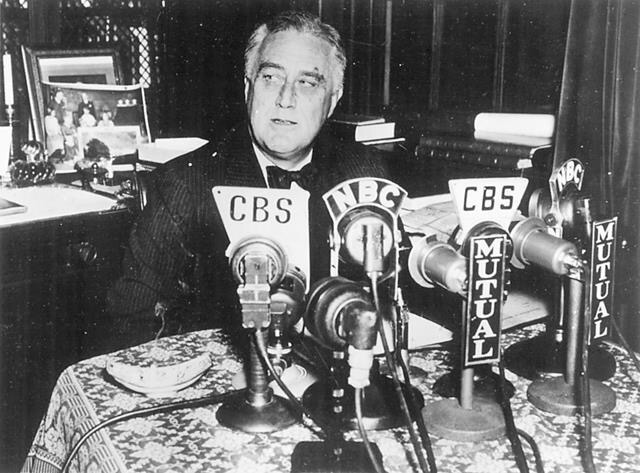 Today in History, March 12: 1933 – President Franklin Delano Roosevelt holds his first “Fireside Chat” with the American public. We must set the historical stage to begin with. Get rid of your cell phone; you don’t have a computer, nor a television. Chances are, you don’t have a telephone at all. You have, however, scrimped, and saved so that you could buy a radio for your family. Each evening you and your family huddled close to the large box that conveyed sound from all over the country. Last week the President unilaterally closed every bank in the country because people were panicking and making “runs” on the banks during the Great Depression. Today, after the panic had calmed down, he re-opened the banks. And tonight, he spoke to his “friends”, as if he were sitting in their living rooms by the fire, to explain his actions with his calming, melodious voice. He was the first President that was able to do so…and FDR was a master politician, a master at making his listeners believe that he was actually sitting next to his fire in a rocker chatting with his friends. Although he was certainly upper class, he spoke in common language so he could relate to all walks of life. In reality he was sitting at his desk in the oval office, speaking into several microphones, surrounded by wires. He calmed the American citizens, as he did 31 more times in “fireside” chats until 1944 through financial strife and World War. I wonder what his cousin TR would have done with this medium; I also wonder what it would be like to live in a “simpler” time…I say that because our values were more focused then, not because our parents and grandparents dealt with less complicated problems…that is certainly not the case. Some reading this could school us on their feelings as children during those times. The rest of us can only imagine that it was new and amazing for the President to speak to you directly.
Bipartisan Service


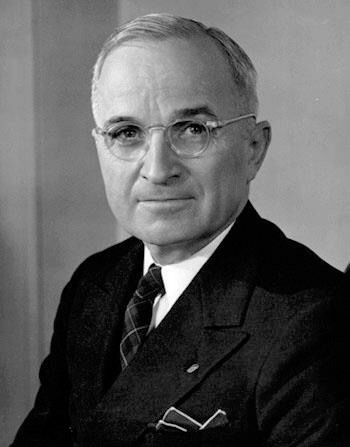 Today in History, March 11: 1947 – Democrat President Harry Truman writes a letter to former Republican President Herbert Hoover, thanking him for his efforts in helping to save Europe…for the second time. It is so interesting looking at history absent the biased perspective we’ve grown accustomed to. Most of us know Hoover…you know, “Hooverville’s” full of starving people, the man who was asleep at the switch and helped caused the great depression. The story is never as simple as we are told. Hoover made it to the Presidency because after WWI, he organized the assistance of a starving war-torn Europe, demonstrating his abilities. As WWII ended, the same disastrous conditions, magnified, existed. Truman, who had been a young artillery officer as Hoover was doing his good deeds in 1917, called upon his 71-year-old friend to repeat his actions. Hoover worked tirelessly to create the conditions to feed a starving Europe and end their dependence upon America. Truman then assigned the former chief executive to head the “Hoover Commission” to organize an objective Truman (D) and Hoover (R) shared…to limit the power of the Executive Branch and streamline the government. Thus we find that a decent man, Truman, called upon another decent man, Hoover, to aid in helping the world and America.
Legacies tend to fluctuate with the perspectives of the day.
Two Westerners, President and Lt. General
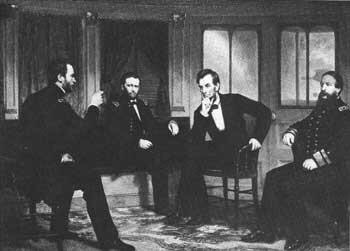 Today in History, March 10: 1864 – President Lincoln signs documents promoting Ulysses S. Grant to the rank of Lieutenant General. Grant was only the second person to hold the rank, the first having been George Washington. Winfield Scott had held the rank in the interim, but only as a “brevet” or temporary rank. Lincoln wanted his commanding general to have a rank above his other generals for leadership purposes. Grant would answer only to the President.
Lincoln had difficulties with several Generals prior to Grant being appointed as the commander of all the Union Armies. The two communicated and worked very well together. Perhaps because they were both westerners from Illinois and understood each other. Certainly because Grant carried out Lincoln’s wishes to pursue Confederate Armies with vigor.
 Mark Loves History!