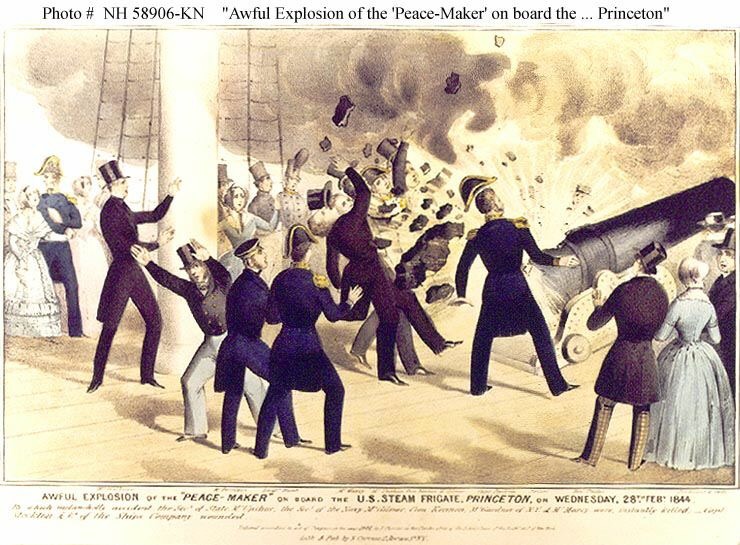
 Today in History, February 28: 1844 – The Peacemaker Disaster. President Tyler, Secretary of State Abel Upshur, Secretary of the Navy Thomas Gilmer, New York financier David Gardiner, his daughter Julia and several hundred other dignitaries are aboard the new steamship USS Princeton sailing on the Potomac River to review the ship and her new 14 inch guns. The guns had already been fired twice in demonstration, and the party had moved below decks. One of the dignitaries suggested firing the “Peacemaker” one more time in honor of George Washington. Once the observers had moved back upstairs the gun was fired…and exploded. 6 were killed, including Upsher, Gilmer and Gardiner. 20 others were injured including famous Senator Thomas Hart Benton and Captain Robert F. Stockton. President Tyler, below decks, escaped injury. When Julia Gardiner head of her father’s death, she fainted, falling into Tyler’s arms. Tyler, a 54-year-old widower, had already proposed marriage to 20-year-old Julia; they were married four months later. The disaster led to re-engineering of naval guns and the processes used in their construction, making them much safer.
“Neither let us be slandered from our duty by false accusations against us, nor frightened from it by menaces of destruction to the Government nor of dungeons to ourselves. Let us have faith that right makes might, and in that faith, let us, to the end, dare to do our duty as we understand it.” – Abraham Lincoln at Cooper Union


 Today in History, February 27: 1860 – “One of the most happiest and most convincing political arguments ever made in this City … No man ever made such an impression on his first appeal to a New-York audience.” — Horace Greeley in his paper regarding “The Cooper Union Speech” by Abraham Lincoln. A former Congressman and Illinois lawyer, Lincoln had been launched to the national stage by his debates with Stephen Douglas over the slavery question 2 years before, but he was still mostly unknown in the east. A young Republicans group in New York invited him to speech at Cooper Union’s Great Hall. The hall was not filled for the speech, but the text of it was given to Greeley’s and other’s papers; from there it was broadly published across the nation in pamphlet form. Lincoln made convincing arguments that the Founding Fathers were against the expansion of slavery and desired it’s eventual end. At the same time he tried to convince Southerners that the Republican party did not wish to interfere in their affairs. While in New York he had his photo taken by Matthew Brady, and the photo was used along with the pamphlet to broaden his recognition. It is widely believed that the speech is what launched him into the Presidency. He closed with a message to his colleagues: “Neither let us be slandered from our duty by false accusations against us, nor frightened from it by menaces of destruction to the Government nor of dungeons to ourselves. Let us have faith that right makes might, and in that faith, let us, to the end, dare to do our duty as we understand it.” (See below for video of Sam Waterston performing the speech).
“Let this great wonder of nature remain as it now is. Do nothing to mar its grandeur, sublimity and loveliness. You cannot improve on it. But what you can do is to keep it for your children, your children’s children, and all who come after you, as the one great sight which every American should see.” -President Theodore Roosevelt
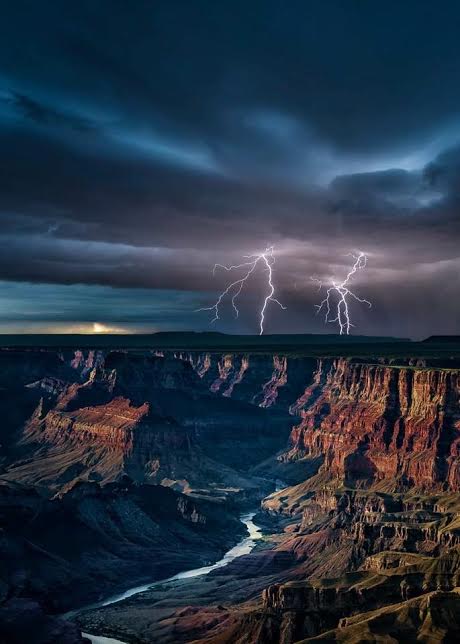
Today in History, February 26: 1919 – President Woodrow Wilson designates the Grand Canyon as a National Park. His nemesis and predecessor, President Theodore Roosevelt, had designated the Grand Canyon as a National Monument in 1908. Thanks, guys!
A First in History
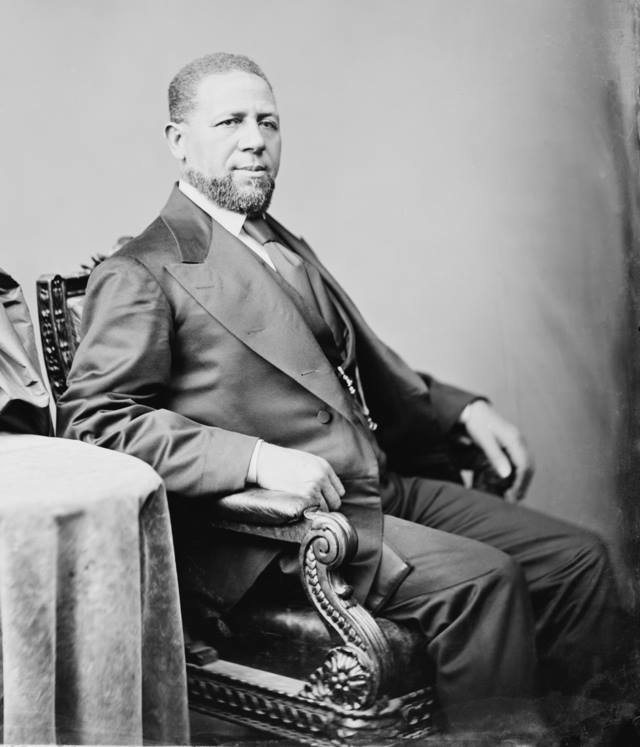
Today in History, February 25: 1870 – On a strict party line vote (we’ve heard that a lot lately) of 48 Republicans for and 8 Democrats against, Methodist minister Hiram Rhodes of Mississippi is confirmed as the first African-American US Senator, the first African-American member of Congress. Rhodes had been a minister, had helped raise the first two black regiments to fight in the Civil War, had been a veteran of the Battle of Vicksburg in Mississippi. Ironically he had served in Lincolnton, North Carolina as a barber with his brother, and served in a seminary in UNION county, Indiana. Democrats had attempted to use the 1857 Dredd Scott decision, A ridiculous Supreme Court decision that decided black people were not citizens, as a basis for preventing Rhodes from attaining the Senate seat.
The Amistad Trial
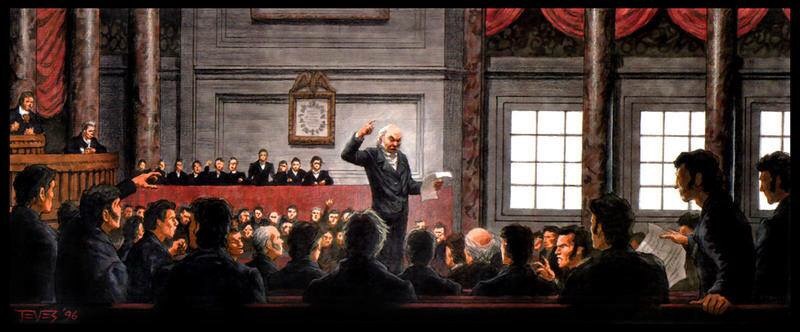 Today in History, February 24: 1840 – US Representative John Quincy Adams, a former President, begins his defense of slaves aboard the Amistad, a Spanish slave ship which was transporting them to Cuba to be sold. The slaves killed the ship’s Captain and forced the crew to sail them back to Africa…the crew instead took them to the US. The case went all the way to the US Supreme Court, where Adams argued for their return to their home. He won the argument….but not the funds to return them. The funds would have to be raised from sympathetic Americans.
Adams would continue to serve in the House until he collapsed at his desk, and died two days later on February 23, 1848. Several of his decendants would serve prominently in the government.
Setting Precedents
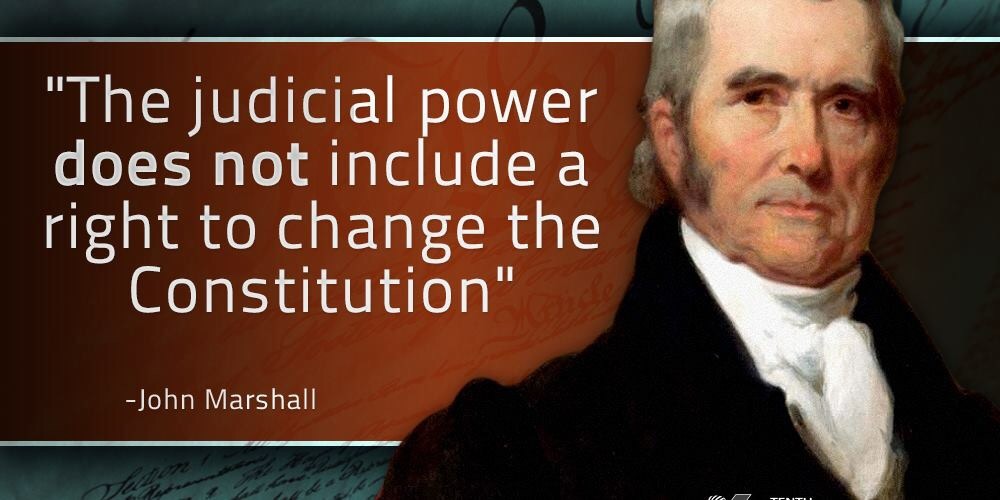 Today in History, February 24: 1803 – Marbury vs. Madison. The Supreme Court establishes the principle of Judicial Review. In a case fraught with typical American skullduggery, the US Supreme Court gains it’s power. In the election of 1800, Thomas Jefferson had defeated the one term John Adams. In the time before the end of his term, Adams appointed as many judges and justice of the peace as he could, even working with his fellow party members to increase the number of judges. This resulted in the infamous “midnight judges” that were appointed at the last minute. Adams’ Secretary of State, John Marshall, wasn’t able to deliver all of the commissions to the judges and justices of the peace in time before Adams’ term ended, but figured the new Secretary of State, James Madison, would do so. He did not. Realizing they’d been snookered, Jefferson and Madison’s party did not deliver the new commissions. One of the Justices of the Peace, William Marbury, sued. The case went all the way to the Supreme Court…whose Chief Justice now was…John Marshall. Marshall made a decision that was a master stroke. The Court decided that the commissions should have been delivered…but at the same time decided that the court could not enforce the decision because Marbury did not have standing to file suit. While this initially seemed to emasculate the Court…in the end the decision established that the Court could render Congressional acts Unconstitutional if it chose to do so. The are dozens of examples of why appointments to the Court are important, not the least of which we are watching play out now.
A Life Saving Decision?

 Today in History, February 23: 1861 – President elect Abraham Lincoln arrives at Washington DC’s Willard Hotel. He had intended to travel to Baltimore on his trip from Illinois to DC, but his wife and an ardent supporter, Chicago Detective Allan Pinkerton talked him out of the Baltimore stop. Pinkerton had taken it upon himself to infiltrate a secessionist group and discovered a plot to assassinate Lincoln while he was in Baltimore. Pinkerton’s information likely saved Lincoln’s life. I’ve often wondered what would have happened if President Lincoln hadn’t been assassinated in 1865, what our country would look like today if he had handled reconstruction and reunification with his patience and kindness. One also has to wonder what the country would look like had he never even made it into the White House.
“Where Else Would We Find Him?”
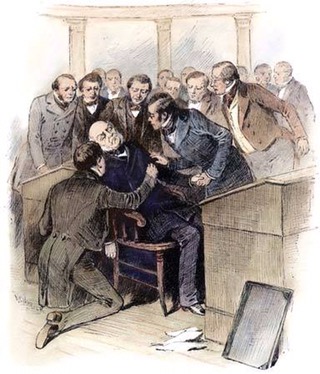 Today in History, February 21: 1848 – “Where else would we find him?” Former President, former Secretary of State, Former US Senator from Massachusetts, current Representative to the House John Quincy Adams, collapses after suffering a stroke while vehemently stating his opinion on the House floor. Adams had, by most reports, been a mediocre President. However he had authored the Monroe Doctrine telling European nations that America was in charge of police actions in the Western Hemisphere; he had served as the Ambassador to the Court of St. James (England); had negotiated the ceding of Florida to the US from Spain; had acted as the attorney for the slaves in the Amistad Trial; stated his vehement abolitionist views, and served 17 years in the House after his Presidency…because that’s what a servant to the people was supposed to do. His contemporaries were not surprised that he would die while serving the people. He was carried to the office of the Speaker of the House, where he would die two days later. What an example!
Where There’s a Will…
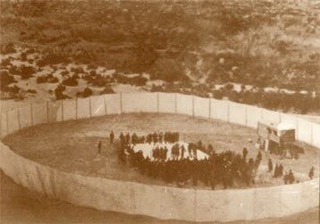

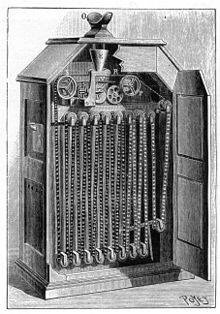 Today in History, February 21: 1896 – It was illegal. The Governor of Texas called a special session of the legislature specifically to make sure it didn’t happen in Texas. The Governor of Arkansas threatened to enlarge the state penitentiary to hold anyone that was involved. The Federal Government ruled that it would NOT happen in Indian Territory. No other state would step up to allow it. But the promoters were tenacious…and Judge Roy Bean had a reputation for making money. The World Championship Boxing champion from 1895 had retired…after watching his sparring partner being dropped within seconds by a young up-and-comer Irish boxer named Peter Maher. So the challenger, Australian Bob Fitzsimmons wanted to fight Maher. In an attempt to find a place for the “prize fight”, which was illegal in the US and Mexico, So Judge Roy Bean and other promoters arranged for the viewers to meet in El Paso, where they would be taken to a secret location for the fight. Would it be on a barge in the Gulf? A special train left El Paso and stopped at Langtry, Texas. The entire party…fighters, promoters, audience, soldiers, Texas Rangers, soon found themselves at a ring Bean had set up on a sandbar in the middle of the Rio Grande River…where the Army, the Rangers and the Mexican Federales could not stop it. Within seconds, Fitzsimmons, bruised by a quick attack by Maher, blitzed in return and took Maher down, becoming the World Heavyweight Champion before the Edison Kinetoscope could even be set up to film the event.
An American Hero


Today in History, February 20: 1942 – Lt. Edward “Butch” O’Hare saves his ship. The USS Lexington was initiating a raid on Rabaul, a Japanese stronghold. However the Task Force was spotted, and many Japanese aircraft were sent to destroy the valuable aircraft carrier. Lt. O’Hare was part of the “CAP”, or Combat Air Patrol for the Lexington (CV-2).
O’Hare singe-handedly shot down five of the attacking “Betty” bombers, effectively saving his ship, one of the few aircraft carriers the United States had available at the time. This also made him the US Navy’s first ace of WWII. About a year later, O’Hare, ever the hero, would be lost in unknown circumstances in one of the first night time fighter operations. O’Hare Airport in Chicago is named for Butch. What many people don’t know is that this American hero, who gave the “last full measure of devotion” for his country, was the son of a gangster. His father had been Al Capone’s lawyer. The senior O’Hare (Fast Eddie), according to the story, had exchanged his testimony against Capone for a chance for his son to enter the Naval Academy. He paid with his life, gunned down by Capone’s thugs. As a result, thousands of American sailors aboard the Lexington were saved due to Butch’s heroism.
 Mark Loves History!