A General Above All Others

Today in History, October 11, 1976:

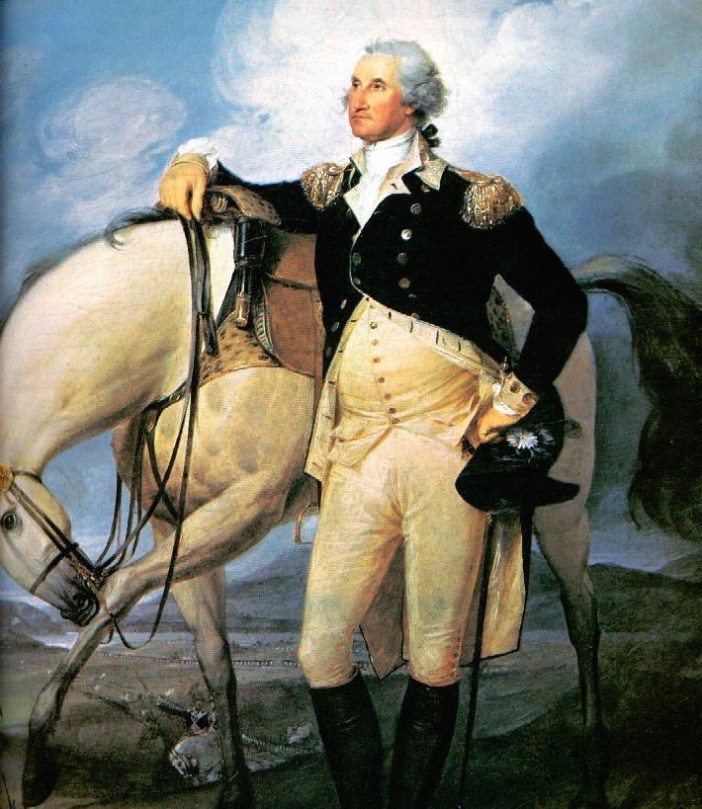
Lt. Gen. George Washington is promoted to General of the Armies.

No, that is not a typo.

After leading all American Continental forces to victory in the Revolutionary War and serving two terms as our first President, George Washington maintained his rank as Lieutenant General.

In the interim, other men were promoted to Gen. of the Army…Grant, Sherman, Sheridan (4-star), Marshall, Eisenhower, MacArthur, Arnold and Bradley 5-star.). Admirals Leahy, King and Nimitz became 5-star Fleet Admirals. And John “Back Jack” Pershing.

At our Bicentenial, Congress decided, and rightly so, that no General should ever outrank the father of our nation.

So they created the rank of General of the Armies (not to be confused with Gen. of the Army), and posthumously promoted General Washington and declared none should ever exceed his rank.

——————————————–

Hereas Lieutenant General George Washington of Virginia commanded our armies throughout and to the successful termination of our Revolutionary War;

Whereas Lieutenant General George Washington presided over the convention that formulated our Constitution;

Whereas Lieutenant General George Washington twice served as President of the United States of America; and

Whereas it is considered fitting and proper that no officer of the United States Army should outrank Lieutenant General George Washington on the Army list;

Now, therefore, be it

Resolved by the Senate and House of Representatives of the United States of America in Congress assembled, That

(a) for purposes of subsection (b) of this section only, the grade of General of the Armies of the United States is established, such grade to have rank and precedence over all other grades of the Army, past or present.

(b) The President is authorized and requested to appoint George Washington posthumously to the grade of General of the Armies of the United States, such appointment to take effect on July 4, 1976.

Approved October 11, 1976.

Public Law 94-479
Meriwether Lewis: Murdered? Or Suicide?

Today in History, October 11, 1809:

We all know of the adventures of Lewis and Clark.

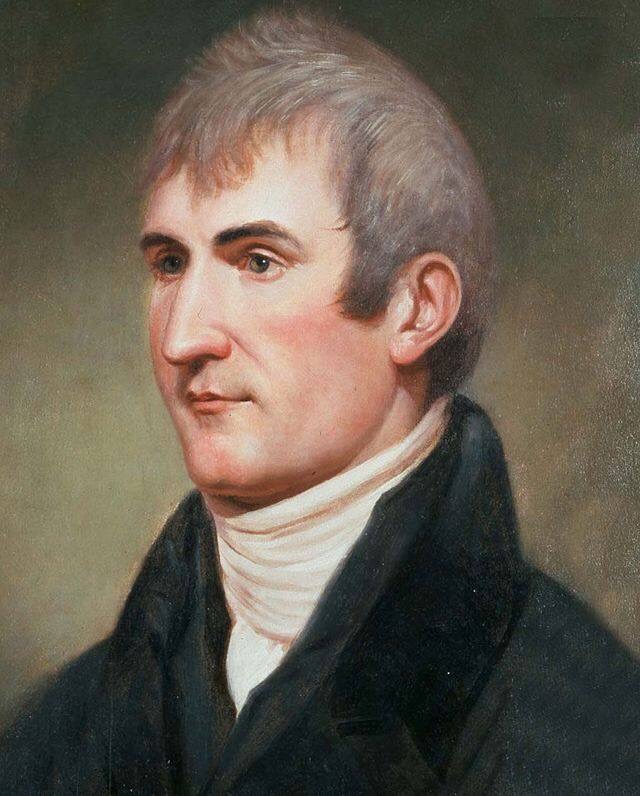
But on this day in 1809, only 3 years after the completion of his groundbreaking expedition, Meriwether Lewis died. He was only 35 years old.

The big question is whether it was murder or suicide. He was, at the time, the Governor of Upper Louisiana, and traveling the Natchez Trace to bring information to Washington about his efforts as Governor and as an explorer.

He was staying at Grinder’s Stand, an inn along the Trace, when the owners and other travelers heard “several” gunshots ring out.

Depending on who you talked to, he suffered through the night, the result of gunshots by his own hand or by murderers who stole the money he had with him.

Clark and President Jefferson, who knew him best, were easily convinced that he killed himself. Not publicized nearly as much as his courageous exploits is the reality that he battled depression and alcohol.

Others believed he was murdered by one of the many pirates along the trace. I have to wonder about the “several shots” at a time of flintlock pistols. How determined would a suicidal person have to be to shoot himself several times to complete a suicide then, or even now? The cash he was carrying with him was never found.

The Unknown Soldier & the USS Olympia

TODAY IN HISTORY, OCTOBER 3, 1921:

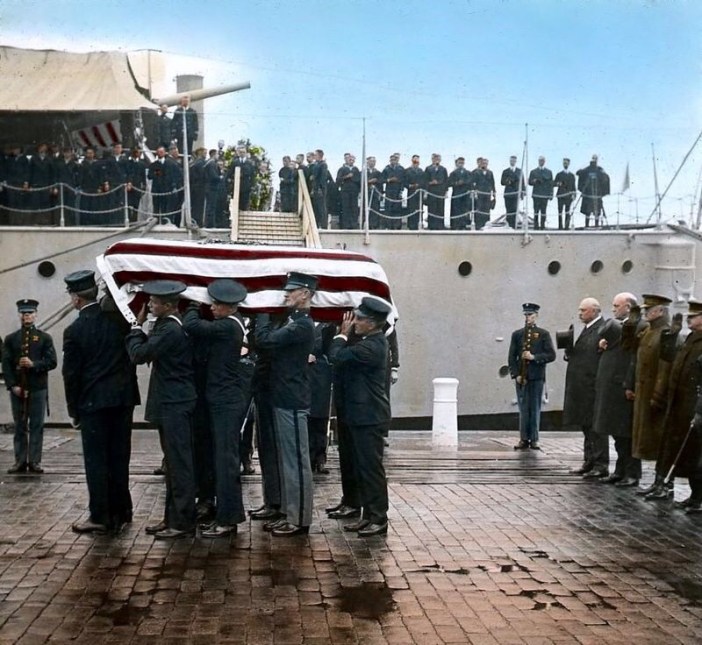
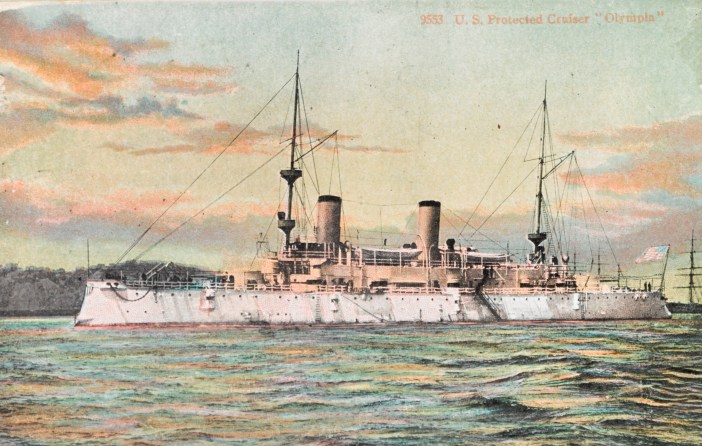
The USS Olympia sets sail for France.

Her mission: To bring the Unknown Soldier back home for burial at Arlington National Cemetery.

The Olympia had a distinguished career. in 1898 she was Admiral Dewey’s flagship during the Battle of Manila Bay in the Philippines (Spanish-American War) in which the American fleet devastated the Spanish Fleet, propelling the US to international player status.

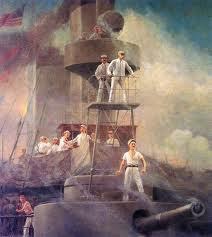
Dewey stood on the Olympia’s bridge when he famously said, “You may fire when ready, Gridley”.

The trip back to America from France with the Unknown Soldier was not uneventful. The ship feared they would be lost to a devastating storm.

Today, the Olympia is the oldest remaining steel hulled ship of the US Navy, a nearly 130 year old museum ship. But her story is far from over. The Olympia is suffering severe natural damage and it will take millions to keep her from dissolving into the Delaware River in Philadelphia.

And of course you can visit her famous passenger at Arlington National Cemetery in Washington D.C.

“Damn the Torpedoes!”

Today in History, August 5, 1864:

“Damn the Torpedoes, Full Speed Ahead!!”

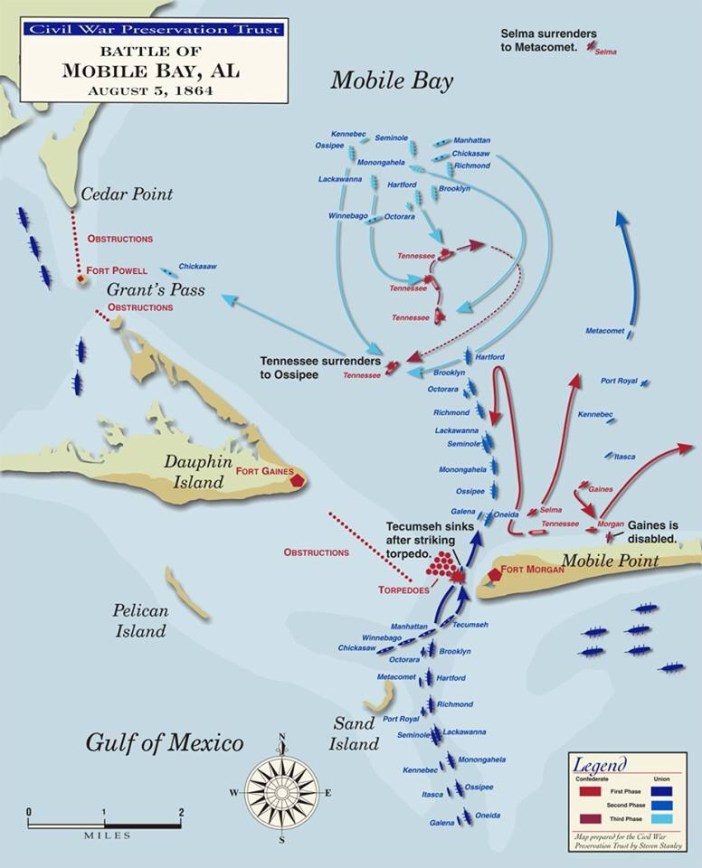
The Battle of Mobile Bay. During the Civil War, Confederate “blockade runners” (Rhett Butler types) kept the South in vital supplies by running past the Union Navy blockade from Cuba to ports like Mobile Bay, Alabama.

US Navy Admiral David Glasgow Farragut was tasked with closing this last Confederate source of supplies. His fleet had to fight past the Confederate fleet of ironclads and two forts that guarded the bay. As the battle progressed, the Union fleet began to fragment, until Farragut rallied his sailors with famous admonition, winning the battle.

Mobile would remain in Confederate hands, but access to it was cut off for the duration. Farragut was the adopted son of US Naval Officer David Porter, who also raised his biological sons, famous Naval officers David Dixon Porter, and William Porter. One family played such a vital role in the glory of the US Navy. Can you imagine being a part of it?

“Steady, men….steady! ChaaaaAAAaaRRGE!!”

Today in History, July 1:

A day for important battles.

1863 – The Union and the Confederates first clash at The Battle of Gettysburg, and both send reinforcements. The first day went badly for the Union, but the largest battle in North America had three more days to go, and would become a major turning point in the Civil War.

1898 – The Battle of San Juan Hill becomes a major victory for the US in the Spanish-American War as the US Army’s Fifth Corps takes the heights over Santiago de Cuba. It also set the stage for Colonel Theodore Roosevelt to become President as he became famous for leading his Rough Riders up Kettle Hill (not San Juan).

1916 – The Battle of the Somme in France; after a week’s bombardment with over 250,000 shells, the British launch an attack into no-man’s land. The Germans had retained many machine guns despite the bombardment, and the British soldiers were slaughtered. With 20,000 dead and 40,000 wounded in one day, it was one of the worst defeats for the British military’s history.

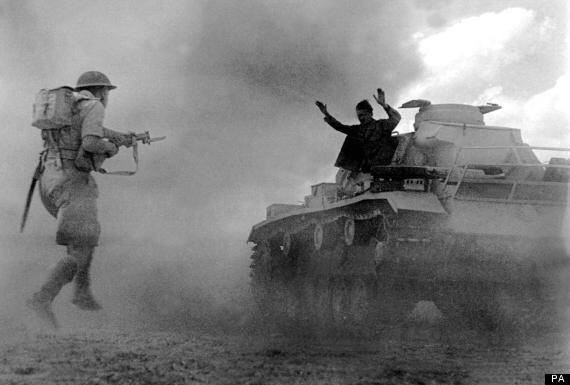
1942 – The Battle of El Alamein; In North Africa Erwin Rommel’s army had routed the British and their allies, driving them back so quickly that they had to leave much of their equipment behind. But on today’s date the British Army, resupplied by Americans and reorganized, turned the tide back on Rommel at El Alamein.

Marie-Joseph Paul Yves Roch Gilbert du Motier de Lafayette, Marquis de Lafayette

Today in History, June 13, 1777:

A 19-year-old boy, Marie-Joseph Paul Yves Roch Gilbert du Motier de Lafayette, Marquis de Lafayette, arrives at North Island, Georgetown, South Carolina from his native France. He had been a commissioned officer in the French Army since he was 13.

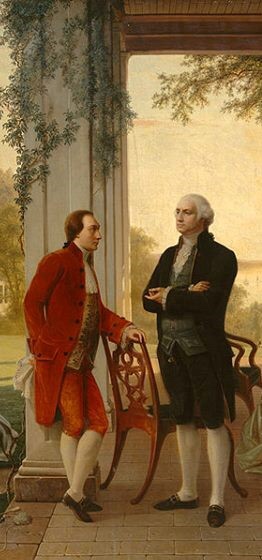
I’m sure Lafayette seemed somewhat ridiculous to many in the Continental Army at first, but he was dedicated to the American cause and soon gained the confidence of Gen. George Washington. He served with distinction in several battles, including the siege of Gen. Cornwallis at Yorktown. His influence as a French aristocrat gained vital support for the US cause from the French King and populace. 

Americans were thoroughly impressed with him, and he idolized Washington…his only son would be named George Washington Lafayette. He would go on to be a key figure in the French Revolution, penning “Declaration of the Rights of Man and of the Citizen” with the assistance of Thomas Jefferson.

A Violent Decade of Assassinations

Today in History, June 8, 1968:

What a busy news day this must have been?!

James Earl Ray, the assassin of Martin Luther King, Jr is arrested in London, England where he was attempting to make his way to an African nation run by racists (ironic). He would eventually be convicted of assassinating Civil Rights leader King.

On the same day…..

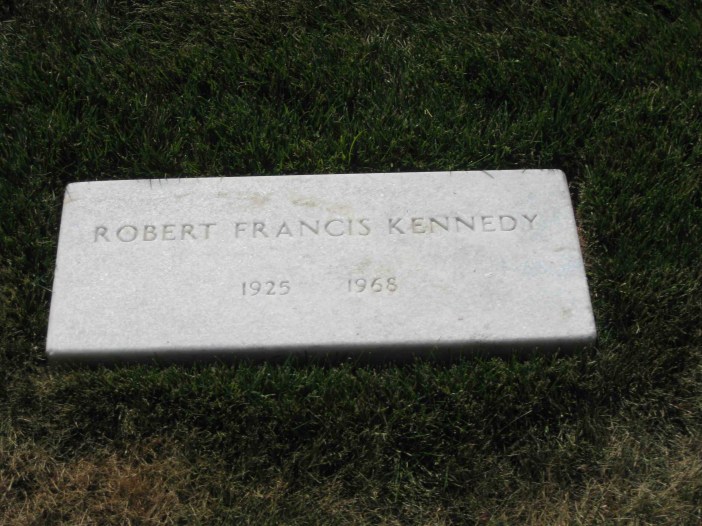
…another civil rights activist is laid to rest at Arlington National Cemetery. Robert F. Kennedy would be laid to rest within 30 yards of his brother John, assassinated only five years earlier.

Lincoln’s Assassin Killed

Today in History, April 26, 1865:

Union Army forces track down John Wilkes Booth 12 days after he assassinated President Lincoln.

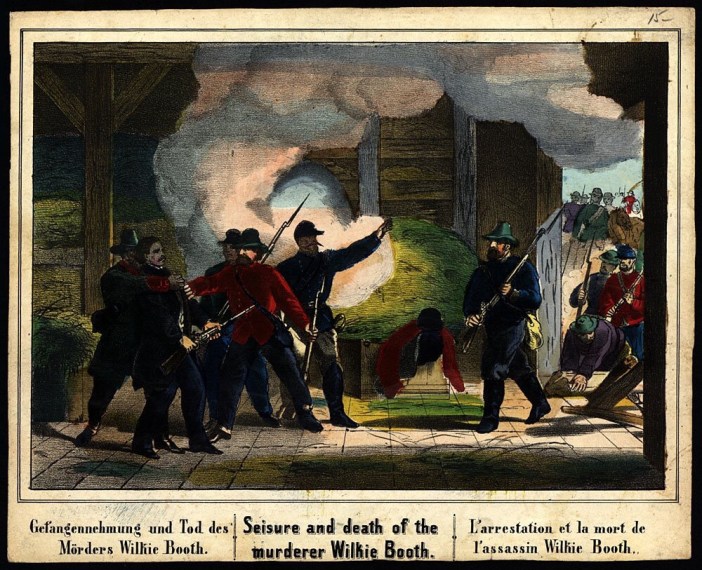
In the meantime, he had been hidden by Confederates, treated by Doctor Samuel Mudd (your name is mud) and hidden in a barn on the Garrett farm in Virginia, where he was found. The barn was set afire and his associate surrendered.

Booth refused…a Union soldier, Boston Corbett, saw Booth inside the barn and fired his Colt revolver…causing a mortal wound to Booth.

Many Confederates saw Booth as a hero. However many Southerners wept openly at Lincoln’s death, and Confederate Generals, including Lee and Johnston, denounced Booth’s actions.

Fortunately, in the interim between his deed and his death, Booth was able to see news accounts that recorded his benefactor’s denunciation of his act. So when he died, he knew what he was.

“Don’t fire unless fired upon, but if they mean to have a war, let it begin here.” –Militiaman Capt. John Parker, on Lexington Green

Today in History, April 19, 1775:

“Don’t fire unless fired upon, but if they mean to have a war, let it begin here.” –Militiaman Capt. John Parker, to his troops on Lexington Green.

When the 700 British troops reached Lexington, they were confronted with a mere 77 minutemen who had managed to convene there. The British plan was to capture an American armory and arrest Samuel Adams and John Hancock.

Thanks to the “midnight ride”, the armaments had been dispersed, Adams and Hancock sprited awat.

Capt. Parker, knowing that the British mission had already been rendered pointless, was not eager to risk the lives of is men. He had them form in ranks on Lexington Green, where they could give an expression of dissention without blocking the road to Concord.

The British commander decided to confront them anyway. With an expression of great insult, the British commander ordered the “damned rebels” to disperse. Parker directed them to do so as the well trained British regulars approached.

Nobody knows who fired the “shot heard ’round the world”. The Americans, of course, believed it was and over eager British soldier; the British believed it was from a minuteman; some speculation is that it was fired from the safety of a nearby tavern.

Whoever fired that first shot, it resulted in the British cutting down nearly a dozen minutemen, and one injured British soldier. The British then marched past the dead and injured on their way to Concord. 

The Brits, emboldened, marched on Concord. When they got there they were confronted with more than 300 minutemen. The outcome was quite different than at Lexington.

The British were quickly repelled, and decided to return to Boston.

As they completed the long march back to Boston, the minutemen continuously fired upon them from behind trees, rocks, fences, etc. By the time the regulars made it back to Boston, they had lost over 300 men.

Why was it the “shot heard ’round the world”? Not just because of the American Revolution. The acts of the revolutionaries did not affect only the “Colonies”. The French were encouraged to aid the Americans with their fleet eventually.

Other portions of the British Empire were encouraged to revolt. King George didn’t know it, but on this date, thanks to a few farmer and merchant “peasants”, the sun had begun to set on the British Empire.

Irredeemable Loss & Grief…Assassination of President Lincoln

Today in History, April 14, 1865:

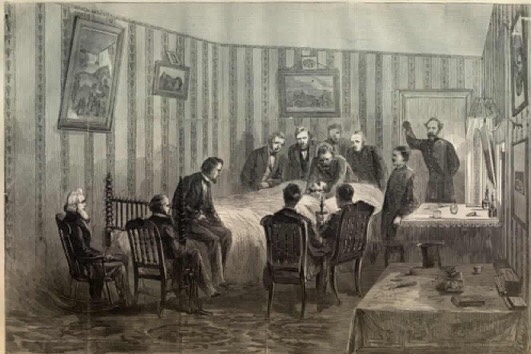
Within a week of the surrender at Appomattox, a coward assassinated President Abraham Lincoln.

If you were old enough on 9/11, you experienced the indescribable loss, grief, and helplessness we all experienced.

I use this in an attempt to fathom the emotions Americans must have felt at the loss of Lincoln. He had led them through the most traumatic time in our nation’s history…the times ahead were still uncertain. How would the North and South reunite? Was the war really over? They needed his steady hand on the rudder stearing the ship of state more than ever.

And suddenly Abraham was gone.

I post “O Captain! My Captain!” By Walt Whitman almost every year on this date, because I believe he came closest to capturing the grief the nation must have felt.

O Captain! My Captain!

O Captain! my Captain! our fearful trip is done,
The ship has weather’d every rack, the prize we sought is won,
The port is near, the bells I hear, the people all exulting,
While follow eyes the steady keel, the vessel grim and daring;
                         But O heart! heart! heart!
                            O the bleeding drops of red,
                               Where on the deck my Captain lies,
                                  Fallen cold and dead.
O Captain! my Captain! rise up and hear the bells;
Rise up—for you the flag is flung—for you the bugle trills,
For you bouquets and ribbon’d wreaths—for you the shores a-crowding,
For you they call, the swaying mass, their eager faces turning;
                         Here Captain! dear father!
                            This arm beneath your head!
                               It is some dream that on the deck,
                                 You’ve fallen cold and dead.
My Captain does not answer, his lips are pale and still,
My father does not feel my arm, he has no pulse nor will,
The ship is anchor’d safe and sound, its voyage closed and done,
From fearful trip the victor ship comes in with object won;
                         Exult O shores, and ring O bells!
                            But I with mournful tread,
                               Walk the deck my Captain lies,
                                  Fallen cold and dead.