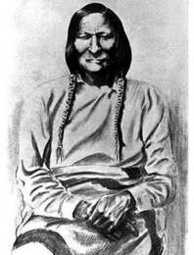
“Nothing lives for long.  Except the Earth and the Mountains.” —Chief White Antelope, age 75

Today in History, November 29, 1864:

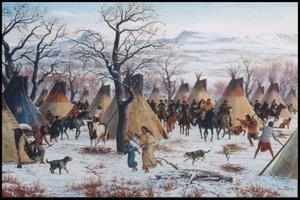
The Sand Creek Massacre.

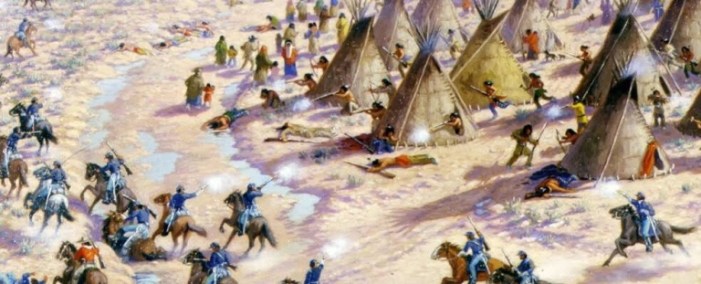
As the morning was dawning in the sleepy village, Chief Black Kettle saw them approaching, and hoisted the Stars and Stripes above his Tipi as a sign of brotherhood and peace.  And then the blue coated soldiers began firing.

The Cheyenne and Arapaho of Colorado had settled in for the winter along a bend in Sand Creek in eastern Colorado.  Resources in the barren area were in short supply and they expected a harsh time.  900-1,000 people in hundreds of Tipis, although many were out hunting buffalo that morning.

The Civil War raged further east, and in Colorado and New Mexico a few months previous.  Colonel John Chivington of the Colorado Volunteers had fought in those battles, but now was looking for a new fight.  After a family of settlers was killed, allegedly by Arapaho or Cheyenne, the Governor tasked Chivington with raising a regiment to defend against hostile Indians.

But his regiment’s enlistment was nearly up and he hadn’t found any hostile Indians.  So he took over 700 troops to attack the peaceful village along Sand Creek.

After the earlier attack on the settlers, the white authorities told the peaceful Indians to encamp at military forts and facilities where they would be protected. If not, they would be considered “Hostile.” A word synonymous with “shoot on site” for Indians in the old West.

Chief Black Kettle had spoken to the commander of nearby Fort Lyon, seeking to comply.  He was told to keep his people at Sand Creek until the commander received further orders, and they would be safe.

Hundreds of women and children dropped to their knees in front of the soldiers that morning, imploring them for mercy.  There was no mercy given as the women and children were shot down or had their skulls caved in.  Many then ran for the creek where they sought cover, or fled north.  For the next several hours Chivington’s soldiers chased them down and killed as many as they could.

Seeing what was happening, Chief White Antelope approached the soldiers, folded his arms, and began singing his death song,

“Nothing lives for long.  Except the Earth and the Mountains.”

Chief Black Kettle carried his wounded wife and fled north towards another band of Cheyenne.  He would make his way to Oklahoma, where he led his people to again attempt peaceful existence.  He would live two days shy of four years more…when he and his wife would be chased down and killed by soldiers of George Custer’s command at the Massacre along the Washita River.

One of the Union officers present at Sand Creek that day refused to follow commands and ordered his company not to fire; and tried to save some of the victims.  Captain Silas Soule was career Army and recognized the cowardly acts being carried out.  The next day he wrote a letter to a Major friend of his back east, telling of the horrific behavior of Chivington’s “mob”.  He told of women and children having their brains bashed in.  He said that Chiefs had their ears and genitals cut off as trophies, and all those killed were scalped.  The crazed killers cut out many of the women’s genitalia as souvenirs.

Chivington would escape court martial by resigning from the Volunteers.  But even during the Civil War, the government and the people were aghast at the atrocities carried out at Sand Creek, and Congressional hearings were held in 1865, during which Captain Soule testified at against Chivington.

For his trouble he was gunned down in the street in Denver a few months later.  His murderers were never prosecuted.

The assault was supposedly intended to force peace for the nascent settlements in Colorado.  It had exactly the opposite effect, as the Cheyenne Dog Soldiers and others fought a decade’s long war with the settlers, their trust of the white people destroyed.

The story was eventually all but forgotten, and was a touchy subject when it was spoken of.  However Colorado eventually began to come to terms with this dark part of its history, and in 2007 the Sand Creek Massacre National Historic Site was established, run by the National Park Service.

Many visit the site in homage to the approximately 200 Native Americans who died that day.

Several of the sites I read in preparation for this posting indicated the subject was not covered much until the 2000’s.  However if you read (or watch) James Michener’s “Centennial”, you’ll find that he covered the events very well, just with a change in names.

Two American “Royals” Killed on the Same Day

Today in History, November 27, 1868:

His story could make him the 19th-Century version of Joe Kennedy, Jr or John F. Kennedy.  He was born in 1844 into a family filled with Secretaries of the Treasury and Secretaries of State, wealthy bankers, and his grandfather, Alexander Hamilton, was a Founding Father and the first Secretary of the Treasury in President Washington’s cabinet.  And of course, Alexander Hamilton lost his bright future in a duel, killed by Vice-President Aaron Burr in 1804.  Both the Hamiltons and the McLanes were well placed.

Louis McLane Hamilton had wealth, influence, a bright future, and according to his contemporaries, a high degree of character.  Joe and Jack Kennedy had used their influence to get INTO combat during WWII.  It cost Joe his life, and very nearly cost JFK his.  Likewise, young Louis Hamilton used his influence to get into combat during the Civil War when he was 17 and 18.  JFK had to use his father the former Ambassador’s influence to get an assignment in the Pacific.  Louis had a letter from President Lincoln himself to Secretary of War Edwin Stanton recommending his commission as an officer.  Louis didn’t waste what was given to him.  He fought with distinction during the Battle of Fredericksburg, the Battle of Chancellorsville, the Battle of Gettysburg, the Siege of Petersburg and Appomattox Courthouse.

After the war Hamilton continued his service, serving as a Lieutenant and a Captain in the 7th Calvary under Colonel George Armstrong Custer.  Hamilton commanded Fort Lyon in Colorado for a time, and fended off an attack led by Chief Pawnee Killer.  

On November 26th, 1868 he found himself assigned as “Officer of the Day”, an assignment which gave him responsibility for the 7th Cavalry’s supply train as Custer searched in Indian Territory for Southern Cheyenne warriors.  As Custer planned a pursuit, some of Hamilton’s command was taken to bolster the assault’s numbers.  True to his nature, Hamilton went to Custer and made his case…earnestly, insistently asking not to be left behind as his troops went into battle.  Custer was sympathetic to the request…he would make the same request before the Battle of the Little Bighorn.  Custer agreed to let Hamilton leave the wagon train and join his troops.

As a result, Captain Louis McLane Hamilton, Alexander’s grandson, was at the lead of his troops who, as it happened, were the first to attack Chief Black Kettle’s village along the Washita River.

“Keep cool, fire low, and not too rapidly” was the last thing Hamilton was heard to say before being shot in the chest, killed instantly, by one of the defenders firing from within a wigwam.  Hamilton the first person killed in the battle.

Elsewhere on the battlefield was Chief Black Kettle and his wife.  Not much is known about Chief Black Kettle prior to the mid 1850’s, but what is known that this leader in the Southern Cheyenne tribe often worked hard to keep the peace.  In 1864 he and his band were in Colorado when some settlers had been attacked.  The Governor declared any Indians who did not report to a military post would be considered hostile.  Chief Black Kettle led his band to Fort Lyon and came to an agreement with the commander there for his Southern Cheyenne to camp along Sand Creek in eastern Colorado.  This agreement didn’t prevent Colorado Militia Colonel Chivington, ambitious and about to lose his troops to the end of their enlistment, from attacking the peaceful encampment, which was complete with an American flag flying.  Many were killed, but Black Kettle and his wife managed to survive.

He was encamped with his people along the Washita River in present day Oklahoma for much the same reason, with the same results.  But this time his luck ran out.  As he and his wife fled, they were shot down and killed.

“The world will little note, nor long remember what we say here…” And Yet…We Do

15095673_10205637473094905_7511930771750709076_n


Today in History, November 19, 1863:

“I should be glad, if I could flatter myself that I came as near to the central idea of the occasion in two hours, as you did in two minutes.” -Edward Everett, popular orator that spoke with President Lincoln at Gettysburg to commemorate those that died there during the pivotal Battle of Gettysburg earlier in the year.

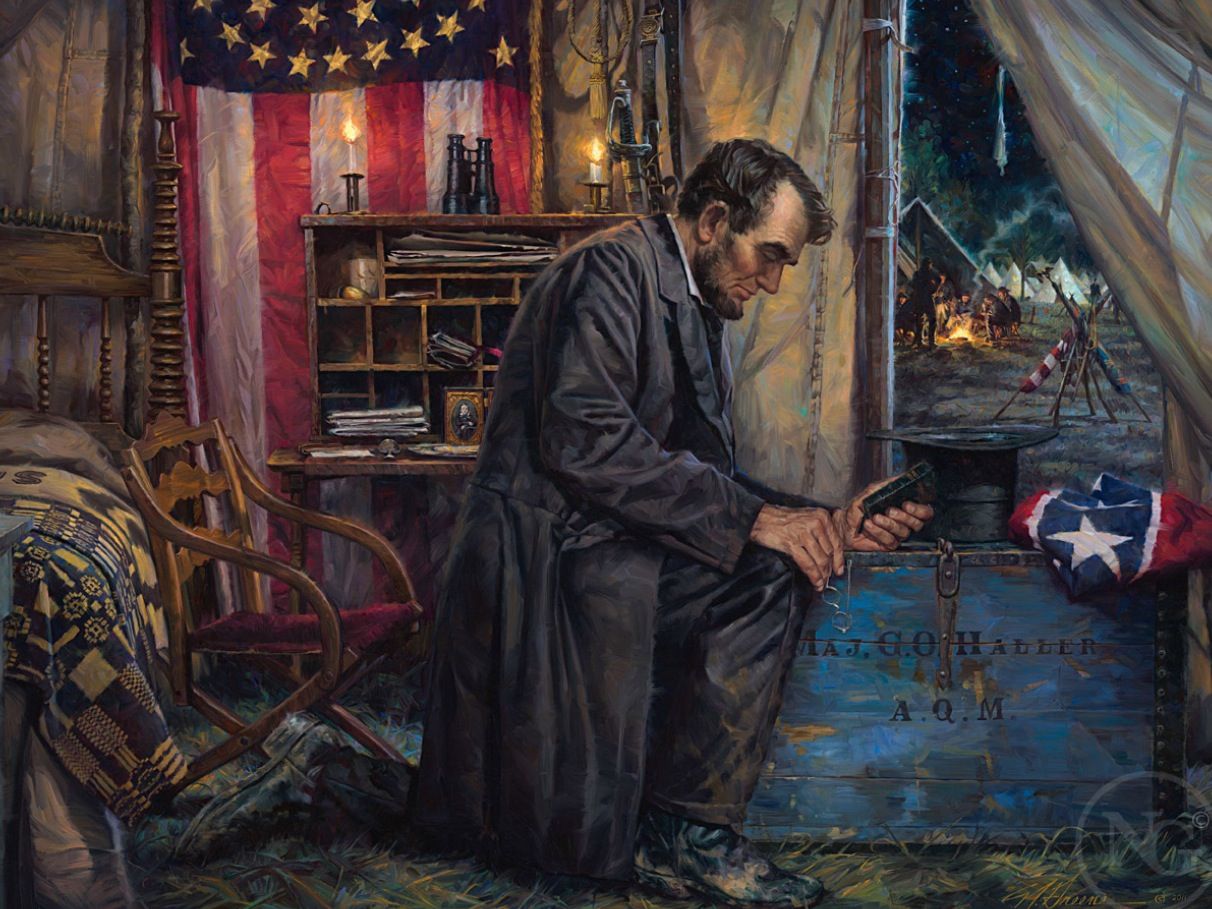
President Lincoln spoke briefly, and his speech was criticized at the time by some media, but has become legendary for it’s prescience. See below for the full text….

Four score and seven years ago our fathers brought forth on this continent, a new nation, conceived in Liberty, and dedicated to the proposition that all men are created equal.

Now we are engaged in a great civil war, testing whether that nation, or any nation so conceived and so dedicated, can long endure. We are met on a great battle-field of that war. We have come to dedicate a portion of that field, as a final resting place for those who here gave their lives that that nation might live. It is altogether fitting and proper that we should do this.

But, in a larger sense, we can not dedicate — we can not consecrate — we can not hallow — this ground. The brave men, living and dead, who struggled here, have consecrated it, far above our poor power to add or detract. The world will little note, nor long remember what we say here, but it can never forget what they did here. It is for us the living, rather, to be dedicated here to the unfinished work which they who fought here have thus far so nobly advanced. It is rather for us to be here dedicated to the great task remaining before us — that from these honored dead we take increased devotion to that cause for which they gave the last full measure of devotion — that we here highly resolve that these dead shall not have died in vain — that this nation, under God, shall have a new birth of freedom — and that government of the people, by the people, for the people, shall not perish from the earth.

The Burning of Atlanta…and Why “Sherman” Became an Epithet in the South

Today in History, November 12, 1864:

The burning of Atlanta.

Union Gen. William Tecumseh Sherman and his army had taken Atlanta in September, and subsequently ordered the citizenry to evacuate the city. That order set off a firestorm of complaints and criticism from Confederate military and civilian leaders. Sherman stuck to his guns…the South could expend the resources to care for and secure their populace. Sherman’s supply lines stretched from Nashville, TN and were constantly threatened by Confederate army raids, so he knew he could not hold Atlanta for long.

But then, he didn’t want to. He stayed in Atlanta long enough to rest and build up supplies. On today’s date in 1864 he ordered the industrial district and anything that might prove useful to the enemy burned. The fires spread and eventually as much as 40% of the city went up in flames.

Sherman sent Gen. Thomas back towards Nashville to tie up the Confederate Army of the Tennessee led by Gen. John Bell Hood.

He then took his army east across Georgia, laying waste to the countryside in the same fashion that he had destroyed the city of Atlanta. This horrified the South, and Sherman’s acts are still points of contention. However if you read Sherman’s thoughts on his decisions, he was merely trying to end the war more quickly by reverting back to ancient principles of war. From times when armies fed themselves and armed themselves by living off of the land they were currently in. Sherman and his army took what they needed and destroyed what was left in order to deny the enemy its use. This was also intended to bring the war to the doorstep of the Southern citizens in the hope that they would press for the termination of hostilities.

By Christmas he would be able to send a telegram to President Lincoln: “I beg to present you as a Christmas gift the City of Savannah, with one hundred and fifty guns and plenty of ammunition, also about twenty-five thousand bales of cotton.”

An Unfairly Ignominious End to a Brilliant Career


Today in History, October 31, 1861:

76-year-old Gen. Winfield Scott steps down as commander of the Union armies due to his age and poor health; 300+ pounds and suffering from gout, Scott could no longer mount a horse without assistance, much less be effective in the field.  He was all but run out of the US Army he loved by a much younger, ambitious officer, Gen. George McClellan.  McClellan was also a brilliant officer, but did not have Scott’s leadership qualities.

However Scott had been a hero; a soldier since 1808, he fought in the War of 1812, wrote many of the rules and regulations for the fledgling American Army, and used brilliant tactics in the Mexican War.  Much of what the US Army has become, is because of Winfield Scott, who in his youth struck an imposing figure.

Most interesting to me is that although he retired in bad shape, Scott had trained and led most of the senior commanders on both sides of the Civil War throughout the years and during the Mexican War. Grant, Lee and many others honed their skills under his tutelage.

When the war began, General Scott had a plan which he called “The Anaconda Plan”, designed to encircle the Confederacy and exert pressure from all sides at once.  McClellan rejected this idea, and fought a losing piecemeal war for years.  Ironically, the war was won in the end when President Lincoln and Gen. Grant used tactics putting pressure on all sides of the South at once.  General Scott had been correct all along.

Harper’s Ferry

Today in History, October 16, 1859:

Abolitionist John Brown leads a small group of followers on a raid of the US Army Armory in Harper’s Valley, Virginia. Brown planned to seize the weapons in the armory and start an insurrection. He believed he would be sparking a firestorm of slaves and abolitionists around the country to end slavery.

However local militia grabbed their weapons and responded quickly, surrounding the armory. A contingent of US Marines led by US Army Colonel Robert E. Lee and Lt. JEB Stuart arrived and attacked the armory, killing several of the raiders and arresting a wounded Brown. Brown was hanged on Dec. 2nd of the same year.

It may not have happened as he envisioned, but within months of the raid at Harper’s Ferry, the nation would be in the midst of a Civil War that would result in his goals being achieved.

The men that led the contingent that arrested him would be Confederate leaders. John Brown’s legacy would include an inspirational marching song that would be come immensely popular in the North, entitled “John Brown’s Body”. The ballad would have many versions, but the final song matched to the tune would become “The Battle Hymn of the Republic”.

Mount Rushmore

Today in History, August 10, 1927:

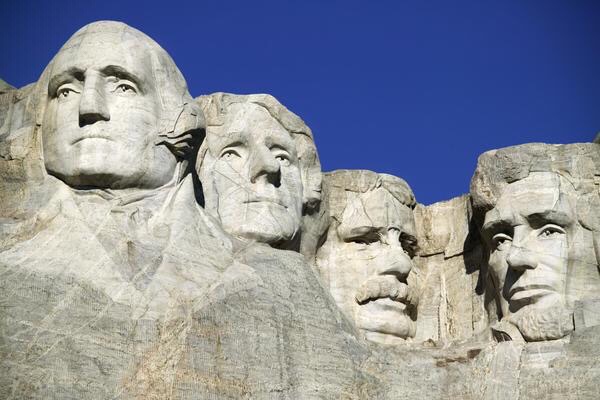
The Memorial at Mt. Rushmore is dedicated by President Calvin Coolidge. The memorial wouldn’t be declared complete until October 31, 1941, seven months after the man in charge of it’s carving, Gutzon Borglum, had died. His son Lincoln finished the project.

President Washington was chosen for obvious reasons, having led the battles that created our nation;

President Jefferson was chosen due to his instrumental work in creating our Declaration of Independence, which has inspired Democracy around the world;

President Lincoln was chosen for leading the nation through the Civil War, preserving the Union and abolishing slavery;

Theodore Roosevelt was chosen for leading the nation through the industrial revolution of the late 19th century, seeing to the construction of the Panama Canal.

An interesting aside…Mt. Rushmore is named for a young NYC attorney who visited the area in 1884 to check land ownership for some eastern investors. He was impressed with the mountain and asked prospectors what it was called…they replied that it had no name, but since he had asked, they would call it Rushmore Peak…and so it was.

Republicans Killed by Democrats

Today in History, July 30, 1866:

The New Orleans Riot.

NOLA had been under Union control for most of the Civil War, although deep South in geography and sentiments.

In 1864, a state convention of mostly Confederate sympathies had tried to enforce “Black Codes” to limit the rights of Freedmen.

Now that the war was over, “Radical” Republicans were holding a state convention in The Mechanic’s Institute in New Orleans in hopes of gaining control of the legislature. A group of black Union veterans formed and marched to the Institute in support of the Republicans, where they were attacked by an armed group of former Confederates, including some authorities (the Mayor and others were Democrat former Confederates). 34-35 black and 3 white Republicans were killed.

Other similar riots in the South occurred, convincing enough voters that more stringent Reconstruction policies were needed. In November Republicans would sweep into both houses of Congress by 77%. The next year they would force through the Fourteenth Amendment protecting citizenship rights and equal protections over the protests of Democrats in Congress. Before it could be ratified, the Reconstruction Acts were passed…requiring former states to ratify if before they could be represented in Congress.

The Bivouac of the Dead

Today in History, July 17, 1862:

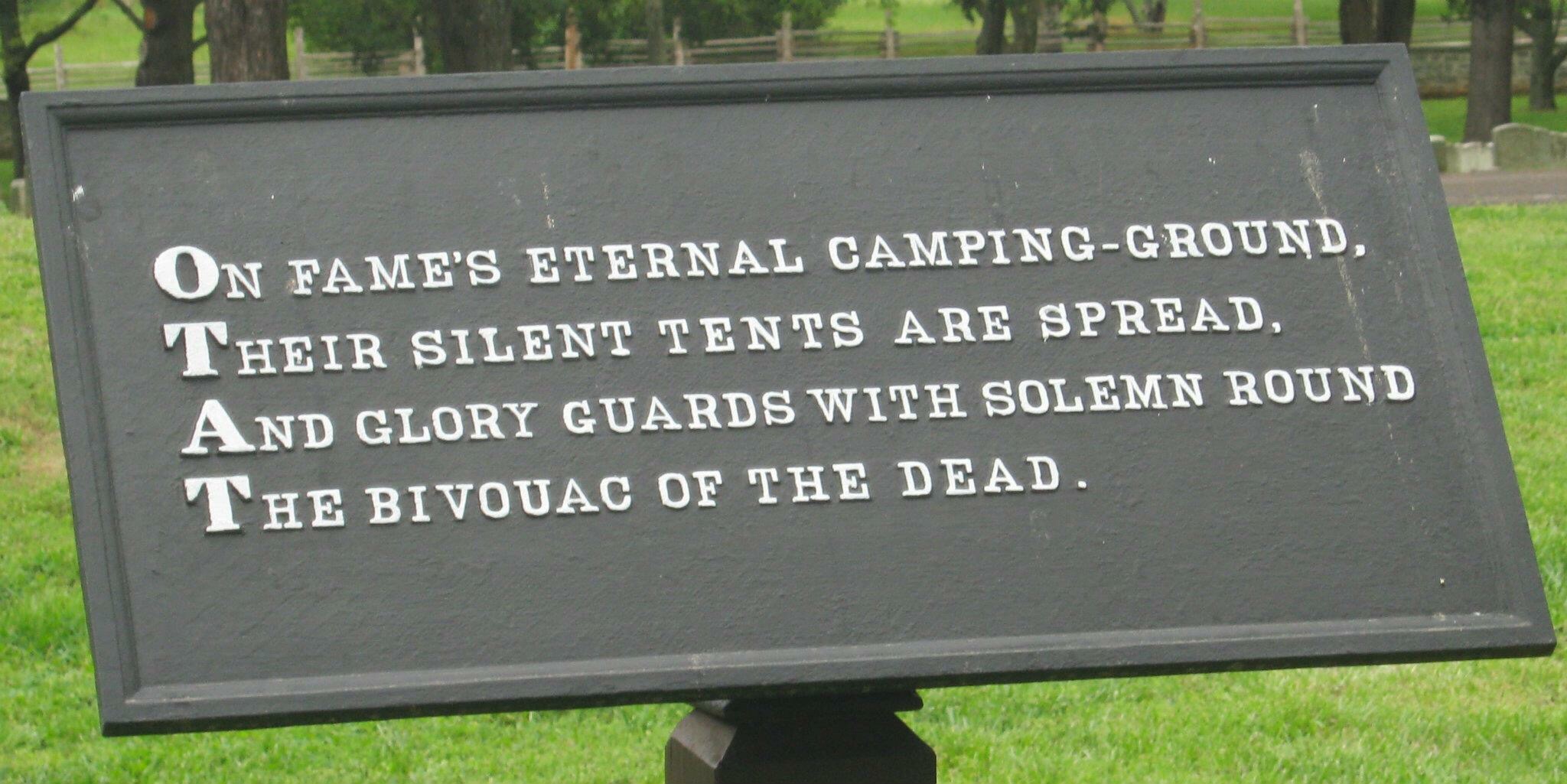
President Lincoln signs a Congressional act authorizing National Cemeteries across the nation.

The huge numbers of dead from the Civil War battles were buried pretty much where they fell. After the national cemeteries were established, they were moved to more honorable resting places…it took five years to accomplish.

Many of the national cemeteries are in the Southeastern US, where so many of the Civil War battles were fought, like this one at Stones River, Tennessee. God bless the men and women that have made our freedom possible. It is up to us to ensure they did not give up their lives in vain.