Fighting the Good Fight…and Consequences

Today in History, March 22: 1871:

North Carolina Governor William Holden (no, not THAT William Holden) is removed from office by impeachment…the first US Governor to receive this punishment.

His crime? Holden was a Republican and an abolitionist…during his tenure as Governor he hired two dozen detectives to hunt down the leaders of the NC KKK, got a bill passed that called out the militia against the KKK, and suspended habeas corpus to enhance his ability to prosecute the leaders of the Klan.

In 1870 the state’s Democrats won the legislature and quickly moved to impeach Holden for his hard-handed tactics against the KKK.

Holden had enacted these actions to counter the assassination of a Republican Senator and the hanging of an African-American police officer, amongst other crimes. In 2011, the entirety of the North Carolina Senate voted to pardon Holden.

The Cooper Union Speech

Today in History, February 27: 1860:

“One of the most happiest and most convincing political arguments ever made in this City … No man ever made such an impression on his first appeal to a New-York audience.”

— Horace Greeley in his paper regarding “The Cooper Union Speech” by Abraham Lincoln.

A former Congressman and Illinois lawyer, Lincoln had been launched to the national stage by his debates with Stephen Douglas over the slavery question 2 years before, but he was still mostly unknown in the east.

A young Republican’s group in New York invited him to speak at Cooper Union’s Great Hall. The hall was not filled for the speech, but the text of it was given to Greeley’s and other’s papers; from there it was broadly published across the nation in pamphlet form.

Lincoln made convincing arguments that the Founding Fathers were against the expansion of slavery and desired it’s eventual end. At the same time he tried to convince Southerners that the Republican party did not wish to interfere in their affairs.

While in New York he had his photo taken by Matthew Brady, and the photo was used along with the pamphlet to broaden his recognition.

It is widely believed that the speech is what launched him into the Presidency.

He closed with a message to his colleagues:

“Neither let us be slandered from our duty by false accusations against us, nor frightened from it by menaces of destruction to the Government nor of dungeons to ourselves. Let us have faith that right makes might, and in that faith, let us, to the end, dare to do our duty as we understand it.”

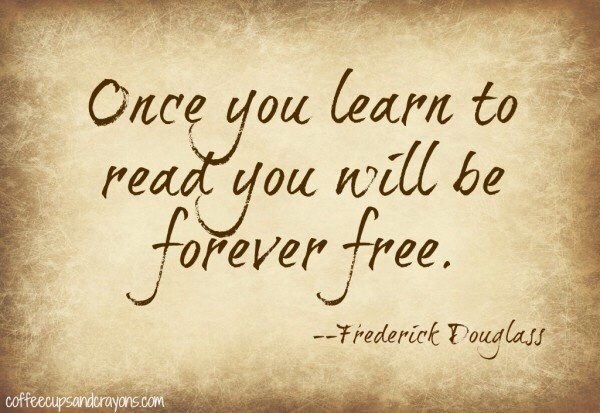
gladness and joy, like the rainbow, defy the skill of pen or pencil.” – Frederick Douglass

Today in History, February 20, 1895:

Frederick Douglass dies of either a heart attack or stroke in Washington DC after having appeared at an event of the National Council of Women where he received a standing ovation.

Thousands paid their respects at his funeral before he was returned to New York City to be interred at Mount Hope Cemetery in his family plot.

Douglass had been born circa 1818 (he never knew his actual birth date) into slavery in Maryland.

In 1838, on his third attempt, he escaped slavery. In the coming years Frederick Douglass became a well respected orator and statesman for the growing abolitionist and equal rights movements, impressing his listeners with his intellect and powerful messages.

“I have often been asked, how I felt when first I found myself on free soil. And my readers may share the same curiosity. There is scarcely anything in my experience about which I could not give a more satisfactory answer. A new world had opened upon me. If life is more than breath, and the ‘quick round of blood,’ I lived more in one day than in a year of my slave life. It was a time of joyous excitement which words can but tamely describe.

In a letter written to a friend soon after reaching New York, I said: ‘I felt as one might feel upon escape from a den of hungry lions.’ Anguish and grief, like darkness and rain, may be depicted; but gladness and joy, like the rainbow, defy the skill of pen or pencil.” – Frederick Douglass

The First Use of the “Temporary Insanity” Defense

Today in History, February 19, 1859:

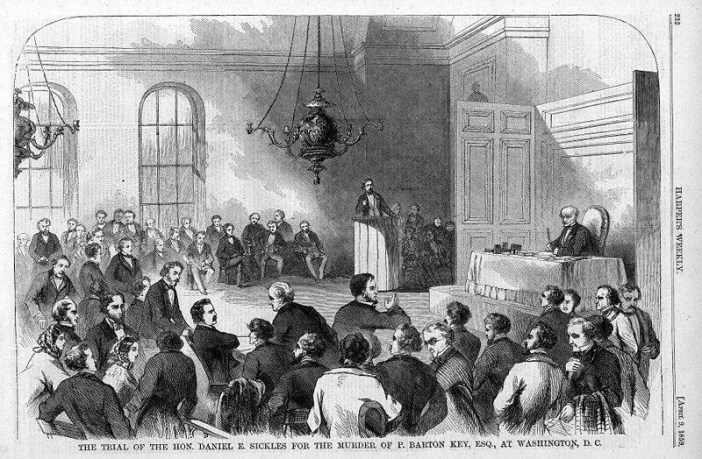
New York Congressman Daniel E. Sickles is acquitted of murder using a temporary insanity defense, the first time this defense was used in US courts.

Sickles was quite a character…he had been censored by Congress more than once, most prominently for having brought a known prostitute into the House chamber, and then taking her to England and introducing her to Queen Victoria while his wife was at home pregnant.

Despite this, he was enraged when his wife confessed to him that she had been carrying on an affair with the District Attorney for the District of Columbia, Phillip Barton Key II (Francis Scott Key’s son…you know..the Star Spangled Banner author).

Sickles confronted Key in Lafayette Square, across the street from the Executive Mansion (White House) and shot him dead. Sickles then went to the Attorney General’s home, turned himself in and confessed.

Future Secretary of War Edwin M. Stanton defended Sickles at his trial, painting the wife as a cheating harlot, and securing Sickles’ acquittal. Sickles went back to his wife, which enraged his supporters much more than the murder.

When the Civil War began, Sickles used his influence to recruit NY volunteers and gain a political generalship, something that was possible in those days. With no military experience he actually made a good accounting of himself in several battles.

Ironically, his most controversial act was yet to come.

At the pivotal Battle of Gettysburg, his III Corps was assigned a portion of the Union lines on Cemetery Ridge. On his own he decided to move his unit forward to higher ground, which thinned his lines and left a gap in the Union lines, and blatantly ignored the orders of the commander of the Army of the Potomac, General Meade.

Confederate General James Longstreet’s Corps attacked and decimated Sickles’ command, costing Sickles his leg.

The controversy amongst historians is whether Sickles sacrifice of his Corps helped or hurt the Union’s chances of victory. In the end the Union could count Gettysburg as a victory, but in my humble opinion, the ambitious Sickles had little to do with it. He put it at risk.

In his later years Sickles served as Minister to Spain (continuing his womanizing there) and returned to the legislature.

He spent much effort in creating the Gettysburg National Military Park and in denigrating Gen. Meade, while promoting himself as the true reason for the victory at Gettysburg. After lobbying for 34 years, he was awarded the Medal of Honor for his bravery in the battle. Perhaps most telling is the fact that there are memorials to almost all of the generals involved in the battle at the Park, but not for Sickles.

Good or bad, between his killing of Francis Scott Key’s son, his pioneering use of the insanity defense, and his military career, Sickles’ story is fascinating.

Honorable Brothers and Enemies at the Same Time…

Today in History, February 18, 1862:

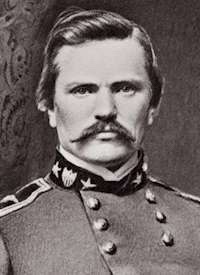
“I know you are separated from your people, and perhaps you need funds.  My purse is at your disposal.”  Union General Ulysses Grant to Confederate General Simon Bolivar Buckner as Buckner prepared to board a river boat taking him north to a Yankee prison.

On February 16, 1862 after a hard-fought battle and investment, Confederate Fort Donelson in Tennessee had surrendered to Union forces.

Tennessee was a strategic area in the Civil War, providing resources, people and a launching point to move against the rest of the South.

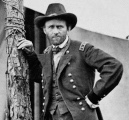
General U.S. Grant had been little known to the public before this battle, but the victory would change all that.  He coordinated with the US Navy to bombard Ft. Donelson and surround the 12,000 men there.  After assaults and counter assaults, the Confederate commanders came to the realization loss of the fort was a foregone conclusion, a tragedy for the South.

Gen. Simon Bolivar Buckner was actually third in command.  His superiors resigned their positions so they could sneak out and escape.  Col. Nathan Bedford Forrest took some of his Cavalry and fled also, leaving Buckner to stay with his men and surrender.

Buckner sent a note through the lines asking Grant for terms.  And here is where Grant became famous.  He wrote out his response for delivery to Buckner,

No terms except unconditional and imme­diate surrender can be accepted. I propose to move immediately upon your works.

In a time when furloughs and prisoner exchanges were common in battle, Buckner found the response to be “ungenerous and unchivalrous.”  Yet he had no choice, his only option was surrender.  Having had little but bad news for some time, the Northern papers seized upon the victory.

They used Grant’s initials to rename him “Unconditional Surrender Grant.”  Turns out it wasn’t the first time others had changed his name for him, but that’s another story.

The public was finding out something those serving with Grant had learned…he was unpretentious, unceremonious and tenacious.  He got results.  President Lincoln would eventually say of him, “I can’t spare this man; he fights” in defense of Grant’s reported drinking problem.

If you want History to be more than dates on a page, watch out for the back stories…the facts that bring out the humanity in what you’re reading.

The story reads good already.  But lets dig further.

When Grant was younger, he wanted an education.  His father worked hard and secured him an appointment to West Point.  Initially, Grant didn’t want to go.  But once in, he liked it.  His uncanny horsemanship impressed fellow cadets and instructors.  And he made friends among the other cadets, including Simon Bolivar Buckner, who was attending at the same time.

Grant and Buckner, among many other officers in the US Army, served together and performed heroics in the Mexican-American War of 1846-1848.

After that conflict Grant found himself assigned to the frontier in California, where he missed his family grievously and took to drink.  In July of 1854 he suddenly resigned his commission from the Army and sought transport home.

Grant found himself in New York without even enough money to get a meal or pay for a room.  And then he happened upon an old classmate and friend, Simon Bolivar Buckner.

The two enjoyed a visit, talked old times and Buckner, who was doing much better financially, paid for his friend’s room and board.

In the intervening years until 1861 and the beginning of the Civil War, Grant was somewhat of a hard luck case.  He tried farming, he tried real estate, nothing worked.  When the war began he was working for his brothers and his father in a store as a clerk.

When Southern states began seceding many in the US Army that were from those states, resigned their commissions and joined the Confederate Army, including Buckner.  Thus the old friends found themselves on opposite sides.

Thus, after the Battle at Fort Dolelson, Grant sought out Buckner before Buckner boarded the boat taking him off to prison in an attempt to return an old favor. Buckner, ever the gentleman, politely refused the return of the kindness.

Grant, of course, would become commander of all Union Armies and eventually President.

Buckner would eventually be exchanged for a Union general officer and continue to serve in the Confederate Army.

He surrendered in New Orleans in 1865 for a second time.  He would become Governor of Kentucky among other political successes.

In 1904 he visited the White House and asked President Theodore Roosevelt to appoint his son to West Point.  TR quickly agreed.

His son, Gen. Simon Bolivar Buckner Jr would be killed at Okinawa in WWII, the highest ranking officer killed by enemy fire in WWII.

Assassination Connections

Today in History, February 15: 1933 –

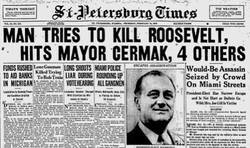
Assassination; Courage; and links between courageous Presidents. President elect Franklin Delano Roosevelt gives a speech, from his car (he is crippled, though few know it), in Bayfront Park in Miami, Florida. Standing on the running board of the car was a political ally, Chicago Mayor Anton Cermak.

Nearby a 5 foot, unemployed Italian immigrant bricklayer stands on a chair so that he can see the soon to be president, and fires his revolver. Instead of FDR he strikes Cermak before a woman standing beside him attacks him…and his next four shots injure standersby instead.

Within weeks Cermak dies…and the assassin will die by execution. Stories will go forward about whether FDR was the intended target, or Cermak, who was at the time fighting the Chicago mob.

What I find most interesting is the extended story. The crowd was about to beat the assassin to death in a bloodlust…Franklin calmed them…the suspect should face a court of law. FDR then directed that the Chicago mayor be loaded into his car, and cradled him in his lap as he was rushed to a nearby hospital. Cermak would die, the assassin would be executed…but FDR’s courage would inspire the nation.

FDR had adored his distant cousin, Theodore Roosevelt. TR had been shot in the chest while campaigning for the Presidency in Milwaukee, Wisconsin (by an insane immigrant)discouraged the crowd from abusing the would-be assassin…and continued on to finish a lengthy speech before seeking medical attention…he was a Bull Moose.

When he was a young boy in 1865 in New York, Teddy Roosevelt had watched from the window of a New York apartment as the body of his idol, President Abraham Lincoln, passed by in a funeral escort after he was assassinated in Washington, D. C. Lincoln had been discouraged from public appearances, including at Ford’s Theater, and responded to the effect that if someone wanted him dead, they would find a way. Our history is not nearly as disconnected as we think, and courage comes from knowledge and perspective.

The Fifteenth Amendment

Today in History, February 3: 1870 –

“Section 1. The right of citizens of the United States to vote shall not be denied or abridged by the United States or by any State on account of race, color, or previous condition of servitude.

Section 2. The Congress shall have power to enforce this article by appropriate legislation.”

The Fifteenth Amendment to the US Constitution is ratified, solidifying the rights of African-Americans to vote. This and several other legislative actions were passed by the Republican majority after the Civil War in the advancement of civil rights in America.

The Thirteenth Amendment

Today in History, February 1: 1865 –

“Section 1. Neither slavery nor involuntary servitude, except as a punishment for crime whereof the party shall have been duly convicted, shall exist within the United States, or any place subject to their jurisdiction.

Section 2. Congress shall have power to enforce this article by appropriate legislation.”

One day after Congress passed the Thirteenth Amendment to the US Constitution, President Abraham lincoln signs the act outlawing slavery.

It would take until December of the same year for enough states to ratify the amendment so that Secretary of State William Seward could proclaim it the law of the land. Of course Lincoln would give his life the cause of Union and freedom before then.

The Importance of Being Thorough…

Today in History, February 1, 1942:

Less than two months after the bombing of Pearl Harbor, the US Navy strikes back.

Task Forces built around the USS Yorktown (CV-5) and USS Enterprise (CV-6) sped in quickly in cover of darkness, then struck at Japanese air bases and shipping in the Marshall Islands. The US aircrews made repeated sorties against the islands throughout the day, until Admiral William Halsey decided they had pressed their luck enough and ordered a withdrawal…the carriers and their support ships were valuable and in short supply.

The air raid did little damage…however it was a tremendous morale booster for the military and the folks at home, and brought home the realization to the Japanese that they could be “touched.”

Now for a History link…I love those. While the US had significant facilities in parts of the Pacific, they had spent little in Japanese held areas before the war.

The command staff and they flyers involved were using the very latest charts and maps they had of Kwajalein Atoll and the Marshall Islands…they were at least 100 years old in 1942.

In 1838, wanting to join the scientific communities of the European nations, the United States authorized and supplied six ships commanded by Lt. Charles Wilkes to explore the Antarctic region, the Northwest and Western coastal regions of the US and the Pacific.

During a more than 3 year circumnavigation of the world, the “US Ex Ex”, or US Exploring Expedition collected more than 4,000 scientific samples, documented their contacts with peoples along their route, and meticulously charted the many islands, bays, inlets, etc they found. Wilkes was very dedicated to this portion of the Expedition, much to the annoyance of the scientists aboard.

Wilkes lengthy US Navy career would bring him to fame again during the Civil War with the Trent Affair…but that’s another story.

As he was charting the Marshalls, his intent was for whalers and other ships to make use of his efforts…he almost certainly couldn’t imagine massive ships carrying aircraft which would drop explosives on the Pacific paradise 100 years hence.

The Democrat Jack-Ass is Born Amidst Hatred

Today in History, January 15: 1870 –

“A Live Jackass Kicking a Dead Lion” “And Such a Lion! and Such a Jackass!”

Harper’s Weekly cartoonist Thomas Nast publishes a cartoon which popularizes the Jackass as the symbol for the Democrat party.

A German immigrant, Nast is considered by many to be the father of the modern political cartoon. In addition to the Democrat Jackass, he popularized the Republican Elephant and our conception of Santa Claus. I use the term popularize because he wasn’t the first to use any of these symbols, but he made them known to everyone.

The Jack-ass originally became known as a Democrat symbol when someone called President Andrew Jackson a jack-ass, and he decided to “own it.”

Among other things Nast was an abolitionist and a patriot. Which is why Northern Copperheads angered him so. Copperheads were Northern Democrats that were sympathetic to the Confederate (Southern Democrats) cause. Nast considered them racists and traitors.

Edwin M. Stanton had been part of President Lincoln’s “Team of Rivals”, the Secretary of War who prosecuted the Civil War from Washington and had become respectful and loyal to Lincoln. When Stanton died suddenly on Christmas Eve 1869, the Copperhead Papers in the North continued their criticism of him, speaking ill of the dead.

This was the inspiration for Nast’s cartoon.

This isn’t to say Stanton was a lovable character.  He angered many in D.C. and in the Army.  General William T. Sherman refused to shake his hand at a military review at the close of the war due to Stanton’s treatment of him.  Stanton was an opportunist, but he worked hard at his job.