Quentin Roosevelt

Today in History, July 14, 1919:

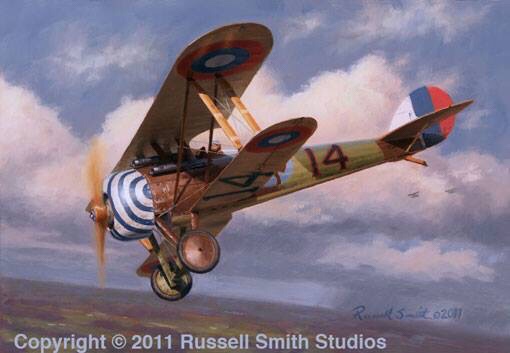
US Airman Quentin Roosevelt, youngest son of President Theodore Roosevelt, dies when he is shot down over France in WWI.

He and his brothers, who all served in WWI were very competitive in the voracity of their service, trying to live up to their father’s exploits…a father who also wanted to serve but was refused due to President Wilson’s fear that TR’s service might lead to a run for President in 1920. TR wouldn’t live that long…and he spent his last years heartbroken over the loss of his youngest son.

TR Jr. would die of a heart attack just weeks after leading his division in the Normandy invasion of 1944…again living up to his father’s legacy. A family of immense wealth; several generations of which dedicated their lives to service to their country.

The USS Kearsarge Ends CSS Alabama’s Run

Today in History, June 19, 1864:

The Battle off Cherbourg. In 1861 the screw sloop CSS Alabama was launched in England, which was just the beginning of the intrigue involving the Confederate cruiser that wreaked havoc on Union shipping until her demise on this date in 1864.

The British gov’t had ordered no ships be built or sold to the rebels, but the company that built the Alabama did so clandestinely. During the intervening years the Alabama, which had both steam engines and sails, circled the globe sinking Union merchant shipping (60 at least) and a Union warship.

She had put in at Cherbourg, France for much needed repairs, but was rebuffed. Before she could leave, the Union screw sloop USS Kearsarge arrived outside the harbor.

Capt. Charles Pickering and many other Union Captains had been searching for the infamous Alabama and Capt. Raphael Semmes for years. Semmes set out to engage the Kearsarge, firing the first shot. The two ships parried, but the Kearsarge had some advantages; powerful new “Dahlgren” guns and chains draped over her sides for protection. Within an hour the Kearsarge’s crew sent the Alabama to the bottom. Semmes escaped on a passing British ship to England with 41 of his crew.

Nazi Atrocities

Today in History, June 10, 1944:

Oradour-sur-Glane, France. Elements of the Nazi SS, acting on belief that one of their officers had been captured by members of the French Resistance, rounded up every citizen of the town and 6 hapless passersby. They locked all of the women and children in a church, then took all of the men to barns, where machine gun nests were already set up. The men were intentionally shot in the legs so that they would die more slowly…once they were all unable to move, the Nazis poured gasoline over them and set the barns afire.

They then returned to the church, where they set off an incendiary device inside. As the church burned, women and children tried to climb out of windows…where they were machine-gunned. 642 innocent civilians were slaughtered.

1944 – Distomo, Greece. In retaliation for a partisan attack, German SS troops go house to house in the village (whose residents had nothing to do with the attack), killing every man woman and child, totaling 218 dead in the end. They disemboweled one infant in front of his family and committed numerous other atrocities before burning the village.

http://youtu.be/sEwBspQTphw

D-Day, the 6th of June

Today in History, June 6, 1944:

The skies overhead filled with aircraft…thousands of bombers, transports, fighters. The British populace watched the boys board transport ships bound for France…and wept. Their towns, so long filled with those damned Americans were now quiet and empty. They wouldn’t be coming back. Many would fill cemeteries across Europe; others would be headed home for the US after fighting their way to Germany.

In America, as the news was broadcast that the invasion had begun at long last, businesses, theaters, and other workplaces emptied and closed…and the churches filled to capacity.

Americans prayed for their sons, husbands and fathers. I’m sure they prayed not to see the Western Union courier on their street in the coming days.

The Allies had been planning, working for and arguing over this day since America had entered the war. Americans had wanted to make the assault on Europe as early as 1942. Stalin in Russia had been pushing for another front to be opened to relieve pressure on his country which had suffered incredible losses.

The British General Staff and Churchill had won the argument, which saw to fighting in Africa, Sicily and Italy first.

By 1944, as America provided more and more supplies…and troops…to the war, the invasion of France was planned.

The largest, most complex invasion in history began on June 6, 1944 with Americans, British, Canadians and troops from the occupied nations of Europe.

The world was saved by boys who should have lived long, happy lives.

We owe a debt we cannot possibly repay.

On that day, my father would be recognizing his 17th birthday. I don’t know when he shipped out, but that is the year he began his service in the Pacific.

Defeat? Or Victory at Dunkirk

Today in History, May 26: 1940 – Operation Dynamo, or the Evacuation of the British Expeditionary Force from France at Dunkirk, begins. The BEF had been sent to France after years of appeasement, when Hitler had invaded Poland in September of 1939. On May 10th Germany invaded France, which, although considered the largest army in Europe, promptly folded like an old lawn chair. The British, French and Belgian troops retreated to Dunkirk, where they faced certain defeat. The idea now was the evacuate across the English Channel, but the first day’s effort on saw the evacuation of 9,000 or so men. A call for assistance went out, and every Royal Navy vessel that could sail, every civilian yacht, fishing vessel and others that could sail for Dunkirk, did so. In the end, 9 days later, more than 338,000 soldiers had been rescued; the best and brightest of the British armed forces that would be needed in the years to come.

The Treaty of Windsor

Today in History, May 9, 1386:

A Treaty of Alliance is ratified at Windsor between King Richard II of England and King John I of Portugal.

The Treaty is the longest alliance still in effect. It came about because the Portuguese needed military assistance in defense against their neighbor Castile (Spain) and England needed the Naval assistance of Portugal against France. Portugal’s sea power was at that time stronger than that of the English.

The treaty was strengthened by the marriage of John I of Portugal to Philippa, daughter of the Duke of Lancaster.

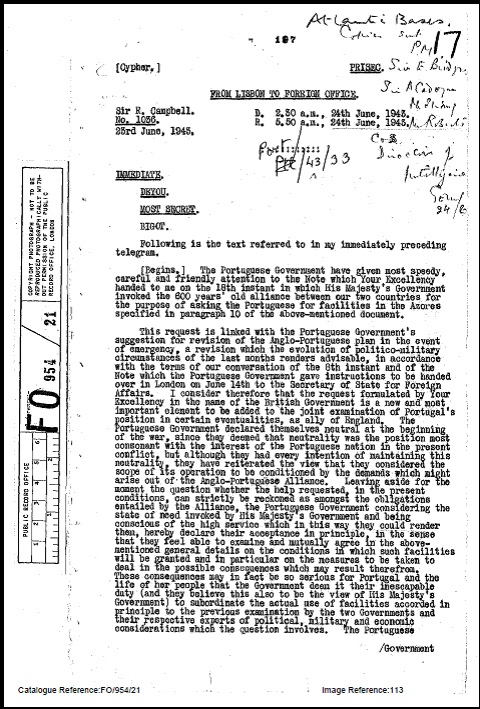
The Alliance was again called upon to thwart a Spanish invasion of Portugal in the 1760’s, to fend off Napoleon in the early 19th century, then in WWII when Portugal provided intel and air bases in the Azores to England and America. Air patrols from the Azores were important in the Battle of the Atlantic. The air bases were again provided to England during the Falkland Islands War.

George Washington Knew How to Fight…And When Not to Fight…

george-washington-portrait

Today in History, April 22, 1793:

President George Washington issues a Proclamation of Neutrality, making it clear to the great powers of Europe, and France in particular, that the newly born United States would not participate in a war then sweeping the old countries.

[Philadelphia, 22 April 1793]

“Whereas it appears that a state of war exists between Austria, Prussia, Sardinia, Great-Britain, and the United Netherlands, of the one part, and France on the other, and the duty and interest of the United States require, that they should with sincerity and good faith adopt and pursue a conduct friendly and impartial toward the belligerent powers:

I have therefore thought fit by these presents to declare the disposition of the United States to observe the conduct aforesaid towards those powers respectively; and to exhort and warn the citizens of the United States carefully to avoid all acts and proceedings whatsover, which may in any manner tend to contravene such disposition.

And I do hereby also make known that whosoever of the citizens of the United States shall render himself liable to punishment or forfeiture under the law of nations, by committing, aiding or abetting hostilities against any of the said powers, or by carrying to any of them those articles, which are deemed contraband by the modern usage of nations, will not receive the protection of the United States, against such punishment or forfeiture: and further, that I have given instructions to those officers, to whom it belongs, to cause prosecutions to be instituted against all persons, who shall, within the cognizance of the courts of the United States, violate the Law of Nations, with respect to the powers at war, or any of them.

In testimony whereof I have caused the Seal of the United States of America to be affixed to these presents, and signed the same with my hand. Done at the city of Philadelphia, the twenty-second day of April, one thousand seven hundred and ninety-three, and of the Independence of the United States of America the seventeenth.”

Go. WASHINGTON.

By the President.
Th: Jefferson.

The assertion of neutrality did not set well with many Americans, and certainly not with the French.  After all, powerful France had been instrumental in the winning of American independence, finalized in the Treaty of Paris only ten years previous in 1783.  Now France had been inspired to undergo their own Revolution, and expected America to reciprocate in support of her war with the other European nations.  French Edmond Genet was then in the United States, appealing directly to the people for support.  President Washington was none too pleased with Genet’s attempts to bypass the American Federal government in his efforts.
Jefferson, Madison and Hamilton debated the subject in the newspapers using aliases, Pacificus and Helivicus.
It wasn’t that President Washington and his cabinet were unfaithful to their first ally.  They were practical.  The French Revolution had taken on a different tone than the American Revolution, with the beheading of King Louis XVI.
Even more importantly, Washington knew America was not yet a world power.  The British did not yet entirely respect American sovereignty, despite the Treaty of Paris.  Washington new the nation needed decades to build it’s resources and to unify politically before playing a meaningful part in world affairs.
America is truly fortunate to have had the guidance and forethought of our Founding Fathers.  The nation would certainly have plenty of opportunities to return the favors France had provided…World War I, World War II most prominent.
Costs of Appeasement

Today in History, March 7: 1936:

“If you French had intervened in the Rhineland in 1936 we should have been sunk and Hitler would have fallen” – German General Heinz Guderian, interviewed after WWII.

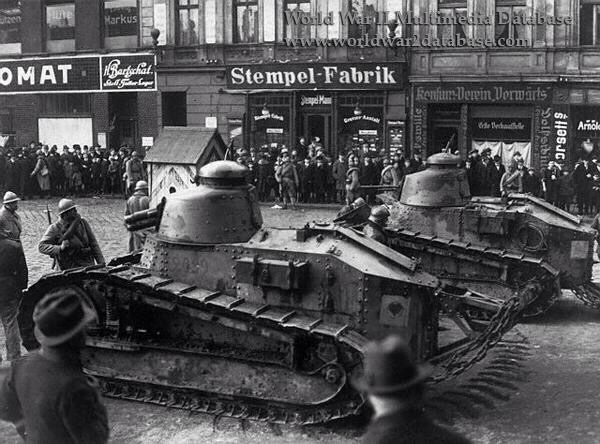
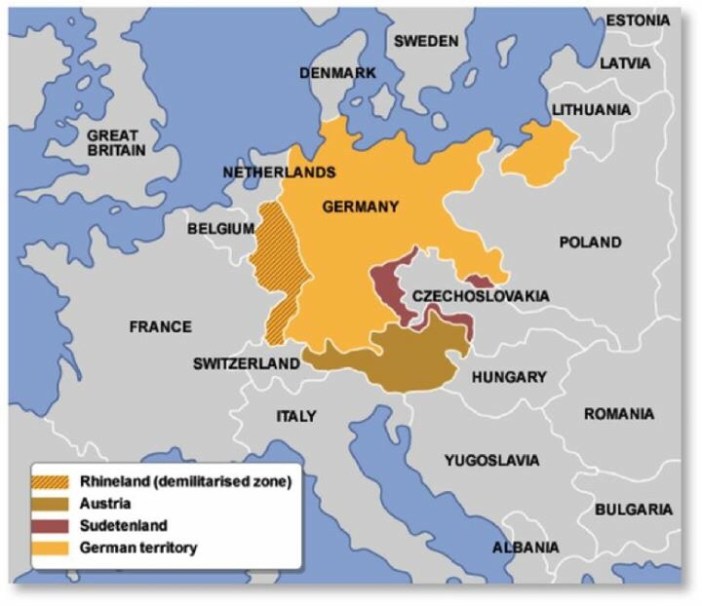
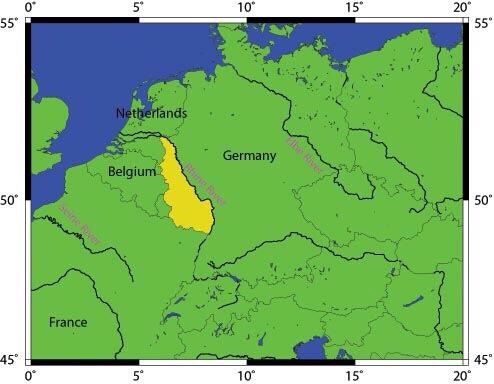
On this date, Germany “remilitarized” the Rhineland with a token force. It had been de-militarized after WWI to protect Germany’s neighbors.

In some skullduggery, Hitler claimed the people of the Rhineland were German peoples, and wanted the military presence. Now it was just a matter of seeing if anyone would call his hand.

In his memoirs, Hitler agreed with Guderian, saying that he had been very nervous in the 48 hours after the move.

Except for a few unheeded voices (Churchill), the governments of Europe refused to act, mostly for financial reasons. Bet they wished they could have had a “do over” on that decision.

The Real “First” World War?

Today in History, February 10: 1763 –

“The Seven Years War”, or as it was known in the colonies, “The French and Indian War” ends with the Treaty of Paris. Britain and France had been battling for years in America, Europe, India and on the high seas over their competing imperial interests. Spain had taken sides with France. Both Britain and France had their allies in what could be considered a World War.

After several British victories on land and at sea, and after several of France’s allies had signed separate peace treaties, France and Spain finally came to the table. France gave up several of her holdings including in Canada, America and India.

The Spanish received the Louisiana Territory, the British received Spanish Florida.

Probably the most important issues for the American colonies however, are these: Many Americans, such as George Washington, gained extensive military experience fighting the French and their Indian allies during the war. And when Americans decided less than two decades later to fight for their independence from the British Crown, the French had a grudge to settle; it wasn’t that difficult for Ben Franklin to convince France to come in on the side of the Colonials. French Naval might was pivotal to the American victory.

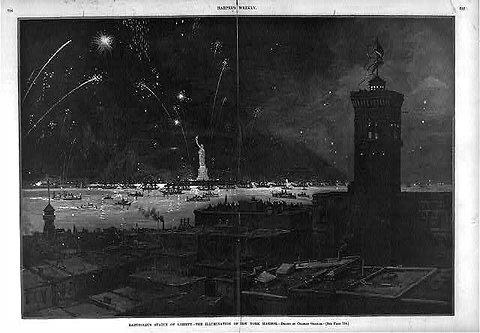
Liberty Enlightening the World


Today in History, October 28: 1886 – “Not like the brazen giant of Greek fame, With conquering limbs astride from land to land;

Here at our sea-washed, sunset gates shall stand

A mighty woman with a torch, whose flame

Is the imprisoned lightning, and her name

Mother of Exiles. From her beacon-hand

Glows world-wide welcome; her mild eyes command

The air-bridged harbor that twin cities frame.

“Keep, ancient lands, your storied pomp!” cries she

With silent lips. “GIVE ME YOUR TIRED, YOUR POOR,

YOUR HUDDLED MASSES YEARNING TO BREATHE FREE,

THE WRETCHED REFUSE OF YOUR TEEMING SHORE.

SEND THESE, THE HOMELESS, TEMPEST TOST TO ME,

I LIFT MY LAMP BESIDE THE GOLDEN DOOR!”

—Emma Lazarus, 1883

“Liberty Enlightening the World” a statue gifted to America by France in recognition of the two nation’s alliance during the Revolutionary War, is dedicated in New York harbor. The dedication was presided over by President Grover Cleveland.