Victory and Assassination

Today in History, April 4: 1865:

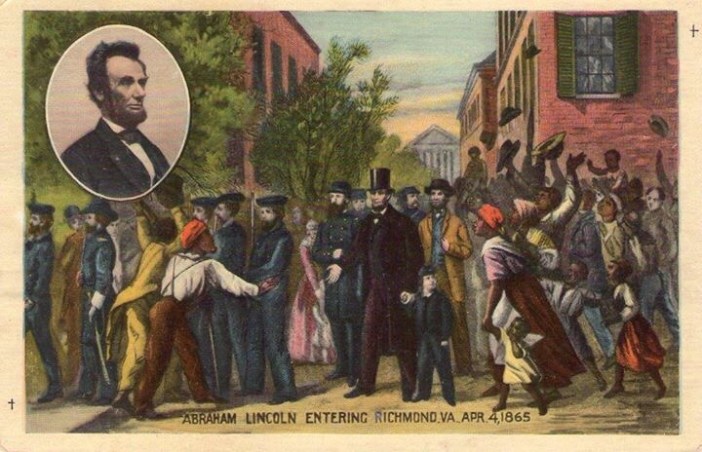
150 years ago today. President Lincoln enters Richmond, the Confederate Capitol. Lincoln had been at City Point when informed that Richmond had been taken the day before by Union Army forces.

He immediately sailed on the USS Malvern, Flag Officer David Dixon Porter’s flagship for Richmond. After he disembarked, he was initially escorted through crowds by a contingent of sailors, who were very relieved when they were met by a group of Union Cavalry to assist in escorting the President to the home of Confederate President Jefferson Davis.

Many former slaves attempted to pay homage to Lincoln, who would not allow it. Onlookers watched from the windows and street corners.

At Davis’ house, Lincoln sat in Davis’ chair, then toured the house.

When later asked by Union Gen. Weitzel how the conquered rebels should be treated, Lincoln indicated that he would not give an order in that regard, but that his advice would be to, “Let them up easy….let them up easy”.

As for the nervous sailors and cavalrymen that escorted him? As it turns out, Lincoln was safer in the Confederate capitol that his own. He had only ten days until he would be assassinated.

103 years later to the day, another man dedicated to civil rights and the advancement of justice, Dr. Martin Luther King, Jr. would be assassinated in Memphis, Tennessee.

April is a Historic month with many stories to tell.

Historic Connections: Lincoln-Hay-Roosevelt

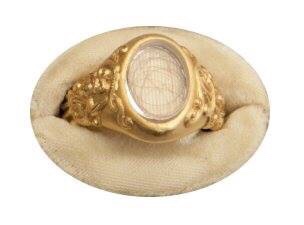
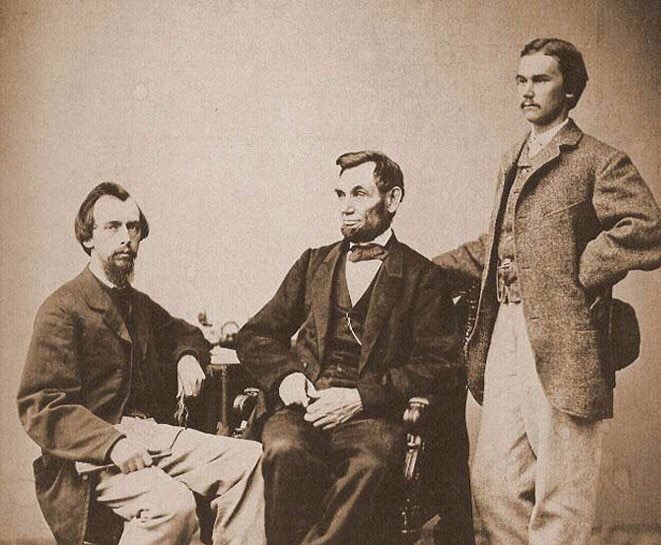
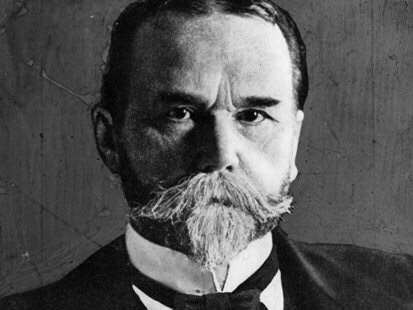
Today in History, March 4: 1861 (Lincoln Inauguration) / 1905 (Theodore Roosevelt Inauguration) – A very special connection between two Presidents, 40 years apart. As a young man in Illinois, John Hay got the chance of a lifetime. His friend John Nicolay was working at the law firm of Abraham Lincoln, Presidential candidate. When Lincoln was elected, Hay and Nicolay became his private secretaries in the Executive Mansion and became his confidants…he would stay up nights sharing stories with them and came to trust them; they helped to keep him balanced through the trials and tragedies of the Civil War. They, in turn nearly idolized him, referring to him as the Ancient One. When Lincoln was assassinated it devastated Hay. He recovered and went on to serve in numerous posts within the government, including the Ambassador to the Court of St. James (England); he was a successful author and journalist (remarkably understated..but I must keep this somewhat brief). He served several other presidents, becoming Secretary of State for President William McKinley. When McKinley was assassinated, Hay stayed on to serve in Theodore Roosevelt’s administration. He was largely responsible for the Open Door Policy in China and negotiated the Hay–Bunau-Varilla Treaty to build the Panama Canal. He initially thought TR a rogue cowboy, but as he grew to respect the President, they became fast friends. TR came to respect Hay’s experience and wisdom, and came to depend upon him. The night before TR was to be inaugurated for his second term, his first in which he was elected, John Hay sent TR a gift. A ring containing a strand of President Lincoln’s hair under glass, taken during his autopsy. Hay included a note:

“Dear Theodore:

The hair in this ring is from the head of Abraham Lincoln. Dr. Taft cut it off the night of the assassination, and I got it from his son-a brief pedigress.

Please wear it tomorrow; you are one of the men who most thoroughly understand and appreciate Lincoln.

I have had your mongram and Lincoln’s engraved on the ring.

Longas, O utiman, bone dux, ferias, Praestes Hesperia.

(Mayest thou, Good Captain, give long holiday to Hesperia!)

Yours affectionately, John Hay”

TR replied:

“Dear John, Surely no other President, on the eve of his inauguration, has ever received such a gift from such a friend. I am wearing the ring now; I shall think of it and you as I take the oath tomorrow. I wonder if you have any idea what your strength and wisdom and sympathy, what the guidance you have given me and the mere delight in your companionship, have meant to me these three and a half years?

With love and gratitude, Ever yours….”

What a life! A integral part of the story of two of our best presidents, and a key player in numerous historic decisions and events. Aside from the photos of the ring, there are photos of Hay in his youth, as an older man (he would die later in 1905), and even the photo of Lincoln’s funeral procession through New York City is important…in a window of one of the buildings to the left are two small boys watching the procession go by…young Theodore Roosevelt, Jr and his brother Elliott.
The Cooper Union Speech

Today in History, February 27: 1860:

“One of the most happiest and most convincing political arguments ever made in this City … No man ever made such an impression on his first appeal to a New-York audience.”

— Horace Greeley in his paper regarding “The Cooper Union Speech” by Abraham Lincoln.

A former Congressman and Illinois lawyer, Lincoln had been launched to the national stage by his debates with Stephen Douglas over the slavery question 2 years before, but he was still mostly unknown in the east.

A young Republican’s group in New York invited him to speak at Cooper Union’s Great Hall. The hall was not filled for the speech, but the text of it was given to Greeley’s and other’s papers; from there it was broadly published across the nation in pamphlet form.

Lincoln made convincing arguments that the Founding Fathers were against the expansion of slavery and desired it’s eventual end. At the same time he tried to convince Southerners that the Republican party did not wish to interfere in their affairs.

While in New York he had his photo taken by Matthew Brady, and the photo was used along with the pamphlet to broaden his recognition.

It is widely believed that the speech is what launched him into the Presidency.

He closed with a message to his colleagues:

“Neither let us be slandered from our duty by false accusations against us, nor frightened from it by menaces of destruction to the Government nor of dungeons to ourselves. Let us have faith that right makes might, and in that faith, let us, to the end, dare to do our duty as we understand it.”

Assassination Connections

Today in History, February 15: 1933 –

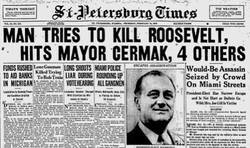
Assassination; Courage; and links between courageous Presidents. President elect Franklin Delano Roosevelt gives a speech, from his car (he is crippled, though few know it), in Bayfront Park in Miami, Florida. Standing on the running board of the car was a political ally, Chicago Mayor Anton Cermak.

Nearby a 5 foot, unemployed Italian immigrant bricklayer stands on a chair so that he can see the soon to be president, and fires his revolver. Instead of FDR he strikes Cermak before a woman standing beside him attacks him…and his next four shots injure standersby instead.

Within weeks Cermak dies…and the assassin will die by execution. Stories will go forward about whether FDR was the intended target, or Cermak, who was at the time fighting the Chicago mob.

What I find most interesting is the extended story. The crowd was about to beat the assassin to death in a bloodlust…Franklin calmed them…the suspect should face a court of law. FDR then directed that the Chicago mayor be loaded into his car, and cradled him in his lap as he was rushed to a nearby hospital. Cermak would die, the assassin would be executed…but FDR’s courage would inspire the nation.

FDR had adored his distant cousin, Theodore Roosevelt. TR had been shot in the chest while campaigning for the Presidency in Milwaukee, Wisconsin (by an insane immigrant)discouraged the crowd from abusing the would-be assassin…and continued on to finish a lengthy speech before seeking medical attention…he was a Bull Moose.

When he was a young boy in 1865 in New York, Teddy Roosevelt had watched from the window of a New York apartment as the body of his idol, President Abraham Lincoln, passed by in a funeral escort after he was assassinated in Washington, D. C. Lincoln had been discouraged from public appearances, including at Ford’s Theater, and responded to the effect that if someone wanted him dead, they would find a way. Our history is not nearly as disconnected as we think, and courage comes from knowledge and perspective.

The Fifteenth Amendment

Today in History, February 3: 1870 –

“Section 1. The right of citizens of the United States to vote shall not be denied or abridged by the United States or by any State on account of race, color, or previous condition of servitude.

Section 2. The Congress shall have power to enforce this article by appropriate legislation.”

The Fifteenth Amendment to the US Constitution is ratified, solidifying the rights of African-Americans to vote. This and several other legislative actions were passed by the Republican majority after the Civil War in the advancement of civil rights in America.

The Thirteenth Amendment

Today in History, February 1: 1865 –

“Section 1. Neither slavery nor involuntary servitude, except as a punishment for crime whereof the party shall have been duly convicted, shall exist within the United States, or any place subject to their jurisdiction.

Section 2. Congress shall have power to enforce this article by appropriate legislation.”

One day after Congress passed the Thirteenth Amendment to the US Constitution, President Abraham lincoln signs the act outlawing slavery.

It would take until December of the same year for enough states to ratify the amendment so that Secretary of State William Seward could proclaim it the law of the land. Of course Lincoln would give his life the cause of Union and freedom before then.

The Democrat Jack-Ass is Born Amidst Hatred

Today in History, January 15: 1870 –

“A Live Jackass Kicking a Dead Lion” “And Such a Lion! and Such a Jackass!”

Harper’s Weekly cartoonist Thomas Nast publishes a cartoon which popularizes the Jackass as the symbol for the Democrat party.

A German immigrant, Nast is considered by many to be the father of the modern political cartoon. In addition to the Democrat Jackass, he popularized the Republican Elephant and our conception of Santa Claus. I use the term popularize because he wasn’t the first to use any of these symbols, but he made them known to everyone.

The Jack-ass originally became known as a Democrat symbol when someone called President Andrew Jackson a jack-ass, and he decided to “own it.”

Among other things Nast was an abolitionist and a patriot. Which is why Northern Copperheads angered him so. Copperheads were Northern Democrats that were sympathetic to the Confederate (Southern Democrats) cause. Nast considered them racists and traitors.

Edwin M. Stanton had been part of President Lincoln’s “Team of Rivals”, the Secretary of War who prosecuted the Civil War from Washington and had become respectful and loyal to Lincoln. When Stanton died suddenly on Christmas Eve 1869, the Copperhead Papers in the North continued their criticism of him, speaking ill of the dead.

This was the inspiration for Nast’s cartoon.

This isn’t to say Stanton was a lovable character.  He angered many in D.C. and in the Army.  General William T. Sherman refused to shake his hand at a military review at the close of the war due to Stanton’s treatment of him.  Stanton was an opportunist, but he worked hard at his job.

A Christmas Gift

Today in History, December 22: 1864 – “I beg to present you, as a Christmas gift, the city of Savannah, with 150 heavy guns and plenty of ammunition, and also about 25,000 bales of cotton.”. General William Tecumseh Sherman wired this message to President Lincoln after his army siezed one of the few remaining port cities in the South.

The message was not merely well received. It ended a six week cliff hanger for the President and the people of the North. That was when Gen. Sherman had taken the daring move of leaving the conquered city of Atlanta, thus cutting his army off from it’s supply lines. The large army would be solely dependent upon the supplies it could obtain from the land. Everything that was not needed to feed or provision the Union Army in a huge swath between the two cities was destroyed to prevent it’s use by the South.

Sherman had several objectives: Take Savannah to prevent supplies reaching the Confederacy from overseas, join up with the Navy, and bring the horrors of war to the Southern populace in an effort to demoralize them and shorten the war.

A Pardon for “Little Sister”

Today in History, December 14: 1863 –

President Lincoln grants amnesty to his sister-in-law, Emilie Todd Helm, whose Confederate General husband had been killed at the Battle of Chickamauga. Emilie had made her way to DC and was staying in the White House with the President and her half sister, Mary Todd Lincoln. This was part of a plan Lincoln had to re-unite the Union.

By his order, any Confederate “rebel” that would swear an oath of loyalty to the Union would be granted amnesty. Lincoln hoped this would foster reconciliation and diminish the ranks of the Confederate Army.

Ironically, “four score and seven” years earlier, the British Army had pronounced the same decree, stating that any “rebel” involved in the Revolutionary War who would swear an oath of loyalty to the British Crown, would be granted amnesty; and the British decree was proffered for the same reason. In 1776 it met with limited success. In 1863, it met with some success, but the war would continue for two more years.

“I should be glad, if I could flatter myself that I came as near to the central idea of the occasion, in two hours, as you did in two minutes.”

Today in History, November 19: 1863 – “I should be glad, if I could flatter myself that I came as near to the central idea of the occasion, in two hours, as you did in two minutes.” -Edward Everett, popular orator that spoke with President Lincoln at Gettysburg to commemorate those that died there during the pivotal Battle of Gettysburg earlier in the year. President Lincoln spoke briefly, and his speech was criticized at the time by some media, but has become legendary for it’s prescience. See below for the full text….

Four score and seven years ago our fathers brought forth on this continent, a new nation, conceived in Liberty, and dedicated to the proposition that all men are created equal.

Now we are engaged in a great civil war, testing whether that nation, or any nation so conceived and so dedicated, can long endure. We are met on a great battle-field of that war. We have come to dedicate a portion of that field, as a final resting place for those who here gave their lives that that nation might live. It is altogether fitting and proper that we should do this.

But, in a larger sense, we can not dedicate — we can not consecrate — we can not hallow — this ground. The brave men, living and dead, who struggled here, have consecrated it, far above our poor power to add or detract. The world will little note, nor long remember what we say here, but it can never forget what they did here. It is for us the living, rather, to be dedicated here to the unfinished work which they who fought here have thus far so nobly advanced. It is rather for us to be here dedicated to the great task remaining before us — that from these honored dead we take increased devotion to that cause for which they gave the last full measure of devotion — that we here highly resolve that these dead shall not have died in vain — that this nation, under God, shall have a new birth of freedom — and that government of the people, by the people, for the people, shall not perish from the earth.