
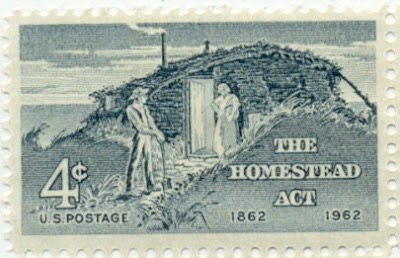
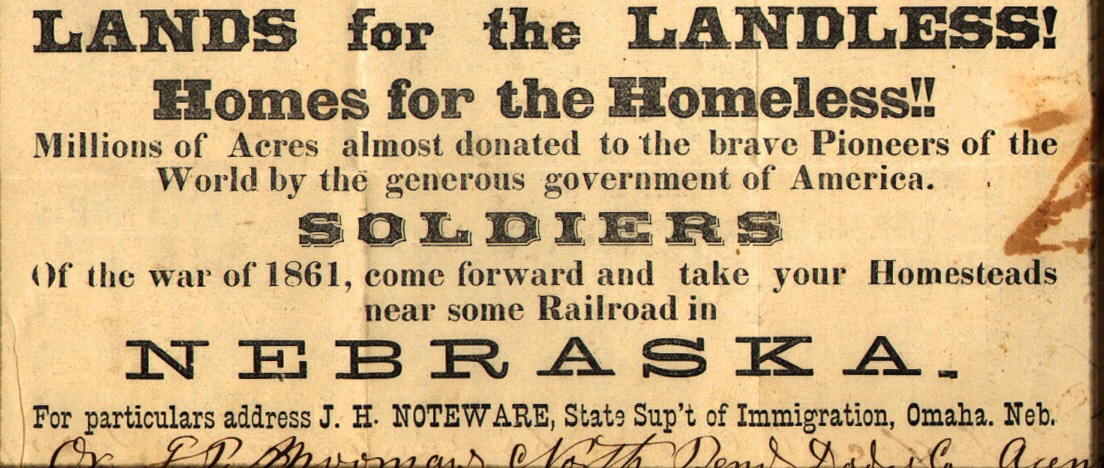
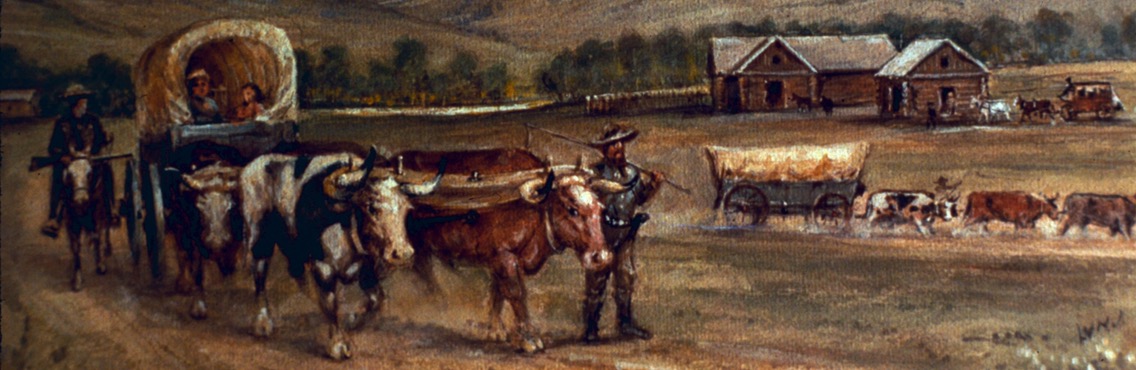
Today in History, May 20: 1862 – President Lincoln signs the Homestead Act, which would give 160 acres of western lands to anyone that would farm it successfully for 5 years and build a residence upon it (often a sod building). The Act would encourage vastly expanded settlement of the west; bad news for Native Americans, good news for those newer Americans wanting to improve their lot in life. Congress had attempted to pass similar acts in 1852, 1854, and 1859, but each time the attempts were shot down by Southern Democrats who were afraid that if the west were populated by poor farmers and immigrants it would result in more “free” states, which would result in more votes against slavery. Once the Republican Lincoln was elected, and the Civil War began, the Southern Democrats were no longer part of the equation. As their states seceded from the Union, their obstructionist votes left Congress. The Republicans soon passed the Homestead Act and the settlement of the west began in earnest. By the end of the war 15,000 settlers (some of which were merely pawns for land speculators) had accepted their lands. Eventually 80 Million acres would be settled.
Tag: lincoln
Let ’em up easy…

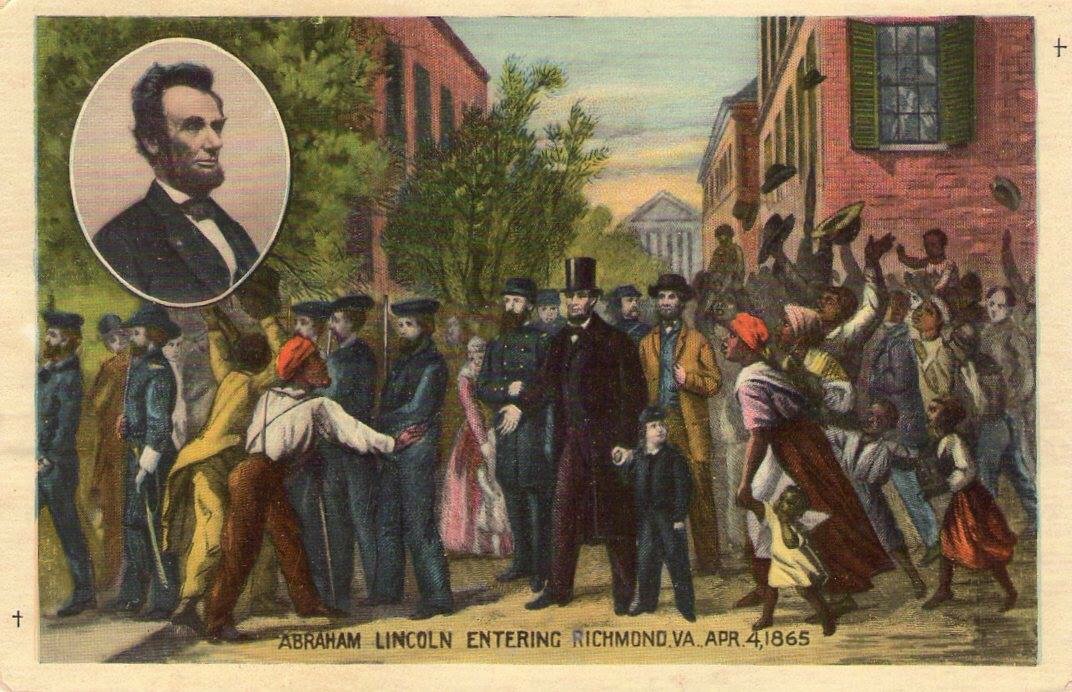
 Today in History, April 4: 1865 – President Lincoln enters Richmond, the Confederate Capitol. Lincoln had been at City Point when informed that Richmond had been taken the day before by Union Army forces. He immediately sailed on the USS Malvern, Flag Officer David Dixon Porter’s flagship for Richmond. After he disembarked, he was initially escorted through crowds by a contingent of sailors, who were very relieved when they were met by a group of Union Cavalry to assist in escorting the President to the home of Confederate President Jefferson Davis. Many former slaves attempted to pay homage to Lincoln, who would not allow it. Onlookers watched from the windows and street corners. At Davis’ house, Lincoln sat in Davis’ chair, then toured the house. When later asked by Union Gen. Weitzel how the conquered rebels should be treated, Lincoln indicated that he would not give an order in that regard, but that his advice would be to, “Let them up easy….let them up easy”. As for the nervous sailors and cavalrymen that escorted him? As it turns out, Lincoln was safer in the Confederate capitol that his own. He had only ten days until he would be assassinated.
Uncle Tom’s Cabin Published


Today in History, March 20: 1852 – “So…you’re the little woman who wrote the book that made this great war!” President Abraham Lincoln greets Harriett Beecher Stowe at the Presidential Mansion in 1862, ten years after her novel “Uncle Tom’s Cabin” was first published. I am amazed at the foresight and courage displayed by this woman, a school teacher turned author. By her own admission, in the epilogue of the book, for the first part of her life, she knew of slavery, disapproved of it, but being a Northerner, it was distant and she felt that the problem would be resolved eventually on it’s own. How many of today’s injustices do we see the same way? Between meeting some runaway slaves, becoming familiar with the Underground Railroad, and stories from her family and friends, and finally the Compromise of 1850 (in which the government promised to return runaway slaves in exchange for new limitations on slavery expansion), she became an avid abolitionist. She wrote Uncle Tom’s Cabin to illustrate the aspects of slavery that most did not understand at that time. As slaves, a mother’s children were often sold off, never to be seen again. Women were sold into prostitution, to be used until their value had diminished. If a good and kindly “master” came on hard times, he might sell a good man “down the river” to cruel and harsh masters, as “Uncle Tom” was. With her novel, Mrs. Stowe humanized the slavery issue, brought it home to people and chastised them for not living up to their Christian values. The novel would become the best selling novel of the 19th century and would inspire abolitionist views amongst Americans. It was certainly far from the only cause of the Civil War…but the novel played it’s part in American History. One has to wonder if this “little woman” had any idea of the importance her words would have. If you haven’t read (or listened to) this novel, you should.
Two Westerners, President and Lt. General
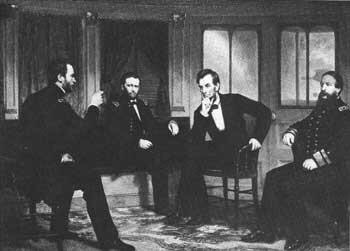 Today in History, March 10: 1864 – President Lincoln signs documents promoting Ulysses S. Grant to the rank of Lieutenant General. Grant was only the second person to hold the rank, the first having been George Washington. Winfield Scott had held the rank in the interim, but only as a “brevet” or temporary rank. Lincoln wanted his commanding general to have a rank above his other generals for leadership purposes. Grant would answer only to the President.
Lincoln had difficulties with several Generals prior to Grant being appointed as the commander of all the Union Armies. The two communicated and worked very well together. Perhaps because they were both westerners from Illinois and understood each other. Certainly because Grant carried out Lincoln’s wishes to pursue Confederate Armies with vigor.
The Supreme Court is not the “Be All, End All.”


Today in History, March 6: 1857 – The Dredd Scott Decision. Dredd Scott was a slave whose owner had traveled and lived in “free states” and had promised him his freedom. When his owner died, Scott sued for his freedom, because he had lived in “free” states. The case worked it’s way up the chain to the Supreme Court, which at that time was loaded with Southerners. Chief Justice Roger Taney wrote the majority opinion that declared that no slave could possibly be a citizen, therefore they had no standing to sue. Also that the Federal Government had no right to regulate slavery in the states and territories. Obviously a biased, politically motivated opinion, the decision, in part, led to the horrific, devastating American Civil War. So our lesson is complex. The Supreme Court, while our highest court, is not infallible. It’s bad decisions lead to horrific consequences for the nation. It DOES make political decisions. And this theory does not end with Dredd Scott.
One has to wonder what Roger Taney was thinking when he had to swear President Abraham Lincoln in to office in his position as Chief Justice of the Supreme Court. He forever tainted and brought into question decisions made by the Court.
Historical Connections: Lincoln-Hay-Roosevelt

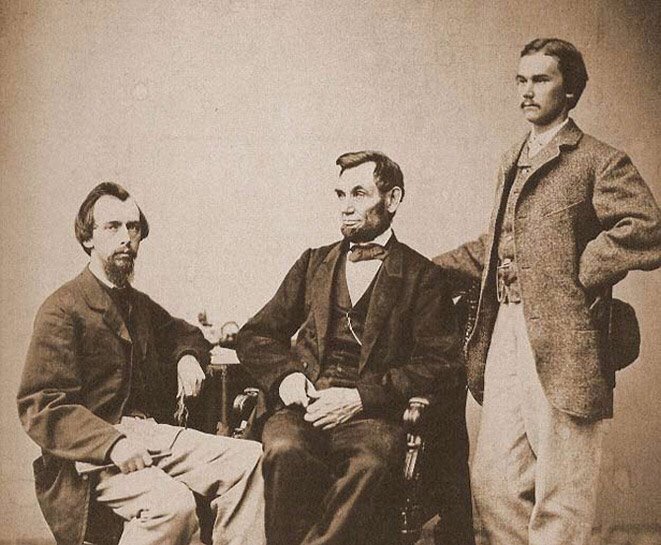


 Today in History, March 4: 1861 (Lincoln Inauguration) / 1905 (Theodore Roosevelt Inauguration) – A very special connection between two Presidents, 40 years apart. As a young man in Illinois, John Hay got the chance of a lifetime. His friend John Nicolay was working at the law firm of Abraham Lincoln, Presidential candidate. When Lincoln was elected, Hay and Nicolay became his private secretaries in the Executive Mansion and became his confidants…he would stay up nights sharing stories with them and came to trust them; they helped to keep him balanced through the trials and tragedies of the Civil War. They, in turn nearly idolized him, referring to him as the Ancient One. When Lincoln was assassinated it devastated Hay. He recovered and went on to serve in numerous posts within the government, including the Ambassador to the Court of St. James (England); he was a successful author and journalist (remarkably understated..but I must keep this somewhat brief). He served several other presidents, becoming Secretary of State for President William McKinley. When McKinley was assassinated, Hay stayed on to serve in Theodore Roosevelt’s administration. He was largely responsible for the Open Door Policy in China and negotiated the Hay–Bunau-Varilla Treaty to build the Panama Canal. He initially thought TR a rogue cowboy, but as he grew to respect the President, they became fast friends. TR came to respect Hay’s experience and wisdom, and came to depend upon him. The night before TR was to be inaugurated for his second term, his first in which he was elected, John Hay sent TR a gift. A ring containing a strand of President Lincoln’s hair under glass, taken during his autopsy. Hay included a note:
“Dear Theodore:
The hair in this ring is from the head of Abraham Lincoln. Dr. Taft cut it off the night of the assassination, and I got it from his son-a brief pedigress.
Please wear it tomorrow; you are one of the men who most thoroughly understand and appreciate Lincoln.
I have had your mongram and Lincoln’s engraved on the ring.
Longas, O utiman, bone dux, ferias, Praestes Hesperia.
(Mayest thou, Good Captain, give long holiday to Hesperia!)
Yours affectionately, John Hay”
TR replied:
“Dear John, Surely no other President, on the eve of his inauguration, has ever received such a gift from such a friend. I am wearing the ring now; I shall think of it and you as I take the oath tomorrow. I wonder if you have any idea what your strength and wisdom and sympathy, what the guidance you have given me and the mere delight in your companionship, have meant to me these three and a half years?
With love and gratitude, Ever yours….”
What a life! A integral part of the story of two of our best presidents, and a key player in numerous historic decisions and events. Aside from the photos of the ring, there are photos of Hay in his youth, as an older man (he would die later in 1905), and even the photo of Lincoln’s funeral procession through New York City is important…in a window of one of the buildings to the left are two small boys watching the procession go by…young Theodore Roosevelt, Jr and his brother Elliott.
“Neither let us be slandered from our duty by false accusations against us, nor frightened from it by menaces of destruction to the Government nor of dungeons to ourselves. Let us have faith that right makes might, and in that faith, let us, to the end, dare to do our duty as we understand it.” – Abraham Lincoln at Cooper Union


 Today in History, February 27: 1860 – “One of the most happiest and most convincing political arguments ever made in this City … No man ever made such an impression on his first appeal to a New-York audience.” — Horace Greeley in his paper regarding “The Cooper Union Speech” by Abraham Lincoln. A former Congressman and Illinois lawyer, Lincoln had been launched to the national stage by his debates with Stephen Douglas over the slavery question 2 years before, but he was still mostly unknown in the east. A young Republicans group in New York invited him to speech at Cooper Union’s Great Hall. The hall was not filled for the speech, but the text of it was given to Greeley’s and other’s papers; from there it was broadly published across the nation in pamphlet form. Lincoln made convincing arguments that the Founding Fathers were against the expansion of slavery and desired it’s eventual end. At the same time he tried to convince Southerners that the Republican party did not wish to interfere in their affairs. While in New York he had his photo taken by Matthew Brady, and the photo was used along with the pamphlet to broaden his recognition. It is widely believed that the speech is what launched him into the Presidency. He closed with a message to his colleagues: “Neither let us be slandered from our duty by false accusations against us, nor frightened from it by menaces of destruction to the Government nor of dungeons to ourselves. Let us have faith that right makes might, and in that faith, let us, to the end, dare to do our duty as we understand it.” (See below for video of Sam Waterston performing the speech).
A Life Saving Decision?

 Today in History, February 23: 1861 – President elect Abraham Lincoln arrives at Washington DC’s Willard Hotel. He had intended to travel to Baltimore on his trip from Illinois to DC, but his wife and an ardent supporter, Chicago Detective Allan Pinkerton talked him out of the Baltimore stop. Pinkerton had taken it upon himself to infiltrate a secessionist group and discovered a plot to assassinate Lincoln while he was in Baltimore. Pinkerton’s information likely saved Lincoln’s life. I’ve often wondered what would have happened if President Lincoln hadn’t been assassinated in 1865, what our country would look like today if he had handled reconstruction and reunification with his patience and kindness. One also has to wonder what the country would look like had he never even made it into the White House.
 Mark Loves History!