“Get off my Lawn!!” – The Roosevelt Corollary

Today in History, December 6, 1904:

The Roosevelt Corollary to the Monroe Doctrine. The Monroe Doctrine had been established to tell European powers to stay out…no Emperialism in the Western Hemisphere. When it was declared, the US didn’t really have the forces to back it up. But, conveniently the Royal Navy agreed and enforced it for their former adversaries.

In 1904 President Roosevelt made an addition to the Doctrine. There had been recent incidents in which European powers threatened actions against South American nations that they felt owed them money. In his annual message to the Congress, TR stated that, should any developing nations in the Western Hemisphere require intervention due to unrest or an inability to handle their financial affairs, it would be the US that would intervene, not foreign nations. This time TR had the Navy to back it up.

Many criticize Roosevelt’s assumption of police powers in the Americas as expansionist, and with the events surrounding the building of the Panama Canal, there is likely some validity to that view. However the primary objective was to ensure that foreign powers knew the US would not tolerate their use of military force in our backyard. And it kept the big kids from taking advantage of the still developing countries in the Western Hemisphere.

http://www.theodoreroosevelt.org/life/rooseveltcorollary.htm

All Hail the Glorious Potato!

Today in History, December 3, 1586:

Sir Thomas Harriott introduces the potato, previously only found in Columbia in South America, to England and Ireland. Sir Walter Raleigh pursued farming of the new staple in Ireland and before you knew it, they were every where.

This would become very important to American development as well. The potato became a staple food for the impoverished Irish populace. In the 1840’s a potato blight ruined the crops of potatoes in Ireland, resulting in a devastating famine. The famine caused approximately a million deaths and also approximately one million emigrants to America. The burgeoning Irish population in America would have a long lasting effect on our country, in labor, the military services and police forces.

Potatoes! Baked, French Fried, Potato soup, Potato Chips, Sweet Potato Pie, Potato Cakes, Mashed Potatoes, Scalloped Potatoes, Potatoes au Gratin….

“Nothing lives for long.  Except the Earth and the Mountains.” —Chief White Antelope, age 75

Today in History, November 29, 1864:

The Sand Creek Massacre.

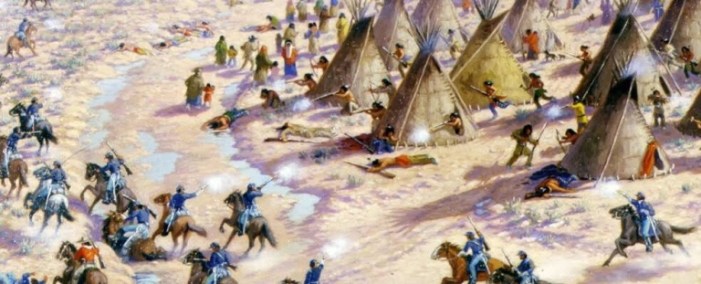
As the morning was dawning in the sleepy village, Chief Black Kettle saw them approaching, and hoisted the Stars and Stripes above his Tipi as a sign of brotherhood and peace.  And then the blue coated soldiers began firing.

The Cheyenne and Arapaho of Colorado had settled in for the winter along a bend in Sand Creek in eastern Colorado.  Resources in the barren area were in short supply and they expected a harsh time.  900-1,000 people in hundreds of Tipis, although many were out hunting buffalo that morning.

The Civil War raged further east, and in Colorado and New Mexico a few months previous.  Colonel John Chivington of the Colorado Volunteers had fought in those battles, but now was looking for a new fight.  After a family of settlers was killed, allegedly by Arapaho or Cheyenne, the Governor tasked Chivington with raising a regiment to defend against hostile Indians.

But his regiment’s enlistment was nearly up and he hadn’t found any hostile Indians.  So he took over 700 troops to attack the peaceful village along Sand Creek.

After the earlier attack on the settlers, the white authorities told the peaceful Indians to encamp at military forts and facilities where they would be protected. If not, they would be considered “Hostile.” A word synonymous with “shoot on site” for Indians in the old West.

Chief Black Kettle had spoken to the commander of nearby Fort Lyon, seeking to comply.  He was told to keep his people at Sand Creek until the commander received further orders, and they would be safe.

Hundreds of women and children dropped to their knees in front of the soldiers that morning, imploring them for mercy.  There was no mercy given as the women and children were shot down or had their skulls caved in.  Many then ran for the creek where they sought cover, or fled north.  For the next several hours Chivington’s soldiers chased them down and killed as many as they could.

Seeing what was happening, Chief White Antelope approached the soldiers, folded his arms, and began singing his death song,

“Nothing lives for long.  Except the Earth and the Mountains.”

Chief Black Kettle carried his wounded wife and fled north towards another band of Cheyenne.  He would make his way to Oklahoma, where he led his people to again attempt peaceful existence.  He would live two days shy of four years more…when he and his wife would be chased down and killed by soldiers of George Custer’s command at the Massacre along the Washita River.

One of the Union officers present at Sand Creek that day refused to follow commands and ordered his company not to fire; and tried to save some of the victims.  Captain Silas Soule was career Army and recognized the cowardly acts being carried out.  The next day he wrote a letter to a Major friend of his back east, telling of the horrific behavior of Chivington’s “mob”.  He told of women and children having their brains bashed in.  He said that Chiefs had their ears and genitals cut off as trophies, and all those killed were scalped.  The crazed killers cut out many of the women’s genitalia as souvenirs.

Chivington would escape court martial by resigning from the Volunteers.  But even during the Civil War, the government and the people were aghast at the atrocities carried out at Sand Creek, and Congressional hearings were held in 1865, during which Captain Soule testified at against Chivington.

For his trouble he was gunned down in the street in Denver a few months later.  His murderers were never prosecuted.

The assault was supposedly intended to force peace for the nascent settlements in Colorado.  It had exactly the opposite effect, as the Cheyenne Dog Soldiers and others fought a decade’s long war with the settlers, their trust of the white people destroyed.

The story was eventually all but forgotten, and was a touchy subject when it was spoken of.  However Colorado eventually began to come to terms with this dark part of its history, and in 2007 the Sand Creek Massacre National Historic Site was established, run by the National Park Service.

Many visit the site in homage to the approximately 200 Native Americans who died that day.

Several of the sites I read in preparation for this posting indicated the subject was not covered much until the 2000’s.  However if you read (or watch) James Michener’s “Centennial”, you’ll find that he covered the events very well, just with a change in names.

Shoot First, Ask Questions Later…

Today in History, November 28: 1941 –

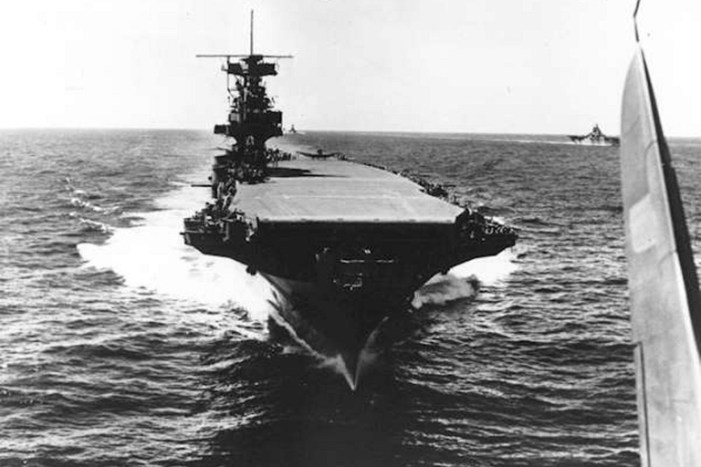
Ten days before the Japanese attack on Pearl Harbor, a Task Force built around the aircraft carrier USS Enterprise (CV-6) sailed from Pearl Harbor bound for Wake Island.

In response to a “war warning” the Enterprise had taken aboard a squadron of US Marine F4F Wildcat fighter planes and their pilots, with orders to deliver them to Wake to bolster the island’s defenses.

Once they were at sea, the TF commander, Admiral William F. (Bull) Halsey signed off on Battle Order #1, which put the Enterprise and her supporting Cruisers and Destroyers on a war footing.

The crew began adding armor behind the pilot’s position’s in the ship’s fighters, painting them in combat colors, and arming them for combat.

More than a week before the Japanese attacked, the Enterprise TF had orders to shoot first and ask questions later should they encounter any foreign ships or planes. The CAP (Combat Air Patrol) kept watch overhead.

The Big E would deliver the Marines and return to Pearl on Sunday, December 7. Her scout plane pilots would fly ahead, ending up right in the middle of the air raid. But that’s another story.

But on this date, Admiral Halsey and Captain Murray closed by telling their sailors “Steady nerves and stout hearts are needed now.”

How Closely “Casablanca” Hit Home

Today in History, November 26, 1942:

The motion picture “Casablanca” premieres in New York City.  The movie that would become a screen classic would be released to theaters in the remainder of the country on January 23, 1943.

The film was set in Casablanca, Morocco in December, 1941.  This time frame is important to the viewer if not the players.  Rick Blaine is an exiled American who owns a high-end bar.  Between continuously matching wits with the local French authorities and Nazis, Rick manages to barter for immigration papers for those fleeing the Nazis and to deal with an old romance interest who re-enters his life…Ilsa.  “Of all the gin joints in all the towns in all the world, she walks into mine.”

The film is at heart a romance, but at the same time a gritty war thriller.  Humphrey Bogart was well accustomed to playing the heavy, and did so well.  Ingrid Bergman did an excellent job playing the femme fatale, but by the time the show is over, one is hard pressed not to find Claude Rains’ portrayal of Captain Louis Renault to be the most compelling.

The plethora of one-liners definitely added to place Casablanca at the top of any “greatest” list, even 75 years later.  Near the end of the film, Rick and Louis are caught at the airport by Nazi SS Major Strasser.  Louis ends up shooting the Major.  As Louis’ troops rush up in response to the shot, Louis says hastily, “Major Strasser’s been shot.  Round up the usual suspects.”

It is important to note the film was released less than a year after the Pearl Harbor attack at a time when the question of who would be victorious was still a very open discussion.  Those viewing the movie most likely had fathers, brothers and sons fighting on a steaming, miserable island named Guadalcanal or on ships in the same theater.  Less than a month earlier (November 8) American soldiers and sailors took part in the landings of Operation Torch assaulting French North Africa.  This would include fighting the Nazis and the Vichy French (French sympathetic to or under the thumb of the Nazis.)  These battles would include Morocco and the Naval Battle of Casablanca between Allied, German and Vichy French naval forces.

All of this was the backdrop for the premiere of Casablanca.  How much more real, how much more emotion, must have been involved seeing it for the first time in 1942.

The Whaleship Essex

Today in History, November 20, 1820:

Loss of the whaleship Essex. Since 1711, the whaling industry had been an important aspect of the American economy. This was the time before crude oil, and the oil, blubber and bone from whales brought good money. Hundred of ships from New England made a living sailing to the Pacific and back.

The Essex had sailed from Nantucket and was hunting 2,000 miles west of the South American coast when and angry whale struck the ship twice, capsizing her and setting her twenty man crew adrift in open long boats.

During the next 83 days three of the men would be marooned on a South Pacific island. Only five others would survive after being picked up by other ships near the South American coast.

The ordeal would inspire Herman Melville’s novel “Moby Dick.”

Movin’ on Up?

Today in History, November 17, 1800:

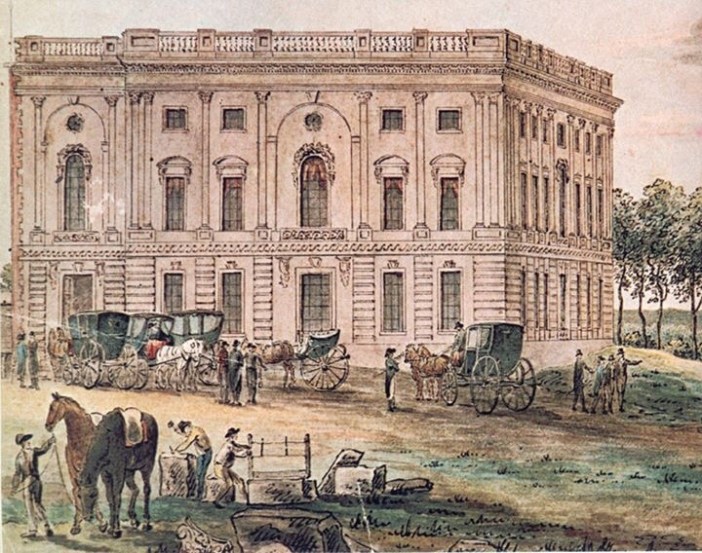
The Sixth US Congress meets for the first time in the new Capitol of Washington, D. C. Five days later President John Adams addressed them for the first time in DC. I know there were political shenanigans then also, but one has to wonder what those Senators and Congressmen would think of the behavior of those that have assumed their roles today.

A Small Blue Cloud

Today in History, November 15: 1806 –

US Army Lt. Zebulon Pike was a brilliant, self-taught explorer. On this date he was on his second expedition to the West, searching for the headwaters of the Arkansas and Red Rivers.

When he observed a mountain in the distance which he described as looking like a “small blue cloud”, he told the Expedition they could reach the mountain, scale it, and return to camp by dinner time.

Never having seen a “14er” before, he had grossly misjudged the distance. He and his team had to shelter from the cold in a cave for the night. When they did reach the base of the mountain which would one day hold Pike’s name, he declared it could not be climbed.

After the discovery Pike and his expedition became lost, wandering until captured by a troop of Spanish soldiers who took them to Santa Fe before releasing them. Pike took advantage of this misfortune by mapping this valuable area also.

Pike would be made a Brigadier General during the War of 1812 during which he would be killed.