Hero…Scapegoat…Hero…

Today in History, March 16: 1916 – German Admiral, and commander of the German Navy Alfred von Tirpitz, submits his resignation to kaiser Wilhelm, who accepts it. Tirpitz had been a trusted advisor to the kaiser, overseeing the build up of the Navy begun in 1897.

Despite his best efforts, the German surface fleet never became a match for the Royal Navy. In 1914 Tirpitz began unrestricted submarine warfare in the war zone…sinking neutral ships as well as combatants. When the Lusitania was sunk, with significant loss of neutral American lives, Wilhelm became nervous that America would enter the war, and Tirpitz, formerly a national hero, fell out of favor. Thus his resignation. The ship pictured was commissioned in 1936 and named after Tirpitz. It would be sunk by RAF bombers in 1944.

Costs of Appeasement

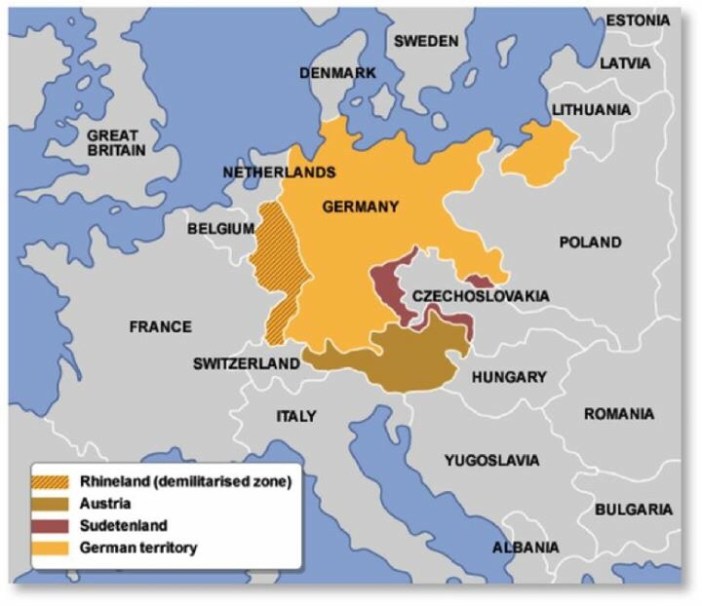
Today in History, March 7: 1936:

“If you French had intervened in the Rhineland in 1936 we should have been sunk and Hitler would have fallen” – German General Heinz Guderian, interviewed after WWII.

On this date, Germany “remilitarized” the Rhineland with a token force. It had been de-militarized after WWI to protect Germany’s neighbors.

In some skullduggery, Hitler claimed the people of the Rhineland were German peoples, and wanted the military presence. Now it was just a matter of seeing if anyone would call his hand.

In his memoirs, Hitler agreed with Guderian, saying that he had been very nervous in the 48 hours after the move.

Except for a few unheeded voices (Churchill), the governments of Europe refused to act, mostly for financial reasons. Bet they wished they could have had a “do over” on that decision.

Heck no…They All Have Guns! The Zimmerman Telegram

Today in History, March 1, 1917:

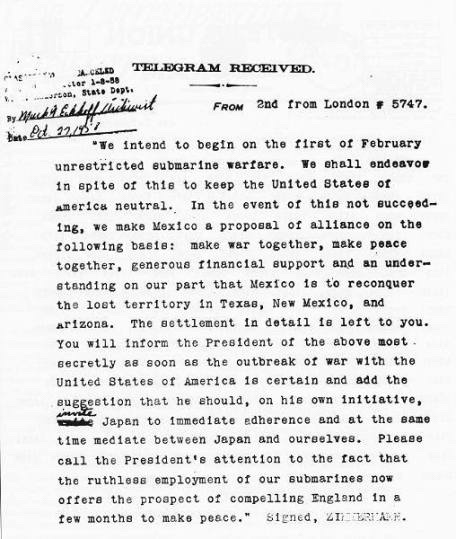
The Zimmermann Telegram is made public by the United States, on the authority of President Woodrow Wilson.

The German government had sent the telegram to their envoy in Mexico City in January, in anticipation of beginning unlimited submarine warfare in the North Atlantic Ocean on February 1st.

Germany wanted the United States, and her supply of men and materiel, to stay out of the war. And, should she enter the war, Germany wanted to limit her ability to assist Great Britain.

And that is what the Zimmermann Note was all about. It was an offer to the Mexican government; if Mexico would open up a “second front” for the United States by siding with Germany, the Germans would provide monetary support and promise to return Texas, New Mexico and Arizona to Mexico.

Germany hoped the second front would distract the Americans from shipping men and equipment to Britain, and that the sinking of what ships did venture forth by U-Boats would strangle the UK, forcing her to sue for peace.

The Mexican government actually established a committee to study the proposal…things had not been good between the US and Mexico, what with Gen. John Joseph “Black Jack” Pershing chasing Poncho Villa around Northern Mexico in recent years.

Mexico decided against the offer…because America was too powerful, because she would anger her neighbors, and (I find this VERY important), because they considered the fact that the citizens in the suggested states WERE ALL ARMED.

British intelligence managed to obtain a copy of the telegram and give it to the Americans. Our ancestors in the beginning of the 20th century shared our isolationist views and were not excited about involvement in a European War.

The release of the Zimmermann Telegram and unrestricted submarine warfare against our shipping helped change public opinion…and we were soon headed “over there”.

Caruso Came “Over Here” to Sing “Over There”. America

Today in History, February 25: 1873 – Enrico Caruso, considered to be the greatest tenor to ever live, is born in Naples, Italy. Caruso would perform in opera houses all over the world before finally coming to America in 1903; soon after he would make the Metropolitan Opera House in New York his home base. Soon he was recording records for the Victor Talking Machine Company, later RCA Victor. Caruso would be the first person to sell over a million records, demonstrating his wide-spread popularity. When “The Great War” came, he showed his patriotism to his adopted country by singing a rousing song that inspired many to enlist and told the Hun that Americans were coming “Over There, and we wouldn’t come back til it was over….over there.”

https://youtu.be/VDmIRWh83aE

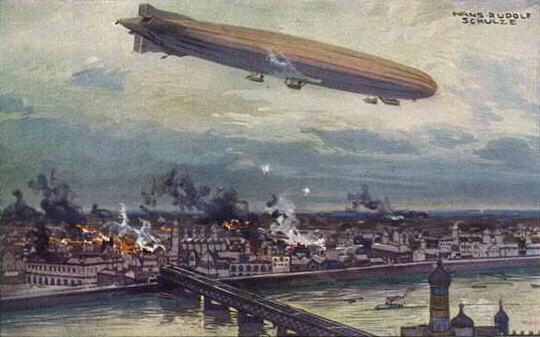
Aerial Bombing Begins in Britain

Today in History, January 19, 1915:

Germany begins aerial bombing of Britain using dirigibles, mostly Zeppelins during WWI.

The attacks would cause many deaths, but would be mostly ineffective and inaccurate.

The Zeppelins would eventually be replaced with aircraft. The bombings would lead to an early warning system and tactics by the Royal Air Force which would carry into the Battle of Britain during WWII.

Many civilians would die in the Zeppelin raids, leading to them being labeled “baby killers”, raising anger rather than the intended demoralization.

Listen to the Professionals

Today in History, December 12: 1917 –

Rail disaster in the Alps. Between 1,000 and 1,200 French soldiers had Christmas leave from the Italian front, and boarded an overloaded train bound for France over the Alps.

The train’s engineer refused to begin the trip…the passenger cars did not have enough brakes to make the trip safely. He changed his mind when when a well-meaning French officer pointed a pistol to his head…intent on his troops seeing their families for Christmas.

As the train reached the bottom of a long grade near Modane, France, the engineer’s fears were realized…the brakes would not slow the train and when the train reached a wooden bridge it derailed, most of the passenger cars bursting into flames. At least half of the soldiers were killed in the horrific crash…over 500. Listen to the professionals.

A Proclamation in Jerusalem

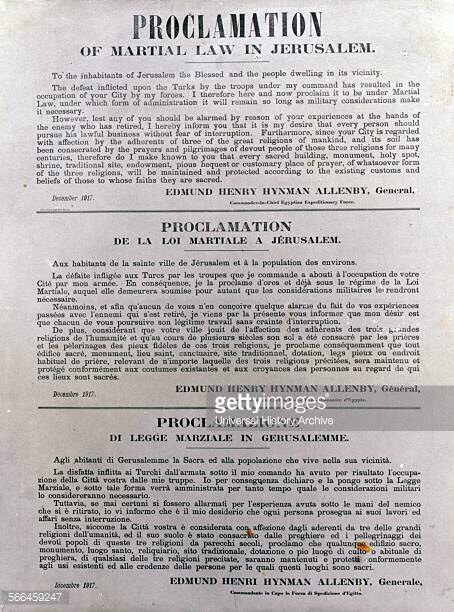
Today in History, December 11: 1917 –

During WWI, the British Prime Minister David Lloyd George had ordered that Jerusalem be taken as part of a second front in the war against the Ottoman Empire…German allies.

The war had not been going well in 1917. Lloyd George decided to move on of the Western Front commanders, Gen. Edmund Allenby, to the Middle East. Allenby reported to Cairo, taking command of the Egyptian Expeditionary Force (EEF) and immediately making changes.

Allenby and his troops fought hard battles across the desert, entering Palestine and arriving outside Jerusalem on December 9. The Ottoman Turks, having fought hard, abandoned the city.

On the 11th Allenby entered through the Jaffa Gate by foot as a display of respect for the Holy City.

Having ended hundreds of years of Ottoman rule over the city, he presented a proclamation in English, French, Italian, Hebrew, Arabic, Russian and Greek assuring people of all religions of his intent to keep Holy sites open to all.

So much History and importance before and since in Jerusalem.

According to the Times of Israel, a re-enactment of the event was held today with the assistance of the Tower of David Museum, complete with descendants of General Allenby in attendance.

Objector to Hero

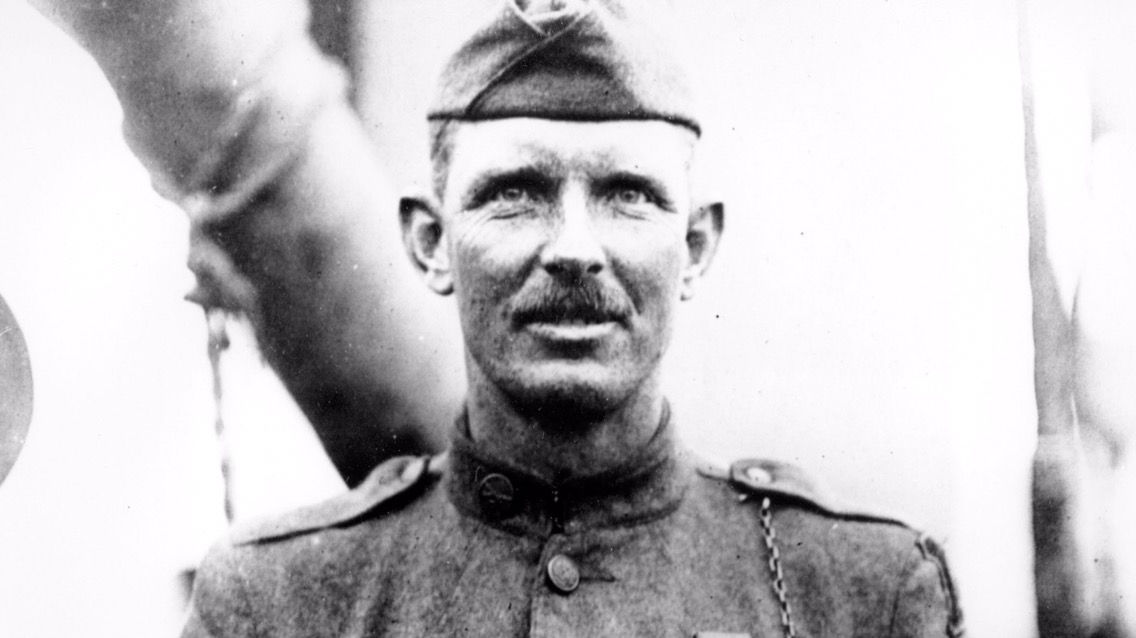
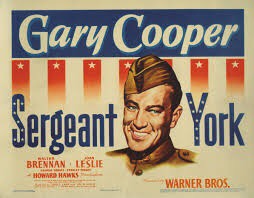
Today in History, October 8: 1918 – During the WWI battle of Argonne in France, a squad of American soldiers is pinned down by a German machine gun nest. Nine of the American soldiers had been cut down. The squad’s leader, Cpl. Alvin York, took action.

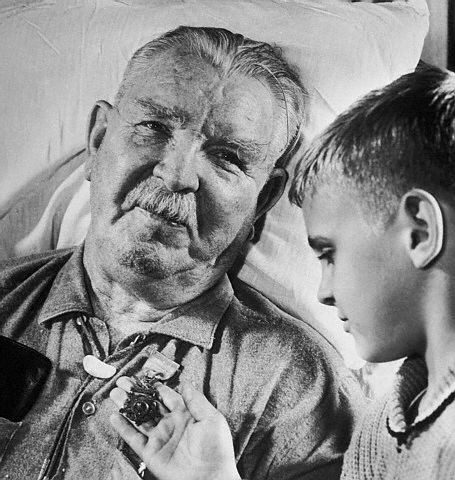
Born in a log cabin near the Kentucky/Tennessee border, York had been drafted into the Army and filed for conscientious objector status, but was denied. He had been a hunter back home in the hills. On that day in the Argonne, he stood his ground and used his uncanny marksmanship; each time a German soldier showed himself to sight in on the Americans, he was quickly killed by York’s deadly aim. After at least 20 Germans had been killed, their commander thought he must have miss judged the size of the American force and surrendered his remaining 90 troops. On their way back to friendly lines, the squad of now less than a dozen Americans took on more prisoners, returning with 132. York was promoted to Sergeant and the next year presented with the Medal of Honor. 

Years later, as WWII was beginning, American sailors aboard the Enterprise were watching the movie “Sergeant York” on the hangar deck as they sailed unknowingly into war. 

As the last photo shows…no matter our importance in our youth, we all get old. But what we chose to do in our youth remains. 

Connections Bring History Home


Today in History, July 17: 1763 – John Jacob Astor is born in Germany in modest circumstances.  He would immigrate to America…selling flutes.  Convinced to sell the musical instruments in New York and invest in the fur trade, he became America’s first Millionaire with his American Fur Company.  On April 12, 1912 his grandson and namesake, the world’s richest man, John Jacob Astor IV would die in the Titanic Disaster.

July 17: 1918 – Crossing paths in history.  The RMS Carpathia is sunk by U-Boat U-55 during WWI.  All but 5 of her crew managed to escape to lifeboats. They were in turn saved by the Sloop HMS Snowdrop, which arrived and drove off the German sub before it could machine gun the crew in their boats.

As previously stated, on April 12, 1912, RMS Titanic struck an iceberg and sank within 4 hours. The nearest ship to receive her distress signal was the RMS Carpathia, which sped at full speed for two hours to the disaster scene. Upon her arrival, she rescued 705 survivors from the freezing waters of the North Atlantic. The Carpathia’s crew became heroes, being awarded medals. Her Captain, Arthur Henry Rostron, was knighted and was a guest of President William Taft in the White House. During WWI the Carpathia served as a troop ship, transporting thousands of American soldiers across the Atlantic to the war in Europe.

Among them was Frank Buckles, who would become the last surviving American Soldier from WWI before his death in 2011. He was a prisoner of war in the Philippines during WWII (as a civilian) and a strong advocate for a WWI Memorial, which…led him to be a guest of President George W. Bush in the White House. 

Everything is connected in history…you just have to find it.


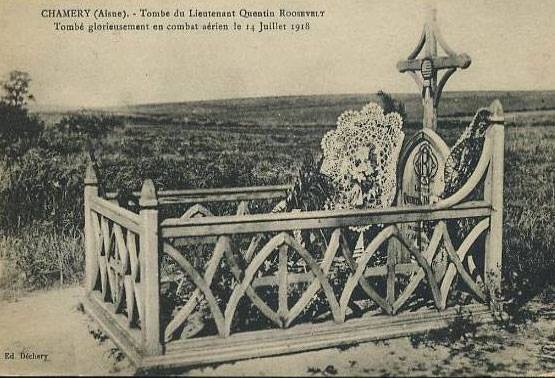
Today in History, July 14: 1918 – US Airman Quentin Roosevelt, youngest son of President Theodore Roosevelt, dies when he is shot down over France in WWI.   The German military returned his affects to President Roosevelt, and the French wanted to erect a monument to Quentin. He and his brothers, who all served in WWI were very competitive in the voracity of their service, trying to live up to their father’s exploits…Rough Rider, etc. 

The back story is interesting. TR had been a sickly child who nobody expected to become much. But he was a fighter. He forced himself to exercise through severe pain until he became “barrel chested” and strong. He led an incredibly busy life, full speed throughout. His youngest son Quentin struggled with some of the same challenges. 

After TR’s presidency, TR went on an treacherous exploring expedition in South America, putting the dangerous “River of Doubt” on the map. Quentin went with him, aiding his father through deprivations that nearly killed the elder Roosevelt. 

 TR wanted to go to war for his country when WW1 began, but President Wilson, of the opposite political party, would not allow it, afraid TR would gain favor and face him in the next election.

TR wouldn’t live that long…and he spent the intervening time heartbroken over the loss of his youngest son.

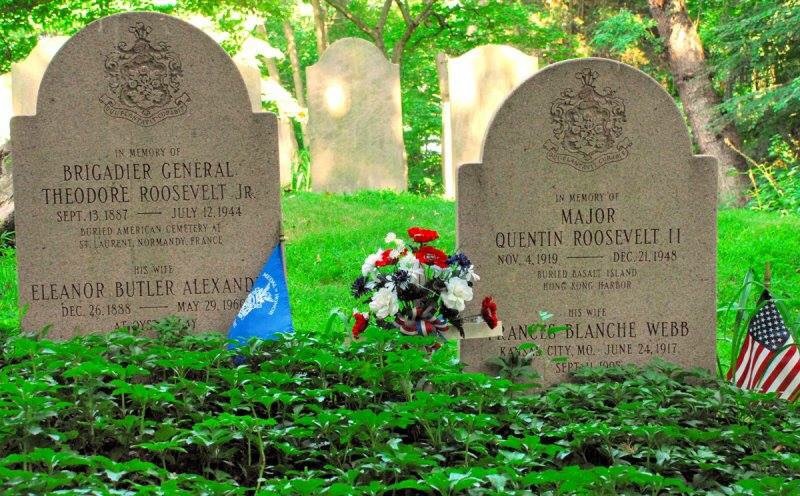
All of the boys had served on the front lines in France. And 26 years later General Theodore Roosevelt, Jr had to pull strings so he would be allowed to go ashore with the unit he commanded at Normandy on D-Day. Within days he was dead of a heart attack.