A Violent Decade of Assassinations

Today in History, June 8, 1968:

What a busy news day this must have been?!

James Earl Ray, the assassin of Martin Luther King, Jr is arrested in London, England where he was attempting to make his way to an African nation run by racists (ironic). He would eventually be convicted of assassinating Civil Rights leader King.

On the same day…..

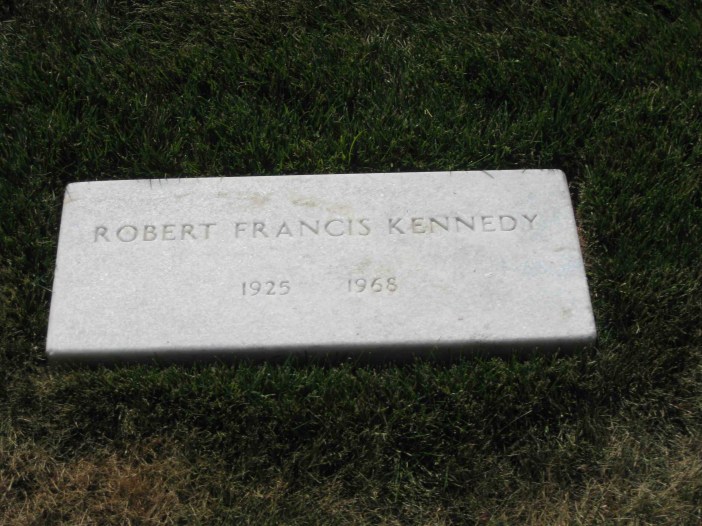
…another civil rights activist is laid to rest at Arlington National Cemetery. Robert F. Kennedy would be laid to rest within 30 yards of his brother John, assassinated only five years earlier.

Vengeance at Midway

Today in History, June 4, 1942:

The Battle of Midway.

The war had been going badly for the Americans in the Pacific. The Japanese had begun the war 7 months earlier by bombing Pearl Harbor, destroying most of the American fleet, but missing the US carriers, which had all been at sea. In the interim came sweeping victories across the Pacific for the IJN, raids by US carrier task forces on Japanese strongholds, the Doolittle Raid and the Battle of the Coral Sea. The US lost the Lexington at Coral Sea, and the Yorktown had been badly damaged.

Then code breakers at Pearl figured out that the next target of the IJN was Midway Island, the westernmost island of the Hawaiian chain. Admiral Yamamoto’s plan was to draw the American carriers out and destroy them, leaving the Pacific unprotected. The code breakers changed the entire game.

The Enterprise and Hornet rushed back to Pearl for rearming, as did the Yorktown. The repair crew told Admiral Nimitz they needed 3 months to repair the Yorktown; he gave them 3 days.

When the IJN attacked Midway, they expected the American carriers to be responding to the scene, giving them plenty of time to lay a trap; instead, Nimitz had positioned his carriers northeast of Midway to lay in wait. When a PBY seaplane (Strawberry 5) spotted the Japanese carriers, it was all Admirals Spruance and Fletcher needed.

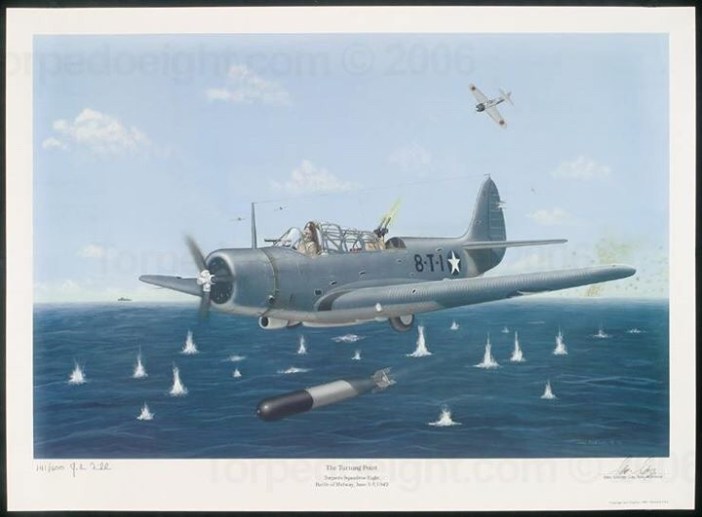
The three American carriers launched their aircraft. The obsolete TBD Devastator torpedo bombers were the first to find the IJN carriers. The versatile Japanese Zero fighters dove to the wave tops and tore them apart, leaving almost no survivors. The sacrifice, while not intentional, served a purpose.

Next to arrive on the scene were SBD Dauntless dive bombers, which dove to attack from altitude. With all of the Japanese fighters drawn to the “deck”, they had no fighters to oppose them. Diving at 70 degrees, the pilots hanging from their seat belts, the rear gunners pressed against their seats with no view of what was to come, the bombers dropped their bombs with deadly accuracy.

Admiral Nagumo, informed of the American fleet by a scout plane, had ordered his aircraft, just back from Midway, rearmed. So when the American bombs fell, the Japanese carrier decks were filled with aircraft, bombs, torpedoes and fuel. Three of the four IJN carriers were destroyed in minutes. The fourth would be picked off in a later raid.

Within minutes, thanks to the sacrifice and courage of a few brave airmen, the tide of the war in the Pacific had changed. There was still a long road ahead; but the seemingly unstoppable onslaught of the IJN had been stopped. Worse than the loss of 4 carriers was the loss of hundreds of Japans finest aviators.

The Americans would lose the Yorktown, but the Japanese were devastated. Admiral Yamamoto had told his contemporaries that they had a year before the tide of the war turned against them due to American industries. The American sailors and airmen at Midway cut that time in half.

Conviction

Today in History, June 2, 1997:

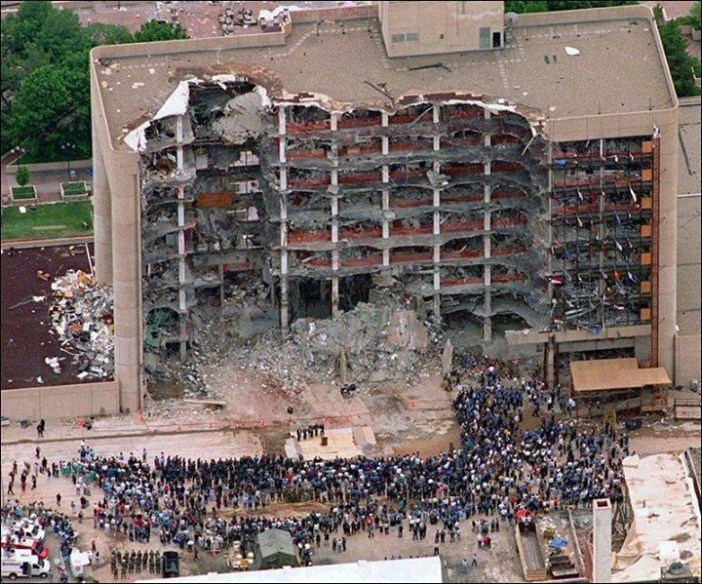
The individual responsible for the murder of 168 men, women and children at the Alfred P. Murrah Federal Building in Oklahoma City on April 19, 1995 is convicted in Denver, Colorado.

He would be put to death 4 years later. We all know his name, but I won’t mention it here.

I for one believe in the ancient practice of obliterating the names of criminals and evil doers from all public records, and never mentioning their names again, denying them the notoriety they craved so much.

Instead, remember the names from the link below.

https://oklahomacitynationalmemorial.org/people/

Turns Out…”Perpetual Peace” Born of Marriage Lasts About Ten Years and Ends Badly….Hmmm…

Today in History, May 28, 1503:

King James IV of Scotland and Margaret Tudor of England marry, fulfilling an international agreement which had been sanctioned by the Pope, The Treaty of Perpetual Peace between England and Scotland.

As it turns out, “perpetual” peace is good for about 10 years. In 1513 James declares war on England in support of France, who Scotland had a previous treaty with…and England had declared war on France.

The Pope would excommunicate James IV for going back on his word, and he would soon die during the Battle of Flodden Field, becoming the very last Monarch of the British Empire to die in battle.

Full-Contact Politics

Today in History, May 22, 1856:

Years before the Civil War. On May 20, 1856 US Senator Charles Sumner, a free soil Democrat and later Republican from Massachussetts, had given a firey speech entitled “Crime Against Kansas” about the violence in that state over slavery.

A devout abolitionist, he excoriated the south, in particular Senator Andrew Butler of South Carolina, who he likened to a pimp abusing a prostitute (slavery).

This enraged Butler’s nephew, Senator Preston Brooks. When Sen. Stephen Douglas heard the speech, he commented, “this damn fool Sumner is going to get himself shot by some other damn fool.”

On the 22nd, Brooks entered the Senate chamber with two other Southern Senators, found Sumner at his desk writing and proceeded to bludgeon him nearly to death with his heavy metal tipped cane while Sumner was trapped within his desk, defenseless.

Southerners hailed Brooks a hero.

Northerners called him a coward. One of these, Republican Representative Anson Burlingame called him such on the House floor.

Brooks challenged Burlingame to a duel. When Burlingame actually accepted and showed up, Brooks did not.

Sumner would suffer debilitating pain for the rest of his life from his injuries, but would recover to become a key proponent of abolitionist policies during reconstruction, living until 1872.

Brooks on the other hand died in January 1857, less than a year after the attack, of the croup.

A Clothing Revolution

Today in History, May 20, 1873:

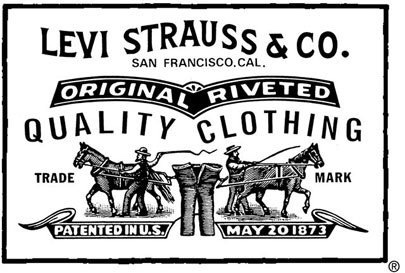
Jewish immigrant, successful San Francisco businessman Levi Strauss and Reno, Nevada tailor Jacob Davis go in together and obtain a patent for a revolutionary, extremely durable work pant….the XX model (eventually 501) denim pant, reinforced at the stress points by copper rivets.

Cowboys and other hard working people needed a pant that would last. The “jeans” fit the bill and sold like hotcakes. I’m told there was originally a rivet at the crotch…but cowboys began complaining about crouching over the campfire with obvious results…and it was removed….

You Must First Catch the Rabbit…

Today in History, May 19, 1863:

The Siege of Vicksburg continues.

After two failed assaults, the Union troops and the Union Navy settle in for an extended siege.

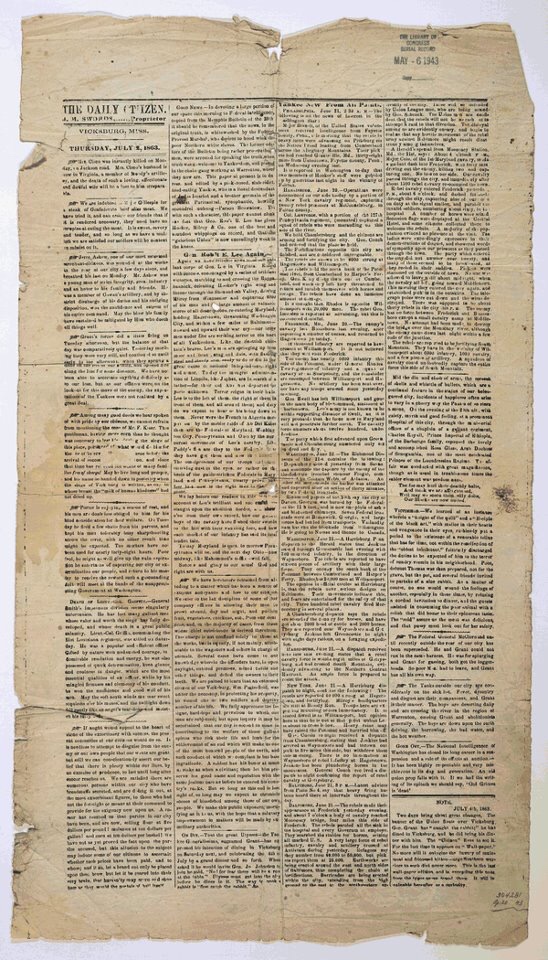
After 44 days, during which Vicksburg would be compared to a “Prairie Dog Town”, with most of the population living underground, the Vicksburg newspaper, “The Daily Citizen” was reduced to printing it’s media on used wallpaper,

By day 44, the paper printed, “[T]he great Ulysses—the Yankee Generalissimo, surnamed Grant—has expressed his intention of dining in Vicksburg on Saturday next, and celebrating the 4th of July by a grand dinner and so forth. When asked if he would invite Gen. Jo Johnston to join he said. ‘No! for fear there will be a row at the table.’ Ulysses must get into the city before he dines in it. The way to cook rabbit is ‘first catch the rabbit.’ &c.” A week later, the Union troops had taken over the paper, having taken Vicksburg, and added and addendum, “Two days bring about great changes, The banner of the Union floats over Vicksburg, Gen. Grant has ‘caught the rabbit;’ he has dined in Vicksburg, and he did bring his dinner with him. The ‘Citizen’ lives to see it. For the last time it appears on ‘Wall-paper.’ No more will it eulogize the luxury of mule-meat and fricasseed kitten—urge Southern warriors to such diet never-more.”

“I Cannot Spare This Man…He Fights!”

Today in History, May 18, 1863:

Running the Table.

Gen. Grant planned the taking of Vicksburg and Admiral David Dixon Porter’s running of the guns at that fortress city. In the interim between then and today’s date, Grant’s army was taken across the Mississippi from several victories in Louisiana, won five major victories in Mississippi, including taking the capitol of Jackson. He pushed Confederate Gen. John C. Pemberton back to the Big Black River Bridge, which Pemberton burned on the 14th during his retreat to Vicksburg.

Pemberton could no longer face Grant in the field, having lost three quarters of his army. Grant had the bridge rebuilt by the 18th, and the siege of Vicksburg had begun.

Grant made two unsuccessful attempts to take the city and then determined to have no more losses, lay siege to the city. The siege involved entrenchments, mines and bombardment by land based artillery as well as by Admiral Porter’s ships.

The civilians and soldiers in the city had to live underground. By July 4th, his troops and civilians starving and demoralized, Pemberton agreed to surrender. Grant initially demanded his trademark “Unconditional Surrender”, then reconsidered. Even after having lost 3/4 of it’s manpower, Pemberton’s army still numbered 30,000 famished troops. He decided instead to utilize a long respected military method of “paroling” the rebel troops. That meant that they would be freed as long as they never took up arms against the Union again. It would have taken months and a great deal of manpower Grant did not want to expend to move 30,000 prisoners north. The Confederates agreed to the terms. Yet many of them were back in battle against Union troops by Pemberton could no longer face Grant in the field, having lost three quarters of his army. Grant had the bridge rebuilt by the 18th, and the siege of Vicksburg had begun. Grant made two unsuccessful attempts to take the city and then determined to have no more losses, lay siege to the city. The siege involved entrenchments, mines and bombardment by land based artillery as well as by Admiral Porter’s ships. The civilians and soldiers in the city had to live underground. By July 4th, his troops and civilians starving and demoralized, Pemberton agreed to surrender. Grant initially demanded his trademark “Unconditional Surrender”, then reconsidered. Even after having lost 3/4 of it’s manpower, Pemberton’s army still numbered 30,000 famished troops. He decided instead to utilize a long respected military method of “paroling” the rebel troops. That meant that they would be freed as long as they never took up arms against the Union again. It would have taken months and a great deal of manpower Grant did not want to expend to move 30,000 prisoners north. The Confederates agreed to the terms.

Yet many of them were back in battle against Union troops by September. This ended the act of paroling for the remainder of the war.

After Vicksburg and Port Hudson fell in July, President Lincoln proclaimed, “The Father of Waters again goes unvexed to the sea.” This victory was considered the turning point in the Civil War; Union control of the Mississippi not only allowed US Navy movement and resupply all along it’s course, it effectively cut the Confederacy in half, depriving it of the resources and armies of the west. This battle is also largely the reason Grant was advanced to command of all Union Armies…as Lincoln said, “I cannot spare this man…he fights!” A quality the President found lacking in many of his other Generals.

Today in History, May 17, 1954:

In 1898 the Supreme Court had ruled in Plessy v Ferguson that keeping blacks and whites separate on railroad cars was constitutional, as “separate but equal” didn’t violate the 14th Amendment.

This was eventually perverted to all public facilities being segregated.

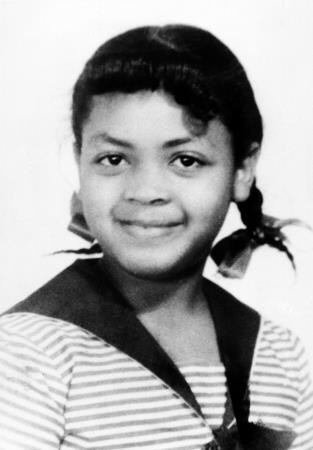
In the 1954 Decision of Brown v Board of Education of Topeka, the Supreme Court Ruled that 3rd grader Linda Brown could attend a white school, and that segregation was illegal. The Civil Rights evolution in America had begun. Future Supreme Court Justice Thurgood Marshall led the team that won this case.

H. Norman Schwarzkopf Stared Down into Baby Charles Lindbergh’s Shallow Grave…

Today in History, May 12, 1932:

H. Norman Schwarzkopf looks down into the recently found shallow grave of infant Charles Lindbergh, Jr. in a field not far from the Lindbergh home.

The Lindbergh baby had been kidnapped from his home on March 1st, the ransom paid, but the child was not returned to his parents.

Schwarzkopf, a West Point graduate and WWI veteran, had been appointed in 1921 by the Governor of New Jersey to create, organize and train the New Jersey State Police.

It was in this capacity that he led the investigation of the Lindbergh Kidnapping, the “Crime of the Century”. He would prove that the baby had been killed accidentally as he was being carried down a ladder from his second floor bedroom.

When a new governor took office, Schwarzkopf would be sacked. Politics.

He would return to the US Army when WWII broke out, where he would be tasked to use his logistics and organizational talents to train the Iranian police, a country where the US was setting up railroads to supply the Soviet Union for the fight against Germany.

After the war, Schwarzkopf would also help set up the security forces of the Shah of Iran…back before the Iranian revolution made that country enemy #1.

Two years after he investigated the Lindbergh kidnapping, his son, H. Norman Schwarzkopf, Jr. would be born.

And as most know, “Stormin’ Norman” would follow his father to the middle east in the service of his country nearly six decades later.

The elder H. Norman Schwarzkopf would take part in the intrigue and skullduggery of the Middle East during the forties and fifties after solving the Lindbergh Kidnapping; his namesake would go back to the volatile region with him father’s background and wisdom, but to kick ass and take names.