D. C. Donnybrook

Today in History, March 4, 1829:

A real Donnybrook.

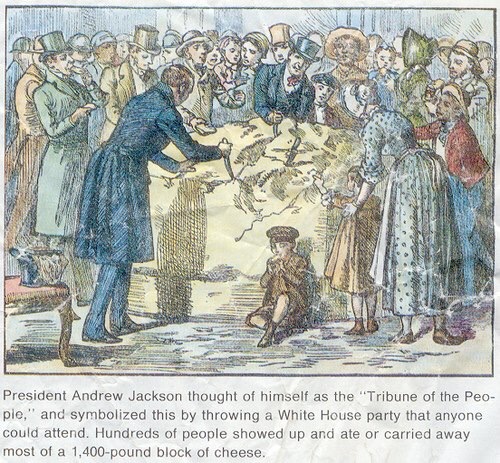
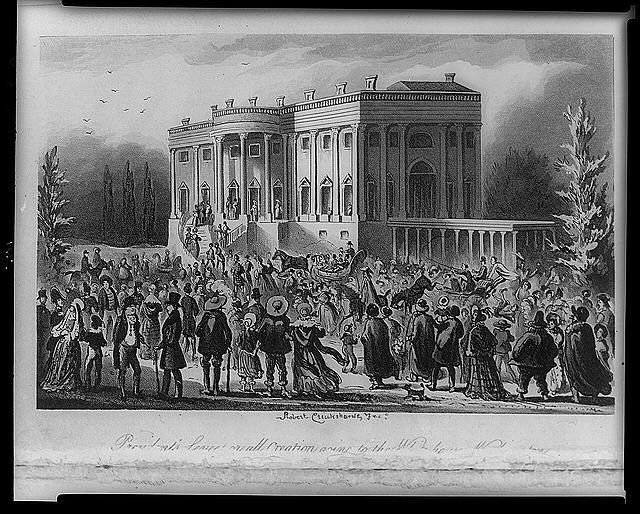
It was a tradition to have an “open house” after a Presidential Inauguration. Newly elected President Andrew Jackson continued the tradition, but there was a problem.

Every President has tried to portray himself as a “man of the people”, but in Jackson’s case, it was true. He was a frontiersman, and a combat veteran of the War of 1812.

Rather than a few blue bloods showing up for the open house, upwards of 20,000 common citizens showed up to visit the Executive Mansion.

They entered through windows, stood on the furniture, and were only drawn outside by an inventive White House staffer that filled troughs with juice and liquor on the White House lawn.

The President himself fled to the hotel he had been residing in prior to the election. The carpet “smelled like cheese” for months, but not due to a sampling of cheese…the production of a huge block of cheese to the President actually happened near the end of his term.
1st Joint Navy & Marine Amphibious Op…in 1776

Today in History, March 3, 1776:

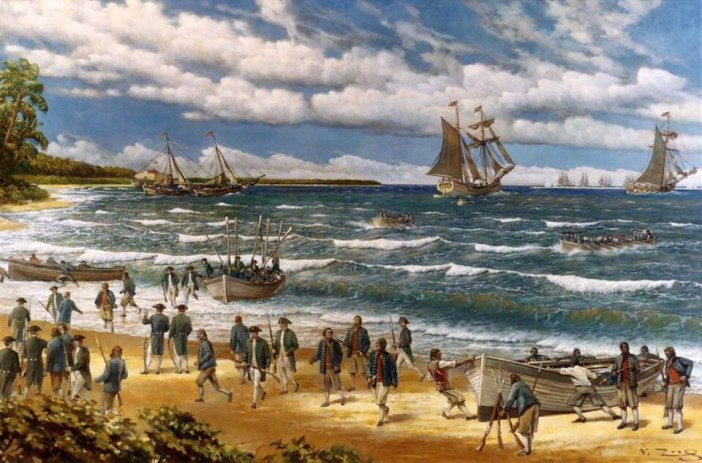
The Continental Navy transports a contingent of Continental Marines to Nassau, Bahamas where the Marines make their first amphibious landing. The mission was to raid and capture gunpowder and munitions stored at the British possession for use in the American Revolutionary War. The Continental Navy and Marines are of course the origins of the US Navy and US Marines.

Kicking the Abolition Can Down the Road…

Today in History, March 2, 1807:

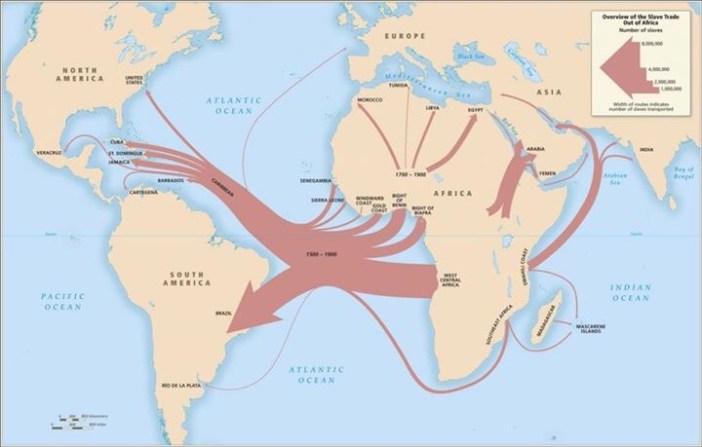
The US Congress passes a law abolishing the transatlantic slave trade in the US, “An Act to prohibit the importation of slaves into any port or place within the jurisdiction of the United States, from and after the first day of January, in the year of our Lord, One Thousand Eight Hundred and Eight.”

Congress began the habit of “kicking the can down the road” from the very beginning. When the Constitution was ratified, a clause was included that prohibited any laws affecting slavery for 20 years, or 1808.

The clause was included to ensure that southern states would sign off on the union.

By 1794 abolitionist groups were already forming to push for action once the time was up; in 1805 Senator Stephen Row Bradley of Vermont announced his intention to present the bill described here, and did so. The British also outlawed the slave trade in 1807.

However the importation of slaves continued in Central and South America, especially in Brazil where it had begun, until 1860 (officially).

Even this step by US lawmakers was a bit of a cynical compromise…the South signed off on the new law easily because they had enough slaves already in the country that they didn’t feel they needed to import them anymore.

The Reichstag Fire Decree and the Surrender of Freedom

Today in History, February 28, 1933:

The Reichstag Fire Decree. On the night of February 27, 1933, the German Parliament, or Reichstag, was burned by arsonists.

The very next day (strike while the iron is hot) German President Paul Von Hindenburg, on the “advice” of Chancellor Adolph Hitler, issues the Reichstag Fire Decree “for the protection of the people and the state.”

The order suspended basic civil liberties guaranteed by the German Constitution.

The fire was blamed on the Nazi’s enemies, Communists. However it is likely the fire was contrived to justify the order, which began Hitler’s dictatorship.

The same type of maneuver would be used by the Nazis in September, 1939, to justify the invasion of Poland.

“Those who would give up essential liberty, to purchase a little temporary safety, deserve neither liberty nor safety.” – Benjamin Franklin

Cooper Union – The Speech that Propelled Lincoln to the Presidency and Proves He Was an Abolitionist

Today in History, February 27, 1860:

“One of the most happiest and most convincing political arguments ever made in this City … No man ever made such an impression on his first appeal to a New-York audience.” — Horace Greeley in his paper regarding “The Cooper Union Speech” by Abraham Lincoln.

A former Congressman and Illinois lawyer, Lincoln had been launched to the national stage by his debates with Stephen Douglas over the slavery question 2 years before, but he was still mostly unknown in the east.

A young Republicans group in New York invited him to speech at Cooper Union’s Great Hall. The hall was not filled for the speech, but the text of it was given to Greeley’s and other’s papers; from there it was broadly published across the nation in pamphlet form.

Lincoln made convincing arguments that the Founding Fathers were against the expansion of slavery and desired it’s eventual end. At the same time he tried to convince Southerners that the Republican party did not wish to interfere in their affairs.

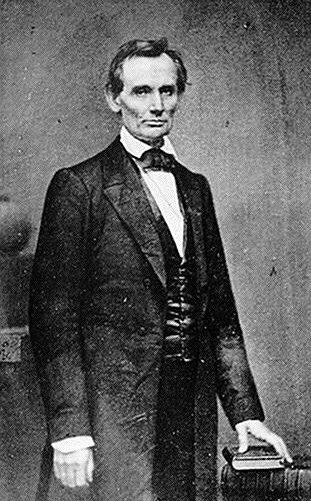
While in New York he had his photo taken by Matthew Brady, and the photo was used along with the pamphlet to broaden his recognition. It is widely believed that the speech is what launched him into the Presidency.

He closed with a message to his colleagues:

“Neither let us be slandered from our duty by false accusations against us, nor frightened from it by menaces of destruction to the Government nor of dungeons to ourselves. Let us have faith that right makes might, and in that faith, let us, to the end, dare to do our duty as we understand it.”

Mexico Could’ve Declared War on US in Exchange for Western States…

Today in History, February 26, 1917:

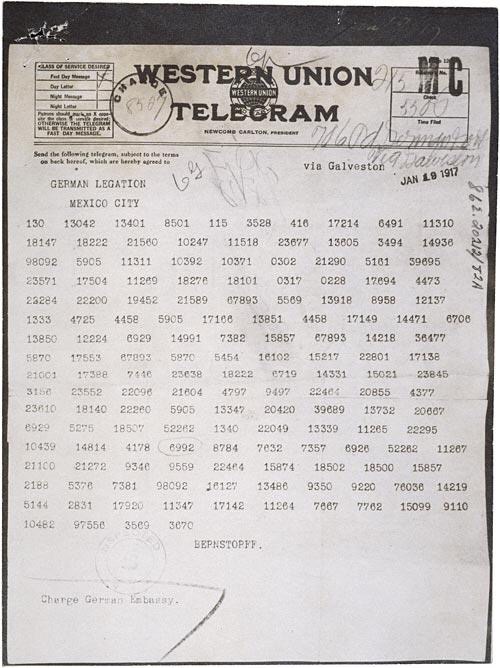
President Woodrow Wilson is informed of the “Zimmermann Telegram”.

German Foreign Secretary Arthur Zimmermann had sent the telegram to the German Ambassador to Mexico, Count Johann von Bernstorff, authorizing him to offer Mexico a great deal of money if they would become allies with Germany should America enter the war.

To top it off, Germany offered to give Mexico Texas, New Mexico and Arizona should they agree.

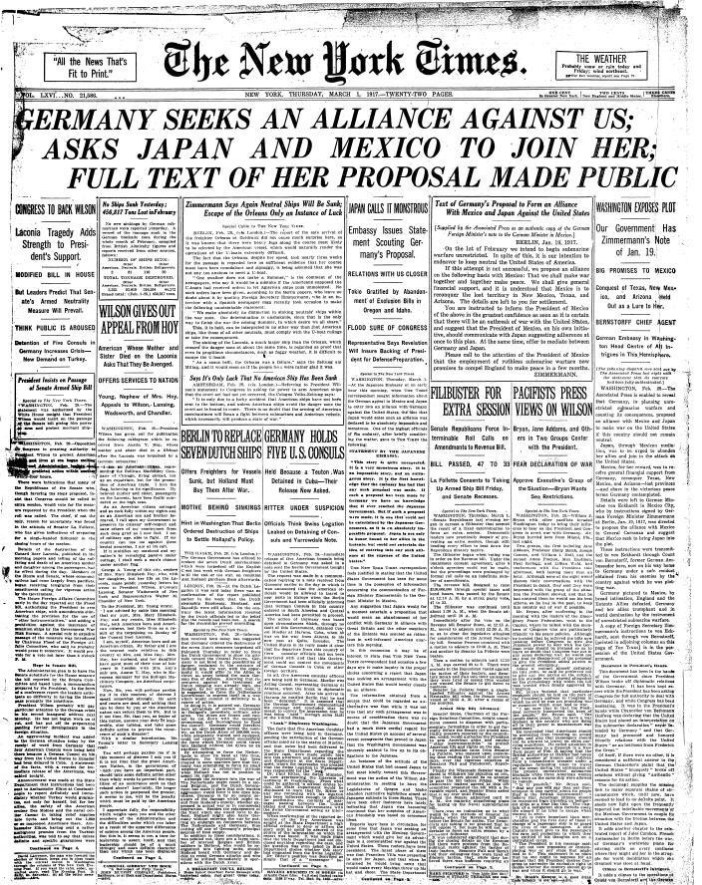
Wilson ordered American shipping to be armed and authorized the release of the telegram to the media. News of the treachery enraged the American public, who were already angry over German submarine attacks on American ships. By April 6th Wilson had asked for and received a declaration of war.

“Over There” – Enrico Caruso

https://youtu.be/VDmIRWh83aE

Today in History, February 25, 1873:

Enrico Caruso, considered to be the greatest tenor to ever live, is born in Naples, Italy. Caruso would perform in opera houses all over the world before finally coming to America in 1903; soon after he would make the Metropolitan Opera House in New York his home base.

Soon he was recording records for the Victor Talking Machine Company, later RCA Victor. Caruso would be the first person to sell over a million records, demonstrating his wide-spread popularity.

When “The Great War” came, he showed his patriotism to his adopted country by singing a rousing song that inspired many to enlist and told the Hun that Americans were coming “Over There, and we wouldn’t come back til it was over….over there.”

Trailblazer!

Today in History, February 24, 1864:

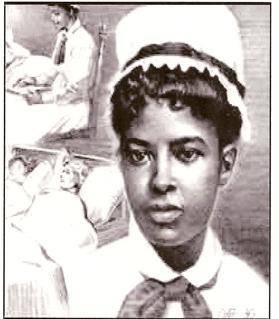
Rebecca Lee, later Rebecca Lee Crumpler, graduates from the New England Female Medical College in Massachusetts, becoming the first black female Medical Doctor in America, doing so in the midst of the Civil War.

After the war ended, she voluntarily moved to the heart of the south, Richmond, Virginia and worked for the Freedman’s Bureau treating freed slaves.

She later wrote a book about her experiences working as a doctor amongst people that hated her for the color of her skin and for her chosen profession.

“Uncommon Valor was a Common Virtue”

Today in History, February 23, 1945:

After a hard fought battle, the US Marines reach the top of Mount Suribachi on Iwo Jima.

5 Marines and 1 US Navy Corpsman raised the US flag at the peak, and photographer Joe Rosenthal caught it on camera.

3 of the flag raisers would be dead before the Battle for Iwo Jima was won. After many deaths and the earning of 27 Medals of Honor (half posthumous), the tiny island was deemed “secure” on March 16. Then B29 Superfortress bombers and long range fighters could use the airstrip in the bombing of Japan.

The photo became famous, and inspired the US Marine Memorial at Arlington National Cemetery.

The first flag was considered too small, and a second larger flag, scrounged up from one of the landing ships, was raised to replace it.

Admiral Chester Nimitz described the battle as one “where uncommon valor was a common virtue.”

“Settled Science” and Heresy

Today in History, February 22, 1632:

Galileo Galilei delivers his book Dialogue Concerning the Two Chief World Systems to his patron, Ferdinando II de’ Medici, Grand Duke of Tuscany.

The book was sold (bestseller) as a discussion of the Copernican System, which stated that the Earth and planets orbited around the sun, and the Ptolemaic System, which allowed that the entire universe orbited around the Earth.

The next year Galileo was convicted of suspicion of heresy and the book, which leaned heavily towards the Copernican system was banned, a status that was not lifted until 1835.

To the scientists of Galileo’s time, the Ptolemaic system was “settled science”. Perhaps in another 2 hundred years or so, the “settled science” of Global Warming will be truly settled.