“A People’s Dream Died There…”

Today in History, December 29: 1890 –

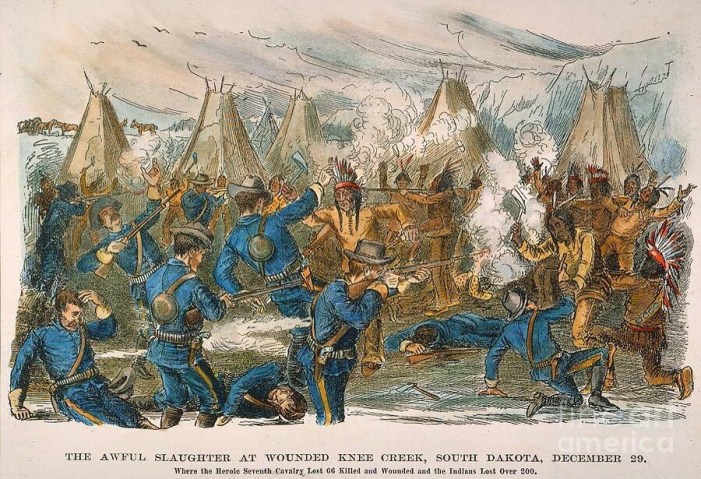
Massacre at Wounded Knee. “I did not know then how much was ended. When I look back now from this high hill of my old age, I can still see the butchered women and children lying heaped and scattered all along the crooked gulch as plain as when I saw them with eyes young. And I can see that something else died there in the bloody mud, and was buried in the blizzard. A people’s dream died there. It was a beautiful dream … the nation’s hope is broken and scattered. There is no center any longer, and the sacred tree is dead.” – Black Elk, Lakota Sioux Medicine Man.

“scuffle occurred between one warrior who had [a] rifle in his hand and two soldiers. The rifle was discharged and a battle occurred, not only the warriors but the sick Chief Spotted Elk, and a large number of women and children who tried to escape by running and scattering over the prairie were hunted down and killed.” – Gen. Nelson A. Miles, US Army.

Most of the Lakota were demoralized by life on the reservations due to the impoverished and bitter conditions. A new religious belief began to spring up and gave them hope…that by performing the Ghost Dance, their dead would return, the Bison would become plentiful again, and the white men would leave, allowing them to return to their former lives.

There were no plans to attack anyone, but the increasing fervor of the movement made the Indian Agent nervous and he called for military protection. It came in the form of the 7th Cavalry, Custer’s old command, and some of the soldiers at Wounded Knee had been with Capt. Benteen at Little Big Horn.

Earlier in December an attempt was made to arrest famed Sitting Bull at his home, who was not part of the movement. When he pulled away from one of those attempting to arrest him, he and several others were killed. Tensions rose…

On December 28th a contingent of the 7th intercepted a band of Lakota and escorted them to Wounded Knee Creek, where they all camped. On the 29th the remainder of the 7th arrived and surrounded the camp, supported by 4 rapid fire Hotchiss guns…

Col. James Forsyth ordered that the Indians be disarmed. Troopers moves about the encampment, seizing weapons. When they attempted to take Black Coyote’s rifle (he was deaf and didn’t understand their commands) he protested. A scuffle ensued and a shot was fired. Nobody knows if it was his rifle going off or a nervous participant, but that is all it took.

The troopers surrounding the camp opened fire with all they had, and chased fleeing men, women and children across the plains. When it was over 150 Lakota and 25 troopers lay dead. Most of the Sioux bodies would not be recovered until a blizzard occurring the next few days passed. This was the last battle (if you can call it that) of the Plains Indian Wars. Commanding Gen. Miles removed Forsyth from his command, but he would be reinstated.
“If I Am Judged By My Acts…”

Today in History, December 28, 1832:

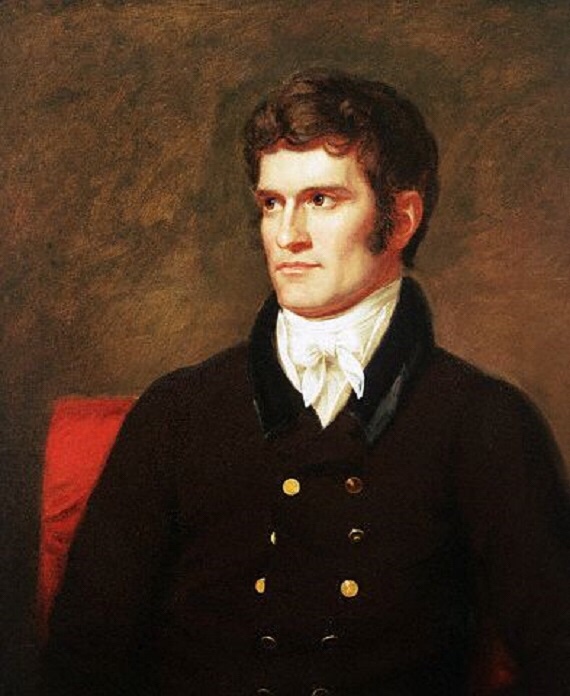
John C. Calhoun, 7th Vice President of the United States, resigns to take a Senate seat from his native South Carolina. Calhoun was a short step away from the Presidency, twice. He ran unsuccessfully in 1821, and had he been able to remain as Vice President to Andrew Jackson, he almost certainly would have been assured the nomination and perhaps the election after Jackson’s two terms had ended.

But Calhoun and Jackson would get cross-ways over accusations of adultery involving the wife of the secretary of war, along with most of Jackson’s cabinet. This and their differences over nullification (the belief that the states could nullify ANY act by the federal government-admittedly a simplified explanation, but accurate), led to Calhoun’s resignation.

Calhoun was a fierce proponent of state’s rights, and as a result, of slavery.

However, a comment shortly before his death showed his loyalties, “If I am judged by my acts, I trust I shall be found as firm a friend of the Union as any man in it. If I shall have any place in the memory of posterity it will be in consequence of my deep attachment to it.”

Calhoun felt himself a patriot. He is, perhaps, a reminder that we can disagree with someone politically without assuming they are otherwise.

Today in History, December 28: 1867 –

The United States annexes it’s first territory outside of the continental US, two tiny specs of coral land halfway to Asia in the Pacific, first known as the Brook Islands for the man who discovered them, later renamed Midway Atoll.

The Navy attempted unsuccessfully to build a coaling station on the island, and later the Commercial Pacific Cable Company used the island as a link for telegraph lines across the world’s largest ocean.

In 1903 President T. Roosevelt stationed 21 US Marines there to ward off poachers. In the 1930’s Pan American Airways began using Midway as one of the stations for its now romantically famous island hopping China Clipper. And of course the “Goony Bird” filled islands became known to most of us for it’s part during the Battle of Midway during WWII.

Manifest Destiny

Today in History, December 27: 1845 –

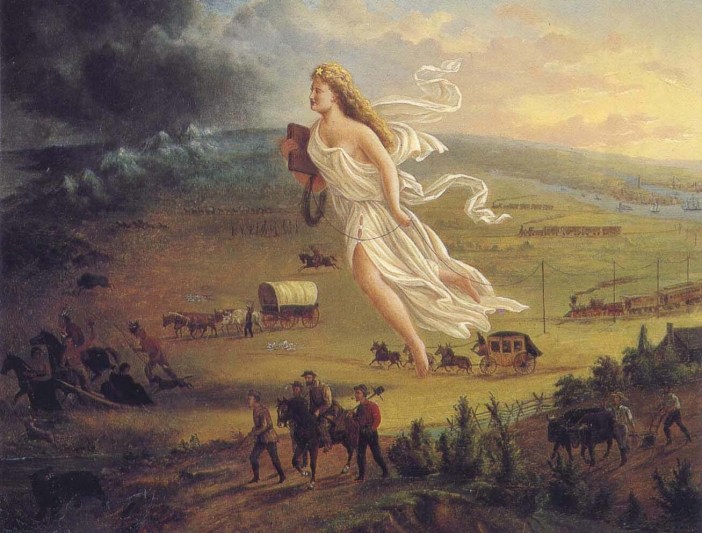
John L. Sullivan writes in the New York Morning News of “Manifest Destiny” regarding American expansion into the Oregon Territory after the session of Texas to the United States.

“And that claim is by the right of our manifest destiny to overspread and to possess the whole of the continent which Providence has given us for the development of the great experiment of liberty and federated self-government entrusted to us.”

The Trent Affair

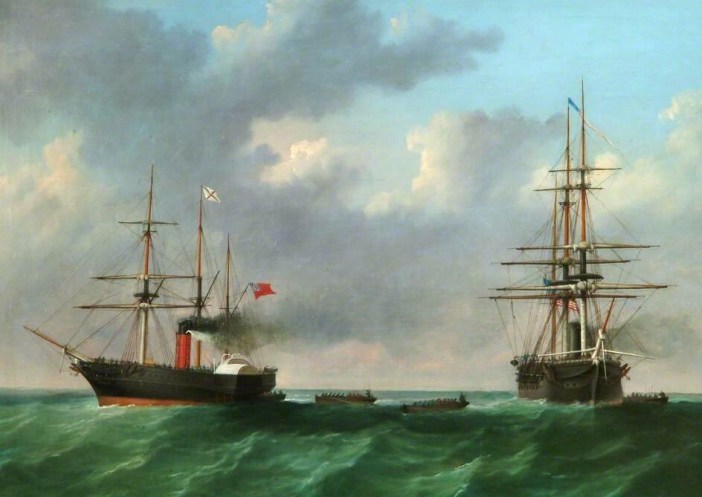
Today in History, December 26: 1861 – The “Trent Affair” ends with the release of Confederate envoys James Mason and John Slidell into British custody. Seems mundane initially, but this is a fascinating story that helps define American character. Earlier in the year, Union forces had been made aware that Confederate emissaries were being sent to Britain…believing that the desire for Southern cotton (King Cotton) by British merchants would inspire the UK Government to recognize the Confederacy as as separate nation, and to support her against the North. The USS San Jacinto, commanded by US Navy Captain Charles Wilkes, found the HMS Trent, a mail “packet” ship carrying Mason and Slidell to Britain to lobby for recognition and for support. He ordered the ship boarded and the envoys arrested as “contraband”, taking them to a Union port. Wilkes had led the American Exploring Expedition years earlier…science was his domain, not international relations. He created an international incident….the British were outraged that one of their ships had been boarded and her passengers seized. Ironically, by international law, had he seized the entire ship and brought her to port pending a trial, nobody would have been offended. US Secretary of State William Seward had to deal with the situation. American public sentiment was that the Southerners were taken legitimately. But if you looked at American history to that date…the Revolution had been won partially because Americans had gained foreign recognition by France. So was the Confederacy really doing anything that the Americans of the Revolution hadn’t done? Subsequently, the War of 1812 had been fought largely because Americans were tired of the British boarding their ships and seizing the ships crewmen. So could Capt. Wilkes’ actions be defended? Foremost in Seward’s thinking (and Lincoln’s) was that the Union would be hard pressed to win the Civil War if Britain came in on the side of the Confederacy, deciding that the CSA was a nation unto itself rather than a rebellious segment of one nation. In the end Seward voiced an eloquent conciliatory message to the British, released the Southern envoys to the British government, and avoided creating another enemy the North could not fight. Mason and Slidell continued on to Britain, but their efforts came to naught.

Knowing When to Say No Secured Nimitz’ Fate…and Kimmel’s

Today in History, December 25, 1941:

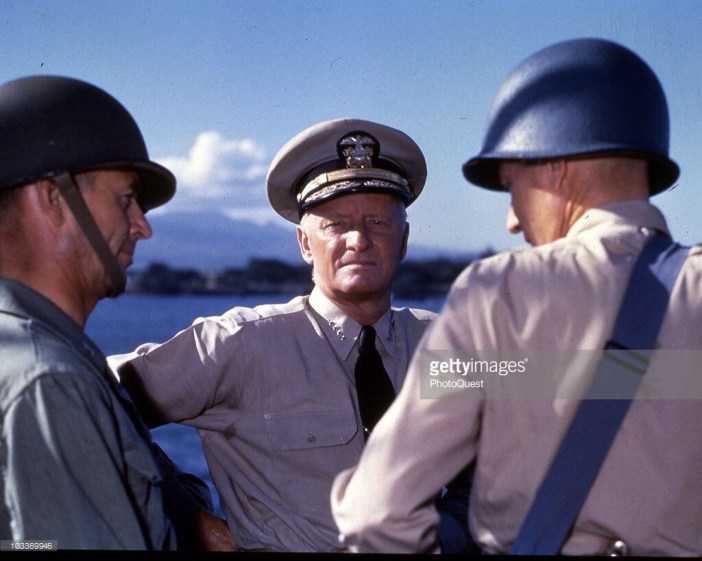
Admiral Chester W. Nimitz arrived in Pearl Harbor aboard a PB2Y Coronado flying boat after a flight from the west coast. Before the flight he had taken a six day train ride from Washington DC across the country.

On December 17th Nimitz, who at the time was the Commander of the Bureau of Navigation (the Navy’s personnel dept) was ordered to take command of the US Pacific Fleet, much of which was either sunk or damaged at Pearl Harbor. FDR had told him to get out there until “the war was won.” He did.

When the Japanese attacked Oahu on December 7, the current commander of the Pacific Fleet, Admiral Husband E. Kimmel, quickly became the scapegoat for all that had been done wrong. He would spend years defending himself while Nimitz led the US Navy to victory.

But Nimitz very nearly assumed Kimmel’s fate. Nimitz had been an innovator in the Navy for years…as a result he had been offered CINCPAC earlier in the year, but turned it down…he wanted the Bureau instead.

So did Nimitz’ instincts tell him not to take the offer? Either way his choice kept him from being in Kimmel’s shoes, which allowed him to be the historic leader he became.

After his arrival in Pearl Nimitz spent a lot of time with Kimmel, and then kept Kimmel’s staff in place.

Nimitz told Kimmel and others that, “The same thing could have happened to anyone.”

George Washington Setting Standards

10300976_10202008870182100_5882756852648273895_n

Today in History, December 23: 1783 – “The Greatest character of the age” – King George III of England describing George Washington. American General of the Armies and Commander in Chief George Washington, resigns his commission at the Maryland Statehouse in Annapolis. He had waited until the English armies that he had helped vanquish had, at length, removed themselves from New York. He was in a position to rule the youthful nation. The move giving up so much power shocked Europeans. Washington went home to Mt. Vernon, but of course was not done. In 1787 he accepted the Presidency of the Constitutional Convention, and in ’89 the Presidency of the United States. He set the standard for future generations by relinquishing the power he held, and then later by limiting himself to only two terms as President.

A Christmas Gift

Today in History, December 22: 1864 – “I beg to present you, as a Christmas gift, the city of Savannah, with 150 heavy guns and plenty of ammunition, and also about 25,000 bales of cotton.”. General William Tecumseh Sherman wired this message to President Lincoln after his army siezed one of the few remaining port cities in the South.

The message was not merely well received. It ended a six week cliff hanger for the President and the people of the North. That was when Gen. Sherman had taken the daring move of leaving the conquered city of Atlanta, thus cutting his army off from it’s supply lines. The large army would be solely dependent upon the supplies it could obtain from the land. Everything that was not needed to feed or provision the Union Army in a huge swath between the two cities was destroyed to prevent it’s use by the South.

Sherman had several objectives: Take Savannah to prevent supplies reaching the Confederacy from overseas, join up with the Navy, and bring the horrors of war to the Southern populace in an effort to demoralize them and shorten the war.

All Glory is Redeemed…

Today in History, December 21: 1945 –

“For over a thousand years, Roman conquerors returning from the wars enjoyed the honor of a triumph – a tumultuous parade. In the procession came trumpeters and musicians and strange animals from the conquered territories, together with carts laden with treasure and captured armaments. The conqueror rode in a triumphal chariot, the dazed prisoners walking in chains before him. Sometimes his children, robed in white, stood with him in the chariot, or rode the trace horses. A SLAVE STOOD BEHIND THE CONQUEROR, HOLDING A GOLDEN CROWN, AND WHISPERING IN HIS EAR A WARNING: THAT ALL GLORY IS REDEEMED.” Closing lines of the movie “Patton”.

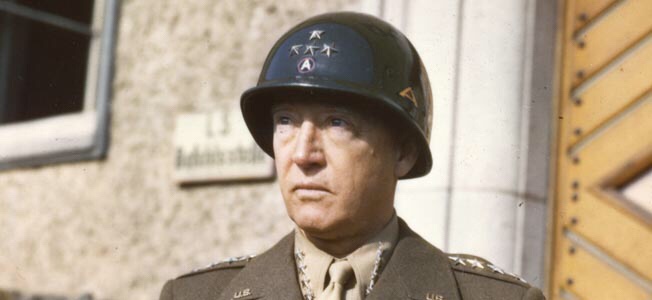
On this day in 1945 Gen. George S. Patton dies of injuries sustained in an automobile accident in Germany. Patton was a brilliant tactician and leader, but often a contentious figure. It probably WAS just an accident, but speculation continues about whether it really was an accident, or whether Patton’s comments about America’s response, or lack thereof, to Communist aggression after WWII led to his demise.

I would like to think the consummate warrior had served his purpose was called home.