Nothing Lives Long. Except the Earth and the Mountains. -Death song of Chief White Antelope, age 75

Today in History, November 29:  1864 –

The Sand Creek Massacre.

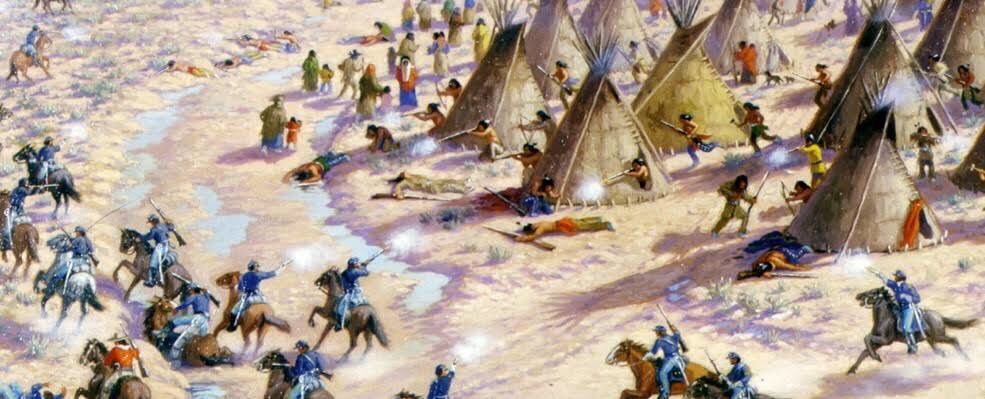
As the morning was dawning the sleepy village, Chief Black Kettle saw them approaching, and hoisted the Stars and Stripes above his Tipi as a sign of brotherhood and peace.  And then the blue coated soldiers began firing.

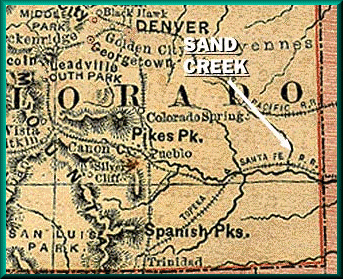
The Cheyenne and Arapaho of Colorado had settled in for the winter along a bend in Sand Creek in eastern Colorado.  Resources in the barren area were in short supply and they expected a harsh time.  900-1,000 people in hundreds of Tipis, although many were out hunting buffalo that morning.

The Civil War raged further east, and in Colorado and New Mexico a few months previous.  Colonel John Chivington of the Colorado Volunteers had fought in those battles, but now was looking for a new fight.  After a family of settlers was killed, allegedly by Arapaho or Cheyenne, the Governor tasked Chivington with raising a regiment to defend against hostile Indians.

But his regiment’s enlistment was nearly up and he hadn’t found any hostile Indians.  So he took over 700 troops to attack the peaceful village along Sand Creek.

After the attack on the settlers, the white authorities told the peaceful Indians to encamp at military forts and facilities where they would be protected.  Chief Black Kettle had spoken to the commander of a nearby fort seeking to comply.  He was told to keep his people at Sand Creek until the commander received further orders, and they would be safe.

Hundreds of women and children dropped to their knees in front of the soldiers that morning, imploring them for mercy.  There was no mercy given as the women and children were shot down or had their skulls caved in.  Many then ran for the creek where they sought cover, or fled north.  For the next several hours Chivington’s soldiers chased them down and killed as many as they could.

Seeing what was happening, Chief White Antelope approached the soldiers, folded his arms, and began singing his death song, “Nothing lives for long.  Except the Earth and the Mountains.”

Chief Black Kettle carried his wounded wife and fled north towards another band of Cheyenne.  He would make his way to Oklahoma, where he led his people to again attempt peaceful existence.  He would live two days shy of four years more…when he and his wife would be chased down and killed by soldiers of George Custer’s command at the Massacre along the Washita River.

One of the Union officers present that day refused to follow commands and ordered his company not to fire; and tried to save some of the victims.  Captain Silas Soule was career Army and recognized the cowardly acts being carried out.  The next day he wrote a letter to a Major friend of his back east, telling of the horrific behavior of Chivington’s “mob”.  He told of women and children having their brains bashed in.  He said that Chiefs had their ears and genitals cut off as trophies, and all those killed were scalped.  The crazed killers cut out many of the women’s genitalia as souvenirs.

Chivington would escape court martial by resigning from the Volunteers.  But even during the Civil War, the government and the people were aghast at the atrocities carried out at Sand Creek, and Congressional hearings were held in 1865, during which Captain Soule testified at against Chivington.

For his trouble he was gunned down in the street in Denver a few months later.  His murderers were never prosecuted.

The assault was supposedly intended to force peace for the nascent settlements in Colorado.  It had exactly the opposite effect, as the Cheyenne Dog Soldiers and others fought a decade’s long war with the settlers, their trust of the white people destroyed.

The story was eventually all but forgotten, and was a touchy subject when it was spoken of.  However Colorado eventually began to come to terms with this dark part of its history, and in 2007 the Sand Creek Massacre National Historic Site was established, run by the National Park Service.

Many visit the site in homage to the approximately 200 Native Americans who died that day.

Several of the sites I read in preparation for this posting indicated the subject was not covered much until the 2000’s.  However if you read (or watch) James Michener’s “Centennial”, you’ll find that he covered the events very well, just with a change in names.

Giving up Coffee for the Troops

Today in History, November 29: 1942 –

Rationing of Coffee begins in the United States. There wasn’t a shortage…South American coffee growers were experiencing banner years. However with shipping problems (U-boats, etc) and so many American servicemen overseas, the government enacted rationing of basic goods…gasoline, rubber goods, etc to ensure that the troops had what they needed.

And the nectar of the Gods, the elixir of life, coffee. Imagine how thankful those soldiers and sailors were to be able to have a cup of coffee in their distant battlefields.

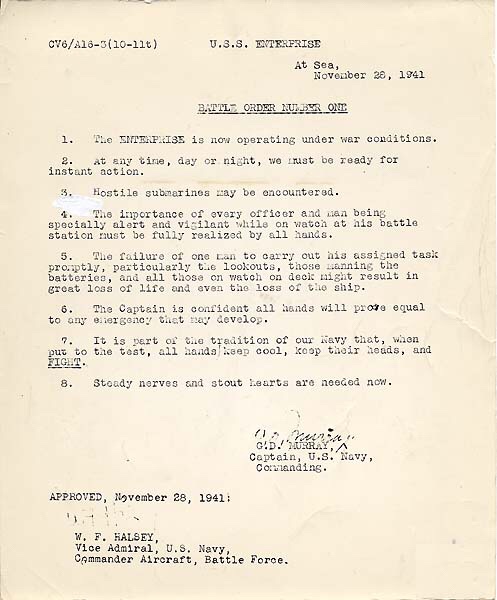
Battle Order #1

Today in History, November 28: 1941 –

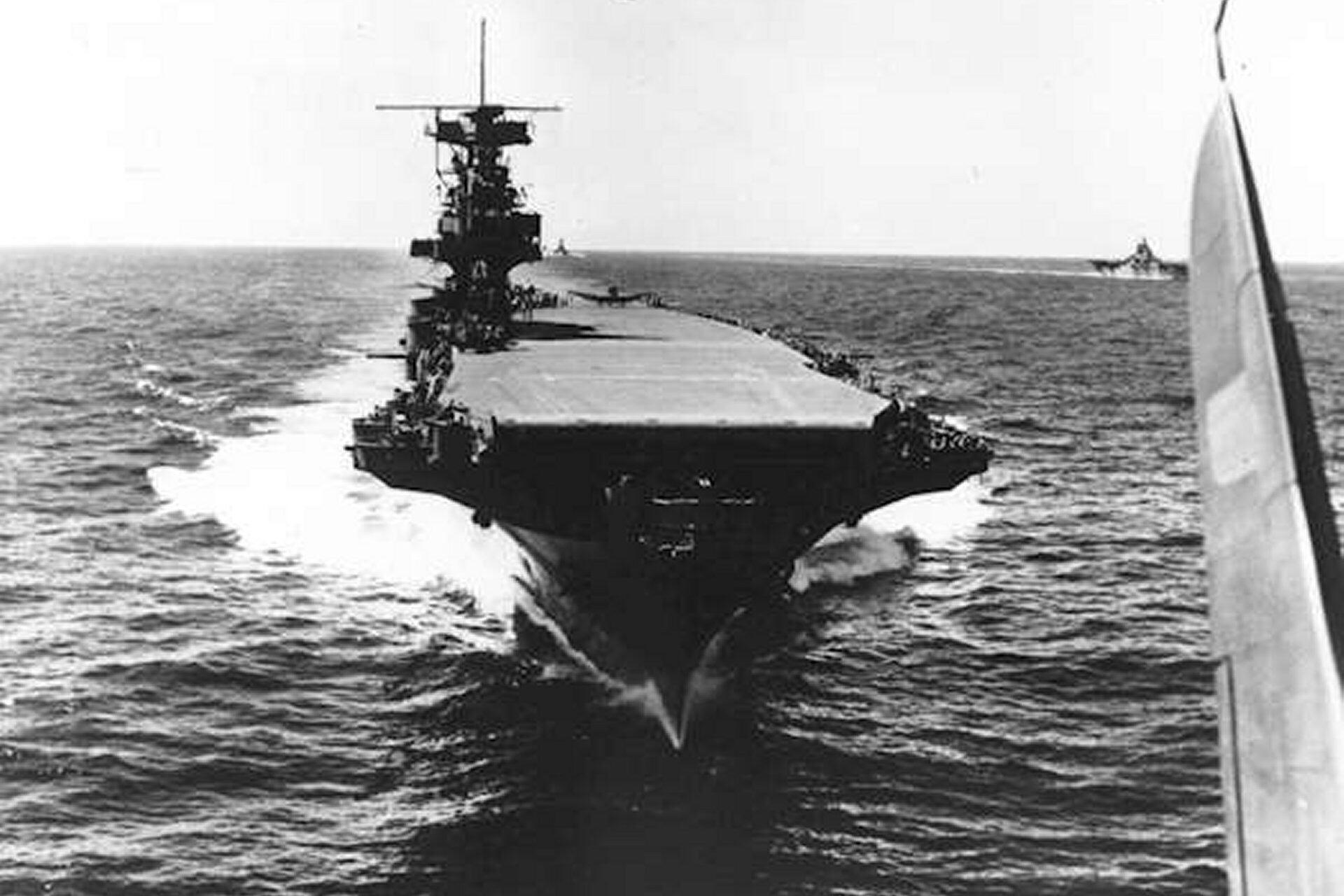
Ten days before the Japanese attack on Pearl Harbor, a Task Force built around the aircraft carrier USS Enterprise (CV-6) sailed from Pearl Harbor bound for Wake Island.

In response to a “war warning” the Enterprise had taken aboard a squadron of US Marine F4F Wildcat fighter planes and their pilots, with orders to deliver them to Wake to bolster the island’s defenses.

Once they were at sea, the TF commander, Admiral William F. (Bull) Halsey signed off on Battle Order #1, which put the Enterprise and her supporting Cruisers and Destroyers on a war footing.

The crew began adding armor behind the pilot’s position’s in the ship’s fighters, painting them in combat colors, and arming them for combat.

More than a week before the Japanese attacked, the Enterprise TF had orders to shoot first and ask questions later should they encounter any foreign ships or planes. The CAP (Combat Air Patrol) kept watch overhead.

The Big E would deliver the Marines and return to Pearl on Sunday, December 7. Her scout plane pilots would fly ahead, ending up right in the middle of the air raid. But that’s another story.

But on this date, Admiral Halsey and Captain Murray closed by telling their sailors “Steady nerves and stout hearts are needed now.”

US Army War College

Today in History, November 27: 1901 – The US Army War College is established at Washington Barracks, Washington, DC by Secretary of War Elihu Root. Look at the War College as a Masters program for command level military officers. Surprisingly to me, the US Navy had beaten the Army by 17 years, the US Naval War College was established in 1884.

“Louis, I think this is the beginning of a beautiful friendship.”


Today in History, November 26:  1942 – The motion picture “Casablanca” premieres in New York City.  The movie that would become a screen classic would be released to theaters in the remainder of the country on January 23, 1943.

The film was set in Casablanca, Morocco in December, 1941.  This time frame is important to the viewer if not the players.  Rick Blaine is an exiled American who owns a high-end bar.  Between continuously matching wits with the local French authorities and Nazis, Rick manages to barter for immigration papers for those fleeing the Nazis and to deal with an old romance interest who re-enters his life…Ilsa.  “Of all the gin joints in all the towns in all the world, she walks into mine.”

The film is at heart a romance, but at the same time a gritty war thriller.  Humphrey Bogart was well accustomed to playing the heavy, and did so well.  Ingrid Bergman did an excellent job playing the femme fatale, but by the time the show is over, one is hard pressed not to find Claude Rains’ portrayal of Captain Louis Renault to be the most compelling.

The plethora of one-liners definitely added to place Casablanca at the top of any “greatest” list, even 75 years later.  Near the end of the film, Rick and Louis are caught at the airport by Nazi SS Major Strasser.  Louis ends up shooting the Major.  As Louis’ troops rush up in response to the shot, Louis says hastily, “Major Strasser’s been shot.  Round up the usual suspects.”

It is important to note the film was released less than a year after the Pearl Harbor attack at a time when the question of who would be victorious was still a very open discussion.  Those viewing the movie most likely had fathers, brothers and sons fighting on a steaming, miserable island named Guadalcanal or on ships in the same theater.  Less than a month earlier (November 8) American soldiers and sailors took part in the landings of Operation Torch assaulting French North Africa.  This would include fighting the Nazis and the Vichy French (French sympathetic to or under the thumb of the Nazis.)  These battles would include Morocco and the Naval Battle of Casablanca between Allied, German and Vichy French naval forces.

All of this was the backdrop for the premiere of Casablanca.  How much more real, how much more emotion, must have been involved seeing it for the first time in 1942.

Evacuation Day

Today in History, November 25: 1783 –

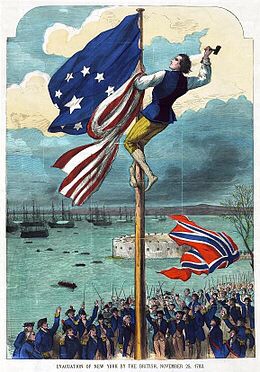
After seven years of occupation, the last British troops depart New York City, three months after the Treaty of Paris was signed ending the American Revolutionary War.

At the outset of the war Gen. George Washington had wanted to fight to keep NYC, but after losing tactically to British forces, had to flee with his army in the dark of night. NY would remain in British hands throughout the war.

After the last British troops left, Gen. Washington entered the city to great fanfare from its citizens.

He would later be inaugurated as the first President in the city that would become the nation’s first capitol.

Texas Rangers Become Official

Today in History, November 24: 1835 –

The provincial legislature of Texas, before Texas was a nation or a state, orders the creation of companies of “Rangers” to patrol the range, or frontier. Their job, continuing a less official group of rangers begun by Stephen F. Austin in 1823, was to protect citizens from Indians and bandits.

The Rangers would see success at fighting Commanche and bandits. When the Texas war for independence came they served as scouts and couriers.

During the Mexican-American War they would earn more fame (or infamy depending on your position…the Mexican populace referred to them as los Diablos Tejanos, or Texas Devils) for their fighting acumen and scouting for the US Army. How many police agencies can say they were recruited as a unit to fight alongside the military at war?

Over the next century and a half the Rangers would have their highs and lows…being all but disbanded during the Civil War and due to politics on other occasions.

But when it counted they were there to track down bad guys like John Wesley Hardin, Sam Bass and other terrors as the West was settled, and Bonnie and Clyde during the thirties.

The Rangers were known for their relentless tactics against the Native American tribes and others. They also took the fight to the KKK and against lynchings.

Today the Texas Rangers are much different. They are still the elite response unit…but as part of the Texas Department of Public Safety they are the investigators working with the patrol arm of the Highway Patrol.

As Long as I Count the Votes…

Today in History, November 23: 1876 –

“It’s hard not to admire the skill behind Tweed’s system … The Tweed ring at its height was an engineering marvel, strong and solid, strategically deployed to control key power points: the courts, the legislature, the treasury and the ballot box. Its frauds had a grandeur of scale and an elegance of structure: money-laundering, profit sharing and organization.”

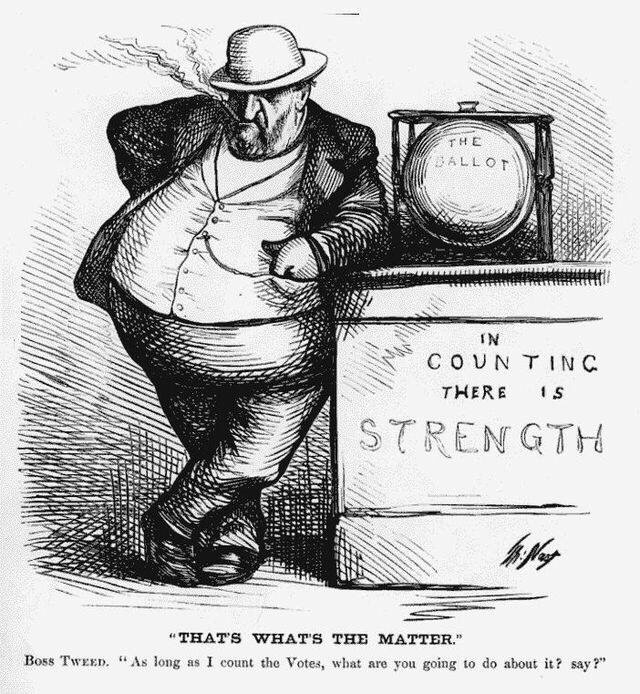
“Boss Tweed”, William Magear Tweed, is delivered back to US custody by the US Navy after being captured in Spain, where he was working as a sailor. Tweed had been elected to the New York Legislature in the 1850’s, but soon realized he would have more power on various commissions and controlling WHO got elected.

For several years he ruled New York and in a large part the nation through his corrupt control of votes and purchased positions via Tammany Hall. It finally led to potential financial collapse, which is when his friends finally turned on him and he was arrested.

Released to visit his family, he fled, ending up in Spain. Unfortunately for him, Thomas Nast of Harper’s Weekly had drawn him so many times, that he was recognized. Once he was out of options, he testified against his cohorts, but remained in prison until his death in 1878. This was the Democrat Party of the 19th century.

The China Clipper Adventure

Today in History, November 22, 1935:

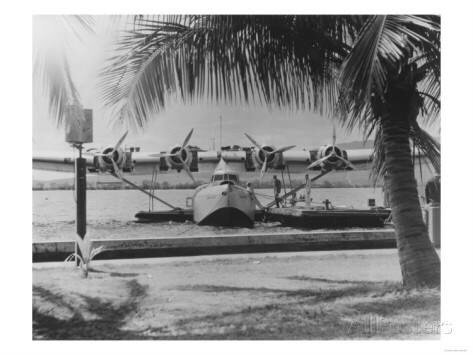
A Martin M-130 flying boat owned by Pan American Airways takes off from San Francisco, flies under the yet to be completed San Francisco Bridge on it’s way to the Orient.

With this the China Clipper inaugurated commercial air service via Hawaii, Midway, Wake Island, Guam to the Philippines. If you had the money, a romantic 7 day trip across the Pacific Ocean was now possible.