The Knights Templar…An Army of God

Today in History, January 13, 1128:

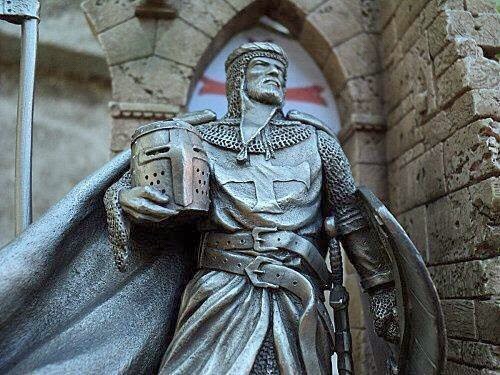
The Knights Templar are named an “Army of God” and given a papal sanction by Pope Honorius II. The Templars protected pilgrims traveling to and from the Holy Land during the Crusades. They called themselves the Templars after the Temple Mount in Jerusalem, where they were headquartered.

By the 14th century the wealthy and powerful had become jealous of the wealth and status of the Templars. The Templars were arrested, accused of heresy, tortured, and burned at the stake. Pope Clement V dissolved the Templars and their extensive property and wealth was turned over to the French and English monarchies. Today’s Catholic church has acknowledged the unfounded persecution of the order.

Radio and the Eiffel Tower

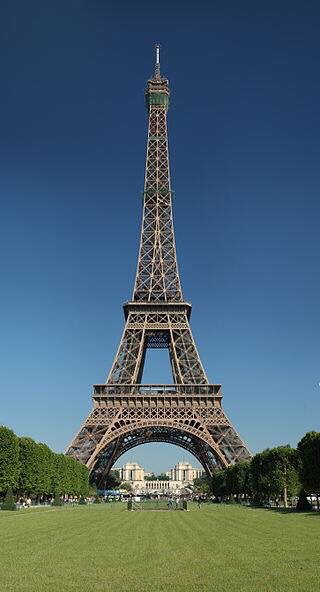
Today in History, January 12: 1908 – A long distance radio signal message was sent from the Eiffel Tower for the first time. Within a few years the signals would be exchanged with the US Naval Observatory in Washington, DC for scientific purposes. The tower had been designed by Gustave Eiffel for the 1889 World Exposition held in Paris.

Eiffel had also designed the interior support for the Statue of Liberty, which was a gift given to the United States in the 19th century by the people of France in recognition of America’s inspiration to France for independence and freedom.

“We Will Be As A City Upon A Hill”

Today in History, January 11, 1989:

President Ronald Reagan gives his farewell speech from the White House,

“…And that’s about all I have to say tonight, except for one thing. The past few days when I’ve been at that window upstairs, I’ve thought a bit of the “shining city upon a hill.” The phrase comes from John Winthrop, who wrote it to describe the America he imagined. What he imagined was important because he was an early Pilgrim, an early freedom man. He journeyed here on what today we’d call a little wooden boat; and like the other Pilgrims, he was looking for a home that would be free.

I’ve spoken of the shining city all my political life, but I don’t know if I ever quite communicated what I saw when I said it. But in my mind it was a tall, proud city built on rocks stronger than oceans, wind-swept, God-blessed, and teeming with people of all kinds living in harmony and peace; a city with free ports that hummed with commerce and creativity. And if there had to be city walls, the walls had doors and the doors were open to anyone with the will and the heart to get here. That’s how I saw it, and see it still.”

Reagan had spoken of the “Shining city on a hill” throughout his career, and in a 1974 speech he quoted Winthrop; “Standing on the tiny deck of the Arabella in 1630 off the Massachusetts coast, John Winthrop said,

“We will be as a city upon a hill. The eyes of all people are upon us, so that if we deal falsely with our God in this work we have undertaken and so cause Him to withdraw His present help from us, we shall be made a story and a byword throughout the world.”

What will we leave behind when we “Walk off into the city streets?”

Crossing the Rubicon…The Die is Cast

Today in History, January 10, 49 BC:

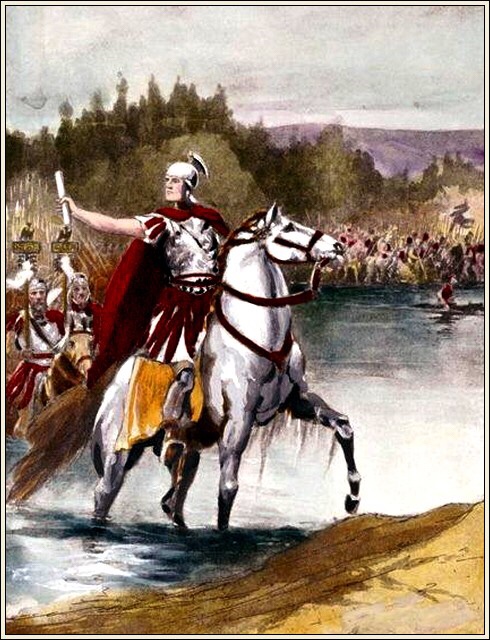
Julius Caesar’s time was up as the General in charge of Cisalpine Gaul, a province of the Roman Republic encompassing current France, etc.

The Senate had ordered Caesar home to Rome…and by tradition, to leave his army behind; Armies were not allowed in the Republic proper, and for good reason.

As Caesar sat on the other side of the river Rubicon, with his army, he made a decision to cross. Once he did so he would become a criminal, committing an act of war. And there would be no turning back.

He made his decision and plunged Rome into a civil war. He would be named dictator for life when he was victorious, something that was as significant for Romans as it would be for us.

Hence, “crossing the Rubicon” and “the die is cast” are synonymous with making an irreversible decision.

“the greatest battle implement ever devised.”

Today in History, January 9, 1936:

“the greatest battle implement ever devised” – Gen. George S. Patton

1936 – The first semi-automatic rifle is issued to the US Army in the form of the M-1 Garand Rifle. Semi-automatic, meaning that a round would be fired each time the trigger was pulled.

The rugged rifle would be used by American fighting men to help win WWII.

And For Your Trouble…

Today in History, January 8: 1642 – Italian astronomer Galileo Galilei dies in Italy at age 77. Considered the father of astronomy, Galileo was the first to use a telescope, enabling him to makes several stellar discoveries. This included the ability to confirm that the earth rotated around the sun, rather than the other way around. He published his findings and for his trouble, in 1633 (Inquisition) he was convicted of heresy, sentencing him to house arrest (due to his advanced age) until his death.

Electoral College

Today in History, January 7, 1789 –

The states first elected their Electoral College electors, who would elect George Washington as the first President. The Electoral College was established so that less populated states would not be left without a say in the choice of the Chief Executive.

If the President was elected by popular vote, the states with the highest population would always made the decision. This was of great concern to the more rural, less populated states.

The system has been tested several times throughout our history, and surely will be again.

Death had to take Roosevelt sleeping, for if he had been awake, there would have been a fight.” -Vice President Thomas Marshall

Today in History, January 6: 1919 –

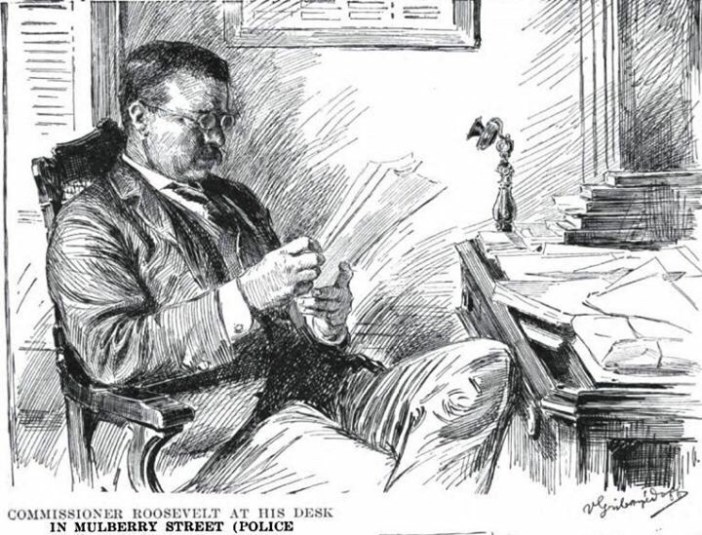
“Death had to take Roosevelt sleeping, for if he had been awake, there would have been a fight.” -Vice President Thomas Marshall. President Theodore Roosevelt dies at Sagamore Hill, Oyster Bay, New York in his sleep of a heart attack. “Teddy” had taken every last drop of adventure and worthiness that he could squeeze out of life in the preceding 60 years.

Roosevelt had been a sickly child; constantly plagued by breathing problems, he could rarely play with the other children. His father, Theodore Sr., a remarkable man himself, told “Teedie” that if he wanted to have a successful life, he would have to take charge and force his body into the form he needed to match his intellect. Roosevelt did just that. He took exercise as his “raison detre” until he was barrel chested and of vigorous health. Each time he became sick during his life, he would simply work through it.

As a young man, while serving in the New York Assembly, Roosevelt’s wife and mother died on the same day…February 14, 1884. Roosevelt fled into the west, becoming a rancher and for a time a lawman in the Dakota Territory. The experience would strengthen him and give him a background people respected.

During his life he was a state rep from New York, the Police Commissioner for New York City, Governor of New York, the Assistant Secretary of the Navy (he oversaw the building of a modern US Navy while his boss was not paying attention), he led the “Rough Riders” (1st Volunteer US Cavalry) up San Juan Hill in the Spanish-American War, became Vice President, and the President after President McKinley was assassinated.

As President he defined the modern presidency, breaking up monopolies, seeing that mistreated workers got a fair shake, sent the “Great White Fleet” around the world establishing American as a world influence, saw the Panama Canal built, saw the establishment of the National Parks Service, and countless other accomplishments.

He worked tirelessly for the American people. After the Presidency he traveled extensively, going on an African Safari, and exploring an unknown region of South America, “The River of Doubt”; a region so treacherous that it was considered a no-man’s land. He nearly died in the mapping of the river, now called “Rio Roosevelt” in his honor.

All of his male children fought in WWI, and the only reason Teddy didn’t was because the Democrat President (Wilson) refused to let him, afraid Roosevelt would run against him in the next election and win. One of his sons, Quentin, would be shot down over France and be killed. That was the last straw for the “Old Lion”. He mourned dreadfully until his death.

One of his other children, Theodore Roosevelt, Jr., would be the only General to go ashore with the troops at D-Day in WWII; Teddy Jr would die of a heart attack himself several weeks after the Normandy invasion. The entire world would mourn President Roosevelt’s passing; he had become larger that life, a hero to people the world over. The quintessential American. And in case you couldn’t tell, my favorite Hero.
Ground Breaking Labor Decision

Today in History, January 5: 1914 –

The Ford Motor Company makes the radical decision to double it’s employee’s pay to $5 per day, and to reduce their hours to 8 hours per day.

Ford’s competitors were unhappy, but followed suit once the company’s productivity and profits doubled.

It may not seem like much now, but it was ground breaking in 1914, much like Ford’s use of the assembly line had been.

Colt Walker

Today in History, January 4: 1847 –

Samuel Colt sells 1,000 revolvers to the Texas Rangers. Capt. Samuel Walker of the Rangers had used one of Colt’s revolvers in the Seminole wars and was so impressed that he traveled to New York City to find Colt. He ordered the revolvers, insisting that the order include 6 shots rather than 5, and have enough caliber to kill man or horse. The finished product was named the “Colt Walker”, and was followed by another thousand, which allowed Colt to build his own factory.

Colt was not the first to make a “revolving gun”, but he did perfect interchangeable parts and an assembly line to make his reliable pistols.