“Louis, I think this is the beginning of a beautiful friendship.”


Today in History, November 26:  1942 – The motion picture “Casablanca” premieres in New York City.  The movie that would become a screen classic would be released to theaters in the remainder of the country on January 23, 1943.

The film was set in Casablanca, Morocco in December, 1941.  This time frame is important to the viewer if not the players.  Rick Blaine is an exiled American who owns a high-end bar.  Between continuously matching wits with the local French authorities and Nazis, Rick manages to barter for immigration papers for those fleeing the Nazis and to deal with an old romance interest who re-enters his life…Ilsa.  “Of all the gin joints in all the towns in all the world, she walks into mine.”

The film is at heart a romance, but at the same time a gritty war thriller.  Humphrey Bogart was well accustomed to playing the heavy, and did so well.  Ingrid Bergman did an excellent job playing the femme fatale, but by the time the show is over, one is hard pressed not to find Claude Rains’ portrayal of Captain Louis Renault to be the most compelling.

The plethora of one-liners definitely added to place Casablanca at the top of any “greatest” list, even 75 years later.  Near the end of the film, Rick and Louis are caught at the airport by Nazi SS Major Strasser.  Louis ends up shooting the Major.  As Louis’ troops rush up in response to the shot, Louis says hastily, “Major Strasser’s been shot.  Round up the usual suspects.”

It is important to note the film was released less than a year after the Pearl Harbor attack at a time when the question of who would be victorious was still a very open discussion.  Those viewing the movie most likely had fathers, brothers and sons fighting on a steaming, miserable island named Guadalcanal or on ships in the same theater.  Less than a month earlier (November 8) American soldiers and sailors took part in the landings of Operation Torch assaulting French North Africa.  This would include fighting the Nazis and the Vichy French (French sympathetic to or under the thumb of the Nazis.)  These battles would include Morocco and the Naval Battle of Casablanca between Allied, German and Vichy French naval forces.

All of this was the backdrop for the premiere of Casablanca.  How much more real, how much more emotion, must have been involved seeing it for the first time in 1942.
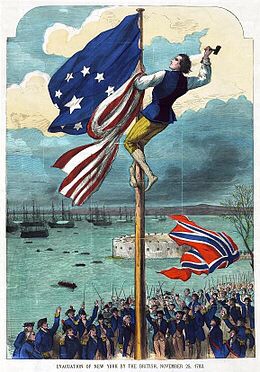
Evacuation Day

Today in History, November 25: 1783 –

After seven years of occupation, the last British troops depart New York City, three months after the Treaty of Paris was signed ending the American Revolutionary War.

At the outset of the war Gen. George Washington had wanted to fight to keep NYC, but after losing tactically to British forces, had to flee with his army in the dark of night. NY would remain in British hands throughout the war.

After the last British troops left, Gen. Washington entered the city to great fanfare from its citizens.

He would later be inaugurated as the first President in the city that would become the nation’s first capitol.

Texas Rangers Become Official

Today in History, November 24: 1835 –

The provincial legislature of Texas, before Texas was a nation or a state, orders the creation of companies of “Rangers” to patrol the range, or frontier. Their job, continuing a less official group of rangers begun by Stephen F. Austin in 1823, was to protect citizens from Indians and bandits.

The Rangers would see success at fighting Commanche and bandits. When the Texas war for independence came they served as scouts and couriers.

During the Mexican-American War they would earn more fame (or infamy depending on your position…the Mexican populace referred to them as los Diablos Tejanos, or Texas Devils) for their fighting acumen and scouting for the US Army. How many police agencies can say they were recruited as a unit to fight alongside the military at war?

Over the next century and a half the Rangers would have their highs and lows…being all but disbanded during the Civil War and due to politics on other occasions.

But when it counted they were there to track down bad guys like John Wesley Hardin, Sam Bass and other terrors as the West was settled, and Bonnie and Clyde during the thirties.

The Rangers were known for their relentless tactics against the Native American tribes and others. They also took the fight to the KKK and against lynchings.

Today the Texas Rangers are much different. They are still the elite response unit…but as part of the Texas Department of Public Safety they are the investigators working with the patrol arm of the Highway Patrol.

As Long as I Count the Votes…

Today in History, November 23: 1876 –

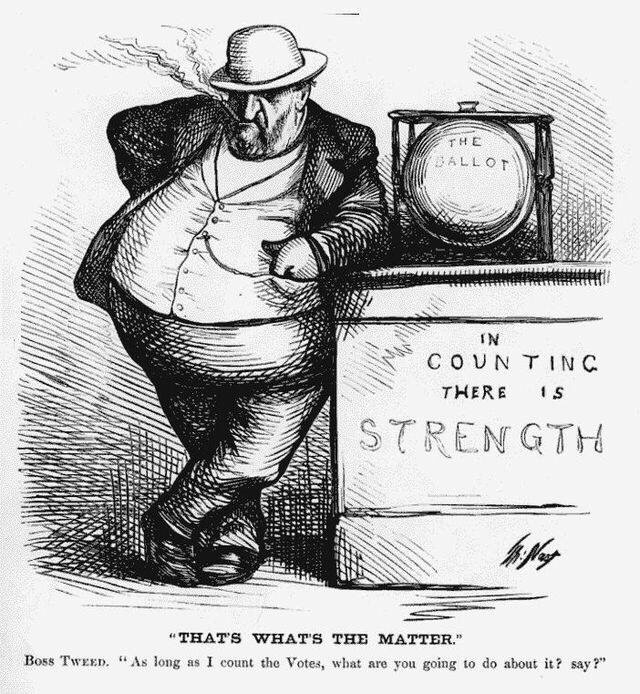
“It’s hard not to admire the skill behind Tweed’s system … The Tweed ring at its height was an engineering marvel, strong and solid, strategically deployed to control key power points: the courts, the legislature, the treasury and the ballot box. Its frauds had a grandeur of scale and an elegance of structure: money-laundering, profit sharing and organization.”

“Boss Tweed”, William Magear Tweed, is delivered back to US custody by the US Navy after being captured in Spain, where he was working as a sailor. Tweed had been elected to the New York Legislature in the 1850’s, but soon realized he would have more power on various commissions and controlling WHO got elected.

For several years he ruled New York and in a large part the nation through his corrupt control of votes and purchased positions via Tammany Hall. It finally led to potential financial collapse, which is when his friends finally turned on him and he was arrested.

Released to visit his family, he fled, ending up in Spain. Unfortunately for him, Thomas Nast of Harper’s Weekly had drawn him so many times, that he was recognized. Once he was out of options, he testified against his cohorts, but remained in prison until his death in 1878. This was the Democrat Party of the 19th century.

The China Clipper Adventure

Today in History, November 22, 1935:

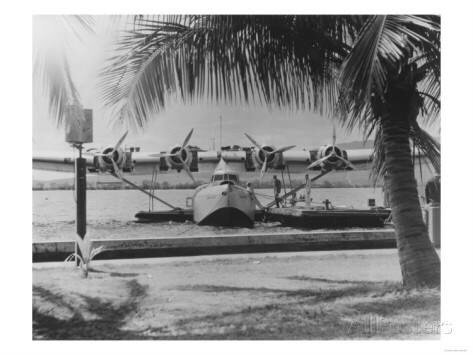
A Martin M-130 flying boat owned by Pan American Airways takes off from San Francisco, flies under the yet to be completed San Francisco Bridge on it’s way to the Orient.

With this the China Clipper inaugurated commercial air service via Hawaii, Midway, Wake Island, Guam to the Philippines. If you had the money, a romantic 7 day trip across the Pacific Ocean was now possible.

The Whaleship Essex

Today in History, November 20: 1820 –

Loss of the whaleship Essex. Since 1711, the whaling industry had been an important aspect of the American economy. This was the time before crude oil, and the oil, blubber and bone from whales brought good money. Hundred of ships from New England made a living sailing to the Pacific and back.

The Essex had sailed from Nantucket and was hunting 2,000 miles west of the South American coast when and angry whale struck the ship twice, capsizing her and setting her twenty man crew adrift in open long boats.

During the next 83 days three of the men would be marooned on a South Pacific island. Only five others would survive after being picked up by other ships near the South American coast.

The ordeal would inspire Herman Melville’s novel “Moby Dick.”

“I should be glad, if I could flatter myself that I came as near to the central idea of the occasion, in two hours, as you did in two minutes.”

Today in History, November 19: 1863 – “I should be glad, if I could flatter myself that I came as near to the central idea of the occasion, in two hours, as you did in two minutes.” -Edward Everett, popular orator that spoke with President Lincoln at Gettysburg to commemorate those that died there during the pivotal Battle of Gettysburg earlier in the year. President Lincoln spoke briefly, and his speech was criticized at the time by some media, but has become legendary for it’s prescience. See below for the full text….

Four score and seven years ago our fathers brought forth on this continent, a new nation, conceived in Liberty, and dedicated to the proposition that all men are created equal.

Now we are engaged in a great civil war, testing whether that nation, or any nation so conceived and so dedicated, can long endure. We are met on a great battle-field of that war. We have come to dedicate a portion of that field, as a final resting place for those who here gave their lives that that nation might live. It is altogether fitting and proper that we should do this.

But, in a larger sense, we can not dedicate — we can not consecrate — we can not hallow — this ground. The brave men, living and dead, who struggled here, have consecrated it, far above our poor power to add or detract. The world will little note, nor long remember what we say here, but it can never forget what they did here. It is for us the living, rather, to be dedicated here to the unfinished work which they who fought here have thus far so nobly advanced. It is rather for us to be here dedicated to the great task remaining before us — that from these honored dead we take increased devotion to that cause for which they gave the last full measure of devotion — that we here highly resolve that these dead shall not have died in vain — that this nation, under God, shall have a new birth of freedom — and that government of the people, by the people, for the people, shall not perish from the earth.

Time Zones

Today in History, November 18: 1883 –

The origin of time zones. American railroads were hardly ever on time. Each depot was on a different time, since they used the path of the sun to determine what time it was. American railroads established a system of “time zones”, so that more of the country would be on the same time. East, Central, Mountain and Pacific. Eventually cities and then the entire country would adopt the system.

The Santa Fe Trail

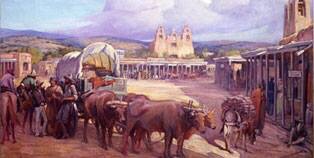
Today in History, November 16: 1822 – William Becknell arrives in Santa Fe, New Mexico with a train of mules loaded down with supplies. Recently, he had been jailed for the more than $20,000 in debts (today’s dollars) that he owed. In desperation he put together a trip with supplies across the dangerous midwest to Santa Fe, Mexico, in an attempt to make the money to pay his creditors. On his first trip he made an incredible profit from the Mexicans living in Santa Fe, since Mexico had recently won it’s Independence from Spain and could trade with Americans again. On his second trip, he turned a $3,000 investment into a $91,000 return for the people of Franklin, Missouri. Before his death in 1865, he would run for the state legislature, own land once owned by the survivors of Daniel Boone, be a Captain in the Texas War for Independence, and be a Texas Ranger. Oh…and before all this happened, he served under Daniel Boone’s son in the War of 1812. He would be honored for blazing the trail to Santa Fe. His father and two of his uncles served in the Revolutionary War…the uncles were killed in battle. What a life!