Today in History, November 29: 1864 – The Sand Creek Massacre.
As the morning was dawning over the sleepy village, Chief Black Kettle saw them approaching, and hoisted the Stars and Stripes above his Tipi as a sign of brotherhood and peace. And then the blue coated soldiers began firing.
The Cheyenne and Arapaho of Colorado had settled in for the winter along a bend in Sand Creek in eastern Colorado. Resources in the barren area were in short supply and they expected a harsh time. 900-1,000 people in hundreds of Tipis, although many were out hunting buffalo that morning.
The Civil War raged further east, and in Colorado and New Mexico a few months previous. Colonel John Chivington of the Colorado Volunteers had fought in those battles, but now was looking for a new fight. After a family of settlers was killed, allegedly by Arapaho or Cheyenne, the Governor tasked Chivington with raising a regiment to defend against hostile Indians. But his regiment’s enlistment was nearly up and he hadn’t found any. So he took over 700 troops to attack the peaceful village along Sand Creek.
After the attack on the settlers, the white authorities told the peaceful Indians to encamp at military forts and facilities where they would be protected. Chief Black Kettle had spoken to the commander of a nearby fort seeking to comply. He was told to keep his people at Sand Creek until the commander received further orders, and they would be safe.
Hundreds of women and children dropped to their knees in front of the soldiers that morning, imploring them for mercy. There was no mercy given as the women and children were shot down or had their skulls caved in. Many then ran for the creek where they sought cover, or fled north. For the next several hours Chivington’s soldiers chased them down and killed as many as they could.
Seeing what was happening, Chief White Antelope approached the soldiers, folded his arms, and began singing his death song, “Nothing lives for long. Except the Earth and the Mountains.”
Chief Black Kettle carried his wounded wife and fled north towards another band of Cheyenne. He would make his way to Oklahoma, where he led his people to again attempt peaceful existence. He would live two days shy of four years more…when he and his wife would be chased down and killed by soldiers of George Custer’s command at the Massacre along the Washita River.
One of the Union officers present that day refused to follow commands and ordered his company not to fire; and tried to save some of the victims. Captain Silas Soule was career Army and recognized the cowardly acts being carried out. The next day he wrote a letter to a Major friend of his back east, telling of the horrific behavior of Chivington’s “mob”. He told of women and children having their brains bashed in. He said that Chiefs had their ears and genitals cut off as trophies, and all those killed were scalped. The crazed killers cut out many of the women’s genitalia as souvenirs.
Chivington would escape court martial by resigning from the Volunteers. But even during the Civil War, the government and the people were aghast at the atrocities carried out at Sand Creek, and Congressional hearings were held in 1865, which Captain Soule testified at against Chivington. For his trouble he was gunned down in the street in Denver a few months later. His murderers were never prosecuted.
The assault was intended to force peace for the nascent settlements in Colorado. It had exactly the opposite effect, as the Cheyenne Dog Soldiers and others fought a decade’s long war with the settlers, their trust of the white people destroyed.
The story was eventually almost forgotten, and was a touchy subject when it was spoken of. However Colorado eventually began to come to terms with this dark part of its history, and in 2007 the Sand Creek Massacre National Historic Site was established, run by the National Park Service. Many visit the site in homage to the approximately 200 Native Americans who died that day.
Several of the sites I read in preparation for this posting indicated the subject was not covered much until the 2000’s. However if you read (or watch) James Michener’s “Centennial”, you’ll find that he covered the events very well, just with a change in names.




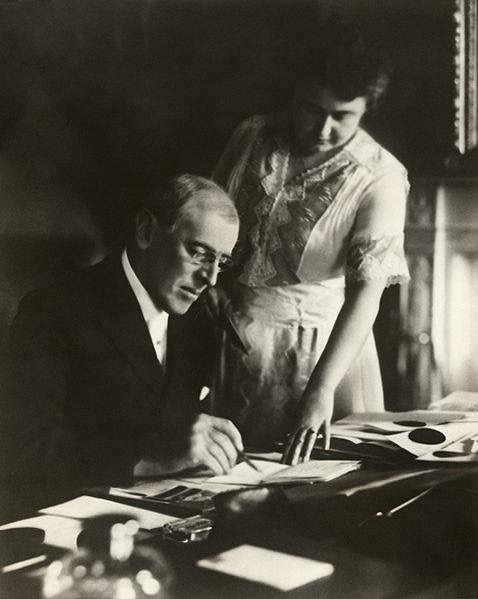 Today in History, October 2: 1919 – President Woodrow Wilson (D) had been on a whirlwind tour of the nation, 8,000 miles in 22 days, pushing America’s entry into the League of Nations (precursor to the United Nations). On September 25 in Pueblo, Colorado, suffering from exhaustion and recovering from a bout with influenza, he collapsed. He made it back to DC before suffering a debilitating stroke that paralyzed his left side and left him bedridden. His wife Edith, fiercely protective, cut off almost all access to him in order to keep his incapacitation a secret. She signed off on paperwork and made decisions without consulting the President, claiming she was only acting as a steward to him. He would eventually recover enough to take part in cabinet meetings, but his participation was severely limited. As for the League of Nations? Wilson’s Republican opponents in the Congress, ferociously opposed to the League, continued to fight it, and with the election of Republican President Warren Harding, the League of Nations issue died.

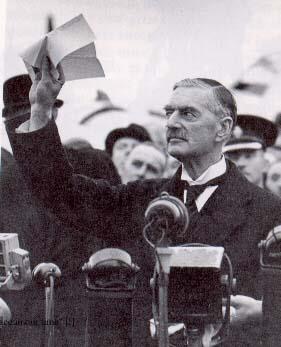 “You had a choice between war and dishonor. You have chosen dishonor; you shall have war” – Winston Churchill. European powers sign the Munich Agreement surrendering the Sudetenland and parts of Czechoslovakia with a promise that Germany will remain peaceful. British Prime Minister Neville Chamberlain rushes home to declare “peace in our time”. That radical Winston calls him on it. It isn’t long before the Panzers and Stukas are in action again. When the Nazis took over these lands, part of their excuse was that there were many Germans living in those places that deserved to be under German governance.
 Today in History, September 14: 1814 – “The Defence of Ft. McHenry”. A young American attorney, Francis Scott Key, had been negotiating the release of prisoners on British ships when he was held on board during the bombardment of Ft. McHenry in Baltimore…so that he couldn’t relay British plans during the War of 1812. He watched through the night of the 13th as the Brits bombarded the fort, and was inspired on the morning of the 14th when the stars and stripes were still flying. The British gave up…and Key wrote a poem called “The Defence of Ft. McHenry” which he published in a local paper, “The Patriot.” It would be years before his poem would be renamed “The Star Spangled Banner” and made the national anthem in 1931…so of course he never knew. Oh, but if our history could be left to only our proudest moments. Key would become a US District Attorney. He defended Sam Houston for assaulting another Congressman. He also was a forceful opponent of emancipation…his grandson would be imprisoned in the same Ft. McHenry he wrote about because he was a Confederate sympathizer…and his sister would marry Roger B. Taney…the future Supreme Court Chief Justice who would forever prove the Court fallible in the Dred Scott Decision. He was also the namesake for a distant cousin…F. Scott Fitzgerald. But in 1814, Francis Scott Key was a Patriot who penned the future National Anthem.
 Mark Loves History!