The Richmond Bread Riots

544543_3961162846269_1150295048_n

Today in History, April 2: 1863 – “As she raised her hand to remove her sunbonnet and use it for a fan, her loose calico sleeve slipped up and revealed the mere skeleton of an arm. She perceived my expression as I looked at it, and hastily pulled down her sleeve with a short laugh. ‘This is all that’s left of me’ she said. ‘It seems real funny, don’t it?. . .We are starving. As soon as enough of us get together, we are going to the bakeries and each of us will take a loaf of bread. That is little enough for the government to give us after it has taken all our men.” The Richmond, Virginia Bread Riots. During the Civil War, Richmond had been made the capitol of the Confederacy. Several factors had led to starvation conditions among the general populace of the South. The Union Navy had blockaded nearly all Southern ports, and the blockade runners could not bring in enough supplies. Growing cotton was more profitable than growing food, so most planters did that; what crops were left were usually taken by armies in the field, Confederate and Union. The prices of what little was left skyrocketed…wheat (bread) prices tripled, dairy products quadrupled…if they could be found at all. On this day in 1863 the mothers of Richmond had enough and rioted, breaking windows of bakeries and other stores, making off with bread, clothing, even jewelry. They confronted Confederacy President Jefferson Davis, who initially threw the change from his pockets at the crowd, saying he sympathized with their plight. When that didn’t work, he threatened to have the militia fire into the crowd of war wives and mothers. That finally got them to disperse.

Uncle Tom’s Cabin Published

Today in History, March 20: 1852 – “So…you’re the little woman who wrote the book that made this great war!” President Abraham Lincoln greets Harriett Beecher Stowe at the Presidential Mansion in 1862, ten years after her novel “Uncle Tom’s Cabin” was first published. I am amazed at the foresight and courage displayed by this woman, a school teacher turned author. By her own admission, in the epilogue of the book, for the first part of her life, she knew of slavery, disapproved of it, but being a Northerner, it was distant and she felt that the problem would be resolved eventually on it’s own. How many of today’s injustices do we see the same way? Between meeting some runaway slaves, becoming familiar with the Underground Railroad, and stories from her family and friends, and finally the Compromise of 1850 (in which the government promised to return runaway slaves in exchange for new limitations on slavery expansion), she became an avid abolitionist. She wrote Uncle Tom’s Cabin to illustrate the aspects of slavery that most did not understand at that time. As slaves, a mother’s children were often sold off, never to be seen again. Women were sold into prostitution, to be used until their value had diminished. If a good and kindly “master” came on hard times, he might sell a good man “down the river” to cruel and harsh masters, as “Uncle Tom” was. With her novel, Mrs. Stowe humanized the slavery issue, brought it home to people and chastised them for not living up to their Christian values. The novel would become the best selling novel of the 19th century and would inspire abolitionist views amongst Americans. It was certainly far from the only cause of the Civil War…but the novel played it’s part in American History. One has to wonder if this “little woman” had any idea of the importance her words would have. If you haven’t read (or listened to) this novel, you should.

A Legacy of Unintended Consequences

Today in History, March 14: 1794 – You never know what your legacy will be. Eli Whitney is granted a patent for his cotton gin (engine), although the patent wouldn’t be free and clear of legal suits until 1807. Whitney was emigrating south to S. Carolina when a fellow passenger, the widow of Revolutionary War hero Gen. Nathanael Greene, convinced him to go to her Georgia plantation instead. It was here that he and his partner, with help from Mrs. Greene, would develop the machine that changed the process of removing seeds from cotton from laborious to simple.  As a result of Whitney’s innovation the South’s cotton exports went from less that 500,000 lbs in 1793 to over 93 million in 1810. It had another effect not intended. Slavery had been of waning use in the late 18th century…but with “King Cotton”, the Antebellum South’s burgeoning economy needed labor, and slavery became an integral part of their livelihood, dashing the hopes of those abolitionists who expected it to die out. In the meantime…all of the legal wrangling over his invention left Eli broke. So to make money he turned to making weapons for the government. While he was not the originator, he was an avowed proponent of using inter-changeable parts…which would eventually influence the industrial revolution. So…both of Whitney’s successes greatly influenced (contributed to?) the Civil War and the nation’s development long after his death in 1825. The Civil War began about state’s rights…but about the right to keep slaves by those states. Expansion westward in the South was mostly about beginning new plantations…hence more slaves. And I’m sure many of Eli’s muskets survived for use in the war. None of which was likely on this little known inventors mind as he worked his trade.

Two Westerners, President and Lt. General

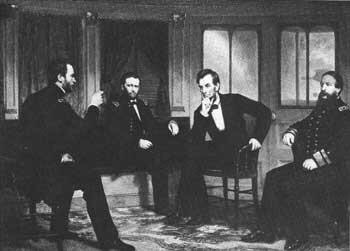
Today in History, March 10: 1864 – President Lincoln signs documents promoting Ulysses S. Grant to the rank of Lieutenant General. Grant was only the second person to hold the rank, the first having been George Washington. Winfield Scott had held the rank in the interim, but only as a “brevet” or temporary rank. Lincoln wanted his commanding general to have a rank above his other generals for leadership purposes. Grant would answer only to the President. 

Lincoln had difficulties with several Generals prior to Grant being appointed as the commander of all the Union Armies. The two communicated and worked very well together. Perhaps because they were both westerners from Illinois and understood each other. Certainly because Grant carried out Lincoln’s wishes to pursue Confederate Armies with vigor. 

All the Worlds’ Navies Became Obsolete…In 3 Hours

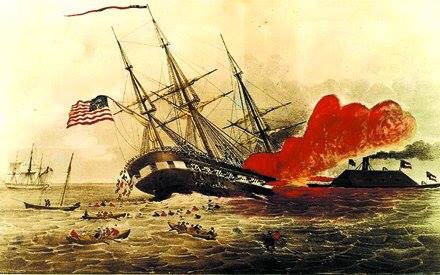
Today in History, March 9: 1862 – The Battle of Hampton Roads. Few are able to be part of a truly history changing event. When the Civil War began, the Union abandoned the Naval Base at Norfolk, Virginia, burning everything they could in retreat. The Confederacy took the base, and raised the sunken Union ship USS Merrimack. They then turned her into the ironclad CSS Virginia. The Union Navy placed an embargo on all Southern ports, including the entrance to the Southern capitol of Richmond. The South attempted to break this embargo with their new ironclad ship, sinking two Union wooden “ships of the line” in the process. The Virginia returned to base for the night, then returned to finish off the last major embargo ship on 9 March, 1862. She was confronted by the Union version of the ironclad…the USS Monitor. The two new iron ships battered away at each other for over three hours without seriously damaging each other, and then withdrew. The Virginia would be scuttled at her base as the Union advanced…the Monitor would be lost at sea. But more importantly….navies worldwide…Britain, France, Spain, the Far East, watched and realized that their wooden navies had suddenly become obsolete.

The Supreme Court is not the “Be All, End All.”

Today in History, March 6: 1857 – The Dredd Scott Decision. Dredd Scott was a slave whose owner had traveled and lived in “free states” and had promised him his freedom. When his owner died, Scott sued for his freedom, because he had lived in “free” states. The case worked it’s way up the chain to the Supreme Court, which at that time was loaded with Southerners. Chief Justice Roger Taney wrote the majority opinion that declared that no slave could possibly be a citizen, therefore they had no standing to sue. Also that the Federal Government had no right to regulate slavery in the states and territories. Obviously a biased, politically motivated opinion, the decision, in part, led to the horrific, devastating American Civil War. So our lesson is complex. The Supreme Court, while our highest court, is not infallible. It’s bad decisions lead to horrific consequences for the nation. It DOES make political decisions. And this theory does not end with Dredd Scott.

One has to wonder what Roger Taney was thinking when he had to swear President Abraham Lincoln in to office in his position as Chief Justice of the Supreme Court.  He forever tainted and brought into question decisions made by the Court.

“Neither let us be slandered from our duty by false accusations against us, nor frightened from it by menaces of destruction to the Government nor of dungeons to ourselves. Let us have faith that right makes might, and in that faith, let us, to the end, dare to do our duty as we understand it.” – Abraham Lincoln at Cooper Union

Today in History, February 27: 1860 – “One of the most happiest and most convincing political arguments ever made in this City … No man ever made such an impression on his first appeal to a New-York audience.” — Horace Greeley in his paper regarding “The Cooper Union Speech” by Abraham Lincoln. A former Congressman and Illinois lawyer, Lincoln had been launched to the national stage by his debates with Stephen Douglas over the slavery question 2 years before, but he was still mostly unknown in the east. A young Republicans group in New York invited him to speech at Cooper Union’s Great Hall. The hall was not filled for the speech, but the text of it was given to Greeley’s and other’s papers; from there it was broadly published across the nation in pamphlet form. Lincoln made convincing arguments that the Founding Fathers were against the expansion of slavery and desired it’s eventual end. At the same time he tried to convince Southerners that the Republican party did not wish to interfere in their affairs. While in New York he had his photo taken by Matthew Brady, and the photo was used along with the pamphlet to broaden his recognition. It is widely believed that the speech is what launched him into the Presidency. He closed with a message to his colleagues: “Neither let us be slandered from our duty by false accusations against us, nor frightened from it by menaces of destruction to the Government nor of dungeons to ourselves. Let us have faith that right makes might, and in that faith, let us, to the end, dare to do our duty as we understand it.” (See below for video of Sam Waterston performing the speech).

Reversal of Fortunes Among Friends

Today in History, February 18, 1862:  “I know you are separated from your people, and perhaps you need funds.  My purse is at your disposal.”  Union General Ulysses Grant to Confederate General Simon Bolivar Buckner as Buckner prepared to board a river boat taking him north to a Yankee prison.

On February 16, 1862 after a hard-fought battle and investment, Confederate Fort Donelson in Tennessee had surrendered to Union forces.  Tennessee was a strategic area in the Civil War, providing resources, people and a launching point to move against the rest of the South.  General U.S. Grant had been little known to the public before this battle, but the battle would change all that.  He coordinated with the US Navy to bombard Ft. Donelson and surround the 12,000 men there.  After assaults and counter assaults, the Confederate commanders came to the realization loss of the fort was a foregone conclusion, a tragedy for the South.  Gen. Simon Bolivar Buckner was actually third in command.  His superiors resigned their positions so they could sneak out and escape.  Col. Nathan Bedford Forrest took some of his Cavalry and fled also, leaving Buckner to stay with his men and surrender.

Buckner sent a note through the lines asking Grant for terms.  And here is where Grant became famous.  He wrote out his response for delivery to Buckner,

No terms except unconditional and imme­diate surrender can be accepted. I propose to move immediately upon your works.

In a time when furloughs and exchanges were common in battle, Buckner found the response to be “ungenerous and unchivalrous.”  Yet he had no choice, his only option was surrender.  Having had little but bad news for some time, the Northern papers seized upon the victory.  They used Grants initials to rename him “Unconditional Surrender Grant.”  Turns out it wasn’t the first name others had changed his name for him, but that’s another story.  The public was finding out something those serving with Grant had learned…he was unpretentious, unceremonious and tenacious.  He got results.  President Lincoln would eventually say of him, “I can’t spare this man; he fights.”

If you want History to be more than dates on a page, watch out for the back stories…the facts that bring out the humanity in what you’re reading.

The story reads good already.  But lets dig further.

When Grant was younger, he wanted an education.  His father worked hard and secured him an appointment to West Point.  Initially, Grant didn’t want to go.  But once in, he liked it.  His uncanny horsemanship impressed fellow cadets and instructors.  And he made friends among the other cadets, including Simon Bolivar Buckner, who was attending at the same time.

Grant and Buckner, among many other officers in the US Army, served together and performed heroics in the Mexican-American War of 1846-1848.

After that conflict Grant found himself assigned to the frontier in California, where he missed his family grievously and took to drink.  In July of 1854 he suddenly resigned his commission from the Army and sought transport home.

Grant found himself in New York without even enough money to get a meal or pay for a room.  And then he happened upon an old classmate and friend, Simon Bolivar Buckner.  The two enjoyed a visit, talked old times and Buckner, who was doing much better financially, paid for his friend’s room and board.

In the intervening years until 1861 and the beginning of the Civil War, Grant was somewhat of a hard luck case.  He tried farming, he tried real estate, nothing worked.  When the war began he was working for his brothers and his father in a store as a clerk.

When Southern states began seceding many in the US Army that were from those states, resigned their commissions and joined the Confederate Army, including Buckner.  Thus the old friends found themselves on opposite sides.  And Grant sought out Buckner before he went off to prison in an attempt to return an old favor.

Grant, of course, would become commander of all Union Armies and eventually President.  Buckner would eventually be exchanged for a Union general officer and continue to serve in the Confederate Army.  He surrendered in New Orleans in 1865 for a second time.  He would become Governor of Kentucky among other political successes.  In 1904 he visited the White House and asked President Theodore Roosevelt to appoint his son to West Point.  TR quickly agreed.  Gen. Simon Bolivar Buckner Jr would be killed at Okinawa in WWII, the highest ranking officer killed by enemy fire in WWII.


An American Success Story

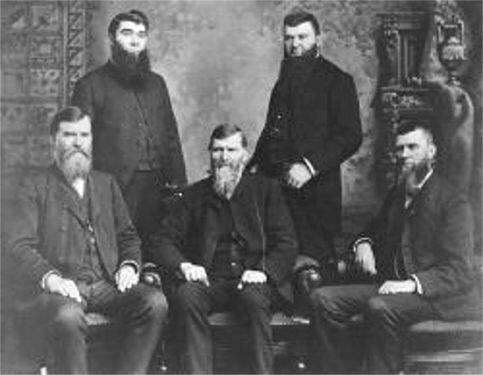
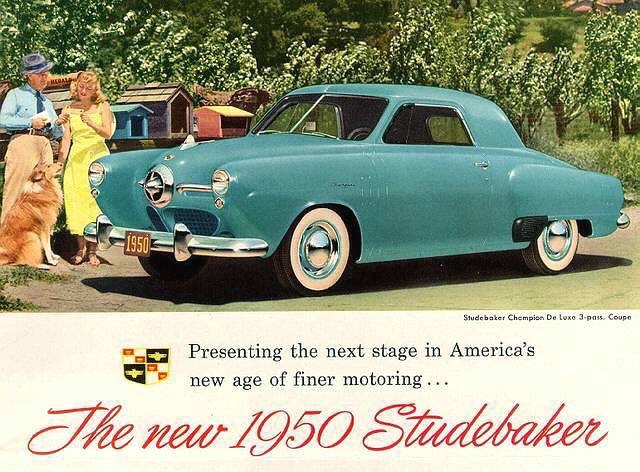
Today in History, February 16: 1852 – The five brothers, Henry, Clement, John Mohler, Peter Everst and Jacob Franklin, had been taught the skill of wagon making by their parents, who had been taught by their parents, who had arrived in America in 1736. They began their combined business on this date in 1852, and soon they were providing fully half of the wagons used for the migration west, and a quarter of those in the nation. They made bank during the Civil War, selling wagons to the Union Army. Their business continued to thrive…those beautiful red 1900 model wagons pulled by the Budweiser Clydesdales…are Studebakers. When motorized vehicles came to be, the Studebaker Company began making first electric and then gasoline cars. The company would last until 1957, having a reputation for quality and class in their cars.

Bleeding Kansas Joins the Union

bleeding-kansas-1

Today in History, January 29: 1861 – Kansas enters the Union as a free state.  Plain, flat Kansas has played a very large role in the formation of our nation.

I wasn’t there but a little while when I went to help a feller shingle a roof. It was about eight o’clock in the mornin’, and I was sittin’ there on the roof just lookin’ out at those miles and miles of prairies, and way off in the distance I see somethin’ about the size of a cigar standin’ up on the horizon. It didn’t seem to get no bigger and after I watched it a while I says to the feller, ‘Look at that thing out there, don’t it look funny.’ He looked where I was pointin’ and he says ‘Know what that is? That’s the freight train comin’ in.’ Well, we worked all mornin’ and we went in and was eatin’ dinner when we heard that train pull into the depot.

Mr. Botsford on Travel—Kansas,” Art Botsford, Interviewee; Francis Donovan, Interviewer; Thomaston, Conn., December 27, 1938. American Life Histories: Manuscripts for the Federal Writers’ Project, 1936-1940. Manuscript Division

“Bloody Kansas” had fought the battle between abolishionists and slavery proponents from Missouri throughout the 1850’s. It’s internal battle was a precursor to the Civil War, during which the entire nation would battle for it’s very life over the unholy concept of one man owning another.