Kristallnacht


Today in History, November 9: 1938 – Kristallnacht. In order to direct Germany in the direction they wanted, the Nazis believed that they had to give the people someone to blame, someone to hate, for their misfortunes. The Jewish people of Germany and Austria were the perfect targets.

The Nazis used the murder of a low level diplomat in Paris as an excuse. Hitler ordered storm troopers to act as if they were citizens angered by the murder and to vandalize and destroy Jewish businesses, thus “The Night of Broken Glass” from the broken windows. Many Jews were killed and 30,000 men were arrested and sent to concentration camps. They were released if they promised to leave Germany….100,000+ did so. Kristallnacht would eventually lead to the Holocaust, during which 6,000,000+ Jews were killed in the Nazis attempt at genocide.

“A Time for Choosing” a California Governor; An American President


Today in History, November 8, 1966:

A Hollywood actor and Screen Actor’s Guild President is elected for the first time to his first term as California Governor, defeating Democrat political veteran Governor Pat Brown (yes, Governor Jerry Brown’s father.)

On October 27, 1964 Ronald Reagan had given a speech entitled, “A Time for Choosing” while campaigning for failed Presidential candidate Barry Goldwater.  That “moment in time” is referred to in political circles as “The Speech” because its dynamic message and Reagan’s powerful delivery, while it didn’t succeed for Goldwater, propelled former Democrat Reagan into a fireball career which would lead him not only to the Governorship, but to two terms as one of America’s most beloved and respected Presidents.  He was so revered by the American people, that it is only natural for leftist to revile him.  He is an excellent example of why you must watch closely for bias when researching individuals and events.

Here are a couple more versions of “The Speech”, one of it in its entirety if you are interested, and one which has been adapted to more modern events.  I share this because that one speech echoed down through history for other events…including “I hear you!  And the people who knocked these buildings down will hear from ALL of us soon!”


What Do “The Resistance”, “The Weather Underground”, and a Harvard Professor have in Common with the US Senate?

Today in History, November 7: 1983 – A bombing in the US Senate.

The Senate was expected to be in session late, but managed to finish early, around 7 PM. A few hours later a bomb which had been placed beneath a bench outside the Republican cloakroom exploded. The device blew the doors off of the office of Democrat leader Robert Byrd and nearly destroyed the painting of Senate legend Daniel Webster.

A five year investigation led to the arrest of six members of the “resistance conspiracy” for the Senate bombing, and bombings at Ft. McNair and the historic Washington Navy Yard.

Shocking, but not as unusual as one might think.

In 1971 a bomb was set off in the Senate by the “weather underground”, another radical group.

In 1915, a German Harvard University professor planted 3 sticks of dynamite in the Senate building in protest of American financiers who we assisting Great Britain in WWI.  He then attempted to assassinate JP Morgan. After being arrested, he committed suicide.

Remember, Remember, the 5th of November…

Today in History, November 5, 1605: …The Gunpowder treason and plot…

The Gunpowder Plot. Several Catholic conspirators had hatched a plan to blow up the Parliament building in London while the king and parliament met.

One of the conspirators told a relative not to attend, and that relative told authorities. On the night of November 5th, conspirator Guy Fawkes was caught lurking in the basement of the building, and subsequently 20 barrels of gunpowder he had hidden there were located.

Fawkes named his conspirators under torture. Several, including Fawkes, were sentenced to be drawn and quartered. As Fawkes climbed a ladder to the gallows, he jumped to his death. Today is Guy Fawkes day in England, celebrating the failure of the plot.

In recent years it seems to have become popular to don a Guy Fawkes mask to render yourself anonymous to protest anything from injustice to prices.

 The Fifth of November

Remember, remember!  
The fifth of November, 
The Gunpowder treason and plot; 
I know of no reason 
Why the Gunpowder treason 
Should ever be forgot! 
Guy Fawkes and his companions 
Did the scheme contrive, 
To blow the King and Parliament 
All up alive. 
Threescore barrels, laid below, 
To prove old England’s overthrow. 
But, by God’s providence, him they catch, 
With a dark lantern, lighting a match! 
A stick and a stake  
For King James’s sake! 
If you won’t give me one, 
I’ll take two, 
The better for me, 
And the worse for you. 
A rope, a rope, to hang the Pope, 
A penn’orth of cheese to choke him, 
A pint of beer to wash it down, 
And a jolly good fire to burn him. 
Holloa, boys! holloa, boys! make the bells ring! 
Holloa, boys! holloa boys! God save the King! 
Hip, hip, hooor-r-r-ray!

USS Oklahoma

Today in History, November 3: 1943 – The USS Oklahoma (BB-37) is re-floated at Pearl Harbor, Hawaii after a months long salvage operation. She had been on Battleship Row on December 7, 1941 when Japanese torpedoes caused her to capsize quickly. After being decommissioned, the ship was sold for scrap, being too old and too damaged for further service. En route from Pearl to San Francisco, the Oklahoma slipped the line from her tow ship and sank to the bottom of the Pacific. I guess she didn’t want to end up in a scrap yard.

https://www.militarytimes.com/2015/07/27/remains-of-pearl-harbor-victims-exhumed-for-identification/

“Dewey Defeats Truman”

Today in History, November 2, 1948:

“Dewey Defeats Truman”.

The Chicago Tribune is so confident that New York Governor Thomas Dewey will win the Presidential election that the paper publishes it’s desired results in an early edition…but Truman won by 2M votes.

Most sources will describe this as a solitary example of media bias, however in 2000 the media almost in it’s entirety called the election for Al Gore as Florida polls closed…several hours before the polls closed in the majority of the nation. Many voters, hearing the news as they drove home, decided there was no point in going to the polls. As it turned out, not even Florida could be declared for Gore at that point.

The media’s actions would send the nation into a legal limbo for weeks as the victor was determined in the courts. In the attached photo a victorious President Truman holds up the erroneous headline.

In 2016, the polls….and the media…reported it was nearly a forgone conclusion that Secretary Clinton would win.

Bill Tilghman

Today in History, November 1, 1924:

– This should make you Oklahoma proud. Law enforcement proud. THIS is what its all about: On this day, William Tilghman is murdered by a corrupt prohibition agent who resented Tilghman’s refusal to ignore local bootlegging operations. Tilghman, one of the famous marshals who brought law and order to the Wild West, was 71 years old.

Known to both friends and enemies as “Uncle Billy,” Tilghman was one of the most honest and effective lawmen of his day. Born in Fort Dodge, Iowa, in 1854, Tilghman moved west when he was only 16 years old. Once there, he flirted with a life of crime after falling in with a crowd of disreputable young men who stole horses from Indians. After several narrow escapes with angry Indians, Tilghman decided that rustling was too dangerous and settled in Dodge City, Kansas, where he briefly served as a deputy marshal before opening a saloon. He was arrested twice for alleged train robbery and rustling, but the charges did not stick.

Despite this shaky start, Tilghman gradually built a reputation as an honest and respectable young man in Dodge City. He became the deputy sheriff of Ford County, Kansas, and later, the marshal of Dodge City. Tilghman was one of the first men into the territory when Oklahoma opened to settlement in 1889, and he became a deputy U.S. marshal for the region in 1891. In the late 19th century, lawlessness still plagued Oklahoma, and Tilghman helped restore order by capturing some of the most notorious bandits of the day.

Over the years, Tilghman earned a well-deserved reputation for treating even the worst criminals fairly and protecting the rights of the unjustly accused. Any man in Tilghman’s custody knew he was safe from angry vigilante mobs, because Tilghman had little tolerance for those who took the law into their own hands. In 1898, a wild mob lynched two young Indians who were falsely accused of raping and murdering a white woman. Tilghman arrested and secured prison terms for eight of the mob leaders and captured the real rapist-murderer.

In 1924, after serving a term as an Oklahoma state legislator, making a movie about his frontier days, and serving as the police chief of Oklahoma City, Tilghman might well have been expected to quietly retire. However, the old lawman was unable to hang up his gun, and he accepted a job as city marshal in Cromwell, Oklahoma. Tilghman was shot and killed while trying to arrest a drunken Prohibition agent.

“Boo!! America!!

Today in History, October 30: 1938 – “The War of the Worlds”. For Halloween, Orson Welles had produced a radio show based on a nineteenth century novel by H.G. Wells. After a disclaimer preceding the show, it was designed as if the events were actually occurring, as if newsmen were reporting an actual invasion of the Earth by Martians….

Unfortunately, most Americans were listening to another popular radio show as The War of the Worlds began, and tuned in AFTER the disclaimer. As many as a million people thought they had actually tuned into coverage of aliens landing and assaulting the planet. The show described people all over the country fleeing in terror; which actually did occur since so many thought it was real. Part way through the show, Welles was informed of the mass panic and interrupted the show with another disclaimer….”This is Orson Welles, ladies and gentlemen, out of character to assure you that The War of The Worlds has no further significance than as the holiday offering it was intended to be: the Mercury Theatre’s own radio version of dressing up in a sheet and jumping out of a bush and saying “Boo!” Starting now, we couldn’t soap all your windows and steal all your garden gates by tomorrow night, so we did the best next thing. We annihilated the world before your very ears, and utterly destroyed the C. B. S. You will be relieved, I hope, to learn that we didn’t mean it, and that both institutions are still open for business. So goodbye everybody, and remember, please, for the next day or so the terrible lesson you learned tonight: that grinning, glowing, globular invader of your living room is an inhabitant of the pumpkin patch, and if your doorbell rings and nobody’s there, that was no Martian — it’s Halloween.”

It was 1938. Unfortunately, within a year, the world would find the horrors they imagined were all too real; but they didn’t need aliens in WWII.

Oklahoma Proud – The Battle Off Samar

Today in History, October 25, 1944:

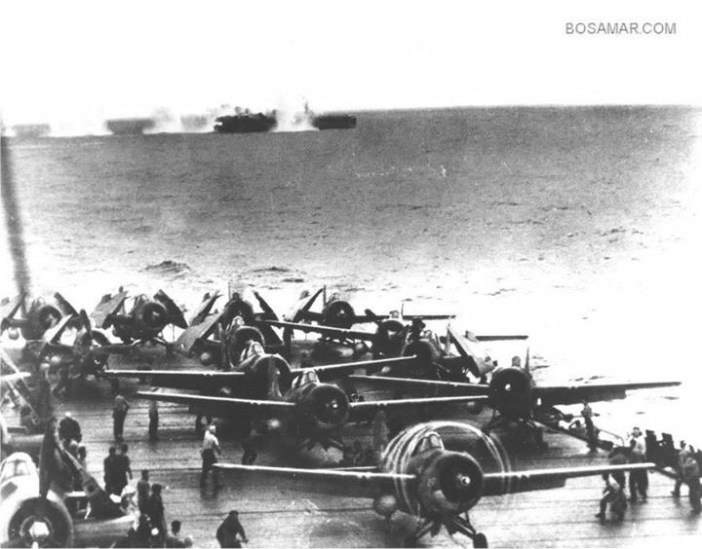
A desperate fight for survival, The Battle off Samar.

The Battle off Samar was only one of several major naval conflicts that constituted the Battles of Leyte Gulf. A few days previous, Gen. Douglas MacArthur had returned to the Philippines and invaded Leyte. His invasion was supported by what is likely the largest assembled fleet in history.

In the days since the invasion began, the Japanese Navy had sent 3 battle groups to intercede. One group of Battleships, cruisers and destroyers were to approach the landing forces in Leyte Gulf through Surigao Strait, another built around the massive IJN Yamato was to approach via San Bernadino Strait, and the last, built around Fleet Carriers with few planes left, was to sail far to the north and make sure they were seen, so that major US forces defending the thin skinned landing ships would leave them unprotected.

The Japanese fleet approaching through Surigao Strait was decimated by American Battleships raised from the mud of Pearl Harbor in the last Battleship vs Battleship engagement in history (US Cruisers and Destroyers were key also).

Admiral Kurita’s force around Yamato was bombed on the 24th and turned back.

Admiral William F. Halsey, known to Americans and Japanese for his aggressive nature (By the time we’re done, the Japanese language will be spoken only in hell) commanded the US 3rd fleet…4 battle groups of 4 fast carriers each, and another of fast battleships.

He took the bait, going after the Japanese carriers that were actually playing no combative part in the battle.

This left only cargo ships, small combatants, and “Jeep Carriers”, or Escort Carriers…basically cargo ships with a flight deck built atop their small, thin hulls. The escort carriers were tasked with close support for troops ashore, and were not equipped for a sea battle.

So far, I’ve just set the stage for the events of the Battle off Samar Island…now for the good part. There were 3 small escort carrier task forces left in Leyte Gulf…Taffy 1, Taffy 2 and Taffy 3. As they began operations on the morning of the 25th, Admiral Clifton “Ziggy” Sprague and the men of Taffy 3 were shocked to find that IJN Admiral Kurita’s task force of fast battleships, cruisers and destroyers, who had turned around in the night, bearing down on them. I recently finished “Last Stand of the Tincan Sailors” by James Hornfischer, and although I knew about this battle, I found out much more, and Oklahoma connections.

The entirety of Taffy 3…6 jeep carriers, 2 Fletcher class destroyers and 3 destroyer escorts…did not match the tonnage of the Yamato alone. And Yamato was joined by several other Battleships, Cruisers and destroyer task forces. The Japanese could manage much more speed than the small American ships, and their guns (18 inch for the Yamato, 14 and 8 inch for the others, out-ranged the American’s 5 inch guns by MILES. As the long range rifles (22 miles avg) began dropping shells around the carriers and destroyers, Admiral Sprague ordered the small destroyers and destroyer escorts to lay smoke and attempt to delay the inevitable. Oklahoman Harold Kite, loading a 5 inch gun on the stern of the carrier USS Fanshaw Bay, watched the tiny escort ships turning to race towards the huge enemy ships, and likened them to the horses that had raced across the plains of central Oklahoma as he was growing up, and marveled at their courage.

The closest escort ship to the Japanese fleet, the USS Johnston, was commanded by another Oklahoman…Commander Ernest E. Evans, known to his Annapolis classmates as “Chief” for his Cherokee heritage. His crew knew what they were in for. Cmdr. Evans had been there for the American defeat during the Guadalcanal campaign, and took his warrior heritage seriously.

When he took command of the Johnston, he told her crew, “This is going to be a fighting ship. I intend to go in harm’s way, and anyone who doesn’t want to go along had better get off right now. Now that I have command of a fighting ship, I will never retreat from an enemy force.”

And he didn’t. Under the fire of longer range, larger guns and other fast destroyers, he raced in close, ordering his gun crews to fire constantly, which they did with amazing effect, and launched his small ship’s torpedoes against the enemy, achieving strikes that disabled cruisers. Fighting to the end, Evans was looking after the survivors of his sinking ship when a Japanese shell destroyed the part of the superstructure he was in, and he went down with his ship.

The other American destroyers and destroyer escorts (even smaller) followed suit, delaying the Japanese ships and confusing them to the point that the Japanese thought they were actually fighting American cruisers and fast carriers…heavies in Navy parlance.

The Jeep carrier’s aircrews were launched in desperation as the battle began…armed with whatever they had…depth charges, anti-personnel bombs, but nothing that was designed to sink ships. The aircrews, flying torpedo bombers, dive bombers and fighter planes, attacked the Japanese ships with desperate ferocity. They dropped the depth charges as best they could beneath enemy ships, dropped their bombs, then came back and made runs against the enemy ships without arms because it would mean the IJN ships had to evade (and slow down) since they didn’t know there were no torpedoes or bombs on the American aircraft. One pilot, out of ammunition, flew alongside a Japanese heavy, opened his canopy, and emptied his .38 revolver into the ship’s bridge to the amazement of her crew.

The flyers then flew to a land base on Leyte and re-armed to attack again. In the end, Admiral Kurita, believing he was attacking a much larger force, ordered his massive force to turn about and retreat.

As for Halsey, who couldn’t leave even his Battleships, or even 4 of his 16 Carriers to defend the Taffy’s and the all but defenseless cargo ships in Leyte Gulf….he received a dispatch from his boss, Admiral Chester W. Nimitz, asking, “Where is Task Force 34? All the world wonders.” The story is that “all the world wonders” was just jibberish added to transmissions to confuse the enemy…but the result was an angry Halsey throwing his cap to the deck and spewing a string of invectives. Of the destroyers, including the Johnston and the Samuel B. Roberts that went down in the battle? Amazingly, many of their crew were lost to sharks before they were rescued in the days hence, the result of faulty reports of their locations. So many brave heroes.