Savannah Falls…

Today in History, December 29, 1778:

It appears Christmas time is not lucky for Savannah, Georgia in war time. On this date in 1778 British forces over powered the Colonials and took the city; they would hold the city, despite a seige by American and French forces, until the end of the Revolutionary War.

86 years later on Dec. 22, 1864, Union forces under William T. Sherman would take Savannah again, presenting it as a “Christmas gift” to President Lincloln during the American Civil War.

The Thirteenth Amendment & The House of Representatives

Today in History, December 18, 1865:

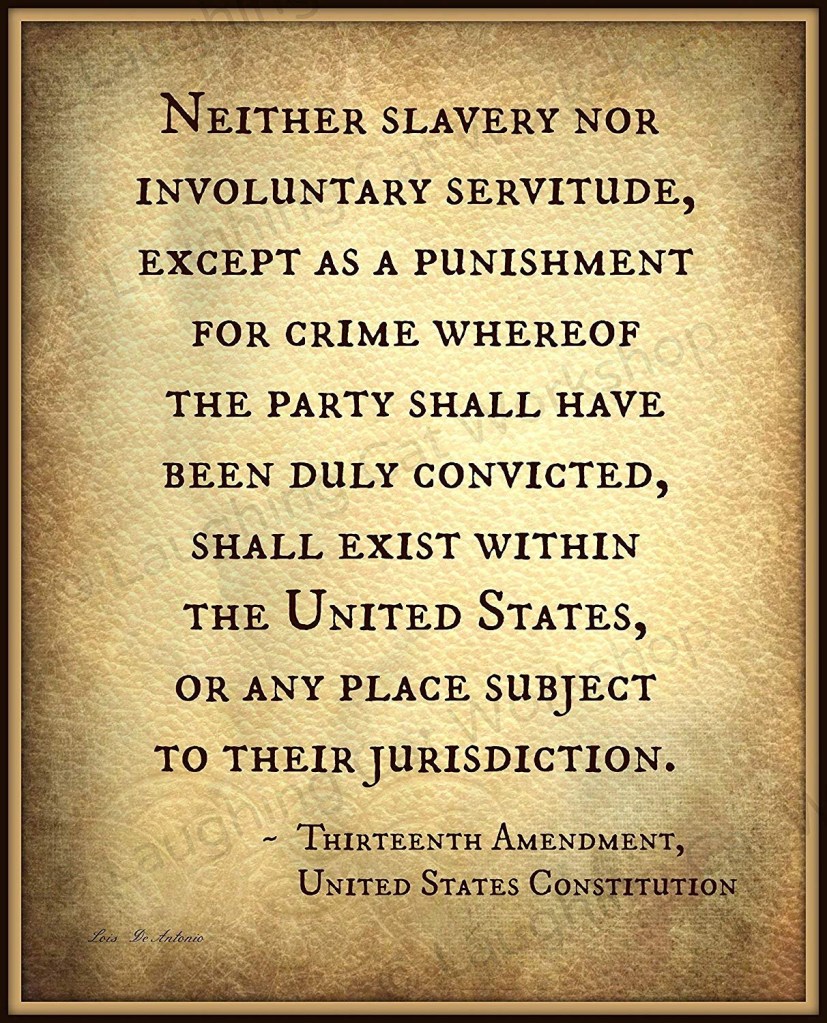
The US House of Representatives passes the 13th Amendment to the Constitution, abolishing slavery in the United States. “Neither slavery nor involuntary servitude…shall exist within the United States, or any place subject to their jurisdiction.” The issue had divided the nation from its inception due to its inherent disagreement with our founding principles….

The Republican Party had been founded by break-away former members of the Whig party, who had formed the new party in the 1850’s because of their abolitionist beliefs. The Civil War had begun because of the election of the first Republican President, Abraham Lincoln; the largely Democrat South believed abolition was eminent due to his election and seceded from the Union rather than give up their slaves. Republican Lincoln did in fact enact the Emancipation Proclamation in 1863, freeing slaves in southern states, an admittedly partial measure. For his efforts a Democrat radical assassinated him in 1865 before he could see the realization of the 13th Amendment. Lincoln had wanted the measure to be bi-partisan in an effort to re-unite the nation. Although he wouldn’t live to see it, he got his wish, to an extent. 7 Democrats abstained from voting rather that be a part of freeing the slaves, but the measure still passed due to a Republican majority and partial Democrat support. Angry southern Democrats would go on to form the KKK, resulting in another century of violence before civil rights measures were finally passed.

Where Have the “Tough as Nails” Presidents Gone?

There have been several courageous or (I dislike the term) “Badass” Presidents in our history.

They are missed.

January 30, 1835:

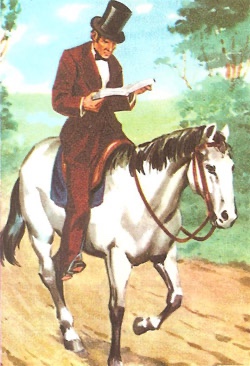
Outside the Capitol building in DC a man with two pistols approached President Andrew Jackson…and fired both pistols. Fortunately both misfired and war-hero Jackson, not knowing if the would-be assassin had other weapons, proceeded to use his heavy cane to beat the laundry off of the bad guy until other arrived to secure him.

August, 1864:

President Lincoln had a habit of relaxing at the “Soldier’s Home” to get away from the madhouse. One night he was riding back to the Executive Mansion, by himself, when someone took a shot at him, putting a hole through his hat.

As Lincoln loped up to a young sentry, the sentry noticed the President was missing his trademark hat. Lincoln explained what happened…and then swore the youth to secrecy. No point working the people (and I’m sure the excitable Mary Lincoln) up and causing a panic.

October 14, 1912:

Theodore Roosevelt is running for a third term in Milwaukee. As he enters his car in front of his hotel, the madman pointed a pistol and shot TR in the chest.

Wounded, TR had the where-with-all to save the Assassin from lynching by the angry supporters who captured him. Then TR inspected his injuries…a thick manuscript and glasses case slowed down the bullet, but it still entered his chest. Being a hunter and combat vet, he took note that he wasn’t coughing up blood. Thus assured he wasn’t shot through the lung, he insisted on finishing a lengthy speech before going to the hospital. “It takes more than that to kill a bull moose!”

February 15, 1933:

The President-elect Franklin Roosevelt is in Miami riding with the Chicago mayor (Cermak) when a man fires numerous shots at them. FDR is not hit. However, though handicapped he emulated his cousin, seeing to the care of the assassin and staying by the side of the dying Cermak.

March 30, 1981:

Ronald Reagan is in DC when an assassin approached and began shooting, striking the elderly enigmatic Chief Executive and others. Seriously wounded, Reagan is rushed to George Washington hospital where he entertains the medical staff with one-liners. “Honey, I forgot to duck!” And “I hope there aren’t any Democrats in the operating room”. The chief surgeon assured him, “Mr. President, today we are ALL Republicans.”

Where have such men gone? I believe they are out there. We just have to advance them.

Lincoln’s Assassin Killed

Today in History, April 26, 1865:

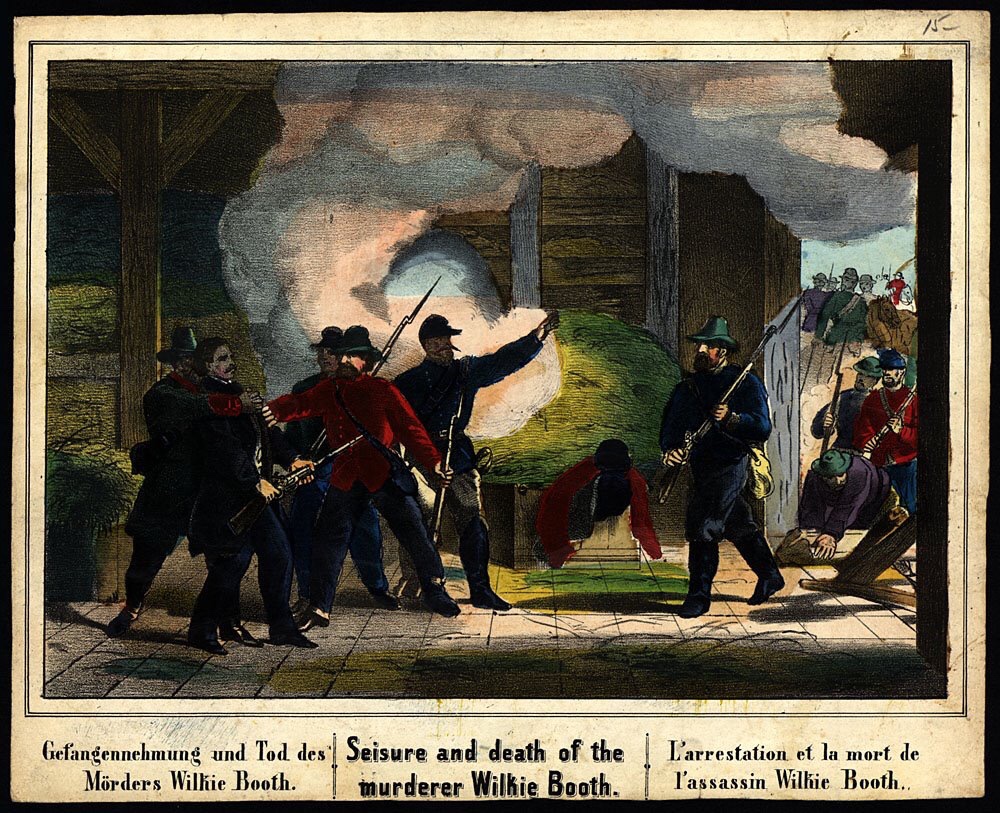
Union Army forces track down John Wilkes Booth 12 days after he assassinated President Lincoln.

In the meantime, he had been hidden by Confederates, treated by Doctor Samuel Mudd (your name is mud) and hidden in a barn on the Garrett farm in Virginia, where he was found. The barn was set afire and his associate surrendered.

Booth refused…a Union soldier, Boston Corbett, saw Booth inside the barn and fired his Colt revolver…causing a mortal wound to Booth.

Many Confederates saw Booth as a hero. However many Southerners wept openly at Lincoln’s death, and Confederate Generals, including Lee and Johnston, denounced Booth’s actions.

Fortunately, in the interim between his deed and his death, Booth was able to see news accounts that recorded his benefactor’s denunciation of his act. So when he died, he knew what he was.

Irredeemable Loss & Grief…Assassination of President Lincoln

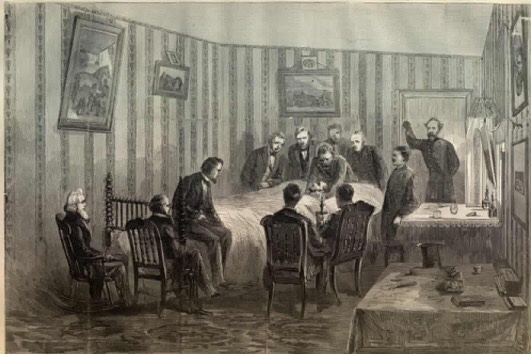
Today in History, April 14, 1865:

Within a week of the surrender at Appomattox, a coward assassinated President Abraham Lincoln.

If you were old enough on 9/11, you experienced the indescribable loss, grief, and helplessness we all experienced.

I use this in an attempt to fathom the emotions Americans must have felt at the loss of Lincoln. He had led them through the most traumatic time in our nation’s history…the times ahead were still uncertain. How would the North and South reunite? Was the war really over? They needed his steady hand on the rudder stearing the ship of state more than ever.

And suddenly Abraham was gone.

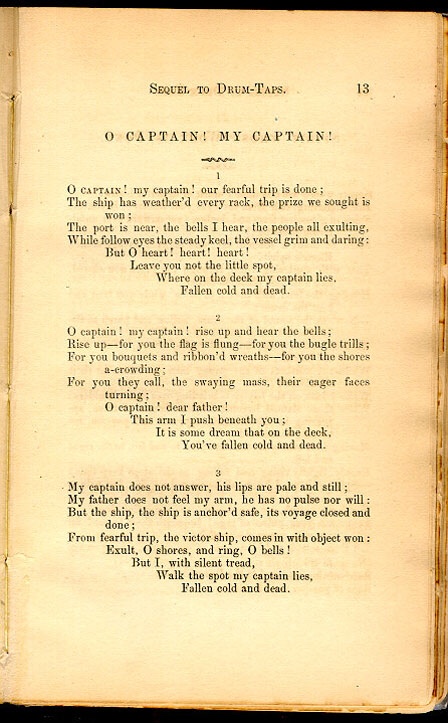
I post “O Captain! My Captain!” By Walt Whitman almost every year on this date, because I believe he came closest to capturing the grief the nation must have felt.

O Captain! My Captain!

O Captain! my Captain! our fearful trip is done,
The ship has weather’d every rack, the prize we sought is won,
The port is near, the bells I hear, the people all exulting,
While follow eyes the steady keel, the vessel grim and daring;
                         But O heart! heart! heart!
                            O the bleeding drops of red,
                               Where on the deck my Captain lies,
                                  Fallen cold and dead.
O Captain! my Captain! rise up and hear the bells;
Rise up—for you the flag is flung—for you the bugle trills,
For you bouquets and ribbon’d wreaths—for you the shores a-crowding,
For you they call, the swaying mass, their eager faces turning;
                         Here Captain! dear father!
                            This arm beneath your head!
                               It is some dream that on the deck,
                                 You’ve fallen cold and dead.
My Captain does not answer, his lips are pale and still,
My father does not feel my arm, he has no pulse nor will,
The ship is anchor’d safe and sound, its voyage closed and done,
From fearful trip the victor ship comes in with object won;
                         Exult O shores, and ring O bells!
                            But I with mournful tread,
                               Walk the deck my Captain lies,
                                  Fallen cold and dead.

“So. You’re the little woman who wrote the book that made this big war?” – A. Lincoln

Today in History, March 20, 1852:

“So…you’re the little woman who wrote the book that made this great war!”

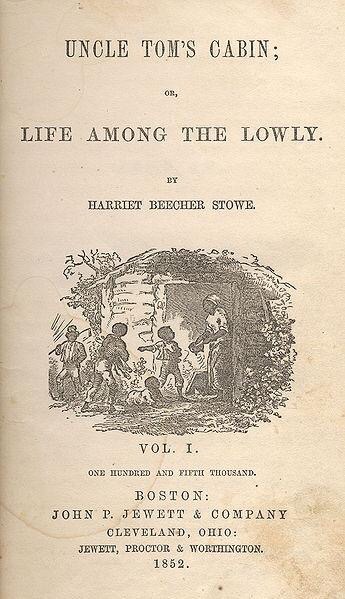
President Abraham Lincoln greets Harriett Beecher Stowe at the Presidential Mansion in 1862, ten years after her novel “Uncle Tom’s Cabin” was first published.

I am amazed at the foresight and courage displayed by this woman, a school teacher turned author.

By her own admission, in the epilogue of the book, for the first part of her life, she knew of slavery, disapproved of it, but being a Northerner, it was distant and she felt that the problem would be resolved eventually on it’s own.

How many of today’s injustices do we see the same way? Between meeting some runaway slaves, becoming familiar with the Underground Railroad, and stories from her family and friends, and finally the Compromise of 1850 (in which the government promised to return runaway slaves in exchange for new limitations on slavery expansion), she became an avid abolitionist.

She wrote Uncle Tom’s Cabin to illustrate the aspects of slavery that most did not understand at that time.

As slaves, a mother’s children were often sold off, never to be seen again.

Women were sold into prostitution, to be used until their value had diminished.

If a good and kindly “master” came on hard times, he might sell a good man “down the river” to cruel and harsh masters, as “Uncle Tom” was.

With her novel, Mrs. Stowe humanized the slavery issue, brought it home to people and chastised them for not living up to their Christian values.

The novel would become the best selling novel of the 19th century and would inspire abolitionist views amongst Americans. It was certainly far from the only cause of the Civil War…but the novel played it’s part in American History.

One has to wonder if this “little woman” had any idea of the importance her words would have. If you haven’t read (or listened to) this novel, you should.ance her words would have. If you haven’t read (or listened to) this novel, you should.

Connections The Nation Grows Honest Men Secure Their Future For Us An Amazing Day

Today in History, March 10:

I was researching for today and found amazing connections – I love connections in History! This will be a long post, but in summary:

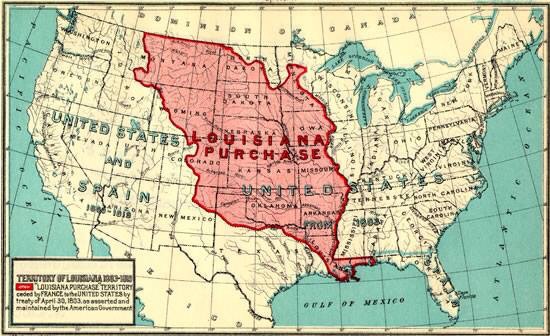
In 1804 a ceremony was held in St. Louis commemorating the Louisiana Purchase, which doubled the size of our young nation overnight.

In 1848 the US Senate ratifies the Treaty of Guadalupe Hidalgo, officially ending the Mexican-American War and again doubling the size of our nation.

Many believed the Mexican-American War was an unjust, fabricated conflict, much as many of us argue today about the Iraq War and its costs (not saying what my beliefs are…but I always stand with my beloved country).

Two of the men who felt the Mexican-American War was unjust spoke out vocally about their beliefs. One was a Congressman who disagreed with men he respected on the issue. The other who spoke out was a young Army officer who, in spite of his beliefs, fought courageously during the war.

In 1864 the Congressman, now President, signed documents promoting the young officer to Lt. General of the US Army (a rank only George Washington had previously held as permanent) so no other officer would be his equal. Abraham Lincoln and Ulysses S. Grant believed wholeheartedly in their cause during the Civil War.

Today in History, March 10, 1804:

In St. Louis (not yet Missouri), an official ceremony is conducted, transferring possession of the “Louisiana Purchase” from Spain to the United States, virtually doubling the size of the American landscape overnight.

Today in History, March 10, 1848:

Treaty of Peace, Friendship, Limits and Settlement between the United States of America and the Mexican Republic, or the Treaty of Guadalupe Hidalgo ending the Mexican-American War is ratified by the US Senate after several amendments were made by that Congressional body.

The treaty had been negotiated in Mexico, documenting monies to be paid by the United States to Mexico and territories including modern day California, New Mexico, Arizona, and parts of Nevada, Colorado, Wyoming and Utah to be ceded to the US.

Senators to include Thomas Hart Benton, Jefferson Davis, Sam Houston, Stephen A. Douglas, and John C. Calhoun fought over the final draft.

Today in History, March 10, 1864:

President Lincoln signs documents promoting Ulysses S. Grant to the rank of Lieutenant General.

Grant was only the second person to hold the rank, the first having been George Washington. Winfield Scott had held the rank in the interim, but only as a “brevet” or temporary rank.

Lincoln wanted his commanding general to have a rank above his other generals for leadership purposes. Grant would answer only to the President. I didn’t find anything to document it, but have to wonder if this was partially because Grant had been promoted over several more senior officers to command the army due to his runaway successes in the west.

Cooper Union – The Speech that Propelled Lincoln to the Presidency and Proves He Was an Abolitionist

Today in History, February 27, 1860:

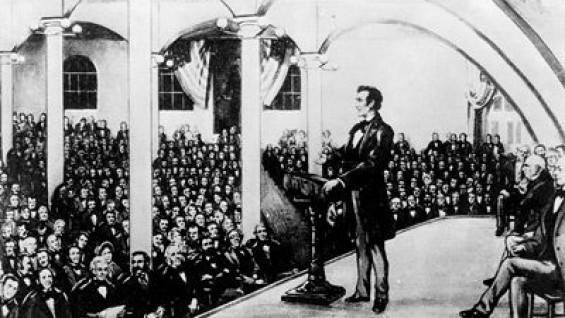
“One of the most happiest and most convincing political arguments ever made in this City … No man ever made such an impression on his first appeal to a New-York audience.” — Horace Greeley in his paper regarding “The Cooper Union Speech” by Abraham Lincoln.

A former Congressman and Illinois lawyer, Lincoln had been launched to the national stage by his debates with Stephen Douglas over the slavery question 2 years before, but he was still mostly unknown in the east.

A young Republicans group in New York invited him to speech at Cooper Union’s Great Hall. The hall was not filled for the speech, but the text of it was given to Greeley’s and other’s papers; from there it was broadly published across the nation in pamphlet form.

Lincoln made convincing arguments that the Founding Fathers were against the expansion of slavery and desired it’s eventual end. At the same time he tried to convince Southerners that the Republican party did not wish to interfere in their affairs.

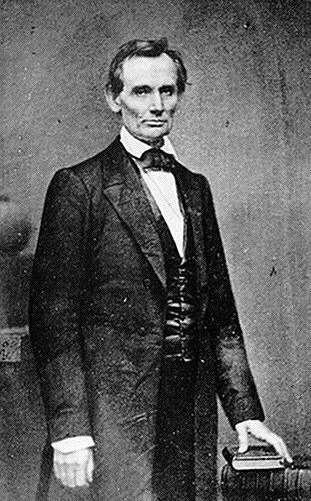
While in New York he had his photo taken by Matthew Brady, and the photo was used along with the pamphlet to broaden his recognition. It is widely believed that the speech is what launched him into the Presidency.

He closed with a message to his colleagues:

“Neither let us be slandered from our duty by false accusations against us, nor frightened from it by menaces of destruction to the Government nor of dungeons to ourselves. Let us have faith that right makes might, and in that faith, let us, to the end, dare to do our duty as we understand it.”

https://youtu.be/aQ2De8VcSLw

The Emancipation Proclamation

Today in History, January 1, 1863:

President Abraham Lincoln signs the final version of the Emancipation Proclamation, declaring an end to slavery in the rebelling states.

The road to the end of slavery had been long and hard, and it wasn’t over yet. But this was the most definitive statement ever made in America about the evil and the demise it must suffer.

The founding fathers had known slavery was wrong; but they didn’t believe they could end it and still create the nation that would be America…the southern states depended on slavery for their economy. So they “kicked the can down the road”.

The nation continued to deal with the inequity of it’s principles and its sins through each administration. Andrew Jackson dealt with it during the Nullification Crisis; but again, half measures to keep the peace.

The Missouri Compromise, the Compromise of 1850, the Kansas-Nebraska Act…our early history was juggling Abolition against the slave driven economy of the South on a continuous basis by some of the most talented people of the time.

The Republican party was born of abolitionist beliefs, but still, only half measures.

Even the Proclamation was a half measure. It only declared slavery ended in states in which it could not be enforced….Confederate states. But it made the war about the end of slavery, not only about the perpetuation of the Union. The dye was cast for freedom.

By the President of the United States of America:

A Proclamation.

Whereas, on the twenty-second day of September, in the year of our Lord one thousand eight hundred and sixty-two, a proclamation was issued by the President of the United States, containing, among other things, the following, to wit:

“That on the first day of January, in the year of our Lord one thousand eight hundred and sixty-three, all persons held as slaves within any State or designated part of a State, the people whereof shall then be in rebellion against the United States, shall be then, thenceforward, and forever free; and the Executive Government of the United States, including the military and naval authority thereof, will recognize and maintain the freedom of such persons, and will do no act or acts to repress such persons, or any of them, in any efforts they may make for their actual freedom.

“That the Executive will, on the first day of January aforesaid, by proclamation, designate the States and parts of States, if any, in which the people thereof, respectively, shall then be in rebellion against the United States; and the fact that any State, or the people thereof, shall on that day be, in good faith, represented in the Congress of the United States by members chosen thereto at elections wherein a majority of the qualified voters of such State shall have participated, shall, in the absence of strong countervailing testimony, be deemed conclusive evidence that such State, and the people thereof, are not then in rebellion against the United States.”

Now, therefore I, Abraham Lincoln, President of the United States, by virtue of the power in me vested as Commander-in-Chief, of the Army and Navy of the United States in time of actual armed rebellion against the authority and government of the United States, and as a fit and necessary war measure for suppressing said rebellion, do, on this first day of January, in the year of our Lord one thousand eight hundred and sixty-three, and in accordance with my purpose so to do publicly proclaimed for the full period of one hundred days, from the day first above mentioned, order and designate as the States and parts of States wherein the people thereof respectively, are this day in rebellion against the United States, the following, to wit: 

Arkansas, Texas, Louisiana, (except the Parishes of St. Bernard, Plaquemines, Jefferson, St. John, St. Charles, St. James Ascension, Assumption, Terrebonne, Lafourche, St. Mary, St. Martin, and Orleans, including the City of New Orleans) Mississippi, Alabama, Florida, Georgia, South Carolina, North Carolina, and Virginia, (except the forty-eight counties designated as West Virginia, and also the counties of Berkley, Accomac, Northampton, Elizabeth City, York, Princess Ann, and Norfolk, including the cities of Norfolk and Portsmouth[)], and which excepted parts, are for the present, left precisely as if this proclamation were not issued.

And by virtue of the power, and for the purpose aforesaid, I do order and declare that all persons held as slaves within said designated States, and parts of States, are, and henceforward shall be free; and that the Executive government of the United States, including the military and naval authorities thereof, will recognize and maintain the freedom of said persons.

And I hereby enjoin upon the people so declared to be free to abstain from all violence, unless in necessary self-defence; and I recommend to them that, in all cases when allowed, they labor faithfully for reasonable wages.

And I further declare and make known, that such persons of suitable condition, will be received into the armed service of the United States to garrison forts, positions, stations, and other places, and to man vessels of all sorts in said service.

And upon this act, sincerely believed to be an act of justice, warranted by the Constitution, upon military necessity, I invoke the considerate judgment of mankind, and the gracious favor of Almighty God.

In witness whereof, I have hereunto set my hand and caused the seal of the United States to be affixed.

Done at the City of Washington, this first day of January, in the year of our Lord one thousand eight hundred and sixty three, and of the Independence of the United States of America the eighty-seventh.

By the President: ABRAHAM LINCOLN 
WILLIAM H. SEWARD, Secretary of State.

When to Hold Your Move – Kentucky in the Civil War

Today in History, December 10, 1861:

Kentucky is accepted into the Confederacy by the Confederate government. However the act didn’t mean much.

When the war had begun, both sides very much wanted Kentucky, a well-positioned border state, contiguous with the Mississippi River, on their side.

However, it’s citizens were pretty evenly split in their allegiances between the North and the South, so they declared themselves neutral in the conflict.

President Lincoln very much wanted the state and it’s resources, but what he wanted even more was not to push them to the South, so he accepted their neutrality.

In September of 1861 the Confederacy, in the form of Gen. Leonidas K. Polk, violated that neutrality by ordering the occupation of Columbus and setting up a fort there.

Union Gen. U. S. Grant responded by occupying Paducah; Union assets had to be defended, and a strategic Confederate presence could not go unopposed.

The Kentucky assembly responded by issuing a proclamation ordering the Confederates out and the US flag to be flown over the capitol. Polk had chosen a side for them.

Soon a shadow government of Confederate sympathizers was formed, elected a governor, and applied for entry into the Confederacy, which was granted.

While Kentucky did have regiments on both sides of the conflict, the Confederate government of the state was impotent, soon having to leave the state, finishing the war by trailing the Army of the Tennessee around the South. Their elected governor was killed at Shiloh.