The Burning of Atlanta…and Why “Sherman” Became an Epithet in the South

Today in History, November 12, 1864:

The burning of Atlanta.

Union Gen. William Tecumseh Sherman and his army had taken Atlanta in September, and subsequently ordered the citizenry to evacuate the city. That order set off a firestorm of complaints and criticism from Confederate military and civilian leaders. Sherman stuck to his guns…the South could expend the resources to care for and secure their populace. Sherman’s supply lines stretched from Nashville, TN and were constantly threatened by Confederate army raids, so he knew he could not hold Atlanta for long.

But then, he didn’t want to. He stayed in Atlanta long enough to rest and build up supplies. On today’s date in 1864 he ordered the industrial district and anything that might prove useful to the enemy burned. The fires spread and eventually as much as 40% of the city went up in flames.

Sherman sent Gen. Thomas back towards Nashville to tie up the Confederate Army of the Tennessee led by Gen. John Bell Hood.

He then took his army east across Georgia, laying waste to the countryside in the same fashion that he had destroyed the city of Atlanta. This horrified the South, and Sherman’s acts are still points of contention. However if you read Sherman’s thoughts on his decisions, he was merely trying to end the war more quickly by reverting back to ancient principles of war. From times when armies fed themselves and armed themselves by living off of the land they were currently in. Sherman and his army took what they needed and destroyed what was left in order to deny the enemy its use. This was also intended to bring the war to the doorstep of the Southern citizens in the hope that they would press for the termination of hostilities.

By Christmas he would be able to send a telegram to President Lincoln: “I beg to present you as a Christmas gift the City of Savannah, with one hundred and fifty guns and plenty of ammunition, also about twenty-five thousand bales of cotton.”

An Unfairly Ignominious End to a Brilliant Career


Today in History, October 31, 1861:

76-year-old Gen. Winfield Scott steps down as commander of the Union armies due to his age and poor health; 300+ pounds and suffering from gout, Scott could no longer mount a horse without assistance, much less be effective in the field.  He was all but run out of the US Army he loved by a much younger, ambitious officer, Gen. George McClellan.  McClellan was also a brilliant officer, but did not have Scott’s leadership qualities.

However Scott had been a hero; a soldier since 1808, he fought in the War of 1812, wrote many of the rules and regulations for the fledgling American Army, and used brilliant tactics in the Mexican War.  Much of what the US Army has become, is because of Winfield Scott, who in his youth struck an imposing figure.

Most interesting to me is that although he retired in bad shape, Scott had trained and led most of the senior commanders on both sides of the Civil War throughout the years and during the Mexican War. Grant, Lee and many others honed their skills under his tutelage.

When the war began, General Scott had a plan which he called “The Anaconda Plan”, designed to encircle the Confederacy and exert pressure from all sides at once.  McClellan rejected this idea, and fought a losing piecemeal war for years.  Ironically, the war was won in the end when President Lincoln and Gen. Grant used tactics putting pressure on all sides of the South at once.  General Scott had been correct all along.

Mount Rushmore

Today in History, August 10, 1927:

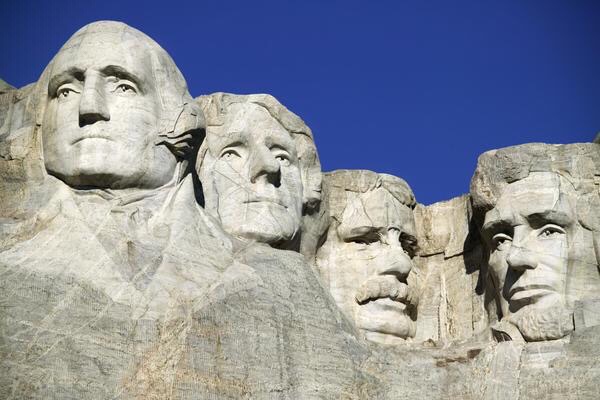
The Memorial at Mt. Rushmore is dedicated by President Calvin Coolidge. The memorial wouldn’t be declared complete until October 31, 1941, seven months after the man in charge of it’s carving, Gutzon Borglum, had died. His son Lincoln finished the project.

President Washington was chosen for obvious reasons, having led the battles that created our nation;

President Jefferson was chosen due to his instrumental work in creating our Declaration of Independence, which has inspired Democracy around the world;

President Lincoln was chosen for leading the nation through the Civil War, preserving the Union and abolishing slavery;

Theodore Roosevelt was chosen for leading the nation through the industrial revolution of the late 19th century, seeing to the construction of the Panama Canal.

An interesting aside…Mt. Rushmore is named for a young NYC attorney who visited the area in 1884 to check land ownership for some eastern investors. He was impressed with the mountain and asked prospectors what it was called…they replied that it had no name, but since he had asked, they would call it Rushmore Peak…and so it was.

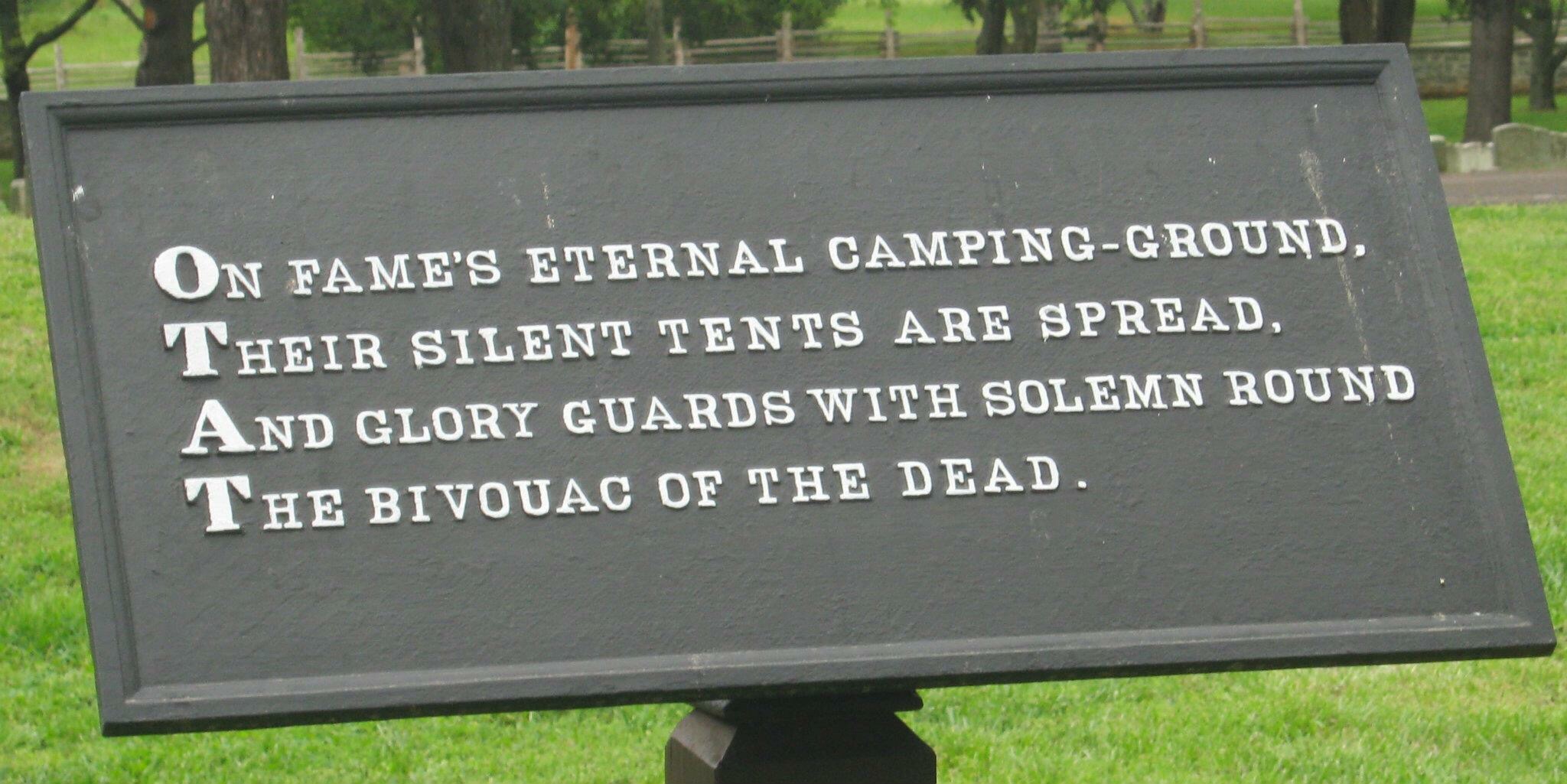
The Bivouac of the Dead

Today in History, July 17, 1862:

President Lincoln signs a Congressional act authorizing National Cemeteries across the nation.

The huge numbers of dead from the Civil War battles were buried pretty much where they fell. After the national cemeteries were established, they were moved to more honorable resting places…it took five years to accomplish.

Many of the national cemeteries are in the Southeastern US, where so many of the Civil War battles were fought, like this one at Stones River, Tennessee. God bless the men and women that have made our freedom possible. It is up to us to ensure they did not give up their lives in vain.

The Patended President

Today in History, May 22, 1849:

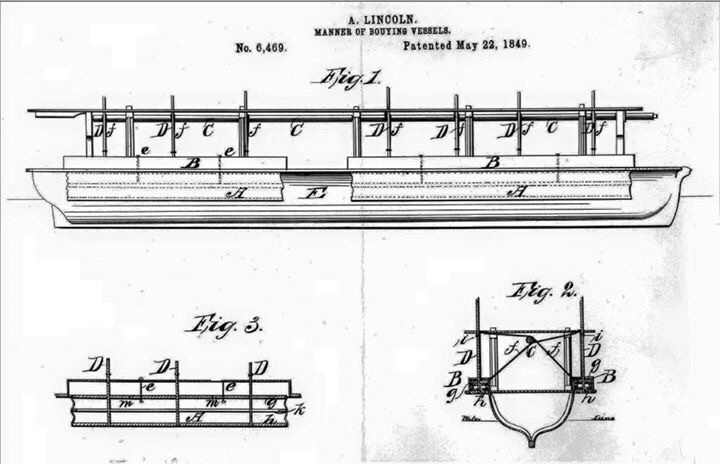
“Be it known that I, Abraham Lincoln, of Springfield, in the county of Sangamon, in the state of Illinois, have invented a new and improved manner of combining adjustable buoyant air chambers with a steam boat or other vessel for the purpose of enabling their draught of water to be readily lessened to enable them to pass over bars, or through shallow water, without discharging their cargoes;”

Young Abraham Lincoln receives patent #6469 for an invention to lift river boats over shoals and other obtructions.

Among many other jobs he’d held, he had hauled freight on flat boats on the Mississippi. Twice his boat was hung up. As was common, once the boat had to be unloaded, repaired and portaged over the obstruction…a very laborous job.

Lincoln’s invention would inflate bladders to create more boyancy, lifting the craft over the problem. His invention was never put into use, so it’s viability remains unproven. It does make Abe the only US President with a patent.

Going West…The Homestead Act

Today in History, May 20, 1862:

President Lincoln signs the Homestead Act, which would give 160 acres of western lands to anyone that would farm it successfully for 5 years and build a residence upon it (often a sod building).

The Act would encourage vastly expanded settlement of the west; bad news for Native Americans, good news for those newer Americans wanting to improve their lot in life.

Congress had attempted to pass similar acts in 1852, 1854, and 1859, but each time the attempts were shot down by Southern Democrats who were afraid that if the west were populated it would result in more “free” states, which would result in more votes against slavery.

Once the Republican Lincoln was elected, and the Civil War began, the Southern Democrats were no longer part of the equation in Congress. The Republicans soon passed the Homestead Act and the settlement of the west began in earnest. By the end of the war 15,000 settlers (some of which were merely pawns for land speculators) had accepted their lands. Eventually 80 Million acres would be settled.

Assassin’s Demise

Today in History, April 26, 1865:

Union Army forces track down John Wilkes Booth 12 days after he assassinated President Lincoln. In the meantime, he had been hidden by Confederates, treated by Doctor Samuel Mudd (your name is mud) and hidden in a barn on the Garrett farm in Virginia, where he was found.

The barn was set afire and his associate surrendered. Booth refused…a Union soldier, Boston Corbett, saw Booth inside the barn and fired his Colt revolver…causing a mortal wound to Booth.

Many Confederates saw Booth as a hero. However many Southerners wept openly at Lincoln’s death, and Confederate Generals, including Lee and Johnston, denounced Booth’s actions.

Fortunately, in the interim between his deed and his death, Booth was able to see news accounts that recorded his hero’s denunciation of his act. So when he died, he knew what he was.

Appomattox

Today in History, April 9, 1865:

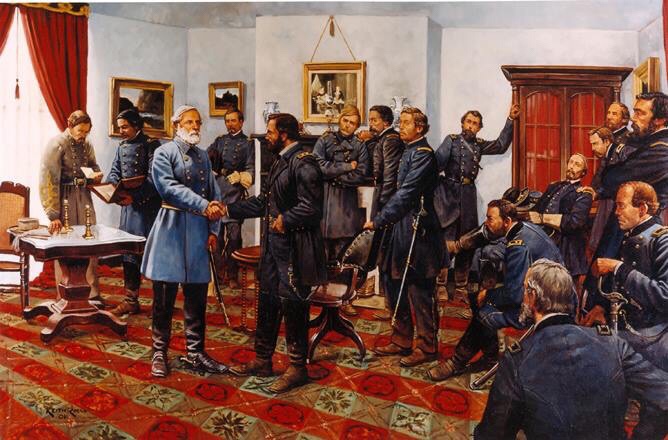
After years of foiling every move the Union made, Confederate Gen. Robert E. Lee had finally been run to ground. Several Yankee Generals had been bested by him, but he had finally met his match…not tactically, but in determination, by Lt. Gen. Ulysses S. Grant.

At Appomattox Courthouse, Virginia, Lee, his army starving and with nowhere else to run, in spite of the fact that he would “rather die a thousand deaths”, agreed to surrender the Army of Northern Virginia to Grant.

Lee arrived in his best uniform; Grant, typically, arrived in a muddy private’s uniform. Grant offered terms that included Confederate officers keeping their horses and sidearms, enlisted men keeping their horses so that they could farm their land, as long as they agreed to abide by their paroles and obey the laws of the land. Lee was very appreciative of these terms, saying they would be helpful to his army, men he loved.

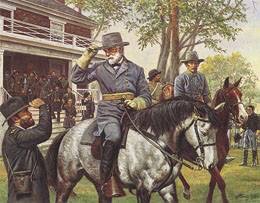
As Lee mounted his horse and left the site of the surrender, Union soldiers began to cheer. Grant quickly silenced them, reminding them that the Confederates were once again their countrymen.

The surrender document was signed in the home of Wilmer McLean. Ironically, in the first battle of the war, First Bull Run, or First Manassas if you are from the South, Confederate Gen. P.G.T. Beauregard’s headquarters were in McLean’s home in Manassas, where cannon shot destroyed part of the house. McLean moved south to Appomattox Courthouse to keep his family safe. So, as is said, the Civil War began in Wilmer McLean’s front yard, and ended in his parlor.

McLean’s home was almost completely stripped of furniture by Union officers seeking momentos of the occasion.

Lee was given the opportunity by Grant to allow one of his subordinates to accept the surrender…to avoid humiliation. Lee refused…his FATHER, Light Horse Harry Lee, had been with Washington at Yorktown and witnessed the ungentlemanly act of British Gen. Lord Cornwallis sending a subordinate to surrender his sword to Washington. Lee refused to dishonor his family name by repeating the act. Grant did not require Lee to surrender his sword, but Lee was the man that represented his army at Appomattox Courthouse. Both gentlemen, North and South, maintained their honor.
Shiloh

Today in History, April 7, 1862:

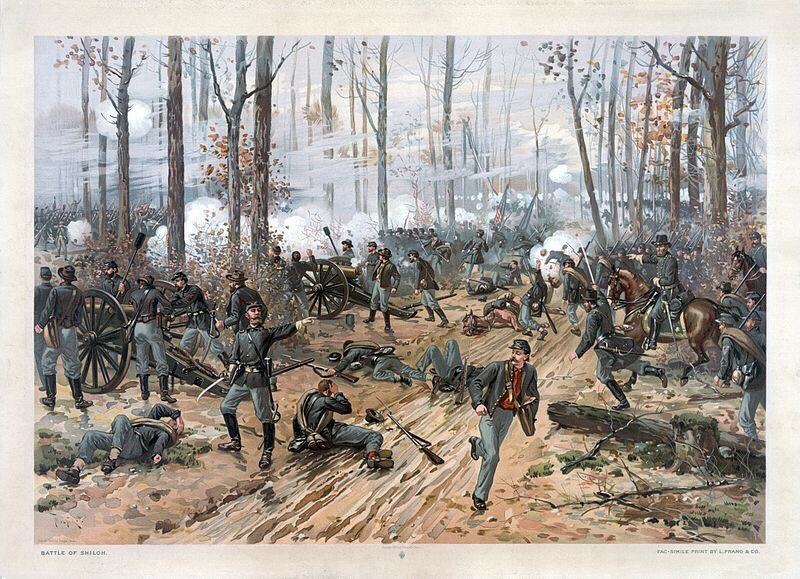
The Battle of Shiloh comes to and end with a Union “Victory”. Union Gen. US Grant had moved his army into Tennessee and was preparing his next campaign.

But Confederate Gen. Albert Sidney Johnston, considered second only to Robert E. Lee by both armies, had different ideas. His troops, in addition to those of CSA Gen. Pierre G. T. Beauregard almost literally caught the Northern Army sleeping….attacking in the morning and routing the Yankees.

The Confederates, always hungry due to their lack of supplies, actually stopped to eat the breakfasts the Union soldiers left in flight. The battle was vicious all through the day. But by the morning of the 7th, Grant had been reinforced by Gen. Buell’s Corps, and Grant quickly turned the rebels back. Shiloh was not so much a victory as a recovery for the North.

But the North nearly lost it’s best commander in the aftermath, as the press excoriated Grant as a drunk who was asleep at the wheel. President Lincoln answered the charges by saying that he could not spare Grant, “he fights” and offering to buy his other generals the brand of whiskey Grant used. In truth Grant had taken to drink when missing his family during his pre-war assignment in California, but was always focused during the Civil War Campaigns.

During the battle, Albert Sydney Johnston was mortally wounded. He died looking in fascination at the sky above.