Iron Bottom Sound Receives Its First Occupants

Today in History, August 9: 1942 – Two days after the US Marines had made an amphibious landing on Guadalcanal seized what would become Henderson Field, the transports that brought them still stood off the coast, protected by 8 American and Australian Cruisers and 14 destroyers. In the early morning hours a force of Japanese Heavy and Light Cruisers moved silently into the waters between Guadalcanal and Savo Island and opened fire on the American and Australian warships, which they caught, quite literally, napping. The British commander of the Allied force, Admiral Crutchley had taken his flagship to a conference with the amphibious force commander, Admiral Richmond Kelly Turner and Marine Gen. Alexander Vandergrift, leaving a subordinate in command. The Japanese Navy had been practicing and perfecting night time combat tactics for years, a fact the USN was not aware of, so they weren’t really expecting an assault. The Japanese also had very effective torpedoes. Several of the Allied ships managed to get off some shots that caused minor damage to the IJN cruisers, but the experienced, practiced Japanese crews poured withering torpedo and gunfire into the American and Australian ships, whose crews were exhausted from 2 days of shelling the enemy ashore in humid high temperatures.

Within an hour the USS Astoria, USS Quincy and USS Vincennes were on their way to the sea floor, making the first of many deposits that would give this passage the name “Iron Bottom Sound” because of all of the Allied and Japanese ships that now rest there with their crews. The next day, Admiral Turner would order the HMAS Canberra scuttled due to her damage. The US aircraft carriers that had been providing air cover for the landings had been ordered out of the area by their commander, Adm. Frank “Black Jack” Fletcher. The transports and their covering surface ships could not remain with range of Japanese aircraft without air cover of their own, so they too left the area, leaving the Marines to their own devices for quite some time. Numerous battles would be fought in the waters of Guadalcanal, Savo and Tulagi Islands, and in “The Slot” leading from Guadalcanal to the enemy bases in the Solomons.
Consequences of Propaganda

Today in History, July 9, 1944:

Victory at the Battle of Saipan. The US Marines defeat the Japanese military on Saipan, the first island with Japanese civilians to be taken by the US.

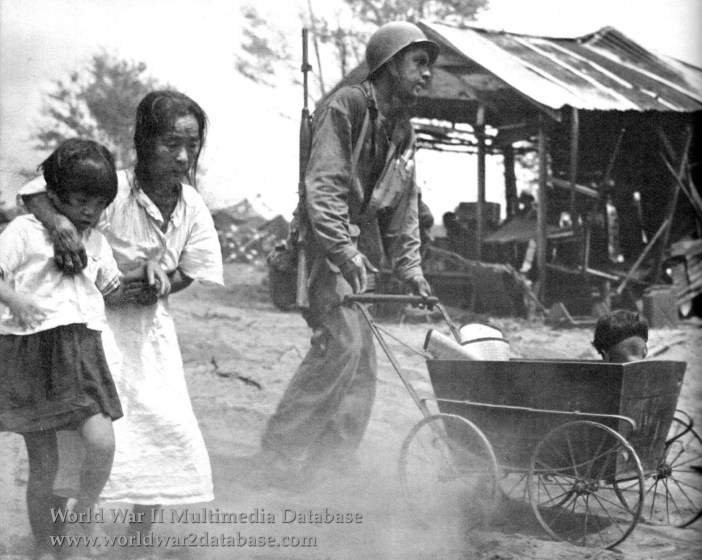
It was a difficult battle, made all the more so by the existence of a civilian population. The Marines set up well lit camps for the civilians to be safe from battle.

Fearing that his citizens would find out that the Americans were not the vicious, heartless enemy projected by propaganda, the Emperor issued a communique to the civilian population of Saipan, telling them that if they committed suicide they would receive the same treatment in the afterlife as Japanese soldiers that died in battle.

American servicemen were horrified as Japanese civilians threw their children from cliffs, then followed them to the rocks below. The newly won island would be used as an air base for B-29 Superfortress bombers that would bomb the Japanese mainland.

The Great Marianas Turkey Shoot

Today in History, June 19, 1944:

Reversal of Fortunes, exhibited by “The Great Marianas Turkey Shoot”, or the First Battle of the Philippine Sea.

US Marines, supported by their parent service, the US Navy, are invading Saipan and other islands in the Marianas Islands, which is such a threat to Japan that the Imperial Japanese Navy finally comes out to fight a definitive battle.

When the war began the Japanese had the most advanced aircraft available, while the US Navy lagged sorely behind. The Japanese Zero, for example, was much faster and more maneuverable than the American Wildcat fighter. But by 1944 the American industrial complex had engaged fully. As late as 1943 the USS Enterprise stood alone in the Pacific against numerous IJN Carriers.

But by June of 1944 the Americans put to sea 15 Aircraft Carriers in 4 Task Groups equipped with modern aircraft that far out matched Japan’s aircraft, which had not been updated since the war began. In addition, Japan’s air service had lost nearly all of it’s experienced pilots, while the Americans had thousands of combat hardened, well-trained pilots and crews.

When the IJN sent it’s carriers and their crews against TF 58, they were massacred. In two days the Japanese lost over 400 aircraft and their crews, 3 aircraft carriers they could not spare, and the Americans lost 29 aircraft (some of the crews were rescued) and no ships. So many Japanese aircraft fell from the skies that a Lexington pilot referred to it as an old time turkey shoot, and the name stuck.

The air crews of the task force had been launched late in the day on the 20th to attack the Japanese fleet. When they returned, it was well after dark and they began landing their planes in the sea, unable to see the carriers well enough for landings aboard.

With the threat from enemy submarines and aircraft during the war, blackout conditions were the rule. Admiral Marc Mitscher wasn’t going to lose his boys and their planes, however. With his order the fleet lit up, and the planes began landing on fumes.

Send in the Marines!

Today in History, May 4, 1946:

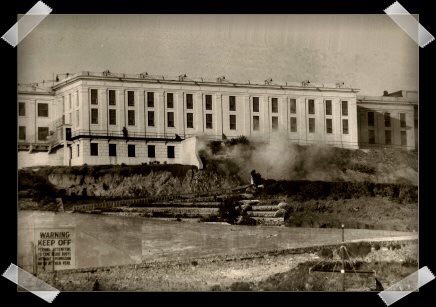
Call in the Marines! The Battle of Alcatraz. On May 2nd, three inmates on D Block of Alcatraz prison managed to overtake the block of cells. One of them managed to expand and crawl between bars leading to the catwalk above the cells and overpower the guard there. Soon they had imprisoned the guards in two cells and taken their weapons. Now they only needed to find the key to the “yard” and they could steal the island’s launch to escape. However by the time they found the key, they had tampered with the lock so much that a security feature kicked in and they were sealed inside. Over the next couple of days they fired on guards outside and on the guards they had imprisoned inside, killing 3 and injuring 14. The Warden called for help from Marines stationed at the nearby Treasure Island Naval Base, many of whom were fresh from fighting Japanese hidden in caves in the Pacific. The Marines assaulted D Block with machine gun fire, grenades and mortars. When the guards went to secure the building, they found the three ringleaders dead in a utility corridor to which they had retreated. Two more inmates would later be executed for their role in the attempted escape.

“Show Me a Hero…”

Today in History, January 3, 1944:

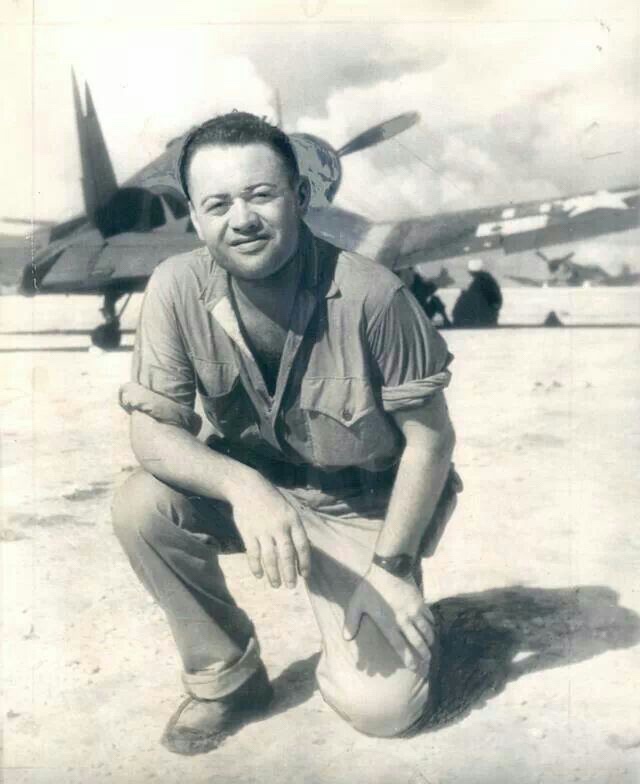
Moments after he became the top fighter ace in the Pacific Theater by shooting down his 26th enemy plane, USMC Major Gregory “Pappy” Boyington was himself shot down over the Japanese base of Rabaul.

He would be captured by the Japanese and held prisoner, brutally treated until rescued from a Japanese prisoner of war camp.

Boyington had been one of the American servicemen to resign their commissions to serve in the AVG, the American Volunteer Group, or “Flying Tigers” in China prior to America’s entry into the war. After Pearl Harbor he rejoined the Marines and fought in the Pacific. Boyington was a Medal of Honor recipient. A warrior. And a drunk. In his good will tours after the war, he stated bluntly, “Show me a hero, and I’ll show you a bum.”

Battle Order #1

Today in History, November 28: 1941 –

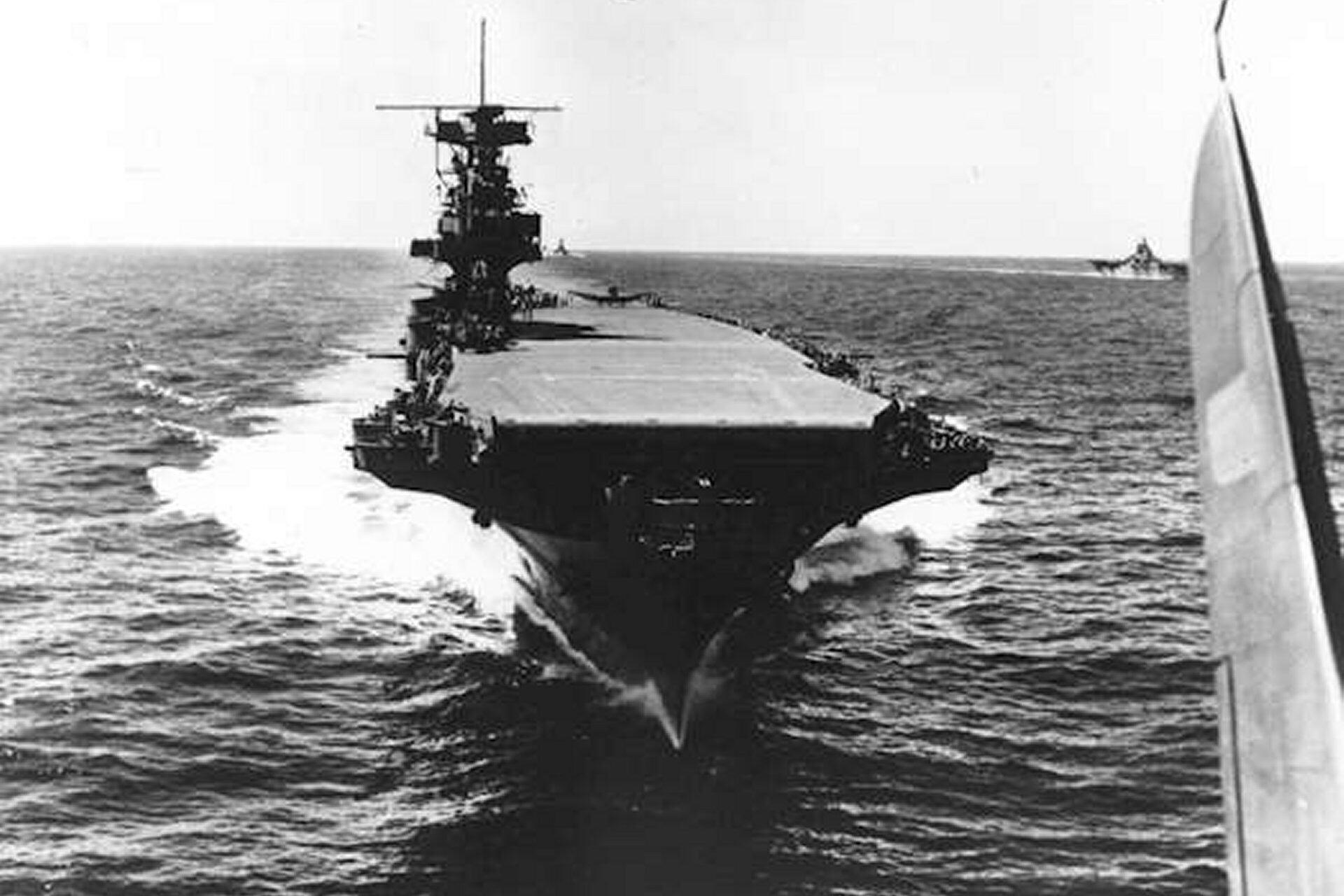
Ten days before the Japanese attack on Pearl Harbor, a Task Force built around the aircraft carrier USS Enterprise (CV-6) sailed from Pearl Harbor bound for Wake Island.

In response to a “war warning” the Enterprise had taken aboard a squadron of US Marine F4F Wildcat fighter planes and their pilots, with orders to deliver them to Wake to bolster the island’s defenses.

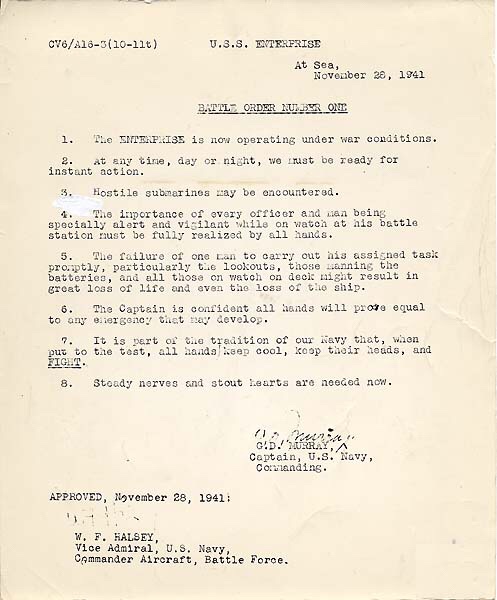
Once they were at sea, the TF commander, Admiral William F. (Bull) Halsey signed off on Battle Order #1, which put the Enterprise and her supporting Cruisers and Destroyers on a war footing.

The crew began adding armor behind the pilot’s position’s in the ship’s fighters, painting them in combat colors, and arming them for combat.

More than a week before the Japanese attacked, the Enterprise TF had orders to shoot first and ask questions later should they encounter any foreign ships or planes. The CAP (Combat Air Patrol) kept watch overhead.

The Big E would deliver the Marines and return to Pearl on Sunday, December 7. Her scout plane pilots would fly ahead, ending up right in the middle of the air raid. But that’s another story.

But on this date, Admiral Halsey and Captain Murray closed by telling their sailors “Steady nerves and stout hearts are needed now.”

The USMC is Born


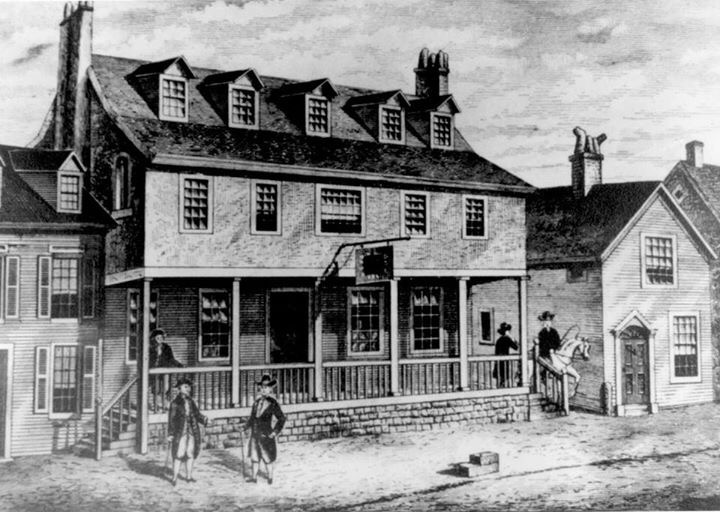
Today in History, November 10: 1775 – The First Continental Congress commissions a local innkeeper to raise two battalions of Marines to serve in the Revolutionary War. At Tun Tavern in Philadelphia the recruiting took place, and the United States Marine Corps was born. Aboard numerous US Navy ships during the Revolution, at Tripoli, during the Civil War, Belleau Wood, Iwo Jima and dozens of places in between, when the chips were down, the cry went out, “Send in the Marines!”

The Marines Begin the Legend of Guadalcanal


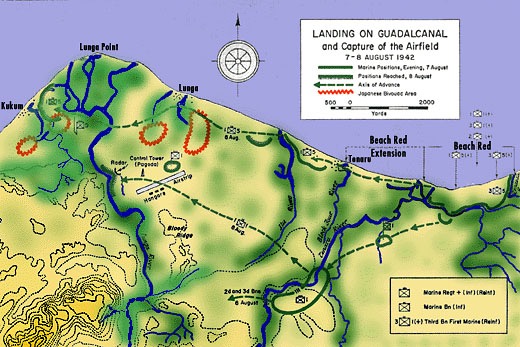
Today in History, August 7: 1942 – The US Marines had fought since the Revolution, incuding WWI (Belleau Wood) but it was THIS day in 1942 that began the legend of the US Marines for many. 

 The Gyrenes went ashore on a humid, muddy, malaria infested jungle island named Guadalcanal; initially to little resistance. Soon they were fighting for every inch of ground against an enemy that was more than willing to die. The battle would last for over six months, during which the Marines lived in muddy ditches, lived on what rations they could find and suffered nightly bombardment by the Imperial Japanese Navy…but they persevered, conquered and then, after buying the island with their blood, handed it over to the Army. Why was Guadalcanal so important?

The Japanese occupied Guadalcanal to build an airfield there. At the eastern most extremity of the Solomon Islands, the airfield would allow the Japanese to use long range aircraft to cut off supply lines to Australia. 

 The Marines quickly took the airfield, and named it Henderson Field, after a Marine Captain that gave his life at another pivotal battle, Midway. The Marines struggled back and forth over Henderson for months, but held it…which meant that the Marine air and Navy air forces called The Cactus Airforce could defend the island from nightly bombardment and constant attempts at reinforcement by Japanese forces.

 Both Navies lost 24 ships…most of which carpet “Iron bottom sound” off the coast of Guadalcanal and Savo Island.  The months ahead would bring many important battles for the Navy and the Marines…but on this date in history, the United States Marines began the battle that proved their place in history.

A Sorrowful Victory 


Today in History, July 9: 1944 – Victory at the Battle of Saipan. The US Marines defeat the Japanese military on Saipan, the first island with Japanese civilians to be taken by the US. It was a difficult battle, made all the more so by the existence of a civilian population. The Marines set up well lit camps for the civilians to be safe from battle. Fearing that his citizens would find out that the Americans were not the vicious, heartless enemy projected by propaganda, the Emperor issued a communique to the civilian population of Saipan, telling them that if they committed suicide they would receive the same treatment in the afterlife as Japanese soldiers that died in battle. American servicemen were horrified as Japanese civilians threw their children from cliffs, then followed them to the rocks below. The newly won island would be used as an air base for B-29 Superfortress bombers that would bomb the Japanese mainland.

Navy & Marine History Made

Today in History, March 3: 1776 – The Continental Navy transports a contingent of Continental Marines to Nassau, Bahamas where the Marines make their first amphibious landing. The mission was to raid and capture gunpowder and munitions stored at the British possession for use in the American Revolutionary War. The Continental Navy and Marines are of course the origins of the US Navy and US Marines.