A General Above All Others

Today in History, October 11, 1976:

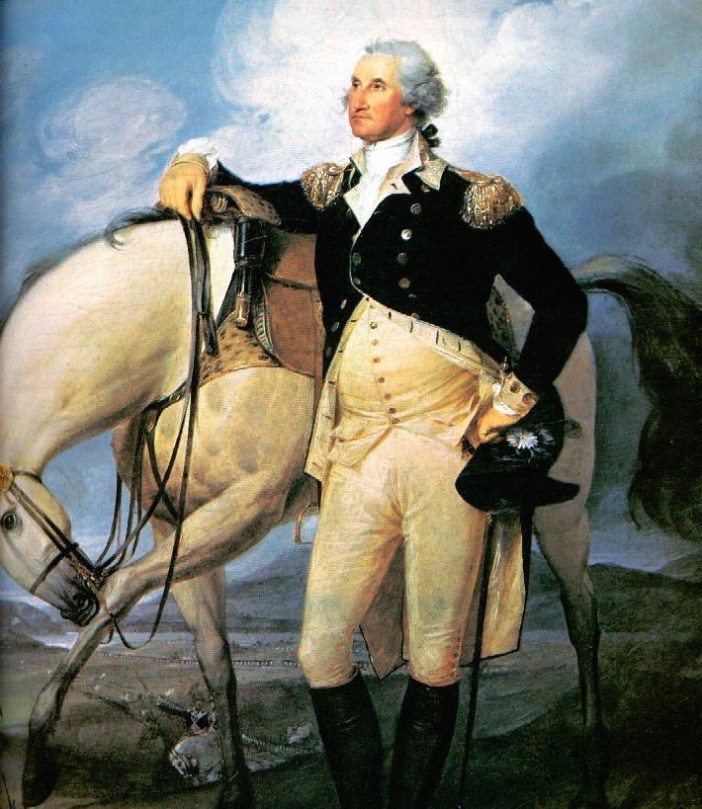
Lt. Gen. George Washington is promoted to General of the Armies.

No, that is not a typo.

After leading all American Continental forces to victory in the Revolutionary War and serving two terms as our first President, George Washington maintained his rank as Lieutenant General.

In the interim, other men were promoted to Gen. of the Army…Grant, Sherman, Sheridan (4-star), Marshall, Eisenhower, MacArthur, Arnold and Bradley 5-star.). Admirals Leahy, King and Nimitz became 5-star Fleet Admirals. And John “Back Jack” Pershing.

At our Bicentenial, Congress decided, and rightly so, that no General should ever outrank the father of our nation.

So they created the rank of General of the Armies (not to be confused with Gen. of the Army), and posthumously promoted General Washington and declared none should ever exceed his rank.

——————————————–

Hereas Lieutenant General George Washington of Virginia commanded our armies throughout and to the successful termination of our Revolutionary War;

Whereas Lieutenant General George Washington presided over the convention that formulated our Constitution;

Whereas Lieutenant General George Washington twice served as President of the United States of America; and

Whereas it is considered fitting and proper that no officer of the United States Army should outrank Lieutenant General George Washington on the Army list;

Now, therefore, be it

Resolved by the Senate and House of Representatives of the United States of America in Congress assembled, That

(a) for purposes of subsection (b) of this section only, the grade of General of the Armies of the United States is established, such grade to have rank and precedence over all other grades of the Army, past or present.

(b) The President is authorized and requested to appoint George Washington posthumously to the grade of General of the Armies of the United States, such appointment to take effect on July 4, 1976.

Approved October 11, 1976.

Public Law 94-479
Meriwether Lewis: Murdered? Or Suicide?

Today in History, October 11, 1809:

We all know of the adventures of Lewis and Clark.

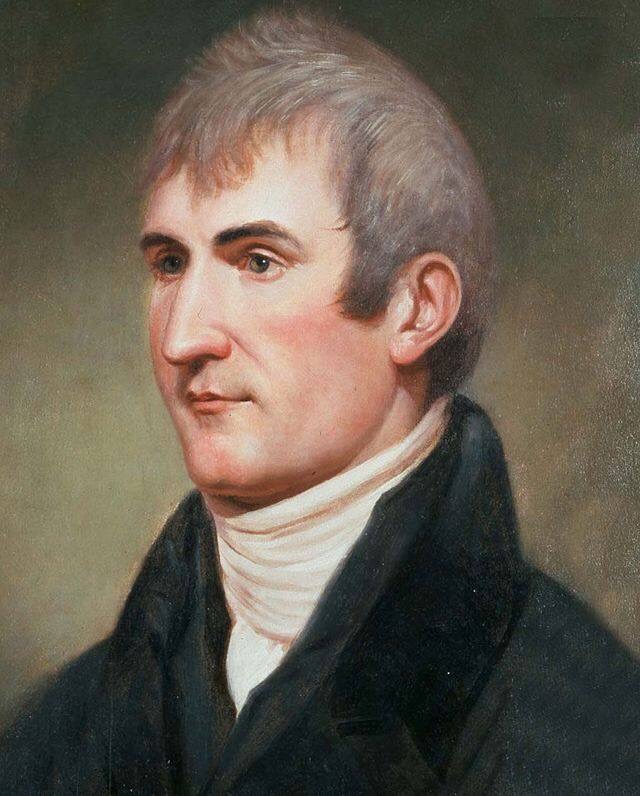
But on this day in 1809, only 3 years after the completion of his groundbreaking expedition, Meriwether Lewis died. He was only 35 years old.

The big question is whether it was murder or suicide. He was, at the time, the Governor of Upper Louisiana, and traveling the Natchez Trace to bring information to Washington about his efforts as Governor and as an explorer.

He was staying at Grinder’s Stand, an inn along the Trace, when the owners and other travelers heard “several” gunshots ring out.

Depending on who you talked to, he suffered through the night, the result of gunshots by his own hand or by murderers who stole the money he had with him.

Clark and President Jefferson, who knew him best, were easily convinced that he killed himself. Not publicized nearly as much as his courageous exploits is the reality that he battled depression and alcohol.

Others believed he was murdered by one of the many pirates along the trace. I have to wonder about the “several shots” at a time of flintlock pistols. How determined would a suicidal person have to be to shoot himself several times to complete a suicide then, or even now? The cash he was carrying with him was never found.

The US Naval Institute is Born

Today in History, October 9, 1873:

The United States Naval Institute (USNI) is founded by 15 USN officers, including the first commander of the USS Monitor.

The USNI was initiated to study Naval issues and to report on them. It began publishing “Proceedings”, a publication to report its findings in 1874, a practice that continues today. I know this may not be of tremendous interest to most, but to me it is very important. I receive “Proceedings” and more importantly to me, “Naval History”, from which I obtain many interesting articles to post. USNI is fantastic! It also publishes many books, maintains history sources, and continues to document veteran’s experiences.

The Unknown Soldier & the USS Olympia

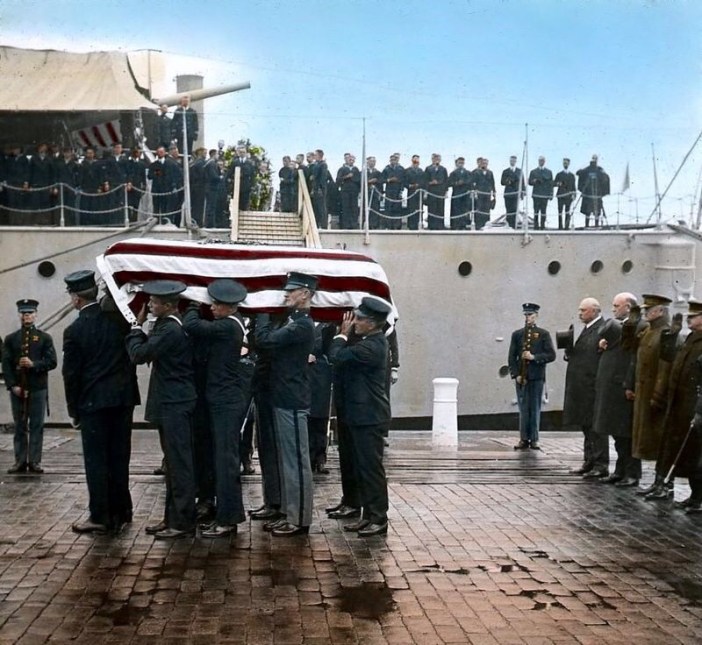
TODAY IN HISTORY, OCTOBER 3, 1921:

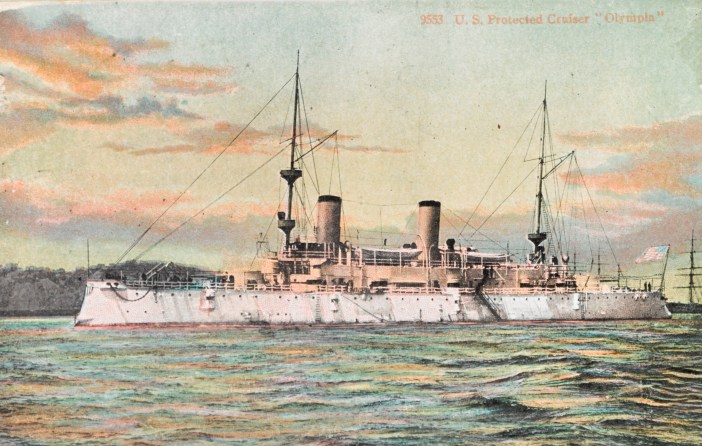
The USS Olympia sets sail for France.

Her mission: To bring the Unknown Soldier back home for burial at Arlington National Cemetery.

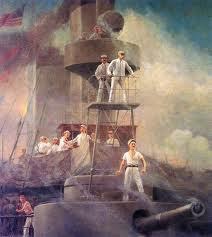
The Olympia had a distinguished career. in 1898 she was Admiral Dewey’s flagship during the Battle of Manila Bay in the Philippines (Spanish-American War) in which the American fleet devastated the Spanish Fleet, propelling the US to international player status.

Dewey stood on the Olympia’s bridge when he famously said, “You may fire when ready, Gridley”.

The trip back to America from France with the Unknown Soldier was not uneventful. The ship feared they would be lost to a devastating storm.

Today, the Olympia is the oldest remaining steel hulled ship of the US Navy, a nearly 130 year old museum ship. But her story is far from over. The Olympia is suffering severe natural damage and it will take millions to keep her from dissolving into the Delaware River in Philadelphia.

And of course you can visit her famous passenger at Arlington National Cemetery in Washington D.C.

“Come and Take It!”

Today in History, October 2, 1835:

Mexican soldiers attempted to retrieve a cannon from American-Mexican settlers in the Village of Gonzales in Tejas.

The settlers fought back and kept their cannon. The Texas war for independence had begun. The Mexican government had encouraged immigration by Americans into the Mexican territory of Tejas in hopes that they would become loyal Mexican citizens.

Instead they continued to speak their native language and maintained loyalty to their native country.

It wasn’t long before Texas was a sovereign nation destined to become an American state.

Government Restricted

Today in History, September 25, 1789:

The US Congress approves the first ten ammendments to the Constitution, or The Bill of Rights.

The ammendments were more about restricting the powers of government than “bestowing” rights the founders considered natural.

The Bill of Rights would be ratified by the states in December, 1791.

“FROM WHERE THE SUN NOW STANDS, I WILL FIGHT NO MORE FOREVER.” 

Today in History, September 21, 1904:

“I am tired of fighting. Our chiefs are killed. Looking Glass is dead. Toohoolhoolzote is dead. The old men are all dead. It is the young men who say, ‘Yes’ or ‘No.’ He who led the young men (Olikut, his brother) is dead. It is cold, and we have no blankets. The little children are freezing to death. My people, some of them, have run away to the hills, and have no blankets, no food. No one knows where they are—perhaps freezing to death. I want to have time to look for my children, and see how many of them I can find. Maybe I shall find them among the dead. Hear me, my chiefs! I am tired. My heart is sick and sad. FROM WHERE THE SUN NOW STANDS, I WILL FIGHT NO MORE FOREVER.” 

 Chief Joseph, who in 1877 had led his band of the Nez Perce in a running battle for 1400 miles in an attempted retreat into Canada from the US Cavalry, ending in his surrender to US troops under Gen. Nelson A. Miles, dies in Washington State.

His people had been friendly with the white people since the time of the Lewis and Clark Expedition. After the Expedition had made it across the Rockies, they were starving and winter was approaching. They met the Nez Perce, who provided them with food and taught them how to survive.

In less than a generation their generosity was repaid with near extinction.

First Air Service Fatality

Today in History, September 17, 1908:

US Army Lt. Thomas Selfridge, who had been the first US military officer to fly a powered aircraft solo, also becomes the first fatality of powered flight.

He was a passenger flying in the Wright Flyer with Orville Wright, during a demonstration flight at Ft. Myer, Virginia. One of the propellers snapped, damaging the aircraft, causing it to crash.

Lt. Selfridge struck his head on impact and died 3 hours later. Orville suffered severe injuries but recovered. Lt. Selfridge rests at adjacent Arlington National Cemetery.

Heroism and Treachery at Chapultepec

Today in History, September 13, 1847:

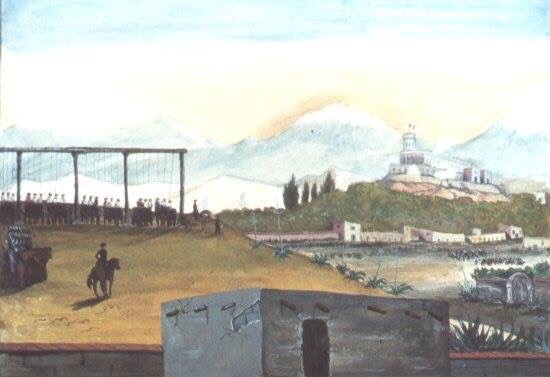
In the midst of the Battle for Mexico City during the Mexican-American War, The US Army, US Marines, work together to storm Chapultepec Castle, and take it. It was a key defensive position for General Antonio López de Santa Anna.

While the battle itself was of importance in establishing American presence on the international stage, it is much more important in my estimation for other reasons.

Key players amongst the American forces were US Army Capt Robert E. Lee, who convinced commanding General Winfield Scott of the winning strategy, along with a young US Army Lieutenant, Pierre G. T. Beauregard. Lt. Col. Joseph E. Johnston fought in the battle, and George Pickett was the first soldier to top the wall of the castle. Lt. Thomas J. Jackson (Stone Wall) fought valiantly;

Lt. Ulysses S. Grant found a strategic artillery position from which to fight during the taking of Mexico City; Naval officer Raphael Semmes saw Grant’s actions and found an equal position on the opposite side of the road to cover the enemy.

Can you imagine? All of these men served together, bled together, and then in the end took up arms against each other in the Civil War over ideological differences.

Think of your very best friend…and then think about taking up arms against him. This was an enigma of the Civil War. There are countless stories of episodes where, during a lull in a battle, or after a defeat, Confederates and Unionist soldiers took the opportunity to meet and commiserate with old friends on the opposite side.

Another aspect is that the US Marines played an important part in the seizure of the castle, thus the beginning lines of the Marine Hymn, “From the Halls of Montezuma…”. My research also indicates that the red stripe down the side of the blue slacks of the US Marine uniform represents the blood shed by US Marines during this battle.

Also that day, the last 30 of the “Saint Patrick’s Battalion”, deserters from the US Army who served as artillery for the Mexican Army, are publicly hanged en masse…by the US Army. They had been poor immigrants who, disenchanted with their lot, were coaxed to the opposite side, making them traitors to their new nation.

Dinner Just Got Easier…

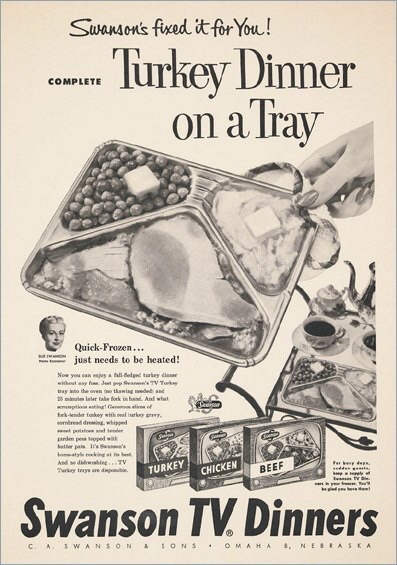
Today in History, September 10: 1953 – Swanson is the first to successfully sell “TV Dinners”, their first being a turkey dinner, in an aluminum foil tray. Soon beef and chicken offerings followed.

This seems simple if not quaint now. But at the time a prepared meal which could just be popped in the oven (no microwaves, kids) was a huge cultural change. Much like fast food restaurants, TV dinners helped free time for wives, mothers and bachelors. Not a sexist statement…those were the times. Not having to spend hours in the kitchen preparing every meal changed lives.

Have you ever eaten from an aluminum tray dinner? I personally preferred them to microwave safe trays.