Defending Her Honor…

Today in History, May 30: 1806:

Andrew Jackson engages in a duel to defend the honor of his wife.

He had married her with the understanding that her divorce was final, which it was not.

Challenged by a reporter, he fought a duel to defend her and killed Charles Dickinson to defend her.

Oddly enough, on May 29th, 1780, only a day before this event in history, Jackson had been one of the few to evade “Tarleton’s Quarter” as British Lt. Col. Banastre Tarleton had butchered those that surrendered at Waxhaws during the Revolutionary War.

The experience added to the brutality in which future General and President Jackson acted during the War of 1812 and during his Presidency in regards to the British, which he despised. During the Revolutionary War he lost his parents and his brother, which led him to despise the British.

“Don’t Fire Unless Fired Upon. But if They Mean to Have a War, Let it Begin Here.”

Today in History, April 19: 1775 – The Midnight Ride continues. Paul Revere and his fellow rider, William Dawes meet up while warning Lexington of the approaching British soldiers. They had stopped at several villages between there and Boston spreading the alarm.

In each village additional riders would set off in all directions to spread the word for minutemen to converge on Lexington and Concord. Village cannons were fired so they would be heard in neighboring villages…a pre-arranged signal. The system was so efficient that before the British soldiers were even disembarking from their boats, still miles away, hundreds of Patriots were converging on the British target of munitions at Concord. Unbeknownst to them, their mission had already been rendered moot. The “rebels”, long aware of the British plans, had already dispersed and hidden the munitions. Revere and Dawes had already warned Samuel Adams and John Hancock, who had been taken elsewhere to prevent their arrest.

In Lexington Revere and Dawes met up with Dr. Samuel Prescott, who had been visiting his fiance. The three set out for Concord to warn them. On the road they encountered an British patrol and were captured. As they were being taken to a nearby meadow Prescott shouted, “Put on!” (scatter, run for it). He and Revere rode off in opposite directions. Prescott jumped his horse over a neaby stone fence and was off into the night. Dawes escaped, but lost his horse, leaving him on foot. Revere made his second escape of the night, as he’d nearly been captured in Charleston earlier. However he soon came upon a group of British officers and was captured again. He would eventually be released, but without his horse. Precott, a Concord native familiar with the area, quickly made his way to Concord and warned them, then continued on to warn others.

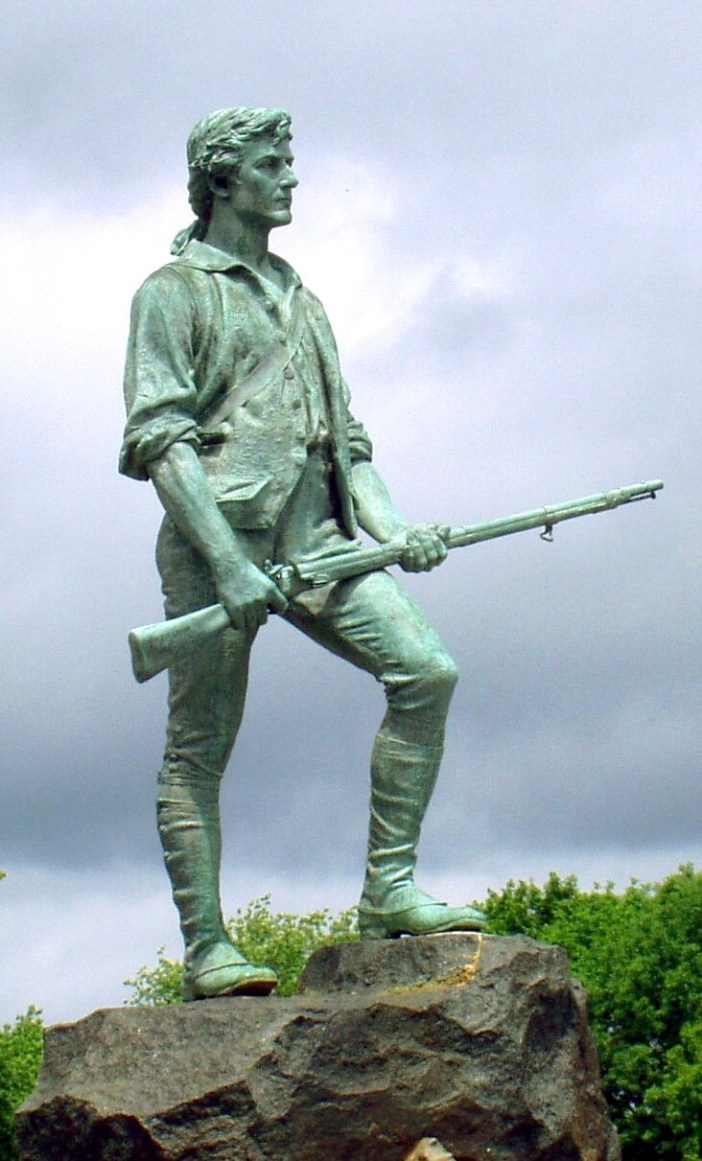
“Don’t fire unless fired upon, but if they mean to have a war, let it begin here.” –Militiaman Capt. John Parker, to his troops on Lexington Green. When the 700 British troops reached Lexington, they were confronted with a mere 77 minutemen who had managed to convene there. Capt. Parker, knowing that the British mission had already been rendered pointless, was not eager to risk the lives of is men. He had them form in ranks on Lexington Green, where they could give an expression of dissention without blocking the road to Concord. The British commander decided to confront them anyway. With an expression of great insult, the British commander ordered the “damned rebels” to disperse. Parker directed them to do so as the well trained British regulars approached. Nobody knows who fired the “shot heard ’round the world”. The Americans, of course, believe it was and over eager British soldier; the British believe it was from a minuteman; some speculation is that it was fired from the safety of a nearby tavern. Whoever fired that first shot, it resulted in the British cutting down nearly a dozen minutemen, and one injured British soldier. The British then marched past the dead and injured on their way to Concord. http://youtu.be/wAFz5YNCTGc

The Brits, emboldened, marched on Concord. When they got there they were confronted with more than 300 minutemen. The outcome was quite different than at Lexington. The British were quickly repelled, and decided to return to Boston. As they completed the long march back to Boston, the minutemen continuously fired upon them from behind trees, rocks, fences, etc. By the time the regulars made it back to Boston, they had lost over 300 men.

Why was it the “shot heard ’round the world”? Not just because of the American Revolution. The acts of the revolutionaries did not affect only the “Colonies”. The French were encouraged to aid the Americans with their fleet eventually. Other portions of the British Empire were encouraged to revolt. King George didn’t know it, but on this date, thanks to a few farmer and merchant “peasants”, the sun had begun to set on the British Empire.

Steam

Today in History, April 11: 1803 – Instrumental in establishing the US Patent system, John Stevens receives a patent for the first screw driven, steam powered boat, or steamboat. The son of a member of the Continental Congress, A Captain and later Colonel in the Continental Army, Stevens turned his talents to inventions after the war. Robert Fulton would win the most fame for the steamship, but it was Stevens who first tied steam power to propeller driven naval craft. He would be best known as the father of the American railroad for steam powered railroad engines. Not nearly as famous as George Washington, or other American heroes…but how much more impact did Stevens have on the world with his inventions? He and his contemporaries took us from a world of sail to paddle wheeled steamships, to ironclads, to battleships, liners, supertankers, and more.

Appomattox

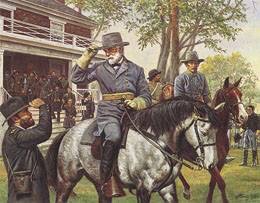
Today in History, April 9, 1865:

After years of foiling every move the Union made, Confederate Gen. Robert E. Lee had finally been run to ground. Several Yankee Generals had been bested by him, but he had finally met his match…not tactically, but in determination, by Lt. Gen. Ulysses S. Grant.

At Appomattox Courthouse, Virginia, Lee, his army starving and with nowhere else to run, in spite of the fact that he would “rather die a thousand deaths”, agreed to surrender the Army of Northern Virginia to Grant.

Lee arrived in his best uniform; Grant, typically, arrived in a muddy private’s uniform. Grant offered terms that included Confederate officers keeping their horses and sidearms, enlisted men keeping their horses so that they could farm their land, as long as they agreed to abide by their paroles and obey the laws of the land. Lee was very appreciative of these terms, saying they would be helpful to his army, men he loved.

As Lee mounted his horse and left the site of the surrender, Union soldiers began to cheer. Grant quickly silenced them, reminding them that the Confederates were once again their countrymen.

The surrender document was signed in the home of Wilmer McLean. Ironically, in the first battle of the war, First Bull Run, or First Manassas if you are from the South, Confederate Gen. P.G.T. Beauregard’s headquarters were in McLean’s home in Manassas, where cannon shot destroyed part of the house. McLean moved south to Appomattox Courthouse to keep his family safe. So, as is said, the Civil War began in Wilmer McLean’s front yard, and ended in his parlor.

McLean’s home was almost completely stripped of furniture by Union officers seeking momentos of the occasion.

Lee was given the opportunity by Grant to allow one of his subordinates to accept the surrender…to avoid humiliation. Lee refused…his FATHER, Light Horse Harry Lee, had been with Washington at Yorktown and witnessed the ungentlemanly act of British Gen. Lord Cornwallis sending a subordinate to surrender his sword to Washington. Lee refused to dishonor his family name by repeating the act. Grant did not require Lee to surrender his sword, but Lee was the man that represented his army at Appomattox Courthouse. Both gentlemen, North and South, maintained their honor.

Six Frigates…The US Navy Makes a Name for Itself

Today in History, March 27: 1794:

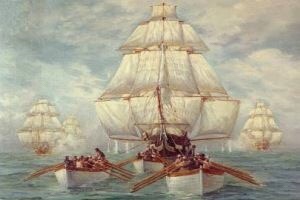
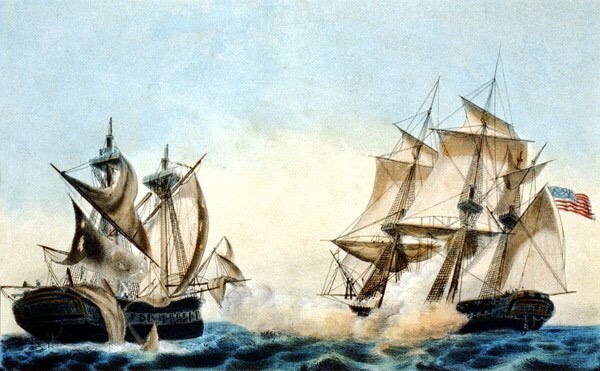
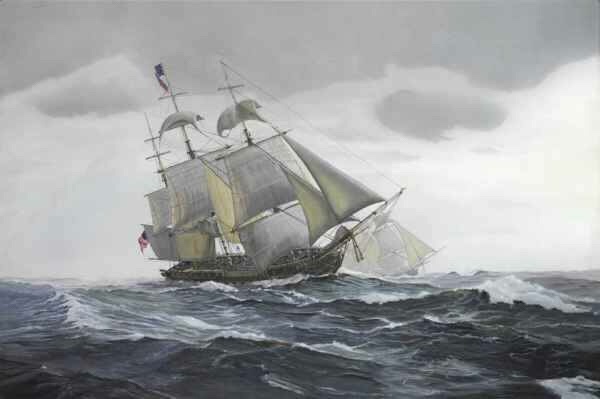
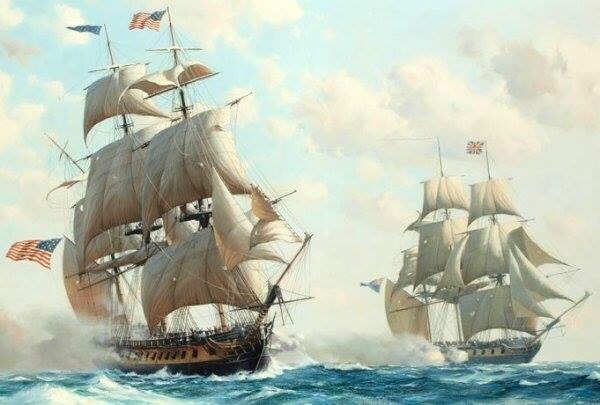
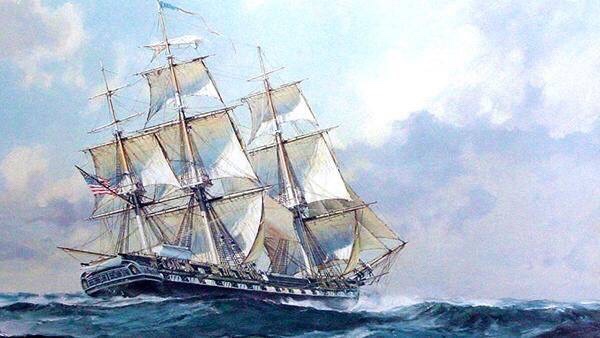
President Washington signs the Naval Act of 1794, ordering the construction of 6 Frigates capable of high speed and of holding their own against “ships of the line.”

After the Revolutionary War, America didn’t feel it needed a navy; after having several ships seized by Barbary pirates, and after abuses by the Royal Navy, the administration and Congress came to the realization that America needed a navy to protect it’s shipping.

Thus the USS Constitution (Old Ironsides, oldest commissioned US Navy vessel), USS Constellation, USS President, USS Congress, USS United States and the USS Chesapeake began their illustrious Naval careers.

Give Me Liberty, or Give Me Death!

Today in History, March 23: 1775 – “Is life so dear, or peace so sweet, as to be purchased at the price of chains and slavery? Forbid it, Almighty God! I know not what course others may take; but as for me, GIVE ME LIBERTY, OR GIVE ME DEATH!” Patrick Henry implores his fellow legislators at the Virginia Convention for separation from England. Henry, the son of Scottish immigrant, had failed at business twice before becoming a successful lawyer. He became part of the Virginia legislature and soon became a talented politician. Considered one of the Founding Fathers, he risked his life to see America free. After freedom was won, he was an ardent opponent to the federalist system, believing any affront to states rights would destroy individual rights.

Revolutionary Irish

Today in History, March 17: 1780 – “The General directs that all fatigue and working parties cease for to-morrow the SEVENTEENTH instant,” read the orders, “a day held in particular regard by the people of [Ireland].”

General George Washington’s Army was bedded down amidst 6 foot snow drifts, suffering through the worst winter on record…even worse than Valley Forge.

Recently the Irish, who were also in rebellion against the Crown, had declared themselves AMERICANS in solidarity with the American colonists that were fighting for their independence.

At least a quarter of Washington’s army was Irish…and a vast majority of his commanders shared that distinction. So GW decided that St. Patrick’s Day…(not Christmas, nor Easter)…would be a day of rest and celebration for his army.

The Boston Massacre

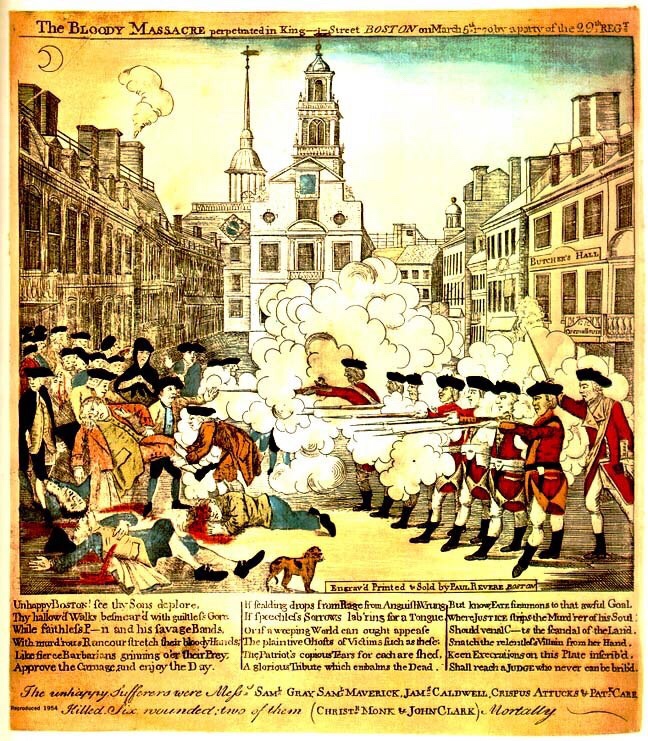
Today in History, March 5: 1770 – The Boston Massacre. American colonists, and Bostonians in particular, had been up in arms over unfair taxation without representation by their British rulers. Britain sent a contingent of soldiers to enforce the taxation and rules in Boston. After brawling with the “continentals” a few days before, they were faced with a crowd of citizens protesting outside of the Customs House. Being pelted with snowballs from the citizenry, they fixed bayonets. Most accounts are that a British soldier either slipped or was pelted with snowballs and his musket fired…then the rest of the soldiers began firing into the crowd. When it was over, five civilians were dead or dieing. Crispus Attucks, Patrick Carr, Samuel Gray, Samuel Maverick and James Caldwell. These are considered the first casualties in the American Revolution. Paul Revere made an engraving of the incident which was widely published (went viral in today’s parlance).

The Real “First” World War?

Today in History, February 10: 1763 –

“The Seven Years War”, or as it was known in the colonies, “The French and Indian War” ends with the Treaty of Paris. Britain and France had been battling for years in America, Europe, India and on the high seas over their competing imperial interests. Spain had taken sides with France. Both Britain and France had their allies in what could be considered a World War.

After several British victories on land and at sea, and after several of France’s allies had signed separate peace treaties, France and Spain finally came to the table. France gave up several of her holdings including in Canada, America and India.

The Spanish received the Louisiana Territory, the British received Spanish Florida.

Probably the most important issues for the American colonies however, are these: Many Americans, such as George Washington, gained extensive military experience fighting the French and their Indian allies during the war. And when Americans decided less than two decades later to fight for their independence from the British Crown, the French had a grudge to settle; it wasn’t that difficult for Ben Franklin to convince France to come in on the side of the Colonials. French Naval might was pivotal to the American victory.

Paradise Found

Today in History, January 18: 1778 – As the American Revolutionary War waged, English Captain James Cook discovers what he called the Sandwich Islands during an exploring expedition to the Pacific; it was not his first. The Hawaiians thought the Europeans were Gods, and the sailors were only too happy to encourage the misconception. The islanders were fascinated with the iron metal used on the ships; the sailors used it to barter for goods and “comfort” from the Polynesian women. Cook continued his voyage, looking for the Northwest Passage. After returning to the Islands a year later, Cook and his sailors continued the ruse. When one of his crew died, they were discovered to be mere mortals. The natives took one of the ship’s cutters. When Cook and crew attempted to retrieve it, killing some of the residents in the process, they were attacked, and Cook was killed.