Gettysburg

11540900_10202999878156680_755858072849452079_n

Today in History, July 4, 1863:

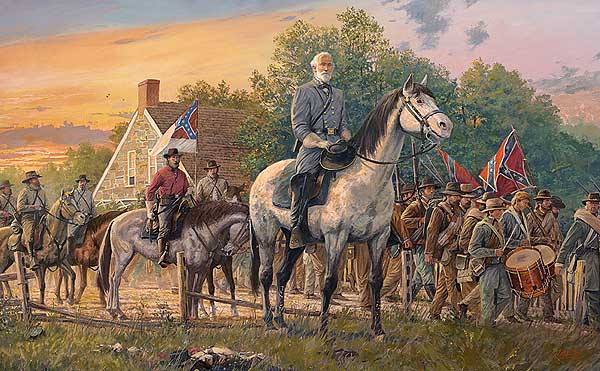
On the same day, half a continent away, Confederate General Robert E. Lee leads his defeated Army of Northern Virginia south away from the Battle of Gettysburg, Pennsylvania. No official surrender here…Lee’s army would survive to fight another day. While both battles were turning points, they did not spell the end of the South as many believe. There were years of hard, bitter fighting still to come with ghastly losses in life and injury. Gettysburg was, however, the last serious attempt by the South to invade the North.

Vicksburg

11143255_10202999879556715_3165056914709351081_n

Today in History, July 4, 1863:

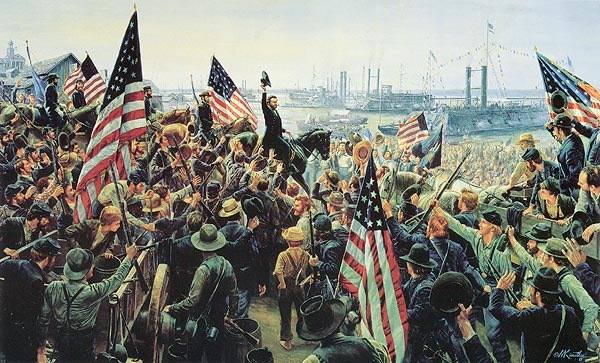
Confederate General John C. Pemberton surrenders Vicksburg, Mississippi to Union General Ulysses S. Grant. Pemberton had sent a note asking for terms on the 3rd, and initially Grant gave is usual “unconditional surrender” response. He then thought about what he would do with 30,000 starving Southern troops, who he had lay siege to since May 18th, and granted them parole, accepting the surrender on the 4th.

The capture of Vicksburg effectively cut off of the Confederate states west of the Mississippi (and their supplies) from the South. Grant’s parole of the rebels would come back to bite him, as the Confederacy did not recognize it’s terms and many of them fought again…which came back to bite the Confederacy because as a result the Union stopped trading prisoners.

The South knew the consequences of the loss of Vicksburg.  It would be many, many years before Independence Day was celebrated in Vicksburg again.

Founding Brothers


Today in History, July 4, 1826:

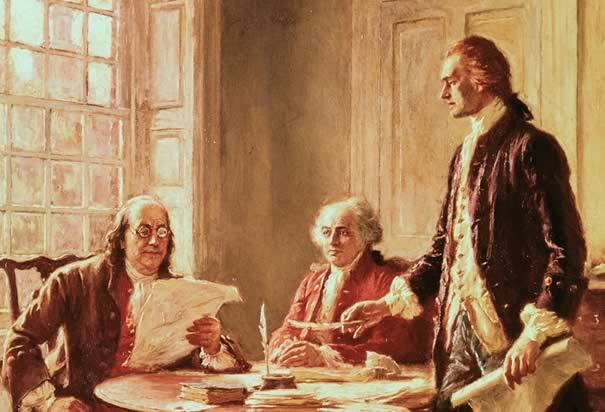
Fifty years after the adoption of the Declaration of Independence, two of it’s signers, second President John Adams and third President Thomas Jefferson, die on the same day.

The two had become bitter political enemies for years (Adams a devout Federalist, Jefferson an equally devout state’s rights man). But in 1812 they made amends and began a years’ long correspondence, making them good friends again.

It is said that Adams’ last words were, “Jefferson survives”. He was wrong, Jefferson had died five hours before. Many Americans at the time saw their death on the same day 50 years after the Nation’s birth as a divine sign.

Happy Birthday, America!

11667385_10202999878996701_1236954361294985427_n

Today in History, July 4, 1776:

“We hold these truths to be self-evident, that all men are created equal, that they are endowed by their Creator with certain unalienable Rights, that among these are Life, Liberty and the pursuit of Happiness.”

The second Continental Congress adopts the Declaration of Independence from England after years of conflict as colonists.

Fort Necessity


Today in History, July 4, 1754:

During the French and Indian Wars, a young colonial member of the British Army abandons “Fort Necessity” after surrendering it to the French the day before.

The officer, 22-year-old Lt. George Washington had also commanded British forces in the first battle of the war on the American continent weeks before. The French and Indian Wars were only part of a global conflict between England and France, the Seven Years War.

His experience here would serve Washington well in our War for Independence.  The conflict would also contribute to the American Revolution.  The war was very expensive for the Crown, and had to be paid for to save the English economy.  The colonialists considered themselves as English subjects; they fought alongside the regulars fighting the French and the Indians, many paying with their lives.  After the war the government felt the colonists owed them for their “rescue.”  The colonists however, felt the Crown owed them for saving British territory.

The ill feelings between the “homeland” and the colonies would only continue to multiply.

Former President Appointed to Supreme Court!!

Today in History, June 30, 1921:

President Warren G. Harding nominated former President William Howard Taft as Chief Justice of the Supreme Court of the United States after the death of the previous Chief Justice, Edward Douglass White…who Taft had nominated when he was President.

The irony is that Taft never wanted to be President…he became such as the result of the efforts of President Theodore Roosevelt…one of his closest friends.

TR then turned on him vociferously when Taft didn’t carry out TR’s policies to his liking. Taft was crushed by the attacks by his friend…but in the end, he obtained the job he had wanted since he was a child…Chief Justice of the Supreme Court of the United States…years after being President.

Taft’s history in the law and government made him very well qualified for the job.

The White House Razed

Today in History, June 28, 1862:

Union soldiers inadvertently burn the White House.  No, not that White House.  In fact, the Executive Mansion which housed the President wasn’t known by that name until 1902 when President Theodore Roosevelt renamed it.

Another difference between these “White Houses”, is that George Washington never resided in the Presidential Mansion along the Potomac.  His successor, John Adams was the first President to live there.

But he courted and married the widow Martha Custis at and near the White House on the Pamunkey River.

One of General Washington’s officers was Henry “Light Horse Harry” Lee.  His son, Robert E. Lee, would marry Martha Custis-Washington’s granddaughter, Mary.

Together they would live in Arlington House, overlooking the Potomac…and the Executive Mansion.  When the Civil War began, Robert E. Lee chose to support “his country”, Virginia; which also meant the Confederacy.  As a result he and his family had to leave Arlington House and move to one of their more southern Virginia properties…the White House on the Pamunkey.

As the Union dead mounted, Union Secretary of War Edwin Stanton ordered the area around Arlington House to be used as a cemetery so that Lee could never again live there.  Today it is Arlington National Cemetery.

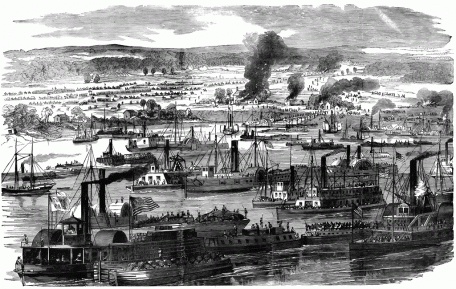
In 1862 during the Seven Day’s Battles, Union forces pushed the Confederates back past the Lee family’s new home at White House Landing, using it as a major supply base.

Before she fled further south from yet another home, Mary Lee left a message on the door of the residence, “Northern soldiers, who profess to reverence Washington, forbear to desecrate the house of his first married life, the property of his wife, now owned by her descendants.”

Union soldiers agreed.  General George McClellan ordered a guard to posted around the house to prevent looting or vandalism.

McClellan took a lot of heat from the press and DC for the protection of General Washington’s one-time home.  It should be used as a hospital for Union soldiers!  Even though it had but six rooms.

As was frequent in the Civil War, the lines moved back north after moving south.  And on this date in 1862 Confederates took White House Landing back.  As the Union Army fled, McClellan ordered all supplies and outbuildings burned to prevent their use by the Confederates…with the exception of the White House, it was to be spared.

As often happens in war, orders from the top rarely get carried out to the letter.  The White House was burned to the ground.
Thank You James Smithson…and Henry Hungerford…

Today in History, June 27: 1829 – Strange that we should be thankful that Henry James Hungerford died childless in 1835. On this date in 1829 a British scientist who had never set foot on American soil died in Genoa, Italy. James Smithson was a wealthy man. He wrote in his will, “In the case of the death of my said Nephew without leaving a child or children, or the death of the child or children he may have had under the age of twenty-one years or intestate, I then bequeath the whole of my property… to the United States of America, to found at Washington, under the name of the Smithsonian Institution, an Establishment for the increase & diffusion of knowledge among men.”….

So thanks to James Smithson’s eccentricity, which he never explained, and the untimely death of his nephew, the US came into possession of over $500,000.00 in funds dedicated to research and learning. President Andrew Jackson sent a diplomat to receive the funds, President James K. Polk signed the bill creating the Smithsonian Institute once Congress agreed how to use the money. President Theodore Roosevelt saw to the movement of Smithson’s body from Italy to “The Castle” of the Institute in 1904. Smithson was escorted from Genoa to Washington by none other than Institute regent Alexander Graham Bell and his wife. Today the Smithsonian has 19 museums and the national zoo, including the National Aeronautics and Space Museum, the most visited museum in the world. Thank you, Mr. Smithson.

The Great Gettysburg Reunion

Today in History, June 25, 1913:

“We have found one another again as brothers and comrades in arms, enemies no longer, generous friends rather, our battles long past, the quarrel forgotten—except that we shall not forget the splendid valor.” –President Woodrow Wilson.

The Great Civil War Reunion at Gettysburg, Pennsylvania. Nearly half a century after the end of the Civil War, aged men and women who had been sworn enemies, who had lost loved ones on both sides of the great conflict, began to gather at Gettysburg for a reunion to honor those they had lost…and each other.

Men missing limbs commiserated with each other, slapped backs, shared stories, joined together as brothers…Union, Confederate, White, Black, recognized that the War was history and they were comrades again. If men and women that were so committed to killing each other could do this….can’t we?