In Harm’s Way


Today in History, July 18: 1792 – “”I wish to have no connection with any ship that does not sail fast for I intend to go in harm’s way.” John Paul Jones dies in Paris, France. John Paul was born in Scotland and went to sea with British merchant ships at 13. In the West Indies he killed another sailor whom he said was a mutineer and had to flee. He settled in the American colonies and changed his name to John Paul Jones. He joined the Continental Navy when the Revolution began and became famous for his daring and courage; capturing several ships as prizes, raiding the English coast and fighting a horrific battle with his ship “Bonhomme Richard” (French for Poor Richard in honor of Benjamin Franklin) during which he responded to a demand for surrender with “I have not yet begun to fight!” After the war he served briefly in the Russian Navy as an admiral, but wanted to return to American service. The “Father of the US Navy” died without fanfare in Paris and was buried in an unmarked grave. Over 100 years later, in 1905, US Ambassador to France Gen. Horace Porter led the search to find Jones’ body, and with the help of the French, succeeded. Jones was taken back to America aboard the cruiser USS Brooklyn and was escorted into port by 7 battleships and 2 other cruisers. President Theodore Roosevelt, a naval power and history enthusiast, spoke at a ceremony at the US Naval Academy honoring Jones. Jones was eventually moved to his current tomb in the chapel at the Academy. An interesting aside; Gen. Porter had quite a history of his own. He was a Medal of Honor recipient for valor during the Civil War, was aide-de-camp to Gen. US Grant, was present in the room at Appomattox when Lee surrendered, and was Grant’s personal secretary during his Presidency.

Connections Bring History Home


Today in History, July 17: 1763 – John Jacob Astor is born in Germany in modest circumstances.  He would immigrate to America…selling flutes.  Convinced to sell the musical instruments in New York and invest in the fur trade, he became America’s first Millionaire with his American Fur Company.  On April 12, 1912 his grandson and namesake, the world’s richest man, John Jacob Astor IV would die in the Titanic Disaster.

July 17: 1918 – Crossing paths in history.  The RMS Carpathia is sunk by U-Boat U-55 during WWI.  All but 5 of her crew managed to escape to lifeboats. They were in turn saved by the Sloop HMS Snowdrop, which arrived and drove off the German sub before it could machine gun the crew in their boats.

As previously stated, on April 12, 1912, RMS Titanic struck an iceberg and sank within 4 hours. The nearest ship to receive her distress signal was the RMS Carpathia, which sped at full speed for two hours to the disaster scene. Upon her arrival, she rescued 705 survivors from the freezing waters of the North Atlantic. The Carpathia’s crew became heroes, being awarded medals. Her Captain, Arthur Henry Rostron, was knighted and was a guest of President William Taft in the White House. During WWI the Carpathia served as a troop ship, transporting thousands of American soldiers across the Atlantic to the war in Europe.

Among them was Frank Buckles, who would become the last surviving American Soldier from WWI before his death in 2011. He was a prisoner of war in the Philippines during WWII (as a civilian) and a strong advocate for a WWI Memorial, which…led him to be a guest of President George W. Bush in the White House. 

Everything is connected in history…you just have to find it.

Innovation in Taxation 


Today in History, July 16: 1935 – The world’s first parking meter, Park-o-meter No. 1, is installed in Oklahoma City, Oklahoma. Newspaperman Carl McGee came up with the idea after local businessmen became concerned that an ever increasing number of automobiles were taking up parking spaces. The idea was that parkers (customers) would be encouraged to move along so that more parkers (customers) could fill their spots. The incidental new tax on citizens was a happy by product. The idea was popular amongst city governments and by 1940 there were 140,000 meters in operation in the country.


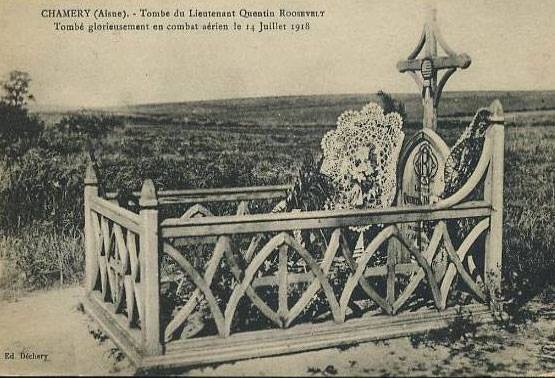
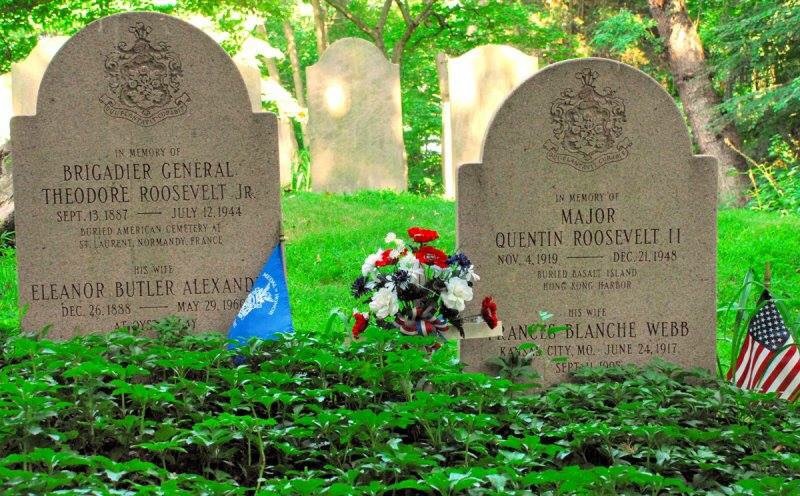
Today in History, July 14: 1918 – US Airman Quentin Roosevelt, youngest son of President Theodore Roosevelt, dies when he is shot down over France in WWI.   The German military returned his affects to President Roosevelt, and the French wanted to erect a monument to Quentin. He and his brothers, who all served in WWI were very competitive in the voracity of their service, trying to live up to their father’s exploits…Rough Rider, etc. 

The back story is interesting. TR had been a sickly child who nobody expected to become much. But he was a fighter. He forced himself to exercise through severe pain until he became “barrel chested” and strong. He led an incredibly busy life, full speed throughout. His youngest son Quentin struggled with some of the same challenges. 

After TR’s presidency, TR went on an treacherous exploring expedition in South America, putting the dangerous “River of Doubt” on the map. Quentin went with him, aiding his father through deprivations that nearly killed the elder Roosevelt. 

 TR wanted to go to war for his country when WW1 began, but President Wilson, of the opposite political party, would not allow it, afraid TR would gain favor and face him in the next election.

TR wouldn’t live that long…and he spent the intervening time heartbroken over the loss of his youngest son.

All of the boys had served on the front lines in France. And 26 years later General Theodore Roosevelt, Jr had to pull strings so he would be allowed to go ashore with the unit he commanded at Normandy on D-Day. Within days he was dead of a heart attack.

“…if They Mean to Have a War…Let it Begin Here.”


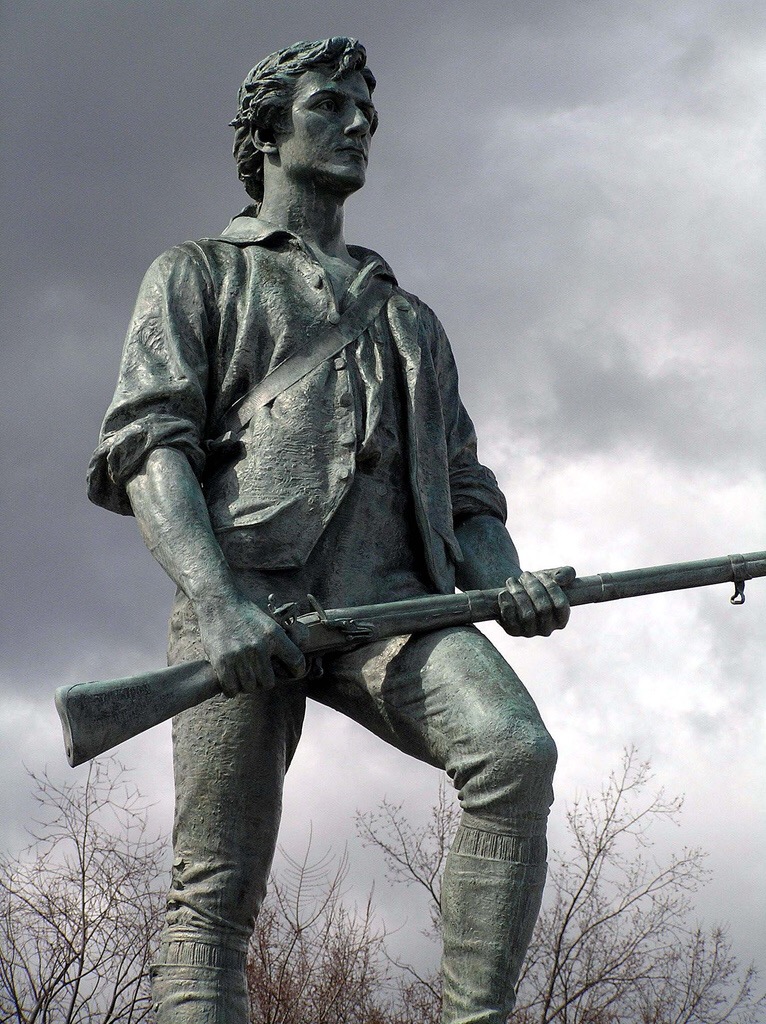
Today in History: July 13, 1729 – Future Captain John Parker is born in Lexington, Massachusetts.

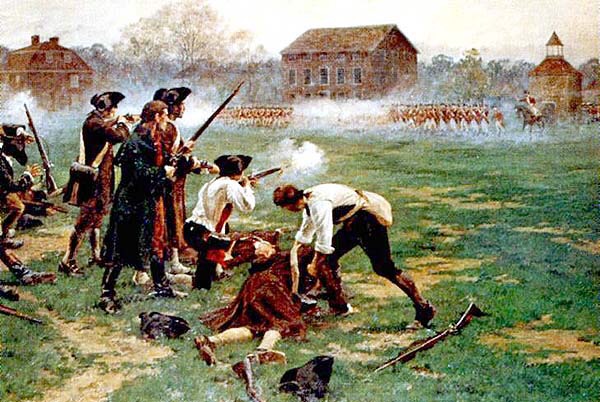
A veteran of the French and Indian Wars, Captain Parker led a contingent of Minutemen on April 19, 1775 when they heard that the King’s soldiers were approaching. In the Skirmish on Lexington Green, Parker ordered the militia, “Stand your ground. Don’t fire unless fired upon, but if they mean to have a war, let it begin here.”

Though simple, if you think about what this command meant in the grand scheme of things, it is profound. Captain Parker was dead by September of the same year, a victim of disease, as so many of the Revolutionary War soldiers were.

Birth of an Empire


Today in History, July 12: 927 – King of the Anglo-Saxons Aethelstan, after some combat and some reaching out, receives the submission of Northern English kings at Eamont, becoming the first King of the English, the first to rule all of England at once. Although the peace made would last for only seven years, his accomplishment is considered the closest thing to a “birth” of England, as he brought together a kingdom from Wessex to Scotland to York, which had been under Viking control.

“Johnny Get Your Gun!”

Mark Mears 1918 – Famous Opera Singer Enrico Caruso records “Over There”, a patriotic song written by George M. Cohan for the First World War…..Verse 1

Johnny,[2] get your gun, get your gun, get your gun.

Take it on the run, on the run, on the run.

Hear them calling you and me,

Every Son of Liberty.

Hurry right away, no delay, go today.

Make your Daddy glad to have had such a lad.

Tell your sweetheart not to pine,

To be proud her boy’s in line.

Verse 2

Johnny, get your gun, get your gun, get your gun.

Johnny, show the “Hun”[3] you’re a son-of-a-gun.

Hoist the flag and let her fly

Yankee Doodle[4] do or die.

Pack your little kit, show your grit, do your bit.

Yankee[5] to the ranks from the towns and the tanks.[6]

Make your Mother proud of you

And the old red-white-and-blue[7]

Chorus

Over there, over there,

Send the word, send the word over there

That the Yanks are coming, the Yanks are coming

The drums rum-tumming everywhere.

So prepare, say a prayer,

Send the word, send the word to beware –

We’ll be over, we’re coming over,

And we won’t come back till it’s over, over there. http://youtu.be/uIr-FoBW5Xw

A Crucial Split Second at Weehawken

394661_2945554496695_2089288260_n


Today in History, June 11: 1804 – A duel between Alexander Hamilton and Vice-President Aaron Burr ends in the death of Hamilton. Both men had played important roles in the birth of America, Hamilton greatly more so. Hamilton had been an aide to Gen. Washington during the Revolutionary War and a key player in the writing of the Constitution, and then the primary driver in creating our financial system.
Burr had been a hero of the Canadian campaign during the war and was a talented politician, if less than diligent in his ethics. Hamilton despised Burr, and considered it his duty to defeat Burr’s ambitions wherever he could. Finally, after Hamilton played a key role in defeating Burr’s ambitions to be New York’s next Governor, Burr challenged Hamilton to a duel.
Duels were then illegal in New York, and most of the challenges were brought to an amicable solution without gunfire. The combatants and their seconds had to go across the river to New Jersey, to a promontory known as Weehawken. Depending on which side you listen to, Hamilton fired his shot into the air, believing the duel to be frivolous. In this version, Burr then took careful aim and shot Hamilton dead.
Burr’s second reports that Hamilton fired at Burr and missed. With the death of such a prominent American, Burr was excoriated as a cad. He finished out his term as Vice-President to hide behind the immunity from prosecution it provided. Afterwards he instigated a scheme to create a separate nation within the Louisiana Territory, going to the British for support (which was refused) and was tried for treason, of which he was acquitted. Nonetheless, he was despised by all, and remained so in history.
This is one of those moments in History, that will forever be shrouded in mystery.  As with time travel theories…what if this had never happened?  What if Burr had missed?  There is a very real possibility Hamilton could have been President at some point.  If so, what effect would he have on the War of 1812?  With his financial acumen, would he have affected Andrew Jackson’s battle with the Bank?  Or would Jackson or any since have even been President?
How often has a split second in History…changed History?

George III Goes to Work


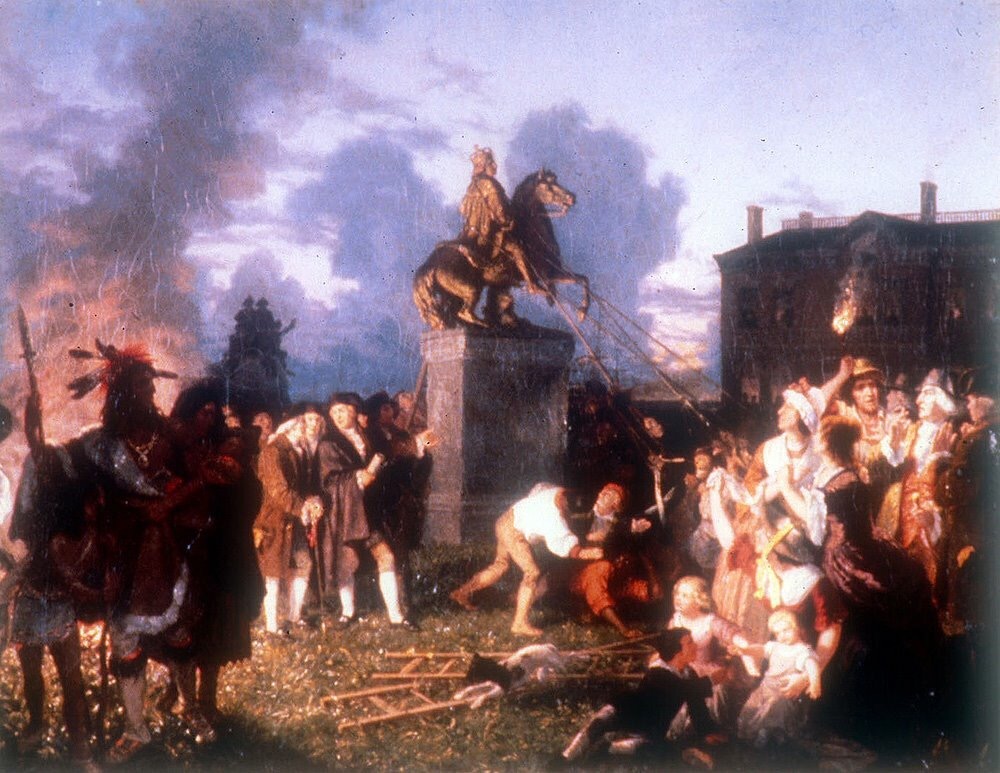
Today in History, July 10: 1776 – After hearing the reading of the Declaration of Independence, jubilant New Yorkers, soldiers and civilians alike, rushed to Bowling Green and pulled down the large lead statue of King George III there. The statue was taken to Connecticut where it was melted down and made into guns and ammunition for use against the British.