

 Today in History, February 27: 1860 – “One of the most happiest and most convincing political arguments ever made in this City … No man ever made such an impression on his first appeal to a New-York audience.” — Horace Greeley in his paper regarding “The Cooper Union Speech” by Abraham Lincoln. A former Congressman and Illinois lawyer, Lincoln had been launched to the national stage by his debates with Stephen Douglas over the slavery question 2 years before, but he was still mostly unknown in the east. A young Republicans group in New York invited him to speech at Cooper Union’s Great Hall. The hall was not filled for the speech, but the text of it was given to Greeley’s and other’s papers; from there it was broadly published across the nation in pamphlet form. Lincoln made convincing arguments that the Founding Fathers were against the expansion of slavery and desired it’s eventual end. At the same time he tried to convince Southerners that the Republican party did not wish to interfere in their affairs. While in New York he had his photo taken by Matthew Brady, and the photo was used along with the pamphlet to broaden his recognition. It is widely believed that the speech is what launched him into the Presidency. He closed with a message to his colleagues: “Neither let us be slandered from our duty by false accusations against us, nor frightened from it by menaces of destruction to the Government nor of dungeons to ourselves. Let us have faith that right makes might, and in that faith, let us, to the end, dare to do our duty as we understand it.” (See below for video of Sam Waterston performing the speech).
Tag: today in history
“Let this great wonder of nature remain as it now is. Do nothing to mar its grandeur, sublimity and loveliness. You cannot improve on it. But what you can do is to keep it for your children, your children’s children, and all who come after you, as the one great sight which every American should see.” -President Theodore Roosevelt
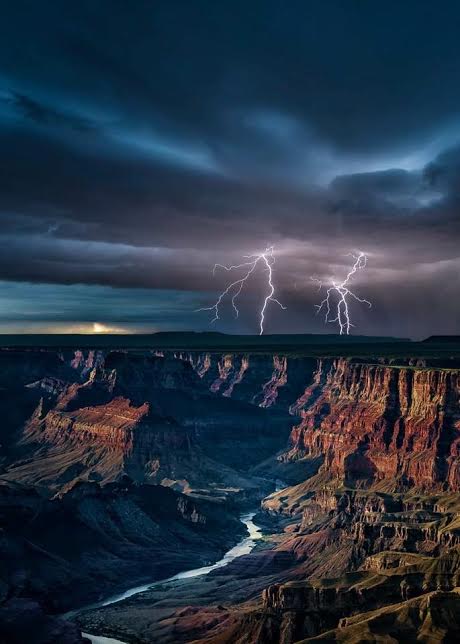
Today in History, February 26: 1919 – President Woodrow Wilson designates the Grand Canyon as a National Park. His nemesis and predecessor, President Theodore Roosevelt, had designated the Grand Canyon as a National Monument in 1908. Thanks, guys!
A First in History
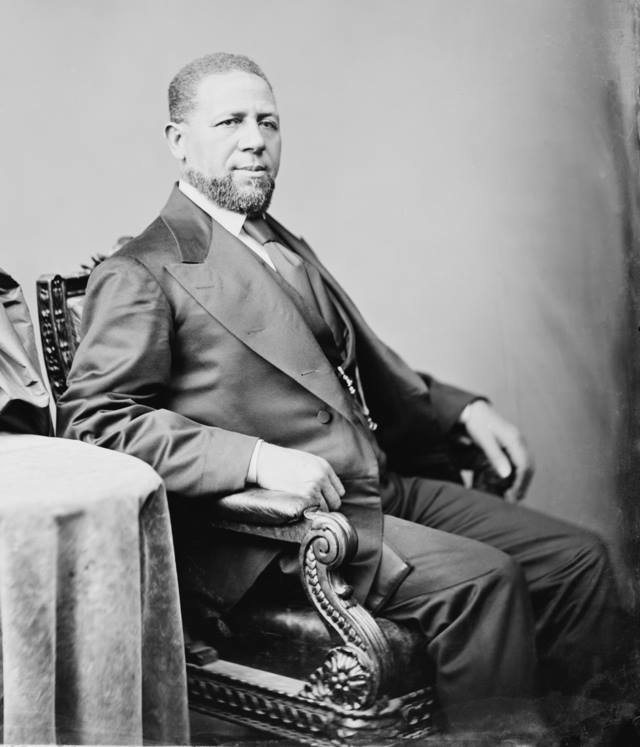
Today in History, February 25: 1870 – On a strict party line vote (we’ve heard that a lot lately) of 48 Republicans for and 8 Democrats against, Methodist minister Hiram Rhodes of Mississippi is confirmed as the first African-American US Senator, the first African-American member of Congress. Rhodes had been a minister, had helped raise the first two black regiments to fight in the Civil War, had been a veteran of the Battle of Vicksburg in Mississippi. Ironically he had served in Lincolnton, North Carolina as a barber with his brother, and served in a seminary in UNION county, Indiana. Democrats had attempted to use the 1857 Dredd Scott decision, A ridiculous Supreme Court decision that decided black people were not citizens, as a basis for preventing Rhodes from attaining the Senate seat.
The Amistad Trial
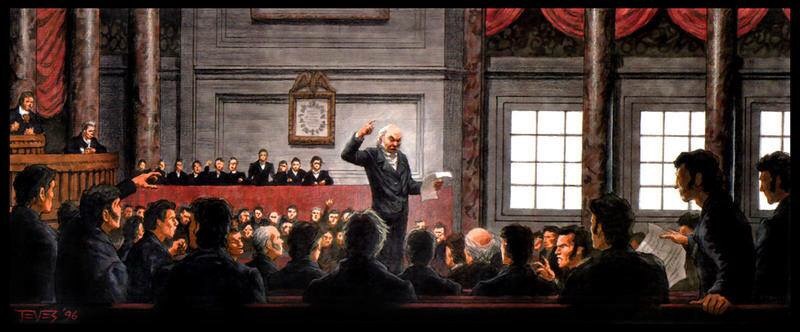 Today in History, February 24: 1840 – US Representative John Quincy Adams, a former President, begins his defense of slaves aboard the Amistad, a Spanish slave ship which was transporting them to Cuba to be sold. The slaves killed the ship’s Captain and forced the crew to sail them back to Africa…the crew instead took them to the US. The case went all the way to the US Supreme Court, where Adams argued for their return to their home. He won the argument….but not the funds to return them. The funds would have to be raised from sympathetic Americans.
Adams would continue to serve in the House until he collapsed at his desk, and died two days later on February 23, 1848. Several of his decendants would serve prominently in the government.
Setting Precedents
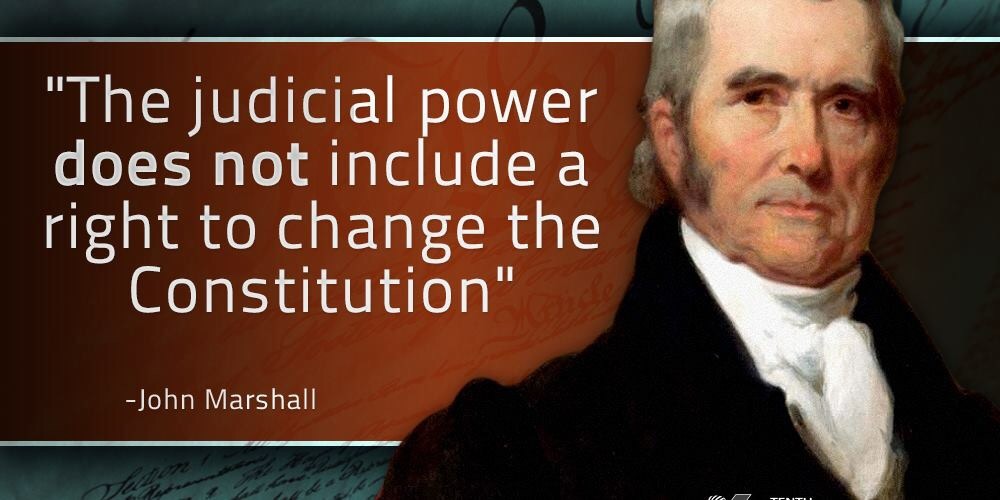 Today in History, February 24: 1803 – Marbury vs. Madison. The Supreme Court establishes the principle of Judicial Review. In a case fraught with typical American skullduggery, the US Supreme Court gains it’s power. In the election of 1800, Thomas Jefferson had defeated the one term John Adams. In the time before the end of his term, Adams appointed as many judges and justice of the peace as he could, even working with his fellow party members to increase the number of judges. This resulted in the infamous “midnight judges” that were appointed at the last minute. Adams’ Secretary of State, John Marshall, wasn’t able to deliver all of the commissions to the judges and justices of the peace in time before Adams’ term ended, but figured the new Secretary of State, James Madison, would do so. He did not. Realizing they’d been snookered, Jefferson and Madison’s party did not deliver the new commissions. One of the Justices of the Peace, William Marbury, sued. The case went all the way to the Supreme Court…whose Chief Justice now was…John Marshall. Marshall made a decision that was a master stroke. The Court decided that the commissions should have been delivered…but at the same time decided that the court could not enforce the decision because Marbury did not have standing to file suit. While this initially seemed to emasculate the Court…in the end the decision established that the Court could render Congressional acts Unconstitutional if it chose to do so. The are dozens of examples of why appointments to the Court are important, not the least of which we are watching play out now.
A Life Saving Decision?

 Today in History, February 23: 1861 – President elect Abraham Lincoln arrives at Washington DC’s Willard Hotel. He had intended to travel to Baltimore on his trip from Illinois to DC, but his wife and an ardent supporter, Chicago Detective Allan Pinkerton talked him out of the Baltimore stop. Pinkerton had taken it upon himself to infiltrate a secessionist group and discovered a plot to assassinate Lincoln while he was in Baltimore. Pinkerton’s information likely saved Lincoln’s life. I’ve often wondered what would have happened if President Lincoln hadn’t been assassinated in 1865, what our country would look like today if he had handled reconstruction and reunification with his patience and kindness. One also has to wonder what the country would look like had he never even made it into the White House.
An American Hero


Today in History, February 20: 1942 – Lt. Edward “Butch” O’Hare saves his ship. The USS Lexington was initiating a raid on Rabaul, a Japanese stronghold. However the Task Force was spotted, and many Japanese aircraft were sent to destroy the valuable aircraft carrier. Lt. O’Hare was part of the “CAP”, or Combat Air Patrol for the Lexington (CV-2).
O’Hare singe-handedly shot down five of the attacking “Betty” bombers, effectively saving his ship, one of the few aircraft carriers the United States had available at the time. This also made him the US Navy’s first ace of WWII. About a year later, O’Hare, ever the hero, would be lost in unknown circumstances in one of the first night time fighter operations. O’Hare Airport in Chicago is named for Butch. What many people don’t know is that this American hero, who gave the “last full measure of devotion” for his country, was the son of a gangster. His father had been Al Capone’s lawyer. The senior O’Hare (Fast Eddie), according to the story, had exchanged his testimony against Capone for a chance for his son to enter the Naval Academy. He paid with his life, gunned down by Capone’s thugs. As a result, thousands of American sailors aboard the Lexington were saved due to Butch’s heroism.
Sickles, Key, & Stanton
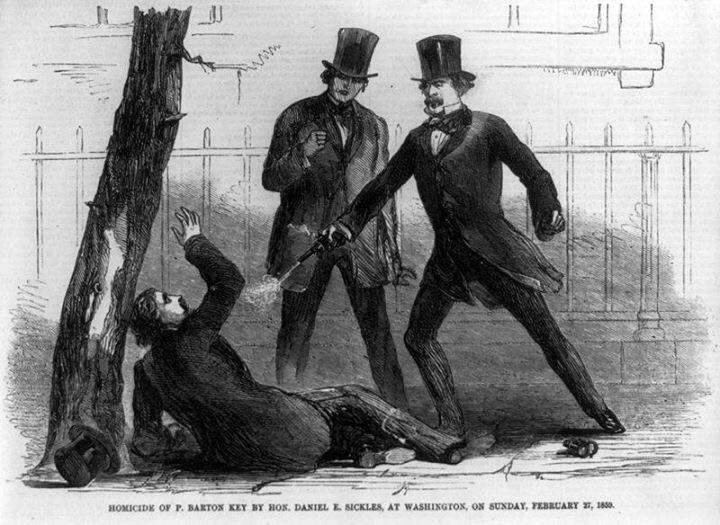

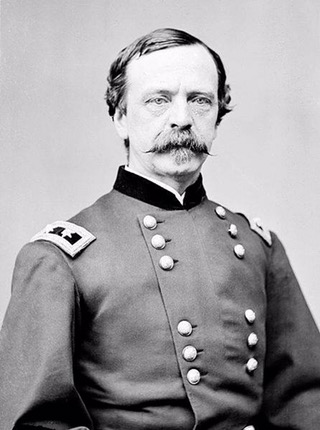 Today in History, February 19: 1859 – New York Congressman Daniel E. Sickles is acquitted of murder using a temporary insanity defense, the first time this defense was used in US courts. Sickles was quite a character…he had been censored by Congress more than once, most prominently for having brought a known prostitute into the House chamber, and then taking her to England and introducing her to Queen Victoria while his wife was at home pregnant. Despite this, he was enraged when his wife confessed to him that she had been carrying on an affair with the District Attorney for the District of Columbia, Phillip Barton Key II (Francis Scott Key’s son…you know..the Star Spangled Banner author). Sickles confronted Key in Lafayette Square, across the street from the Executive Mansion (White House) and shot him dead. Sickles then went to the Attorney General’s home, turned himself in and confessed. Future Secretary of War Edwin M. Stanton defended Sickles at his trial, painting the wife as a cheating harlot, and securing Sickles’ acquittal. Sickles went back to his wife, which enraged his supporters much more than the murder. When the Civil War began, Sickles used his influence to recruit NY volunteers and gain a political generalship, something that was possible in those days. With no military experience he actually made a good accounting of himself in several battles. Ironically, his most controversial act was yet to come. At the pivotal Battle of Gettysburg, his III Corps was assigned a portion of the Union lines on Cemetery Ridge. On his own he decided to move his unit forward to higher ground, which thinned his lines and left a gap in the Union lines, and blatantly ignored the orders of the commander of the Army of the Potomac, General Meade. Confederate General James Longstreet’s Corps attacked and decimated Sickles’ command, costing Sickles his leg. The controversy amongst historians is whether Sickles sacrifice of his Corps helped or hurt the Union’s chances of victory. In the end the Union could count Gettysburg as a victory, but in my humble opinion, the ambitious Sickles had little to do with it. He put it at risk. In his later years Sickles served as Minister to Spain (continuing his womanizing there) and returned to the legislature. He spent much effort in creating the Gettysburg National Military Park and in denigrating Gen. Meade, while promoting himself as the true reason for the victory at Gettysburg. After lobbying for 34 years, he was awarded the Medal of Honor for his bravery in the battle. Perhaps most telling is the fact that there are memorials to almost all of the generals involved in the battle at the Park, but not for Sickles. Good or bad, between his killing of Francis Scott Key’s son, his pioneering use of the insanity defense, and his military career, Sickles’ story is fascinating.
“Rendezvous”


Today in History, February 13: 1822 – Missouri Lt. Governor William Ashley, already an enterprising entrepreneur in the gunpowder business, posts an advertisement in the Missouri Gazette and Public Advisor seeking 100 men to volunteer for an expedition up the Missouri River as fur trappers. The expedition first tried to setting up a trading post on the Yellowstone River in Montana, but the Arikara Indians, firmly entrenched in the fur trading business themselves, kept raiding the post to eliminate the competition. Ashley then set upon a new idea; he told his trappers, including Jim Bridger, Jedediah Smith, James Beckwourth (first African-American mountain man) to go overland by horse into the mountains to trap, and once a year they would meet at a location set by Ashley for a “Rendezvous”, where they would spend several weeks trading their furs for supplies…and taking the opportunity for a rare socializing event, spent mostly intoxicated. The Mountain Men sold their furs to Ashley for a tidy profit, and then disappeared into the wilderness again. Ashley spent two years at this venture, making a huge profit, then sold his Rocky Mountain Fur Company and returned to politics, serving terms in the House and the Senate. But the Rendezvous system carried on for years in the fur trade.
Pioneers in Amusement, Electricity & Abuse

Today in History, January 4: 1903 – Captured as a child in Southeast Asia, then smuggled to America and sold into slavery. Ironically named after a character from “Uncle Tom’s Cabin”, Topsy was forced to perform for crowds in a circus. On one occasion, a drunken spectator found his way into her tent and tormented her…teased her and burned her with his cigar…and ended up dead when she defended herself. Her owners took the opportunity to label her as a killer as advertising. When another incident occurred, they sold her to a menagerie at Coney Island. Her trainer, also a drunk, stuck her with a pitchfork while trying to make her work and was confronted by a police officer who objected (damned cops). The trainer, in anger, set her loose to rampage through Coney Island and later rode her to the police station to batter at the entrance. Through the fault of her captors, Topsy had by now gained such a bad reputation that she couldn’t even be given away. So her captors made even more money…advertising her execution. On this date, monitored by the ASPCA, she was fed poisoned carrots, then wired up and electrocuted by the Edison Electric Company (who also filmed the video below to commemorate the event). To make sure she was dead, ropes pulled by steam engines then strangled Topsy the elephant for 10 minutes. Ain’t we proud?
 Mark Loves History!