Uncle Sam

74490_3879817852695_1948417935_n

Today in History, March 13: 1852 – The first cartoon image of Uncle Sam appears in “The New York Lantern” newspaper, drawn by cartoonist Frank Henry Bellew. Uncle Sam had been used to represent the US Government for years, becoming most popular during the War of 1812, but Bellew’s was the first cartoon to portray him. The cartoon was critical of the US government, expressing that “John Bull” (representing the British government) was helping the US shipping industry while Uncle Sam stood by and did nothing for the industry. The use of Uncle Sam became popular when Samuel Wilson, who provided meat products to the military during the War of 1812. He stamped the products with “US” for United States. However when someone asked a worker what it stood for, the reply was “Uncle Sam” (for Sam Wilson). The moniker stuck.

The First “Fireside” Chat

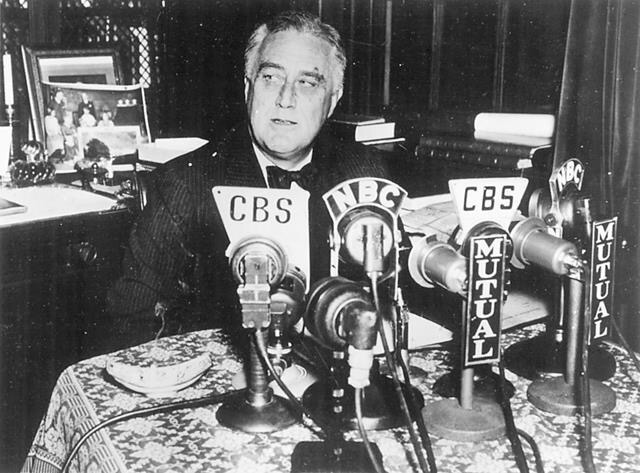
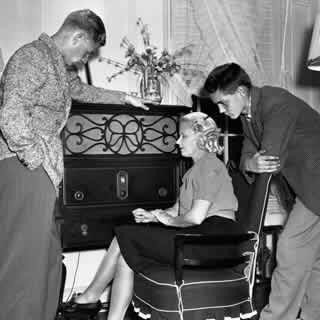
Today in History, March 12: 1933 – President Franklin Delano Roosevelt holds his first “Fireside Chat” with the American public. We must set the historical stage to begin with. Get rid of your cell phone; you don’t have a computer, nor a television. Chances are, you don’t have a telephone at all. You have, however, scrimped, and saved so that you could buy a radio for your family. Each evening you and your family huddled close to the large box that conveyed sound from all over the country. Last week the President unilaterally closed every bank in the country because people were panicking and making “runs” on the banks during the Great Depression. Today, after the panic had calmed down, he re-opened the banks. And tonight, he spoke to his “friends”, as if he were sitting in their living rooms by the fire, to explain his actions with his calming, melodious voice. He was the first President that was able to do so…and FDR was a master politician, a master at making his listeners believe that he was actually sitting next to his fire in a rocker chatting with his friends.  Although he was certainly upper class, he spoke in common language so he could relate to all walks of life. In reality he was sitting at his desk in the oval office, speaking into several microphones, surrounded by wires. He calmed the American citizens, as he did 31 more times in “fireside” chats until 1944 through financial strife and World War. I wonder what his cousin TR would have done with this medium; I also wonder what it would be like to live in a “simpler” time…I say that because our values were more focused then, not because our parents and grandparents dealt with less complicated problems…that is certainly not the case. Some reading this could school us on their feelings as children during those times. The rest of us can only imagine that it was new and amazing for the President to speak to you directly.

Two Westerners, President and Lt. General

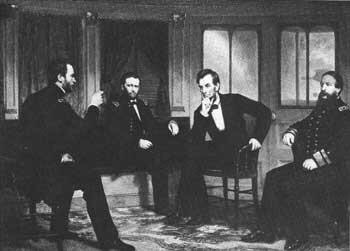
Today in History, March 10: 1864 – President Lincoln signs documents promoting Ulysses S. Grant to the rank of Lieutenant General. Grant was only the second person to hold the rank, the first having been George Washington. Winfield Scott had held the rank in the interim, but only as a “brevet” or temporary rank. Lincoln wanted his commanding general to have a rank above his other generals for leadership purposes. Grant would answer only to the President. 

Lincoln had difficulties with several Generals prior to Grant being appointed as the commander of all the Union Armies. The two communicated and worked very well together. Perhaps because they were both westerners from Illinois and understood each other. Certainly because Grant carried out Lincoln’s wishes to pursue Confederate Armies with vigor. 

All the Worlds’ Navies Became Obsolete…In 3 Hours

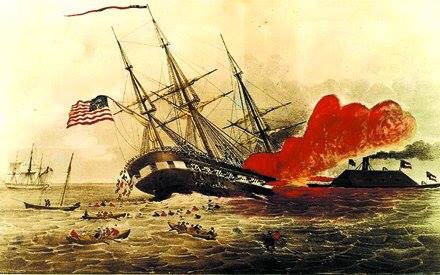
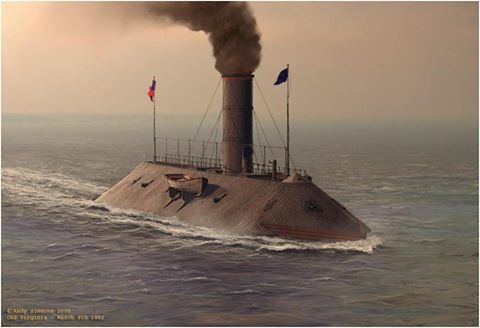
Today in History, March 9: 1862 – The Battle of Hampton Roads. Few are able to be part of a truly history changing event. When the Civil War began, the Union abandoned the Naval Base at Norfolk, Virginia, burning everything they could in retreat. The Confederacy took the base, and raised the sunken Union ship USS Merrimack. They then turned her into the ironclad CSS Virginia. The Union Navy placed an embargo on all Southern ports, including the entrance to the Southern capitol of Richmond. The South attempted to break this embargo with their new ironclad ship, sinking two Union wooden “ships of the line” in the process. The Virginia returned to base for the night, then returned to finish off the last major embargo ship on 9 March, 1862. She was confronted by the Union version of the ironclad…the USS Monitor. The two new iron ships battered away at each other for over three hours without seriously damaging each other, and then withdrew. The Virginia would be scuttled at her base as the Union advanced…the Monitor would be lost at sea. But more importantly….navies worldwide…Britain, France, Spain, the Far East, watched and realized that their wooden navies had suddenly become obsolete.

428065_2420295445547_1462406279_n

Today in History, March 8: 1862 – The CSS (Confederate States Ship) Virginia runs the table at Hampton Roads, Virginia. The Virginia had been built into one of the first “Ironclads” by the Confederacy using the hull of the Union ship Merrimack, which had been in the process of overhaul in Virginia when the Civil War began. The Virginia is an important American ship in history, having sunk or run aground three Union ships at Hampton Roads, the entrance to the James River. This signaled the end of the wooden “ship of the line” and the beginning of the iron naval vessels. Hampton Roads appears prominently in American Naval history repeatedly.  More to come as the Union ironclad Monitor takes on the Virginia.

The End of an Era

Today in History, March 7: 1885 – After the Civil War Texas Cattlemen began driving their herds north across Indian Territory to railroad hubs in Kansas. For twenty years Kansas towns (Abilene, Dodge, Hays, etc) vied to be the main hub to reap the accompanying profits. The cattle drives and the cowboys that led them became the source of our romance with the West.

However by 1885 Kansas had become a mostly agricultural state, and the cattle herds destroyed crops, their cowboys were rowdy. On today’s date the Kansas legislature passed a quarantine restricting Texas cattle from Kansas except in the Winter months, when the diseases they carried were less likely to affect Kansas dairy cows. It was a moot point by then anyway, as the railroads had made their way into Texas cattle country.

The Supreme Court is not the “Be All, End All.”

Today in History, March 6: 1857 – The Dredd Scott Decision. Dredd Scott was a slave whose owner had traveled and lived in “free states” and had promised him his freedom. When his owner died, Scott sued for his freedom, because he had lived in “free” states. The case worked it’s way up the chain to the Supreme Court, which at that time was loaded with Southerners. Chief Justice Roger Taney wrote the majority opinion that declared that no slave could possibly be a citizen, therefore they had no standing to sue. Also that the Federal Government had no right to regulate slavery in the states and territories. Obviously a biased, politically motivated opinion, the decision, in part, led to the horrific, devastating American Civil War. So our lesson is complex. The Supreme Court, while our highest court, is not infallible. It’s bad decisions lead to horrific consequences for the nation. It DOES make political decisions. And this theory does not end with Dredd Scott.

One has to wonder what Roger Taney was thinking when he had to swear President Abraham Lincoln in to office in his position as Chief Justice of the Supreme Court.  He forever tainted and brought into question decisions made by the Court.

A Disloyal Daughter…For a Reason

Today in History, March 6: 1967 – A Russian woman walks into the US Embassy in New Delhi, India and requests asylum in the United States. The US Ambassador weighs her request and decides to grant it. The woman had been in a relationship with an Indian man that she met in a Moscow hospital, but the Soviet government had denied them the ability to marry. When he died she had been given the privilege of taking his ashes to his family in India. The woman, Svetlana Alliluyeva, had lost her father in 1952. Upon her arrival in New York City in April, she held a news conference to denounce her father, Josef Stalin, his regime and the Soviet government. Svetlana’s mother had committed suicide to escape her father’s abuse (although it was rumored that he killed her), Svetlana’s first husband had been arrested and sent to a gulag for 10 years. She had left her adult children in the USSR, would go on to marry a protege of Frank Lloyd Wright, then would move to England, back to the Soviet Union, and finally, back to America. She passed away in Wisconsin in 2011.

All We Are Now Began Long Ago…

Today in History, March 5: 1496 – English King Henry VII issues letters patent to Italian navigators John Cabot (Giovanni Caboto) and his son Sebastian, sponsoring them for explorations. “…free authority, faculty and power to sail to all parts, regions and coasts of the eastern, western and northern sea, under our banners, flags and ensigns, with five ships or vessels of whatsoever burden and quality they may be, and with so many and with such mariners and men as they may wish to take with them in the said ships, at their own proper costs and charges, to find, discover and investigate whatsoever islands, countries, regions or provinces of heathens and infidels, in whatsoever part of the world placed, which before this time were unknown to all Christians.” John would find Newfoundland in North America, initiating future settlements in North America. The Vikings and Columbus came before the Cabots, but their explorations bore fruit for England.

The Chisolm Trail

Today in History, March 4: 1868 – Jesse Chisholm dies. The famous Chisholm Trail is named for Jesse. Most of us assume that Chisholm was a cattle baron that established the trail to take his cattle north. Not so. Jesse was a “halfbreed” in the vernacular of the time…part Scot and part Cherokee. He lived amongst the Native Americans in Arkansas and Indian Territory, and established himself as a merchant. He often negotiated the release of hostages taken by Native American tribes. He knew the landscape well, and established a route from Wichita, Kansas to the Red River, then further south into Texas for his commerce. When Texans needed to move their cattle north to rail heads in Kansas, they used Chisholm’s trail, widening it to as much as 400 yards which can still be seen. Over a million cattle would be moved along the trail established by Jesse Chisholm.