Connections The Nation Grows Honest Men Secure Their Future For Us An Amazing Day

Today in History, March 10:

I was researching for today and found amazing connections – I love connections in History! This will be a long post, but in summary:

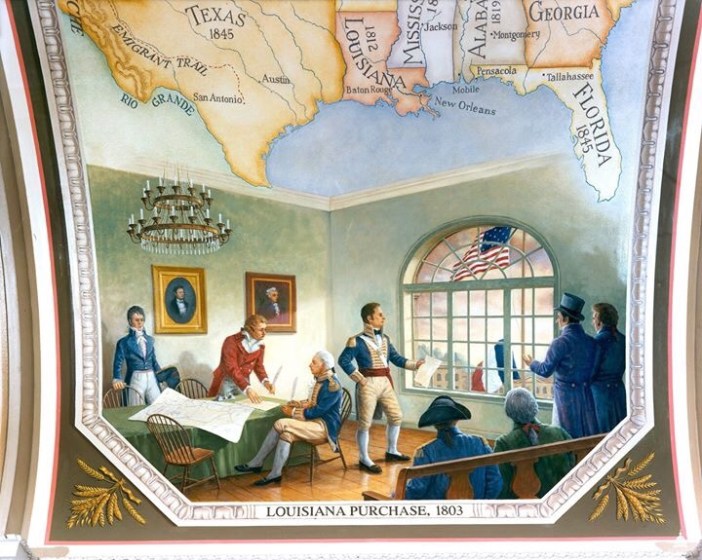
In 1804 a ceremony was held in St. Louis commemorating the Louisiana Purchase, which doubled the size of our young nation overnight.

In 1848 the US Senate ratifies the Treaty of Guadalupe Hidalgo, officially ending the Mexican-American War and again doubling the size of our nation.

Many believed the Mexican-American War was an unjust, fabricated conflict, much as many of us argue today about the Iraq War and its costs (not saying what my beliefs are…but I always stand with my beloved country).

Two of the men who felt the Mexican-American War was unjust spoke out vocally about their beliefs. One was a Congressman who disagreed with men he respected on the issue. The other who spoke out was a young Army officer who, in spite of his beliefs, fought courageously during the war.

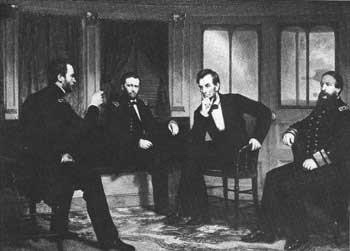
In 1864 the Congressman, now President, signed documents promoting the young officer to Lt. General of the US Army (a rank only George Washington had previously held as permanent) so no other officer would be his equal. Abraham Lincoln and Ulysses S. Grant believed wholeheartedly in their cause during the Civil War.

Today in History, March 10, 1804:

In St. Louis (not yet Missouri), an official ceremony is conducted, transferring possession of the “Louisiana Purchase” from Spain to the United States, virtually doubling the size of the American landscape overnight.

Today in History, March 10, 1848:

Treaty of Peace, Friendship, Limits and Settlement between the United States of America and the Mexican Republic, or the Treaty of Guadalupe Hidalgo ending the Mexican-American War is ratified by the US Senate after several amendments were made by that Congressional body.

The treaty had been negotiated in Mexico, documenting monies to be paid by the United States to Mexico and territories including modern day California, New Mexico, Arizona, and parts of Nevada, Colorado, Wyoming and Utah to be ceded to the US.

Senators to include Thomas Hart Benton, Jefferson Davis, Sam Houston, Stephen A. Douglas, and John C. Calhoun fought over the final draft.

Today in History, March 10, 1864:

President Lincoln signs documents promoting Ulysses S. Grant to the rank of Lieutenant General.

Grant was only the second person to hold the rank, the first having been George Washington. Winfield Scott had held the rank in the interim, but only as a “brevet” or temporary rank.

Lincoln wanted his commanding general to have a rank above his other generals for leadership purposes. Grant would answer only to the President. I didn’t find anything to document it, but have to wonder if this was partially because Grant had been promoted over several more senior officers to command the army due to his runaway successes in the west.

The End of an Era – The Age of Sail was Over

Today in History, March 9, 1862:

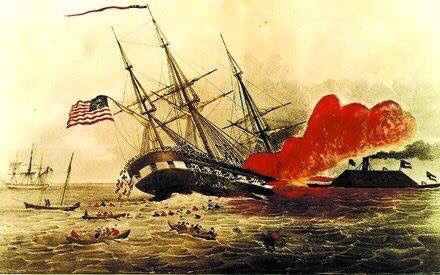
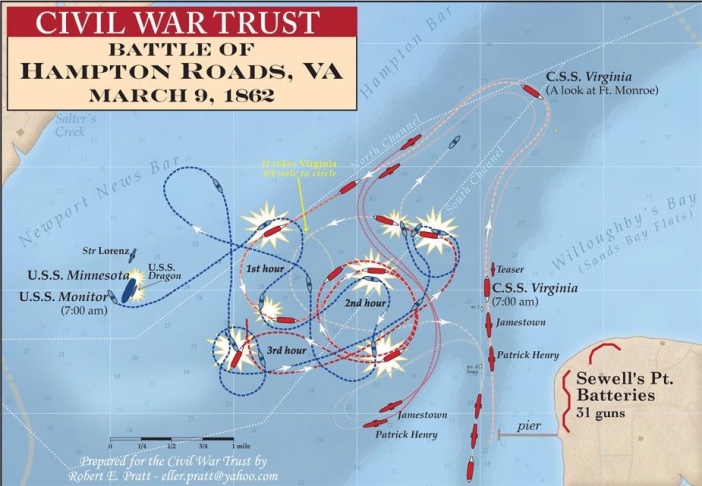
The Battle of Hampton Roads.

Few are able to be part of a truly history changing event.

When the Civil War began, the Union abandoned the Naval Base at Norfolk, Virginia, burning everything they could in retreat.

The Confederacy took the base, and raised the sunken Union USS Merrimack. They then rebuilt her into the ironclad CSS Virginia.

The Union Navy placed an embargo on all Southern ports, including the entrance to the Southern capitol of Richmond. The South attempted to break this embargo with their new ironclad ship, sinking two Union wooden “ships of the line” in the process.

The Virginia returned to base for the night, then returned to finish off the last major embargo ship on 9 March, 1862.

She was confronted by the Union version of the ironclad…the USS Monitor. The two new iron ships battered away at each other for over three hours without seriously damaging each other, and then withdrew.

The Virginia would be scuttled at her base as the Union advanced…the Monitor would be lost at sea.

But more importantly….navies worldwide…Britain, France, Spain, the Far East, watched and realized that their wooden navies had suddenly become obsolete.

Dred Scott & The Supreme Court

Today in History, March 6, 1857:

The Dredd Scott Decision.

Dredd Scott was a slave whose owner had traveled and lived in “free states” and had promised him his freedom. When his owner died, Scott sued for his freedom, because he had lived in “free” states.

The case worked it’s way up the chain to the Supreme Court, which at that time was loaded with Southerners.

Chief Justice Roger Taney wrote the majority opinion that declared that no slave could possibly be a citizen, therefore they had no standing to sue. Also that the Federal Government had no right to regulate slavery in the states and territories.

Obviously a biased, politically motivated opinion, the decision, in part, led to the horrific, devastating American Civil War.

So our lesson is complex. The Supreme Court, while our highest court, is not infallible. It’s bad decisions lead to horrific consequences for the nation. It DOES make political decisions. And this theory does not end with Dredd Scott.

Cooper Union – The Speech that Propelled Lincoln to the Presidency and Proves He Was an Abolitionist

Today in History, February 27, 1860:

“One of the most happiest and most convincing political arguments ever made in this City … No man ever made such an impression on his first appeal to a New-York audience.” — Horace Greeley in his paper regarding “The Cooper Union Speech” by Abraham Lincoln.

A former Congressman and Illinois lawyer, Lincoln had been launched to the national stage by his debates with Stephen Douglas over the slavery question 2 years before, but he was still mostly unknown in the east.

A young Republicans group in New York invited him to speech at Cooper Union’s Great Hall. The hall was not filled for the speech, but the text of it was given to Greeley’s and other’s papers; from there it was broadly published across the nation in pamphlet form.

Lincoln made convincing arguments that the Founding Fathers were against the expansion of slavery and desired it’s eventual end. At the same time he tried to convince Southerners that the Republican party did not wish to interfere in their affairs.

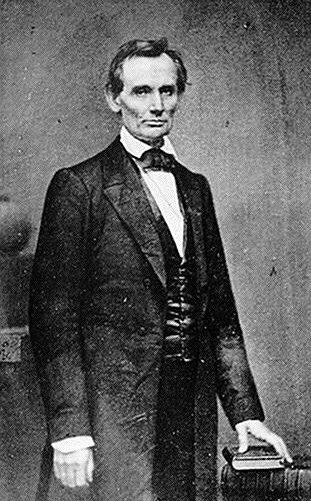
While in New York he had his photo taken by Matthew Brady, and the photo was used along with the pamphlet to broaden his recognition. It is widely believed that the speech is what launched him into the Presidency.

He closed with a message to his colleagues:

“Neither let us be slandered from our duty by false accusations against us, nor frightened from it by menaces of destruction to the Government nor of dungeons to ourselves. Let us have faith that right makes might, and in that faith, let us, to the end, dare to do our duty as we understand it.”

Trailblazer!

Today in History, February 24, 1864:

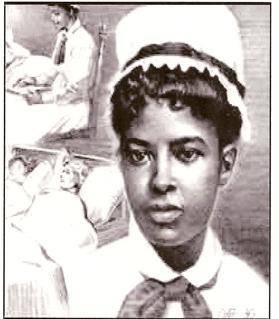
Rebecca Lee, later Rebecca Lee Crumpler, graduates from the New England Female Medical College in Massachusetts, becoming the first black female Medical Doctor in America, doing so in the midst of the Civil War.

After the war ended, she voluntarily moved to the heart of the south, Richmond, Virginia and worked for the Freedman’s Bureau treating freed slaves.

She later wrote a book about her experiences working as a doctor amongst people that hated her for the color of her skin and for her chosen profession.

Frederick Douglass’ Earthly Journey Ends

Today in History, February 20, 1895:

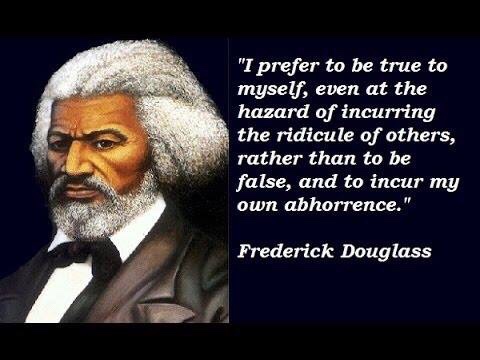
Frederick Douglass dies of either a heart attack or stroke in Washington DC after having appeared at an event of the National Council of Women where he received a standing ovation.

Thousands paid their respects at his funeral before he was returned to New York City to be interred at Mount Hope Cemetery in his family plot.

Douglass had been born circa 1818 (he never knew his actual birth date) into slavery in Maryland.

In 1838, on his third attempt, he escaped slavery. In the coming years Frederick Douglass became a well respected orator and statesman for the growing abolitionist and equal rights movements, impressing his listeners with his intellect and powerful messages.

“I have often been asked, how I felt when first I found myself on free soil. And my readers may share the same curiosity. There is scarcely anything in my experience about which I could not give a more satisfactory answer. A new world had opened upon me. If life is more than breath, and the ‘quick round of blood,’ I lived more in one day than in a year of my slave life. It was a time of joyous excitement which words can but tamely describe.

In a letter written to a friend soon after reaching New York, I said: ‘I felt as one might feel upon escape from a den of hungry lions.’ Anguish and grief, like darkness and rain, may be depicted; but gladness and joy, like the rainbow, defy the skill of pen or pencil.” – Frederick Douglass

Brotherhood

Today in History, February 18, 1862:

“I know you are separated from your people, and perhaps you need funds.  My purse is at your disposal.”  Union General Ulysses Grant to Confederate General Simon Bolivar Buckner as Buckner prepared to board a river boat taking him north to a Yankee prison.

On February 16, 1862 after a hard-fought battle and investment, Confederate Fort Donelson in Tennessee had surrendered to Union forces.

Tennessee was a strategic area in the Civil War, providing resources, people and a launching point to move against the rest of the South.

General U.S. Grant had been little known to the public before this battle, but the victory would change all that.  He coordinated with the US Navy to bombard Ft. Donelson and surround the 12,000 men there.  After assaults and counter assaults, the Confederate commanders came to the realization loss of the fort was a foregone conclusion, a tragedy for the South.

Gen. Simon Bolivar Buckner was actually third in command.  His superiors resigned their positions so they could sneak out and escape.  Col. Nathan Bedford Forrest took some of his Cavalry and fled also, leaving Buckner to stay with his men and surrender.

Buckner sent a note through the lines asking Grant for terms.  And here is where Grant became famous.  He wrote out his response for delivery to Buckner,

No terms except unconditional and imme­diate surrender can be accepted. I propose to move immediately upon your works.

In a time when furloughs and prisoner exchanges were common in battle, Buckner found the response to be “ungenerous and unchivalrous.”  Yet he had no choice, his only option was surrender.  Having had little but bad news for some time, the Northern papers seized upon the victory.

They used Grant’s initials to rename him “Unconditional Surrender Grant.”  Turns out it wasn’t the first time others had changed his name for him, but that’s another story.

The public was finding out something those serving with Grant had learned…he was unpretentious, unceremonious and tenacious.  He got results.  President Lincoln would eventually say of him, “I can’t spare this man; he fights” in defense of Grant’s reported drinking problem.

If you want History to be more than dates on a page, watch out for the back stories…the facts that bring out the humanity in what you’re reading.

The story reads good already.  But lets dig further.

When Grant was younger, he wanted an education.  His father worked hard and secured him an appointment to West Point.  Initially, Grant didn’t want to go.  But once in, he liked it.  His uncanny horsemanship impressed fellow cadets and instructors.  And he made friends among the other cadets, including Simon Bolivar Buckner, who was attending at the same time.

Grant and Buckner, among many other officers in the US Army, served together and performed heroics in the Mexican-American War of 1846-1848.

After that conflict Grant found himself assigned to the frontier in California, where he missed his family grievously and took to drink.  In July of 1854 he suddenly resigned his commission from the Army and sought transport home.

Grant found himself in New York without even enough money to get a meal or pay for a room.  And then he happened upon an old classmate and friend, Simon Bolivar Buckner.

The two enjoyed a visit, talked old times and Buckner, who was doing much better financially, paid for his friend’s room and board.

In the intervening years until 1861 and the beginning of the Civil War, Grant was somewhat of a hard luck case.  He tried farming, he tried real estate, nothing worked.  When the war began he was working for his brothers and his father in a store as a clerk.

When Southern states began seceding many in the US Army that were from those states, resigned their commissions and joined the Confederate Army, including Buckner.  Thus the old friends found themselves on opposite sides.

Thus, after the Battle at Fort Dolelson, Grant sought out Buckner before Buckner boarded the boat taking him off to prison in an attempt to return an old favor. Buckner, ever the gentleman, politely refused the return of the kindness.

Grant, of course, would become commander of all Union Armies and eventually President.

Buckner would eventually be exchanged for a Union general officer and continue to serve in the Confederate Army.

He surrendered in New Orleans in 1865 for a second time.  He would become Governor of Kentucky among other political successes.

In 1904 he visited the White House and asked President Theodore Roosevelt to appoint his son to West Point.  TR quickly agreed.

His son, Gen. Simon Bolivar Buckner Jr would be killed at Okinawa in WWII, the highest ranking officer killed by enemy fire in WWII.

Studebaker…An American Success Story

Today in History, February 16, 1852:

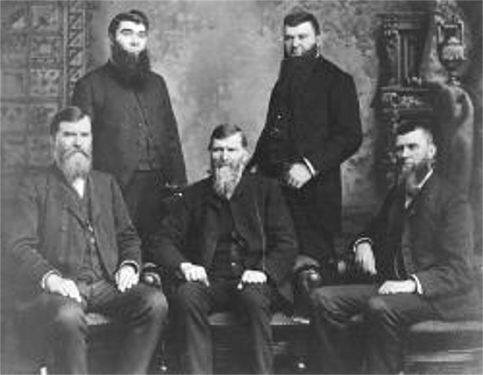
The five brothers, Henry, Clement, John Mohler, Peter Everst and Jacob Franklin, had been taught the skill of wagon making by their parents, who had been taught by their parents, who had arrived in America in 1736.

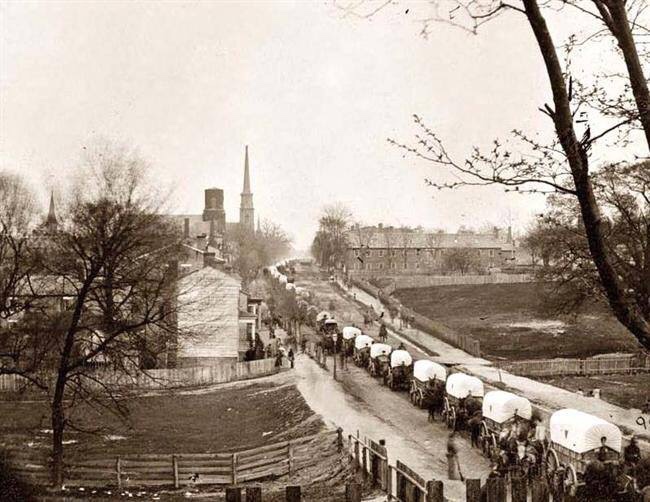
They began their combined business on this date in 1852, and soon they were providing fully half of the wagons used for the migration west, and a quarter of those in the nation.

They made bank during the Civil War, selling wagons to the Union Army.

Their business continued to thrive…those beautiful red 1900 model wagons pulled by the Budweiser Clydesdales…are Studebakers.

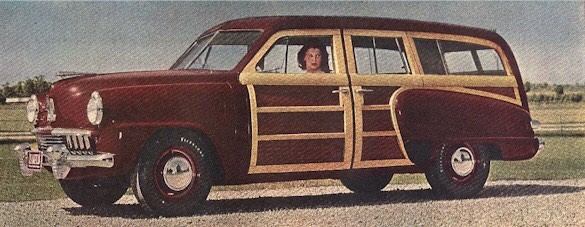
When motorized vehicles came to be, the Studebaker Company began making first electric and then gasoline cars. The company would last until 1957, having a reputation for quality and class in their cars.

The Emancipation Proclamation

Today in History, January 1, 1863:

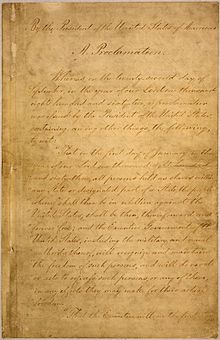
President Abraham Lincoln signs the final version of the Emancipation Proclamation, declaring an end to slavery in the rebelling states.

The road to the end of slavery had been long and hard, and it wasn’t over yet. But this was the most definitive statement ever made in America about the evil and the demise it must suffer.

The founding fathers had known slavery was wrong; but they didn’t believe they could end it and still create the nation that would be America…the southern states depended on slavery for their economy. So they “kicked the can down the road”.

The nation continued to deal with the inequity of it’s principles and its sins through each administration. Andrew Jackson dealt with it during the Nullification Crisis; but again, half measures to keep the peace.

The Missouri Compromise, the Compromise of 1850, the Kansas-Nebraska Act…our early history was juggling Abolition against the slave driven economy of the South on a continuous basis by some of the most talented people of the time.

The Republican party was born of abolitionist beliefs, but still, only half measures.

Even the Proclamation was a half measure. It only declared slavery ended in states in which it could not be enforced….Confederate states. But it made the war about the end of slavery, not only about the perpetuation of the Union. The dye was cast for freedom.

By the President of the United States of America:

A Proclamation.

Whereas, on the twenty-second day of September, in the year of our Lord one thousand eight hundred and sixty-two, a proclamation was issued by the President of the United States, containing, among other things, the following, to wit:

“That on the first day of January, in the year of our Lord one thousand eight hundred and sixty-three, all persons held as slaves within any State or designated part of a State, the people whereof shall then be in rebellion against the United States, shall be then, thenceforward, and forever free; and the Executive Government of the United States, including the military and naval authority thereof, will recognize and maintain the freedom of such persons, and will do no act or acts to repress such persons, or any of them, in any efforts they may make for their actual freedom.

“That the Executive will, on the first day of January aforesaid, by proclamation, designate the States and parts of States, if any, in which the people thereof, respectively, shall then be in rebellion against the United States; and the fact that any State, or the people thereof, shall on that day be, in good faith, represented in the Congress of the United States by members chosen thereto at elections wherein a majority of the qualified voters of such State shall have participated, shall, in the absence of strong countervailing testimony, be deemed conclusive evidence that such State, and the people thereof, are not then in rebellion against the United States.”

Now, therefore I, Abraham Lincoln, President of the United States, by virtue of the power in me vested as Commander-in-Chief, of the Army and Navy of the United States in time of actual armed rebellion against the authority and government of the United States, and as a fit and necessary war measure for suppressing said rebellion, do, on this first day of January, in the year of our Lord one thousand eight hundred and sixty-three, and in accordance with my purpose so to do publicly proclaimed for the full period of one hundred days, from the day first above mentioned, order and designate as the States and parts of States wherein the people thereof respectively, are this day in rebellion against the United States, the following, to wit: 

Arkansas, Texas, Louisiana, (except the Parishes of St. Bernard, Plaquemines, Jefferson, St. John, St. Charles, St. James Ascension, Assumption, Terrebonne, Lafourche, St. Mary, St. Martin, and Orleans, including the City of New Orleans) Mississippi, Alabama, Florida, Georgia, South Carolina, North Carolina, and Virginia, (except the forty-eight counties designated as West Virginia, and also the counties of Berkley, Accomac, Northampton, Elizabeth City, York, Princess Ann, and Norfolk, including the cities of Norfolk and Portsmouth[)], and which excepted parts, are for the present, left precisely as if this proclamation were not issued.

And by virtue of the power, and for the purpose aforesaid, I do order and declare that all persons held as slaves within said designated States, and parts of States, are, and henceforward shall be free; and that the Executive government of the United States, including the military and naval authorities thereof, will recognize and maintain the freedom of said persons.

And I hereby enjoin upon the people so declared to be free to abstain from all violence, unless in necessary self-defence; and I recommend to them that, in all cases when allowed, they labor faithfully for reasonable wages.

And I further declare and make known, that such persons of suitable condition, will be received into the armed service of the United States to garrison forts, positions, stations, and other places, and to man vessels of all sorts in said service.

And upon this act, sincerely believed to be an act of justice, warranted by the Constitution, upon military necessity, I invoke the considerate judgment of mankind, and the gracious favor of Almighty God.

In witness whereof, I have hereunto set my hand and caused the seal of the United States to be affixed.

Done at the City of Washington, this first day of January, in the year of our Lord one thousand eight hundred and sixty three, and of the Independence of the United States of America the eighty-seventh.

By the President: ABRAHAM LINCOLN 
WILLIAM H. SEWARD, Secretary of State.

When to Hold Your Move – Kentucky in the Civil War

Today in History, December 10, 1861:

Kentucky is accepted into the Confederacy by the Confederate government. However the act didn’t mean much.

When the war had begun, both sides very much wanted Kentucky, a well-positioned border state, contiguous with the Mississippi River, on their side.

However, it’s citizens were pretty evenly split in their allegiances between the North and the South, so they declared themselves neutral in the conflict.

President Lincoln very much wanted the state and it’s resources, but what he wanted even more was not to push them to the South, so he accepted their neutrality.

In September of 1861 the Confederacy, in the form of Gen. Leonidas K. Polk, violated that neutrality by ordering the occupation of Columbus and setting up a fort there.

Union Gen. U. S. Grant responded by occupying Paducah; Union assets had to be defended, and a strategic Confederate presence could not go unopposed.

The Kentucky assembly responded by issuing a proclamation ordering the Confederates out and the US flag to be flown over the capitol. Polk had chosen a side for them.

Soon a shadow government of Confederate sympathizers was formed, elected a governor, and applied for entry into the Confederacy, which was granted.

While Kentucky did have regiments on both sides of the conflict, the Confederate government of the state was impotent, soon having to leave the state, finishing the war by trailing the Army of the Tennessee around the South. Their elected governor was killed at Shiloh.