“That Guy” Who Always Seems to be There…and Its Not Always the Glorious Jobs that Render Success…


Today in History, May 28, 1917:

300 miles south of Greenland, a few sailors aboard a US Navy “oiler”, the USS Maumee AO-2, made history with an act which would greatly affect history.

The logistics of keeping fleets supplied at sea was nothing new, but it did have extreme restrictions.  The Navy had tackled the problem in order to display its reach with the around the world tour of the Great White Fleet in 1907-1909, but that had been a task of loading enough coal on board to keep the ships moving.

The Maumee, when commissioned in 1914, was the Navy’s first diesel powered surface ship.  When the United States joined the fight in WWI, she was sent to a point off Greenland to do something which had never been done before…refuel ships while underway at sea.  Her first customers were six Destroyers on their way to England.  They performed the task successfully, and continued refueling ship that weren’t “log-legged” enough to make the trip.

I’ve written before about someone who always seemed to be mentioned when reading Army history about others during the 19th Century…General Nelson A. Miles.  Often he was the guy “cleaning up” an issue or who “also” played an important part.

Well, here is “that guy” for the US Navy in the 20th Century.  He became more famous, of course, but not for everything he should have.

When the Maumee was commissioned, a young Lieutenant was named her Executive Officer because he was an expert in her diesel engine technology.  He was still the Exec when she performed her ground breaking refueling tasks.  Chester Nimitz played an integral part.  Because of his expertise with diesel engines, Nimitz would also play a key part in the development of the Navy’s submarine fleet.

In 1938 the Chief of Naval Operations, Admiral William Leahy, ordered the commander of TF 7 to develop procedures for refueling larger ships, such as battleships, cruisers and carriers while underway at sea.  That, of course, was now Rear Admiral Nimitz.

When the US joined in WWII after the attack on Pearl Harbor, they called Nimitz from a job in DC to command the Pacific Fleet.  Now he was in charge of taking the war to Japan.  A job that required a lot of logistics, including vast advancements in refueling huge fleets at sea.  The underway processes would be key in famous battles such as the Coral Sea, Midway, the Doolittle Raid and many others.  One of the first at-sea casualties in the fleet would be an oiler during the Coral Sea battle.

In 1944 another huge leap was made.  Admiral Raymond Spruance was tasked with performing raids on Japan to minimize air attack threats during the invasions of Iwo Jima and Okinawa.  (His boss was Nimitz.)  He had a problem which had to be solved.  The Navy had underway refueling down to an art.  However his fleet of Aircraft Carriers would “shoot” through their on-board supply of munitions (bombs, torpedoes, bullets) in about three days.  After the three days, they would have to make a 12 day trip to Ulithi Atoll and back for resupply.  This would keep them on station and in the war only six days out of a month.

As Leahy had, Spruance ordered his staff to develop processes to resupply ammunition, food stocks, etc. while underway.  Which they did.  It was a dangerous undertaking, moving bombs across decks of moving ships and across winches between ships, but they did it.  Now, after spending their ammo, the fleet would sail overnight to meet the supply ships, refuel, re-arm and re-supply while underway from different supply ships while underway, and be back in the fight within two days.

After the war, inventive officers asked to design ships which could replenish ships underway using a “one-stop shop” method…where one supply ship would resupply fuel, ammo and other needed supplies in one pass.  The Navy’s new CNO approved heartily…of course…Fleet Admiral Chester W. Nimitz.

The Navy has made huge advancements since, and in recent years has improved their resupply capabilities even more.  They have the massive Gerald Ford carriers to plan for.

The US military’s ability to reach out and touch someone anywhere in the world, would not be possible without the innovations which allow them to resupply on the move…anywhere.

We almost didn’t have “Chester” to help make all of these advancements for the Navy.  In 1907, young Ensign Nimitz ran his Destroyer, the USS Decatur, aground and was found guilty of hazarding his ship during the subsequent court martial.  As we have seen during recent events, this normally would mean a swift end to one’s Naval career.  Thank God the Navy brass saw fit to give Nimitz another chance.
Thank you, Veterans

The skies overhead filled with aircraft…thousands of bombers, transports, fighters. The British populace watched the boys board the transports bound for France…and wept. Their towns, so long filled with those damned Americans were now quiet and empty. They wouldn’t be coming back.

In America, as the news was broadcast that the invasion had begun at long last, businesses, theaters, and other workplaces emptied and closed…and the churches filled to capacity.

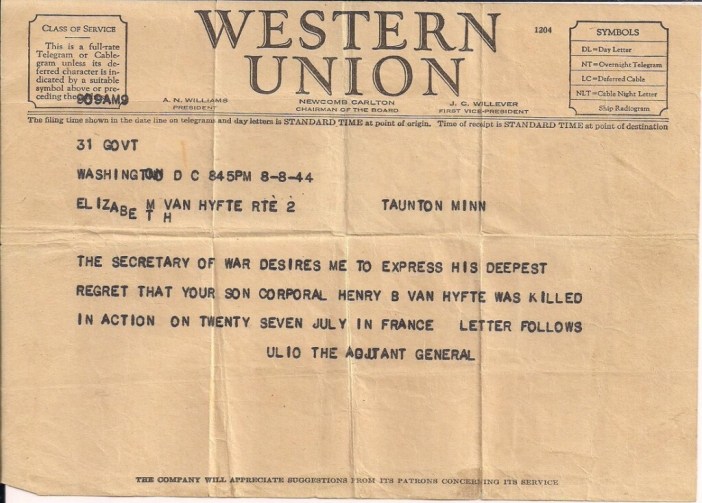
Americans prayed for their sons, husbands and fathers. I’m sure they prayed not to see the Western Union courier on their street in the coming days.

Thank you, veterans.

Defeat? Or Victory at Dunkirk

Today in History, May 26: 1940 – Operation Dynamo, or the Evacuation of the British Expeditionary Force from France at Dunkirk, begins. The BEF had been sent to France after years of appeasement, when Hitler had invaded Poland in September of 1939. On May 10th Germany invaded France, which, although considered the largest army in Europe, promptly folded like an old lawn chair. The British, French and Belgian troops retreated to Dunkirk, where they faced certain defeat. The idea now was the evacuate across the English Channel, but the first day’s effort on saw the evacuation of 9,000 or so men. A call for assistance went out, and every Royal Navy vessel that could sail, every civilian yacht, fishing vessel and others that could sail for Dunkirk, did so. In the end, 9 days later, more than 338,000 soldiers had been rescued; the best and brightest of the British armed forces that would be needed in the years to come.

The British Arrive in Australia…Again…Amy Johnson


Today in History, May 24, 1930:

British aviation pioneer and adventurer Amy Johnson lands in Darwin, Northern Territory, Australia, completing an 11,000 mile solo flight from England.  She was the first woman to do so.  She made the flight in a de Havilland DH.60 Gipsy Moth biplane.

Amy Johnson went on to set several other records during the 1930’s, including flights to Moscow, Japan and South Africa.

When England entered World War II in 1939 she signed up for the Air Transport Auxiliary, flying RAF aircraft from their production sites to their airfields.  On January 5, 1941 she was conducting one of these flights when her aircraft crashed into the Thames estuary.  Despite heroic efforts by a nearby ship, she was drowned in the tragedy…her remains never recovered.  An officer on the ship who dived in to save her died a few days later as a result of his time in the freezing waters.

The circumstances of her demise are somewhat mysterious.  The initial story was her aircraft went down in bad weather, however a sailor has since come forward saying he had shot her down after she failed to respond with proper codes, believing her aircraft to be the enemy.  He stated investigating officers told him and others to remain silent.

A woman air pioneer who set amazing records and died under mysterious circumstances in WWII.  Such incredible similarities to Amelia Earhart.

Curly Joins His Comrades

10325160_10200976993825836_843286957710858486_n

Today in History, May 23, 1923:

Ashishishe, son of Strong Bear and and Strikes by the Side of the Water, husband to Bird Woman and later Takes a Shield, is laid to rest at the National Cemetery of the Bighorn Battlefield in Montana, alongside the members of Lt. Col. George Armstrong Custer’s 7th Cavalry who had died there on June 25, 1876.

He was known by his US Army contemporaries as Curly. Curly was a Crow Indian serving the US Army as a scout with the 7th Cavalry leading up to the Battle of the Little Big Horn.

Just before the battle began, as was customary, Custer released his Native American scouts. Curly rode off with the others, stopping on a hill about a mile away, he watched the battle through field glasses.

When it became obvious that the 7th would be defeated, Curly rode for two days until he met an Army supply boat at the confluence of the Big and Little Big Horn rivers, and made his report.

Curly told of how the 7th fought for hours, until they had expended all of their ammunition; by Curly’s estimation taking approximately 600 Sioux warriors with them. Hailed as a hero for being the “lone survivor”, although reporters attempting to glorify his actions used poetic license to say that he was actually in the battle and escaped by pretending to be one of the Sioux allies, Curly’s original and later accounts were that he “did nothing wonderful.” Some reporters “quoted” Curly as saying that he had been in the battle, which angered some of the Sioux that were. But in many accounts Curly repeated that he was not, and that he “did nothing wonderful.”

He served in the Crow Police and given a military pension only three years before his death from pneumonia. I find his story interesting as an example of why we must remember all of the components of the times when viewing history. Is Curly a traitor to his people because he served the US Army against other Indians? I found while researching this that at that time the Sioux and the Crow were dire enemies, so the Crow allied with the Army (the enemy of my enemy is my friend). Did he “desert” the 7th Cavalry? No. It was customary not to keep the Indian scouts in the midst of battle; his leaving was expected of him.

“This damn fool Sumner is going to get himself shot by some other damn fool.” – Sen. Stephen Douglas

Today in History, May 22, 1856:

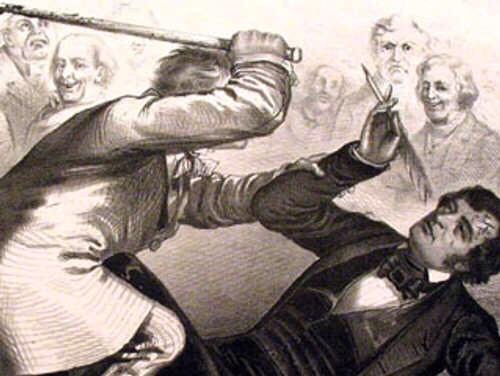
Years before the Civil War. On May 20, 1856 US Senator Charles Sumner, a free soil Democrat and later Republican from Massachussetts, had given a firey speech entitled “Crime Against Kansas” about the violence in that state over slavery.

A devout abolitionist, he excoriated the south, in particular Senator Andrew Butler of South Carolina, who he likened to a pimp abusing a prostitute (slavery).

This enraged Butler’s nephew, Senator Preston Brooks. When Sen. Stephen Douglas heard the speech, he commented, “this damn fool Sumner is going to get himself shot by some other damn fool.”

On the 22nd, Brooks entered the Senate chamber with two other Southern Senators, found Sumner at his desk writing and proceeded to bludgeon him nearly to death with his heavy metal tipped cane while Sumner was trapped within his desk, defenseless.

Southerners hailed Brooks a hero.

Northerners called him a coward. One of these, Republican Representative Anson Burlingame called him such on the House floor.

Brooks challenged Burlingame to a duel. When Burlingame actually accepted and showed up, Brooks did not.

Sumner would suffer debilitating pain for the rest of his life from his injuries, but would recover to become a key proponent of abolitionist policies during reconstruction, living until 1872.

Brooks on the other hand died in January 1857, less than a year after the attack, of the croup.

The Patended President

Today in History, May 22, 1849:

“Be it known that I, Abraham Lincoln, of Springfield, in the county of Sangamon, in the state of Illinois, have invented a new and improved manner of combining adjustable buoyant air chambers with a steam boat or other vessel for the purpose of enabling their draught of water to be readily lessened to enable them to pass over bars, or through shallow water, without discharging their cargoes;”

Young Abraham Lincoln receives patent #6469 for an invention to lift river boats over shoals and other obtructions.

Among many other jobs he’d held, he had hauled freight on flat boats on the Mississippi. Twice his boat was hung up. As was common, once the boat had to be unloaded, repaired and portaged over the obstruction…a very laborous job.

Lincoln’s invention would inflate bladders to create more boyancy, lifting the craft over the problem. His invention was never put into use, so it’s viability remains unproven. It does make Abe the only US President with a patent.

“I loved him so much…so I killed him…”

Today in History, May 21, 1936:

“I loved him so much, I wanted him all to myself. But since we were not husband and wife, as long as he lived he could be embraced by other women. I knew that if I killed him no other woman could ever touch him again, so I killed him…..” –

Sada Abe is arrested in Japan for killing her lover, 3 days earlier. At the time of her arrest she was found to have his genitals in her bag. Abe told police that Ishida had been the most considerate lover she’d ever known, and she would know, having been a Geisha and a prostitute among other things.

During their most recent dalliance, they had become enamored with erotic asphyxiation. On the 18th, Abe strangled Ishida to death in his sleep.

She told police that she had severed his member and taken it with her to remember him by, even engaging in necrophilia with it prior to her arrest. She was sentenced to only 6 years in prison by a judge who admitted to being aroused during her trial.

Even that sentence would be commuted in 1940. The story became a cult like sensation in Japan, spawning numerous successful books and movies, and of course making Abe a celebrity. The last sighting of her was in a nunnery in the 1970’s.

Going West…The Homestead Act

Today in History, May 20, 1862:

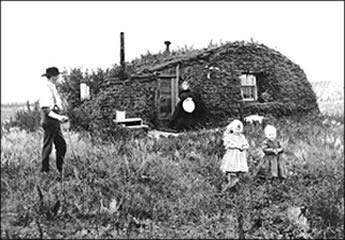
President Lincoln signs the Homestead Act, which would give 160 acres of western lands to anyone that would farm it successfully for 5 years and build a residence upon it (often a sod building).

The Act would encourage vastly expanded settlement of the west; bad news for Native Americans, good news for those newer Americans wanting to improve their lot in life.

Congress had attempted to pass similar acts in 1852, 1854, and 1859, but each time the attempts were shot down by Southern Democrats who were afraid that if the west were populated it would result in more “free” states, which would result in more votes against slavery.

Once the Republican Lincoln was elected, and the Civil War began, the Southern Democrats were no longer part of the equation in Congress. The Republicans soon passed the Homestead Act and the settlement of the west began in earnest. By the end of the war 15,000 settlers (some of which were merely pawns for land speculators) had accepted their lands. Eventually 80 Million acres would be settled.

Firearms Owner’s Protection Act

Today in History, May 19, 1986:

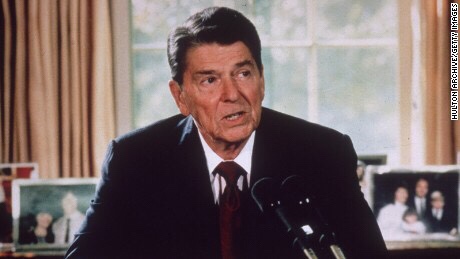
President Ronald Reagan signs the “Firearms Owners Protection Act” in to law.

The Legislation, while effectively banning machine guns from private ownership, primarily responded to complaints from the public and the nascent NRA regarding abuses of the “Gun Control Act of 1968.”

The act by Congress attempted to protect the rights of peaceful firearms owners and also those possessing Federal Firearms Licenses (FFL), or firearms dealers.

https://www.congress.gov/bill/99th-congress/senate-bill/49